> Blog >
The Enterprise AI Readiness Assessment Checklist: 60 Questions and How to Score Them
Audit your enterprise capability with our 60-question ai readiness assessment checklist. Score data, infrastructure, and governance gaps before deployment.

The Enterprise AI Readiness Assessment Checklist: 60 Questions and How to Score Them

4 mins
August 20, 2026
Author
Aditya Santhanam
TL;DR
  • Most enterprise AI projects fail due to unverified assumptions, making an evidence-based assessment vital before funding any deployment.
  • Evaluating readiness across 6 key pillars (Strategy, Data, Infrastructure, Governance, Process, and Talent) exposes hidden operational and security risks early.
  • Simple self-assessments create false confidence; every diagnostic score must be backed by concrete artifacts like data lineage, logs, and policies.
  • A risk-weighted scoring model translates raw diagnostic findings directly into a prioritized, actionable technical remediation roadmap.
  • Are you actually ready to take advantage of the current age of AI, or are you wasting resources making educated guesses? AI readiness assessment checklist: a list of AI readiness questions to identify weaknesses in six key areas before they become expensive. 

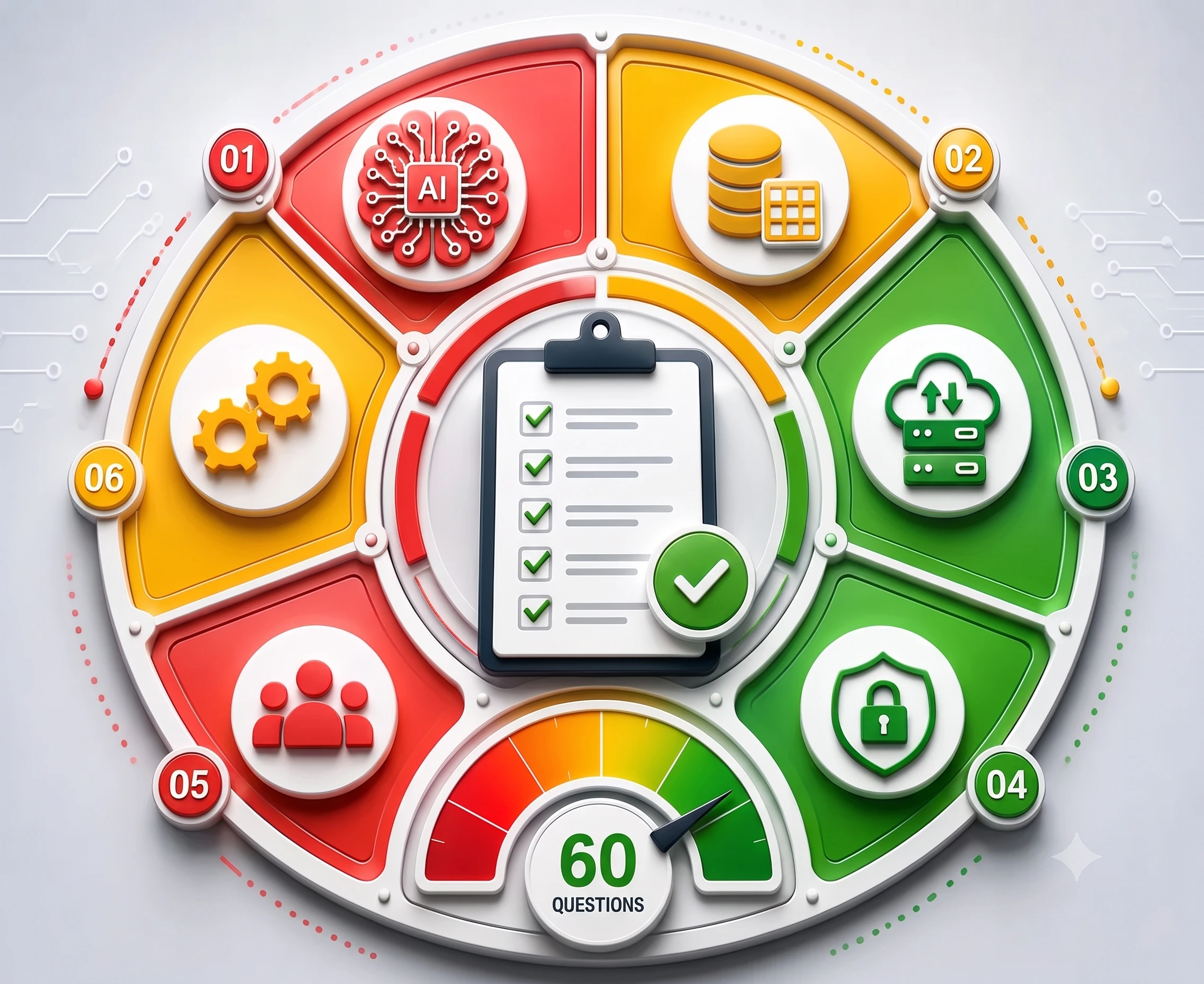
    This blog explains the AI readiness assessment checklist template that gives you 60 questions across the areas that matter most and a scoring model.

    Table of Contents

      How to Use This Checklist

      Begin with those closest to the evidence. An AI readiness checklist without proof is just a wish list. Business owners need to respond to strategic and use-case questions; data groups to address data fundamentals questions; technology groups to answer technology questions; and security, risk, and compliance groups to respond to controls questions. 

      Ensure key evidence is available, such as policies, architecture diagrams, data inventories, project documentation, security reports, and governance documentation. A first round may require 30-60 minutes per section, depending on the scale of the business. Keep the team leads on standby by arranging proof.

      Who Answers What

      • Strategy & Use Cases: Business Unit Leads & Product Managers
      • Data & Infrastructure: Data Engineers & IT Ops Lead
      • Governance & Compliance: Risk Officer & Legal Lead
      • Talent & Operations: HR Lead & Engineering Managers

      Artifacts to Have on Hand 

      Before scoring, collect your data schema docs, API architecture, data security policies, and current IT budget reports.

      How to Score

      Mark it as “Yes”. However, there must be an artifact that is verifiable: either a link, policy document, architectural diagram, or audit log.

      If an answer is based on any kind of assumption or expectation, then it should be marked In Progress or No.

      What an AI Readiness Checklist Should Cover

      An AI readiness checklist consists of a series of questions in the areas of data, infrastructure, governance, process, people, and security. An organization uses it to check its maturity levels in these areas to ensure that all these capabilities have corresponding artifacts to achieve an objective readiness score before funding any AI project.

      Why an AI Readiness checklist is needed

      It helps determine if the company is ready for AI from a foundational standpoint and comes up with an evidence-based readiness score before the AI project is funded or deployed.

      The Six Sections

      The sections below are needed for carrying out an AI readiness assessment step by step.
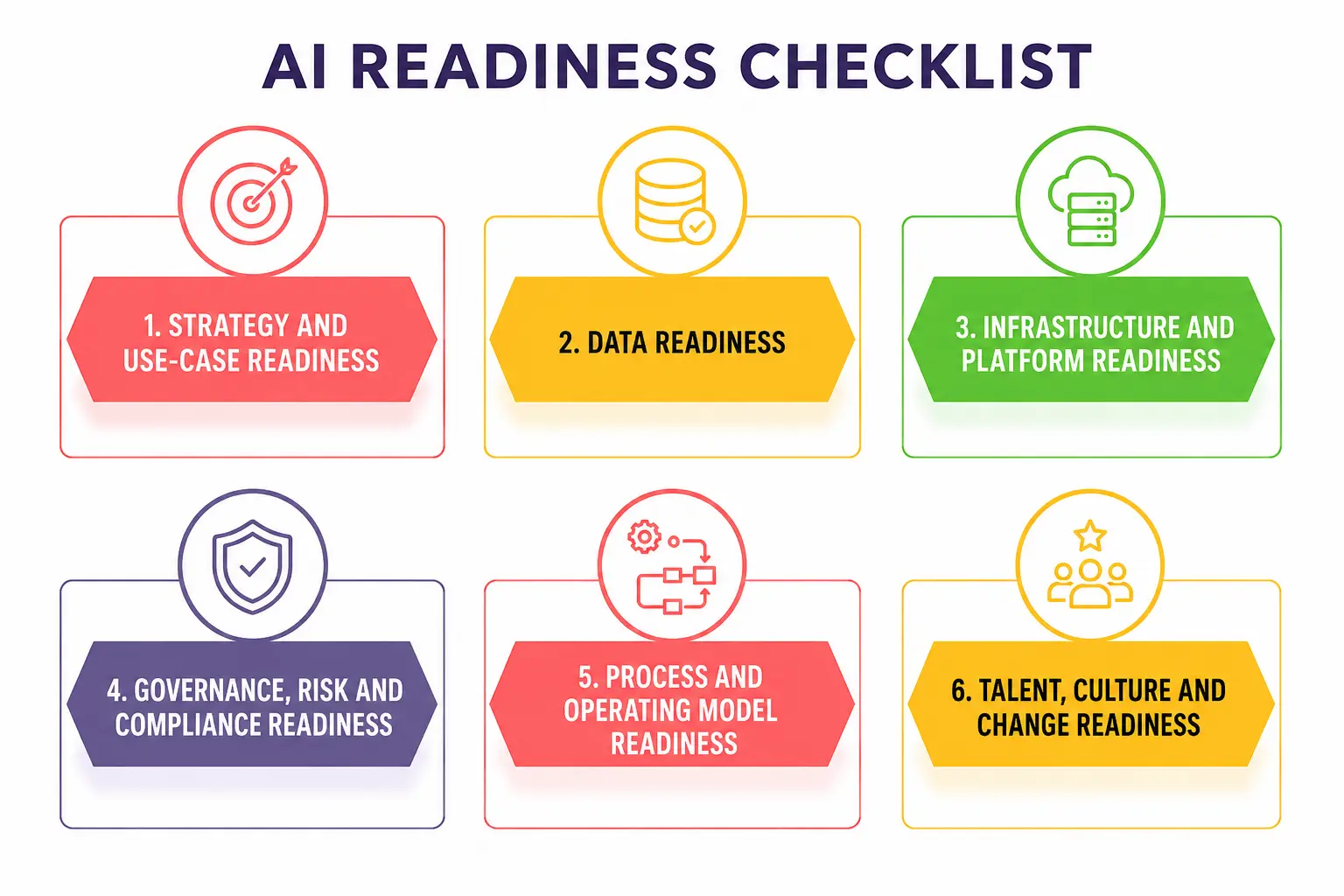
      • Process and Use cases - Validates business outcome alignment, clear KPI definitions, and workflow integration feasibility.
      • Data Readiness - Evaluate the quality, availability, ownership, accessibility, and readiness of data for application in AI applications.
      • Infrastructure - Evaluate cloud capabilities, computing power, storage and integration methods, and technical capabilities for AI.
      • Governance and Risk - Ensuring compliance with data privacy, liability, and AI ethics principles
      • Security - Understanding the ability in model monitoring, data leakage prevention, and security.
      • Talent and Culture - Understanding AI capabilities in the organization, change management, and training opportunities.
      AI Readiness Checklist

      Section 1: Strategy and Use-Case Readiness

      AI readiness starts with a clear business reason. This step evaluates the presence of an outcome, target, and responsible individual for the proposed artificial intelligence project. It should be understood that a use case must not proceed solely on account of its promising nature. It must be known exactly how the business can benefit from this technology. 

      Determine whether the outcome of the business activity has been clearly defined, and whether the metrics are already known for the current situation. Verify that there is an executive sponsor who takes ownership of the project and manages the budget. The scope needs to be defined, including what is included and what is excluded from the scope of the AI solution.

      The checklist should ask whether the team has identified the specific decision AI is meant to improve. It should cover business outcome, baseline metric, executive sponsor, kill criteria, scope boundaries, budget ownership, success measurement, and decision improvement, along with a disqualifying question.

      1. Named Business Outcome: What is the named business outcome that this AI initiative must accomplish within one year?
      2. Baseline Metric: What is the named business outcome’s current, validated baseline, and how was it measured?
      3. Disqualifying Question (The Smoke Test) 🚩: Assuming this AI effort works perfectly, what number on what report gets changed?
      4. Executive Sponsor: Who is the single executive vice president or C-level individual whose name and performance metric is staked to this effort?
      5. Kill Criteria: What are the specific criteria (performance or operational or financial or accuracy) for this project to be shut down or rolled back?
      6. Scope Boundaries: What are the exact out-of-scope situations and limits to this project?
      7. Budget Owner: Which P&L holds the budget cost of ownership of this project, including the continuing cost of inference, drift, and tuning?
      8. Decision augmentation: What exactly is the human decision that is being sought to be improved/automated through this particular AI effort?

      Evidence required: Business case, use case(s), baseline, KPIs, sponsorship sign-off, budget sign-off, and success criteria.

      Section 2: Data Readiness

      This is the longest section by design, because data is where most enterprises actually fail. A checklist must verify if the data needed for the use case really exists, is accessible, and is trustworthy.

      Start by finding out whether the data is centralized or discoverable in systems. Check lineage and whether key attributes trace to their origins. Define quality requirements with regard to completeness, accuracy, recency, and consistency. Find out if data is labeled, classified, and ready for your AI use case. In case of unstructured data, assess documents, emails, audio, images, and other content for usability needs.

      Retention policies and sensitivity of data must be identified as well. The entitlement map will identify access and reasons for access to specific data. Most importantly, find out if the data really exists that represents your use case.

      The checklist must address issues of data availability, centralization, lineage, quality, labeling/classification, unstructured data, retention, sensitivity, access rights, representation, and other relevant data controls.

      1. Data Existence: Do the necessary historical and operational data for the specific use case exist?
      2. Data Centralization: Is the necessary data available via a centralized and low-latency pipeline, or is it distributed across disconnected and ungoverned silos?
      3. Lineage Traceability 🚩: Can you trace each field in the model’s output all the way back to the source-of-record system with full lineage?
      4. Entitlement Mapping 🚩: Are entitlements of your data legitimate?
      5. Quality Thresholds: What are the values of quality thresholds of your data (Accuracy, Completeness, Consistency, Timeliness)?
      6. Data Annotation & Labeling: Is the dataset that could be used to train or fine-tune your model already annotated and labeled? Have you obtained validation from domain experts?
      7. Unstructured Data Ingestion: Do you have unstructured data such as documents, emails, images, audio files?
      8. Data Classification & Sensitivity: Have you classified your data according to its sensitivity and business impact (Public, Internal, Confidential, PII/PHI)?
      9. Retention Policy: Do you have any data retention policy?
      10. Vector & Semantic Alignment: Can you perform semantic Search/RAG without exposing any unauthorized and stale metadata?
      11.  Data Drift Detection: Have baselines been created for the detection of drift between new production data and the historical data?
      12. Synthetic Data Generation: When the amount of edge-case data is scarce, have protocols for generating synthetic data been set in place?
      13. Third-Party Data Usage Rights: Have third-party data sets been screened for use in commercial AI systems?
      14. Database Schema Immutable: Is the database schema immutable or version-controlled so that there is no chance of any unexpected disruptions in the data collection process?

      Requisite Evidence: Data Catalog, Data Lineage, Data Quality, Access Control Mechanisms, Data Classification & Retention, Sample Data Sets, Annotation Guidelines.

      Section 3: Infrastructure and Platform Readiness

      AI workloads require more than access to the model. This step assesses the ability of the technical environment to support development, testing, production, monitoring, and recovery.

      Assess available compute capacity, storage capacity, network capacity, and future load increases. Ensure that development, testing, and production environments are appropriately isolated. In the case of agentic AI, assess the existence of a safe sandbox for testing the autonomous behavior of the AI.

      The checklist should cover compute, capacity planning, environment separation, agent sandboxing, APIs, integrations, observability, workload cost visibility, recovery, and rollback.

      1. Compute & Capacity Planning: Is there any dynamic GPU/TPU or inference compute capacity for the planned AI workloads?
      2. Environment Segregation: Is there any segregation of the Development, Staging, Sandbox, and Production environments?
      3. Sandbox for Autonomous Agent: Is there a suitable sandbox environment for testing the autonomous agent in its ability to interface with other tools?
      4. Reconstruct & Revert Action (The Agent Blindspot): Can you revert an agent's action and reconstruct what it did?
      5. APIs and System Integration: Do the required APIs and integrations exist and make sense for this AI usage scenario?
      6. Observability & Tracing: Is there end-to-end tracing for each and every prompt, data fetching, LLM call, and latency issue?
      7. Cost of AI per Workload: Are there costs associated with each workload, application, or use case when it comes to AI?
      8. Fallback Plan: Is there a redundancy plan in place for testing if the AI goes berserk?
      9. Latency SLAs: Is the system architecture in place to meet the latency SLAs of the end users?
      10. Model evaluation: Are AI model benchmarks automatically included in automated build and deployment pipelines?

      Evidence needed: Architectural diagrams, capacity planning, environment mapping, API specifications, monitoring tools, cost information, fallback plans, and agent logs.

      Section 4: Governance, Risk and Compliance

      Governance should address the question of which actors have the authority to authorize, oversee, challenge, and halt an AI system. In this part, we shall investigate whether this is the case before production.

      This starts with an AI or Model inventory that identifies the existence of the system, who owns it, what datasets it uses, and where it runs. We examine approval gates for development, testing, release, and substantial changes to the model itself. We define human-in-the-loop thresholds for decisions requiring human assessment. We verify whether audit logs record inputs, outputs, actions taken, the version of the model, and usage by the user.

      Controls need to be incorporated that include bias testing, evaluation, third-party model exposure, data handling, and AI failure management. Controls should link with the appropriate regulations such as NIST AI Risk Management Framework, ISO/IEC 42001, and EU AI Act.

      1. Model Inventory: Do you have all your models, prompts, fine-tuned weights, and API calls listed within the governance repository?
      2. Accountability (Ownership): Is there an assigned owner for every AI application developed?
      3. Approval Gates: Do you have any gates put in place to approve the AI system before deployment?
      4. Thresholds: Do you have any thresholds set up to review human decision-making regarding risky decisions made by the AI systems?
      5. Audit Logging: Is there a well-defined process to log input and output, decision-making process, model version, and AI application activity?
      6. Bias & Toxicity Testing: Is there an automatic way of testing to detect any potential biases and toxicity from the outputs?
      7. Exposure of Third-Party Model: What measures have you taken to prevent proprietary information of the enterprise from being employed for training third-party foundation models?
      8. Incident Response Plan: Are there any plans in place for responding to incidents caused by AI, such as hallucinations, prompt injection, and so forth?
      9. Mapping of Regulatory Framework (EU AI Act/NIST/ISO): Is there any mapping done for regulatory frameworks based on NIST AI RMF, ISO/IEC 42001, and EU AI Act risk tiers?
      10. Red Teaming Exercises: Have you performed any testing against adversarial attacks like jailbreaks, prompt injections, and so forth?
      11. Explainability & Transparency: Is there an option for explainability of the reasoning path and attribution source?
      12. IP & Copyright Indemnification: Has the Legal team reviewed the ownership of intellectual property and copyright indemnifications of base model vendors?

      Evidence: AI inventory, governance policy, approval gates, risk assessments, evaluations, audit logs, incident procedures, vendor assessment and regulatory mapping.

      Section 5: Process and Operating Model Readiness

      Since AI is applied in business processes, the checklist should verify that there is proper documentation for those processes so the AI system can follow them. The high-level maps are not sufficient. They should document decision points, input requirements, activities, exceptions, escalations, approvals, and output expectations.

      They should check whether there is an owner of the target process and whether the cycle time is known at present. They should check the handover points among teams, systems, and roles. They need to identify human decisions in the process and whether they can be encoded as rules or need further human intervention.

      Handling of exceptions needs careful consideration. They must consider situations in which there is not enough input information or if the input information contradicts, is unexpected, or goes against policies.

      This list will include process documentation, ownership, decision-making rules, escalation, exception management, handover, cycle time baselines, and undocumented process knowledge.

      1. Granularity of Process Documentation: Does the target process being considered have sufficient process documentation for a machine learning approach or AI Agent?
      2. Undocumented Knowledge Issue: Are the process inputs, decision-making processes, actions, and outputs documented adequately?
      3. Identification of Escalation Paths: Has the path of escalation been recorded where human action may be needed?
      4. Baselines for Cycle Times: Are there reliable time and motion studies showing how much time it takes for human operators to perform each task?
      5. Handoff Process: Is there clarity about how work will go back and forth between human and machine without any dead letter or task dropping situations?
      6. Error Correction Feedback Loop: Is there a seamless feedback loop for domain experts to flag, correct, and re-inject errors into the tuning process?
      7. Standard Operating Procedure (SOP) Versioning: Are business SOPs updated concurrently with model releases to reflect changing worker responsibilities?
      8. Volume & Throughput Constraints: Is the target process designed to absorb a massive increase in throughput without creating downstream operational bottlenecks?

      Required evidence: Process maps, SOPs, workflow documentation, exception logs, escalation procedures, handoff maps, cycle-time reports, and stakeholder interviews. 

      Section 6: Talent, Culture and Change Readiness

      Another critical factor that determines if the company is ready for AI implementation is whether the company has the human capacity to develop, run, manage, and optimize the system. Pure technology will not bridge the capability gap.

      The first step is the assessment of the capability of the business architecture. The teams need to be aware of where the particular application of AI would fit within the business process, application, data, and decision flow. They also need to assess whether the company has the technical capability to develop, manage, test, and solve issues with the system.

      The checklist should include an end-user enablement plan covering role-based training, guidance, support, and feedback. It should cover business architecture skills, technical capability, maintenance capacity, end-user readiness, training, communications, role metrics, and change ownership.

      1. Business Architecture Capability: Do you have bridge-builders who understand both deep domain operations and AI technical constraints?
      2. Build-and-Maintain Capability: Does the internal engineering team possess the skills to maintain, re-tune, and debug RAG/agentic pipelines over time?
      3. End-User Enablement Plan: Is there a structured training program to teach frontline workers how to prompt, verify, and collaborate with the system?
      4. Change Management & Communication: Is there an executive communication strategy addressing job impact, trust building, and shift in role expectations?
      5. Performance Metric Realignment: Have performance KPIs for impacted workers been updated to incentivize AI adoption rather than manual workarounds?
      6. Adoption Ownership: Who is specifically responsible for tracking daily active usage, user feedback, and post-deployment adoption bottlenecks?
      7. Psychological Safety & Trust: Are incentives aligned so employees feel safe raising model failures rather than covering them up?
      8. Continuous Learning Framework: Is there a dedicated team assigned to review model performance weekly and iteratively update prompt/grounding strategies?

      Required evidence: Skills matrix, training plans, role descriptions, hiring plans, communications plan, performance metrics, stakeholder feedback, and change ownership records. 

      Scoring the Checklist

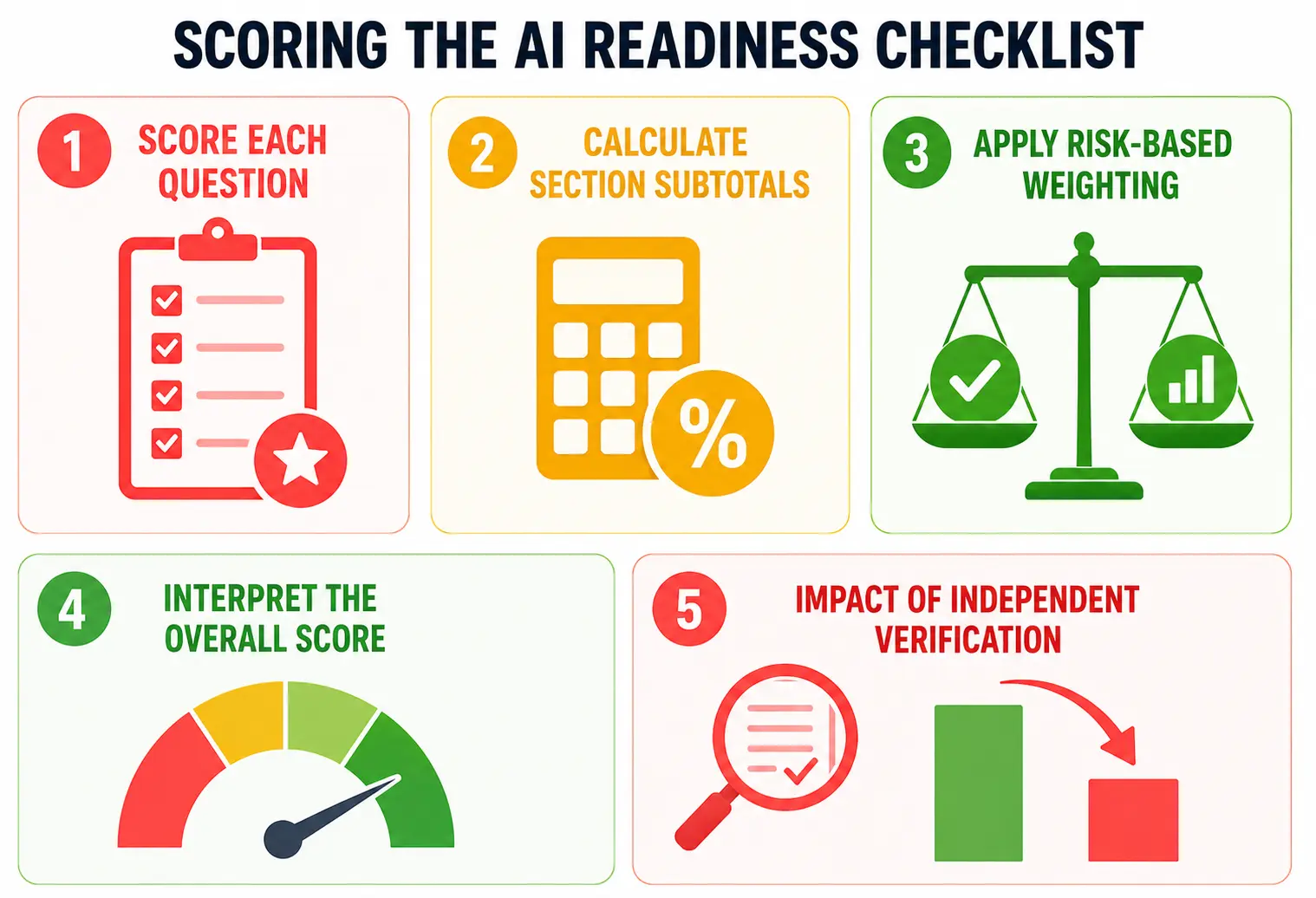
      A scoring model makes the checklist easier to compare across business units and use cases. Score each question 0, 1, or 2, then calculate section scores and apply weights based on business risk.
      Scoring the Checklist

      1. Score Each Question

      Score Meaning
      1 Not in place; no supporting evidence
      2 Early or informal; limited evidence
      3 Partially defined and documented
      4 Defined, documented, and consistently followed
      5 Mature, measured, tested, and continuously reviewed

      2. Calculate Section Subtotals

      Each section has a different number of questions, so convert the raw subtotal into a percentage:

      Section score = (Points earned ÷ Maximum possible points) × 100 

      For example, Section 1 has 8 questions and a maximum of 16 points. If the team scores 12:

      12 ÷ 16 × 100 = 75%

      3. Apply Risk-Based Weighting

      Not all sections have the same degree of business risk. Assign the weights according to the AI program and do not give the same weight to all parts. Check out the weightage for each section, as it differs for the finance and manufacturing domains.

      4. Interpret the Overall Score

      The Cisco approach is divided into six pillars and categorizes firms into the following four bands using a readiness score from 0 to 100.

      It must be seen as a benchmarking tool and not a claim that the checklist presented here reflects the Cisco methodology, since the Cisco index is calculated using 49 indicators.

      5. Impact of Independent Verification

      Self-assessment scores tend to deteriorate when artifacts (such as policies, architectural designs, and license agreements) are asked for and reviewed:

      • Score Shift as a Baseline Finding: Score deterioration is more common than the exception when there is a review during the audit process.
      • Measuring the Governance Gap: The difference between the initial score based on self-assessment and the subsequent post-artifact score is the indicator of organizational overconfidence and governance gap.

      What to Do With a Low Score

      A poor score indicates the first action, not a sweeping transformation effort. 

      • Data blocked: Fix the data access, quality, lineage, and entitlement issues. 
      • Governance blocked: Define the ownership, approval, and control processes. 
      • Processes blocked: Document the workflow, exceptions, and handoffs.

      For full step-by-step remediation strategies, review the complete roadmap treatment in our main pillar guide. 

      Checklist Mistakes That Produce False Confidence

      • Self-scoring the gap: Allowing the team responsible for an operational gap to score their own performance creates an inherent conflict of interest, leading to optimistic evaluations that hide major implementation risks.
      • Answering at the wrong seniority: High-level executives tend to overestimate the state of preparedness due to strategic vision at the higher level, whereas tactical units overlook strategic risk policy.
      • Scoring Intent Over Evidence: Plans, intentions, and verbal assurances are not proof. A policy, report, system record, architecture document, or audit trail should support the score.
      • Treating a Completed Checklist as an Assessment: Just answering the questions does not mean the business is ready. The assessment should surface gaps, dependencies, and production blockers.

      From a Self-Score to a Verified Score

      A self-assessment can identify gaps, but it cannot independently verify its own evidence. It needs an audit of concrete artifacts rather than reliance on verbal confirmations or policy intent.

      Three items commonly fail this check.

      • Data lineage: teams may say a field is traceable, but the lineage stops at an intermediate system. 
      • Entitlement: access may appear controlled, yet no current record proves who can view a sensitive field.
      • Agent rollback: a team may report that actions can be reversed, but logs cannot reconstruct what the agent did or restore the prior state. 

      The confirmed score has been recorded along with the answer provided and the result obtained through evidence. The difference has been documented with details about the missing artifact, control, and next course of action.

      How Entrans conducts an AI readiness assessment checklist

      At Entrans, we carry out an AI readiness assessment that evaluates an organization's maturity across strategy, data, technology, talent, and governance before deploying AI solutions.

      • We do it as an evidence-led review rather than a questionnaire format. The assessment starts with stakeholder interviews across business, data, technology, security, and compliance teams. Each response is then checked against relevant artifacts, including data records, architecture documents, access controls, governance policies, and process documentation.
      • We score the findings across the key readiness areas, identify production blockers, and separate quick fixes from larger capability gaps. 

      Following AI readiness assessment best practices, this structured analysis provides a targeted roadmap to minimize operational risk and accelerate production deployment. 

      Want to know more about how we turn a self-score into a verified readiness view and actionable roadmap? Book a consultation call.

      Share :
      Link copied to clipboard !!
      Move from AI Readiness to Production
      Fix your data, tech, and compliance gaps with custom engineering support.
      20+ Years of Industry Experience
      500+ Successful Projects
      50+ Global Clients including Fortune 500s
      100% On-Time Delivery
      Thank you! Your submission has been received!
      Oops! Something went wrong while submitting the form.

      FAQs

      1. What should an AI readiness assessment checklist include?

      AI readiness assessment checklist template should cover six areas: strategy and use-case definition, data readiness, infrastructure and platform, governance and risk, process and operating model, and talent and change readiness. Every item should be answered with evidence, go through the approval workflow, and be documented.

      2. What are the key questions to ask in an AI readiness assessment?

      The questions to be mentioned in an AI readiness assessment are:

      • Which measurable business number will change?
      • Can every data field be traced to its source?
      • Who is entitled to see this data?
      • Is there a safe environment to test autonomous actions?
      • Is the target process documented well enough for a machine to follow?
      • Who is accountable when the system produces a harmful output?

      3. How do you score an AI readiness checklist?

      A simple approach is to score each question on a 1–5 scale, where 1 means not ready and 5 means fully ready. These individual scores are then weighted, totaled, and mapped to a 0–100 maturity tier that defines your organization's readiness level. 

      4. Is there a free AI readiness assessment checklist template?

      Yes. Several vendors publish gated checklist templates, and Microsoft and Cisco offer free interactive assessments. A basic AI readiness assessment checklist template can be created in a spreadsheet or document with questions covering business strategy, data, technology, governance, security, skills, and operating processes.

      5. How long does it take to complete an AI readiness checklist?

      The time depends on the checklist size and who completes it. A short 20–30 question checklist may take 30–60 minutes. A 50–60 question enterprise checklist can take 2–4 hours when multiple stakeholders contribute.

      6. What is the difference between an AI readiness checklist and an AI readiness assessment?

      An AI readiness checklist is a simple, self-reported diagnostic tool used to quickly spot gaps across various business pillars. An AI readiness assessment is a broader evaluation process. It validates gaps using evidence.

      Hire AI Engineers to Scale
      Access pre-vetted developers to build pipelines and modernize your tech stack.
      Free project consultation + 100 Dev Hours
      Trusted by Enterprises & Startups
      Top 1% Industry Experts
      Flexible Contracts & Transparent Pricing
      50+ Successful Enterprise Deployments
      Aditya Santhanam
      Author
      Aditya Santhanam is the Co-founder and CTO of Entrans, leveraging over 13 years of experience in the technology sector. With a deep passion for AI, Data Engineering, Blockchain, and IT Services, he has been instrumental in spearheading innovative digital solutions for the evolving landscape at Entrans. Currently, his focus is on Thunai, an advanced AI agent designed to transform how businesses utilize their data across critical functions such as sales, client onboarding, and customer support

      Related Blogs

      How to Plan an AngularJS to React Migration Without Breaking the Business

      Plan a seamless AngularJS to React migration. Learn how to manage coexistence, lower security risks, and execute a phased rollout without downtime.
      Read More

      The Enterprise AI Readiness Assessment Checklist: 60 Questions and How to Score Them

      Audit your enterprise capability with our 60-question ai readiness assessment checklist. Score data, infrastructure, and governance gaps before deployment.
      Read More

      AI Readiness Assessment Frameworks Compared: Which Model Should Your Enterprise Use?

      Compare top options using an ai readiness assessment framework. Discover how Microsoft, Cisco, and NIST models evaluate data, governance, and strategy.
      Read More