Learn how to choose the right AI risk management framework and align NIST, ISO 42001, and EU AI Act for enterprise compliance.

Agentic Unconference 2026 - September 19, Chennai
View Event →





With regulatory attention increasing, Generative and Agentic AI develop faster than older governance and management methods allow…
Which means, companies now face an issue where fixing failures costs more than prevention! In fact, in 2024 alone, model hallucinations caused billions in losses.
Due to this, making use of relevant AI risk management frameworks has become a necessity for long-term success. This is why, in this article, we discuss the types of AI risk management frameworks and how to put them into practice for an enterprise.
An AI Risk Management Framework is a structured system designed to handle the unique dangers of probabilistic technology. An AI risk framework acts as a defense system against these threats, organizing the policies, processes, and tools required to keep AI safe, compliant, and effective.
The actual risks associated with AI stem from traditional software relying on deterministic systems where specific inputs yield predictable outputs. Whereas AI systems are non-deterministic. This difference requires a fundamentally different method for governance.
The year 2025 marks a major shift to full operational AI usage. However, a dangerous gap exists: while 81% of companies have AI in production, only 15% govern these systems effectively.
The evolving list of dangers includes several new categories:
Setting up a strong framework yields measurable value beyond avoiding fines. It functions as a central part of business operations.
The most immediate benefit of an AI risk management framework is financial protection. The cost to fix failures leads to massive losses. These losses come from legal sanctions, remediation expenses, and data leaks.
Regulatory fines under the EU AI Act can reach up to 35 million Euros or 7% of total worldwide annual turnover. A framework acts as a shield against these penalties.
Trust is a valuable asset. Clients and partners view governed AI outputs as professional and dependable tools.
Companies that prove their compliance command pricing power. This status allows them to close deals faster. An AI risk management framework reduces the burden of due diligence during the sales cycle.
A major benefit of AI risk management frameworks is seeing what exists. Statistics indicate that 91% of small companies take extreme risks because they lack awareness.
Employees often leak private data into public tools. A framework mandates the usage of discovery tools. These tools find unauthorized AI usage so managers can control it.
AI models degrade over time. 91% of machine learning models experience drift within several years.
An AI risk management framework requires continuous checks. It sets up workflows where humans review high-risk decisions. This action stops the generation of false information that damages brand reputation.
Mature companies are six times more likely to apply AI across their governance, risk, and compliance functions.
This alignment transforms compliance from a reactive process into a main business advantage. An AI risk management framework helps connect the engineering floor to the boardroom.
The market relies on three main pillars. Understanding the separate roles of these frameworks is necessary to build a defense that works for your specific needs.
Developed by the U.S. National Institute of Standards and Technology, the NIST AI RMF is the gold standard for voluntary risk management.
This acts as an operational playbook. It is flexible and works for any industry. It acknowledges that risks come from the interaction between technical systems and human behavior.
It uses four functions that operate at the same time:
NIST gives the operational guidance, while ISO IEC 42001 supplies the formal structure. It is the first international management system standard specifically for AI.
This main value proposition is certification. It verifies to third parties that a company manages AI responsibly.
This AI risk management framework follows a Plan-Do-Check-Act cycle. It requires several specific documents:
This standard is fast becoming a requirement for B2B SaaS companies selling to large enterprises.
The EU AI Act is a legally binding regulation. It applies to any entity placing AI systems on the EU market.
This AI risk management framework applies regardless of where the entity has its headquarters. It uses a method based on danger levels:
Other AI risk management frameworks exist for specific needs:
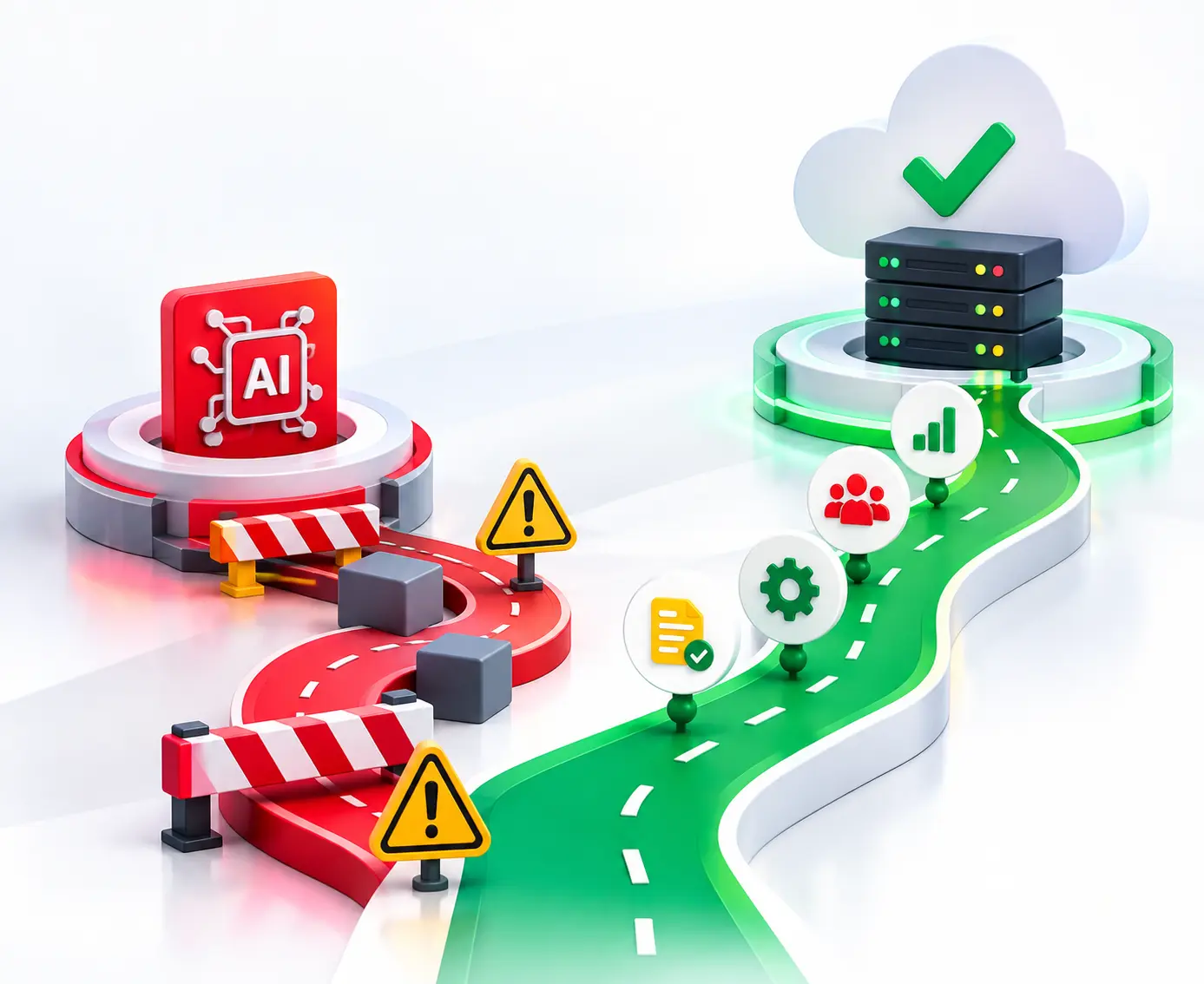
Selecting an AI risk framework is not a single choice. For most modern enterprises, the best strategy is a Governance Stack. This method uses the strengths of multiple frameworks to create a complete defense.
Experts recommend using NIST AI RMF to perform the work and ISO 42001 to prove the work. This creates a layered AI risk management defense.
Enterprises should use specific criteria to decide their starting point.
If you sell AI software to banks or healthcare providers, your priority is ISO 42001. Your customers require assurance.
Certification allows you to bypass skeptical procurement teams. It proves you meet their third-party requirements. It acts as a marketing asset.
If you operate in multiple regions like the US and EU, use a hybrid method. Combine ISO 42001 with the EU AI Act.
You need a global standard to unify operations. At the same time, you must follow the High Risk rules of the EU AI Act for HR and Finance algorithms to avoid fines. Making use of these two AI risk management frameworks allows for global consistency.
For startups in the US focused on product creation, the NIST AI RMF is the priority.
This AI risk management framework supplies a flexible playbook to manage risk without the heavy administrative load of a full audit. It shows due diligence to regulators and investors.
Your current level of advancement matters:
Setting up these frameworks involves hurdles that can stop progress if not anticipated.
One of the most widespread challenges is Shadow AI. Employees often paste sensitive corporate data into public language models to increase speed. This creates an invisible danger surface. Frameworks like ISO 42001 require a complete inventory.
Maintaining this inventory manually is impossible in a decentralized company. Automated discovery tools are necessary to scan network traffic and find unauthorized connections.
The shift to Agentic AI introduces new dangers. These systems can take autonomous actions. Agents can execute financial transactions or delete files without human approval. This introduces the risk of excessive agency.
Most AI risk management frameworks were designed for systems where a human makes the final call. Agentic AI requires governance encoded directly into the software. Guardrails must exist in the agent runtime logic to stop it from exceeding its authority.
73% of companies report data quality issues as a main barrier. Poor data leads to poor results. Historical bias in training data leads to discriminatory outcomes in areas like hiring.
Many entities only discover these biases after deployment. This leads to reputational damage. Without a unified data strategy, models may learn from partial or outdated information.
There is a shortage of professionals who understand both AI technology and risk management. 68% of enterprises report a gap in expertise. Security teams often lack the data science knowledge to check model architecture.
Data scientists often lack the training to understand compliance rules. This leads to a situation where teams fill out forms without understanding the technical failures that might occur.
Engineering teams want speed. Risk teams want safety. This creates resistance. If governance processes are too slow, engineering teams may bypass them.
This leads to more Shadow AI. Governance must exist within the software delivery pipeline. Tools that automate risk checks at the code level reduce this resistance.
Entrans has worked with over 50 companies, including Fortune 500 entities. We handle product engineering, data engineering, and product design from the ground up.
Do you need to set up AI but are working with legacy systems?
We update them so you can set up continuous delivery and ML frameworks. This verifies that your machine learning process stays ahead and is updated in real time. We automate your risk management within your development pipeline.
From AI modeling and testing to full stack development, we handle projects using industry veterans. We work under NDA for full confidentiality.
Ready to turn governance into a competitive weapon? Reach out for a free consultation call.

NIST AI RMF is a voluntary set of guidelines that acts as an operational playbook. It concentrates on how to map and measure risk technically. ISO 42001 is an international standard that concentrates on the management system itself. It offers third-party certification. This certification is important for proving trust to clients.
Shadow AI refers to the unauthorized usage of external AI tools by employees for corporate tasks. It creates massive data leak risks. It makes it impossible to govern the company's AI usage effectively because managers cannot control what they cannot see.
The penalties are severe. They can reach up to 35 million Euros or 7% of a company's total worldwide annual turnover. The higher amount applies. This makes alignment with the EU AI Act a financial necessity for global enterprises.
Agentic AI involves systems that can execute actions like trades or file deletions without human intervention. This introduces excessive agency risks. Governance must change from static checks to code-based rules. Guardrails must be embedded directly into the agent logic to stop unauthorized actions.
No. 91% of small companies currently take extreme risks. While large enterprises face regulatory fines, smaller companies face threats from data leaks and model failures. Adopting a flexible framework like NIST AI RMF is a good idea for smaller innovators.
Governance Ops refers to connecting governance checks into the software development lifecycle. It uses tools to automate risk checks at the code level. For example, it can block personal data in prompts automatically. This reduces resistance between engineering and risk teams.
Yes. This is the Governance Stack method. You can use NIST AI RMF for technical risk mapping. You can use ISO 42001 for management certification. You can use the EU AI Act for legal compliance in Europe. This verifies global consistency while meeting local rules.

-1.svg)