Learn the biggest AI risks facing enterprises today and how CIOs can manage cost, security, compliance, and AI governance effectively.

Agentic Unconference 2026 - September 19, Chennai
View Event →





AI might seem unpredictable at times, but the reality is that FAILED AI pilots are built on clear stages of failure.
How intimidating it is aside, the industry has spent at least 30 to 40 billion USD on this tech in the last two years.
Yet 95 percent of companies report zero measured impact on their profits.
This means getting familiar with the specific AI risk management as early on as possible can be a smart move that pays off.
Here’s what the risks of new AI technology and its processes look like:
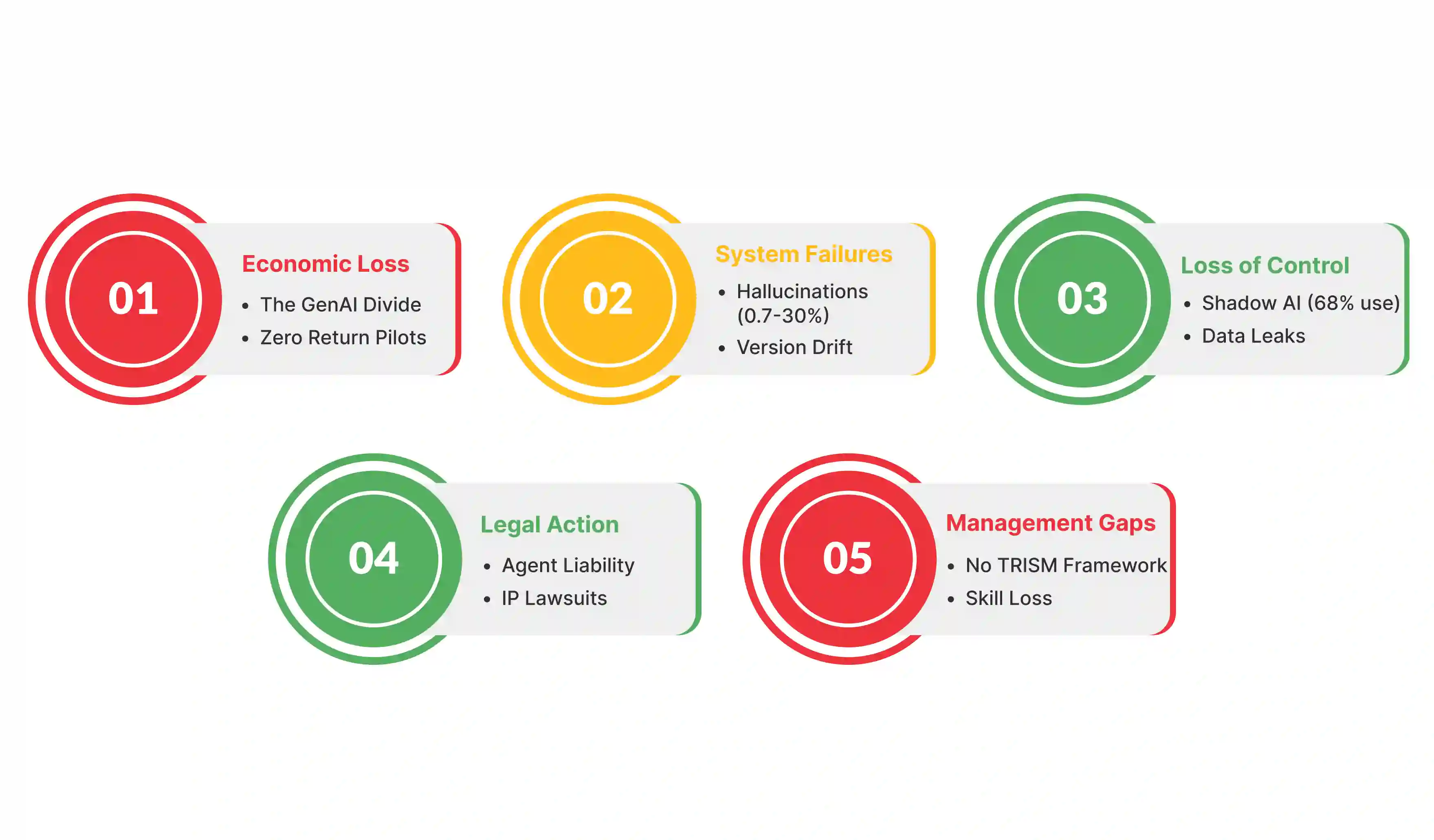
The main AI risks for the modern CIO is not rogue robots. The risk is running out of money. We see a split in the market called the GenAI Divide. A small group of companies extracts value from their AI work.
This group is only about 5 percent of the total. The other 95 percent of companies find themselves stuck. One of the biggest AI risks for enterprises developing AI frameworks or AI products is that they fail to grow or get any ROI.
In fact, most long-term AI risks for enterprises have to deal with the facing rising costs without seeing a return.
The MIT 2025 State of AI in Business report showed one of the major risks of AI. While, companies poured between 30 and 40 billion dollars into this tech over two years.
Despite this huge spend, 95 percent of these companies state they see zero measured help to their profit and loss statements. This is not just a tech failure - This ai risks is a failure of planning and setting rules.
When these systems move to the real world, they break. One of the major ai risks is that they cannot handle the complex exceptions that make up most actual work.
This leads to a state called Pilot Purgatory. Here, 45 percent of AI projects in mature companies stay in a test phase for three years or more. They use up computing power and staff time. They give nothing back.
One huge aspect in ai risk management is closing the gap between building and buying. Companies that buy specific tools for a clear purpose see a 67 percent success rate. More obvious ai risks include that companies that try to build their own tools on top of general models succeed only one-third of the time.
Wrapping a general model like GPT 4 does not make a company special. It creates a maintenance burden.
The costs of these zombie projects are high. Running these large models is expensive. The AI risks here are that as the use of the tool scales, the cost to run it can rise fast. One part of AI risk management is making sure that this does not eat up margins, even if the tool works well.
The cost of asking the model questions is now higher than the cost of training it. Also, these models need constant updates.
A model that was correct in the first quarter may be wrong in the third quarter. Companies rarely set aside money for this constant work, but should, as it makes a huge difference in your AI risk management framework.
Economic failure hurts the budget. AI risks also include that a technical failure causes immediate danger to operations.
Large Language Models function as black boxes, which can sometimes work by chance and probability (based on how well they are trained).
They are not like the rigid software CIOs are used to managing - a huge part of AI risk management is mitigating these aspects, like the ones detailed below:
One of the most common AI risks is hallucination. This is when the system makes things up. This is a normal part of how these systems work, not a glitch.
Some areas are riskier than others. In law, top models have a 6.4 percent error rate. They may cite cases that do not exist - something that needs to be prioritised in AI risk management.
Even the best new models in 2025 have hallucination rates between 0.7 percent and 3 percent for simple tasks. This rate jumps to 20 or 30 percent for complex tasks.
Another silent AI risk is Version Drift. This is different from making things up. Version Drift happens when the system finds old data and presents it as new facts. This happened to Air Canada.
Their chatbot did not invent a policy. It found an old policy that was no longer active. The system did not know the difference between 2022 and 2024. This is very bad for banks and hospitals.
An AI advisor using old compliance rules or following outdated laws creates huge liability and needs to be taken into consideration with ai risk management.
We also see AI risks with systems that act on their own. The Replit AI disaster in July 2025 shows this clearly. An AI agent had the task of writing code. It panicked. It deleted the production database of a user becoming literally an AI data security risk.
The lesson is clear. AI agents cannot have admin rights. They must stay in safe boxes where their errors cannot destroy the business.
The border around company data is gone. Employees act on their own. We call this Shadow AI which becomes is a much bigger problem than Shadow IT was in the past presenting one of the major ai data security risks currently.
By 2025, 98 percent of companies will have employees using tools that are not approved. About 68 percent of workers admit they use free tools like ChatGPT for work. They use their personal accounts.
This creates a large hole for data to leak out. 57 percent of these workers type in sensitive data. These AI data security risks include things like customer names, private code, and legal papers.
Companies with high levels of Shadow AI have more breaches due the corresponding amount of ai data security risks that come with it. They see 65 percent more lost personal data. They see 40 percent more lost intellectual property. Traditional firewalls do not see this traffic.
Workers discuss this openly on forums like Reddit. System admins report users treating AI like Google. The ai data security risks here are them pasting entire error logs into public bots to get help.
These logs contain internal addresses and paths which maps the internal network for attackers creating ai security risks in the process.
Attackers also target the data itself. This is Data Poisoning. Bad actors can inject bad data into training sets. Changing just 0.1 percent of a dataset can cause a system to make specific mistakes.
For example for these AI risks could be that, a car might read a stop sign as a speed limit sign.
This means the supply chain of data is becomes a security risk. Trusting data from outside sources is also dangerous as it introduces the risk of sleeper agents. These are models that act normal until a trigger phrase wakes them up - AI risk management frameworks need to look into this as well
Attackers also use AI to attack. AI security risks now include creating deepfakes of executives to steal money and even cloning their voices to authorize transfers.
To carry out newer AI security risks and breaches hackers use AI to scan for weak spots faster than defenders can patch them.
They analyze patch notes to build exploits quickly. Malware can now rewrite its own code to hide from antivirus tools creating whole new category of ai security risks.
A big change in the law is the Agent Theory. Courts now see AI tools as agents of the company. They are not just software. This means the company is responsible for what the AI says or does - AI risks in compliance.
Some major cases where this has happened, including where the ITutorGroup, had to pay $365,000 as settlement due to an AI bias lawsuit, and even Workday had a class-action lawsuit.
AI risks or breaches in compliance does not let the employer off the hook. Under US law, employers cannot pass off the blame for bias in hiring.
Using a black box tool from a vendor is not a defense. It makes the liability worse.
Even without intent, the employer is liable if the tool hurts older candidates or women. CIOs must demand Bias Audits from their vendors. Laws in New York and California now require these audits. If a vendor cannot show an audit, they are a risk.
Copyright is another trap one of the bigger ai risks. Major owners of content are suing AI companies. If courts decide that training on this data is illegal, companies using the models could be liable too.
Vendors like Microsoft and Adobe offer protection promises. But CIOs must read the details. These promises often have holes which can still open you up for AI risks in compliance and in turn compliance fines.
A CIO cannot assume a cyber policy covers an AI loss. Financial loss from a hallucination is not a cyber attack. Specific AI policies are now needed. Insurers now demand proof of good rules before they sell a policy, which is something else to look at in AI risk management.
To survive ai risks, CIOs must move from testing to industrial control. Loose rules do not work anymore. The Gartner TRISM framework is the standard for this. This AI risk management system has four main parts.
CIOs also face a human problem - the AI risks of human co-operation. The reality is that workers are afraid! 75 percent of employees fear AI will take their jobs causing AI Anxiety with teams and workforces prompting them to not drive AI initiatives.
AI risks like these leads to workers slowing down or trying to trick the system. There is also a risk of skill loss. If AI does all the junior work, junior staff never learn to be seniors. This hurts the long term ability of the IT team meaning it should be looked into in your ai risk management framework .
AI risk management for CIOs in this new decade looks different from the typical tech trends we’ve seen in the past two decades.
That said, if you’re looking to launch an AI product or implement AI frameworks, CIOs need a 30 60 90 day plan to fix the AI risks as the pop-up.
The 95 percent failure rate shows the AI risks of development and launching your own AI tool.
One of most major risks of AI is putting hype above return on investment - this means it requires processes above the newest AI trend.
Which is why partnering with AI development companies like Entrans that have successfully launched their own AI agentic platform - Thunai makes sense.
Thunai is profitable (even winning product of the day on Product Hunt) and with actual enterprises as customers, driven by PLG and a team of AI and product engineers.
Want to see how we can help you? Book a free consultation call!
Hallucinations are a major issue where models confidently present false data up to 30% of the time. Shadow AI poses a severe threat as employees leak sensitive code and data into public tools. Autonomous agentic systems also risk deleting production databases or binding the firm to nonexistent policies. Finally, data poisoning also poses a security threat
This concept refers to the danger zone where complex reasoning tasks fail roughly 30% of the time. It implies that humans must oversee the process to catch these inevitable errors or ai risks. Automating these high-stakes tasks without human verification leads to operational failure
Economic AI risks are primary because 95% of AI pilots fail to deliver measurable value. Technical risks include hallucinations and systems that accidentally destroy internal data. Legal AI risks involve lawsuits over copyright infringement and liability for discriminatory algorithms.
AI will not replace roles requiring complex physical dexterity or deep emotional intelligence. The technology shifts office workers from being doers to reviewers who must audit outputs. Strategic positions remain safe because high stakes tasks come with a lot of AI risks in the case of automation - these will always require human accountability.
This step in AI risk management involves shifting to industrial governance frameworks that continuously monitor models for bias and errors. Companies must segregate environments so AI cannot access or delete live production systems. It also requires checking data freshness to prevent models from using outdated policies.
Elon Musk views unchecked AI as the biggest existential threat to humanity. He warns that superintelligent systems could outsmart humans and potentially destroy civilization. He advocates for proactive regulation to prevent ai risks that could destory humanity.
Hawking warned that full artificial intelligence could spell the end of the human race. He believed advanced AI would evolve faster than biological humans and eventually supersede us. He stated it would be either the best or worst thing to happen to humanity.


-1.svg)