Forward Deployed Engineer vs. Consultant vs. Professional Services
Compare a forward deployed engineer vs consultant vs professional services. Learn when to choose each model based on scope, execution, and production ownership.
Forward Deployed Engineer vs. Consultant vs. Professional Services
4 mins
September 21, 2026
Author
Aditya Santhanam
TL;DR
Consultants diagnose problems and recommend a path, while professional services delivers against a defined scope. An FDE stays involved until the system works in production.
Choose consulting when the problem is still undefined, professional services when requirements are stable, and FDE when the solution needs to evolve through real-world implementation.
Staff augmentation adds engineering capacity but does not own the production outcome, which makes it different from an FDE engagement.
The contract matters more than the job title. Production code, outcome-based success, and code and runbook ownership are strong indicators of genuine FDE work.
In the vast majority of technology projects for enterprises, the problem is not with the software being selected or chosen – the problem is that the software simply will not work in the actual environment.
The team responsible for making sure that it works got away with handing over a strategy deck, or got into legal troubles due to changing requirements.
Selecting the proper engagement model from the outside is one of the most critical tasks for a CTO, CIO, or Project Manager.
This guide helps to understand the key differences between the Forward Deployed Engineer, the consultant, and the professional services team.
It’ll also helps figure out which one to use in case of each particular issue.
Table of Contents▾
Forward Deployed Engineer vs Consultant vs Professional Services: The Main Differences
The three models cannot be replaced for each other, as they all are based on different purposes, different deliverables, and different metrics of success. Understanding those distinctions will help you buy the right solution the quickest way possible.
The consultant diagnoses issues and makes recommendations. The professional services team works according to the defined scope of the contract.
A Forward Deployed Engineer embeds in your environment, writes production code, and stays accountable until the system actually works in production. Staff augmentation is a fourth model that provides engineering capacity without outcome ownership.
Attribute
Forward Deployed Engineer
Consultant
Professional Services
Primary goal
Embed and deliver a working production system
Diagnose problems and advise on strategy
Implement a defined scope against a fixed contract
Main deliverable
Deployed, working software in the client's environment
Strategy deck, roadmap, or audit report
Completed deliverables defined in the SOW
Production code
Yes — committed directly to the client's codebase
No
Sometimes — configuration and scripting
Customer environment
Works inside the client's VPC, data, and systems
Works in external advisory sessions
Works against sanitized or test environments
Scope
Evolves as the system meets live data and edge cases
Fixed to the advisory engagement
Fixed by the Statement of Work
Outcome ownership
Yes — accountable for production performance
No — exits after delivering recommendations
Partial — accountable to SOW milestones only
Pricing
Outcome-based, story-point, or phase pricing
Retainer or fixed project fee
Fixed fee or milestone-based with change orders
Requirements changes
Absorbed — FDE adapts as requirements evolve
Out of scope
Charged as change orders
Handoff
Code, IP, and operational runbook transferred to client
Presentation or document
Completed deliverables per SOW
Success measurement
System running in production with measurable business impact
Recommendation accepted by leadership
Milestones completed on time and on budget
Client responsibility
Provide access, subject matter experts, and a production outcome to aim for
Provide context, data, and executive access
Provide stable requirements and accept deliverables
What Actually Separates an FDE, Consultant and Professional Services Team
The easiest way to understand the difference is to look at what each model is accountable for and where that accountability ends.
Scope vs Outcome
Professional services teams are accountable for scope. If the Statement of Work says deliver a three-stage data pipeline, success means delivering a three-stage data pipeline. Whether that pipeline actually works in production, whether users adopt it, and whether it solves the original problem are not part of what the vendor is measured against.
FDEs are accountable for outcomes. The engagement is not done when the code is written. The engagement is done when the system runs reliably in production and the business result is measurable.
Advice vs Implementation vs Engineering
These three words are not synonyms. They describe fundamentally different types of work with different risk profiles for the buyer.
Consultant: diagnoses the problem, analyzes options, builds the recommendation. Exits when the strategy is delivered. Research shows that between 30 and 50 percent of consulting recommendations are never fully acted on. The implementation gap is real, and it is expensive.
Professional services: implements against what was agreed in writing before the project started. Works well when requirements are stable. Breaks down when the system meets live data and the real complexity emerges.
FDE: runs discovery, builds the solution, deploys it, and owns the production outcome. The discovery and the engineering happen at the same time, not in separate phases.
Handoff vs Ownership
Consultants and professional services teams hand off at the end of an engagement. They pass a document, a completed deliverable, or a configured system. What happens next is the client's problem.
FDEs transfer ownership. That means code committed to the client's repository, an operational runbook the internal team can use, and a knowledge transfer that leaves the client able to run and maintain the system independently. The engagement ends when the client is fully capable of owning what was built.
Which Engagement Model Do You Need?
The majority of procurement failures occur due to the application of the wrong model at the wrong time during the process of the project.
According to research by MIT, 95% of pilot projects using generative AI in enterprises fail to move into production. The reason for this is not the wrong technology but the absence of anyone being responsible for its successful implementation.
Use these five questions to find the right fit.
Is the problem still undefined? If you do not know what you are building yet, you need consulting first. A consultant helps you diagnose the problem and build the strategic case.
Are the requirements already stable? If you know exactly what needs to be built and those requirements will not change, professional services is the right model. Stable scope, fixed delivery, clear milestones.
Will the solution change once it meets live data and systems? If the answer is yes or probably, you need an FDE. Requirements always evolve when software meets real enterprise environments for the first time.
Do you need engineering capacity rather than outcome ownership? If your internal team has a clear roadmap and strong technical leadership and just needs more hands, staff augmentation is more cost-effective than FDE.
Does someone need to own whether the system actually works in production? If accountability for the production outcome matters more than accountability for a defined scope, you need an FDE.
Buyer Situation
Consultant
Professional Services
FDE
Problem is undefined, needs diagnosis
Yes
No
No
Requirements are stable and documented
No
Yes
No
Solution needs to be discovered through implementation
No
No
Yes
Need extra engineering capacity only
No
No
No
Someone must own production outcome
No
No
Yes
Legacy systems, messy data, complex integration
No
Risky
Yes
Standardized SaaS configuration
No
Yes
No
Forward Deployed Engineer vs Consultant
These two roles are often confused because both involve an external expert working on a client's problem. The difference is in what gets built and who is responsible for whether it works.
What Does a Consultant Deliver?
A consultant operates on the observe-recommend-exit model. They conduct interviews, analyze data, map the current state, and deliver a recommendation. The final output is a strategy document, a roadmap, or an audit. The consultant's job is done when the recommendation is accepted. What happens next, whether the recommendation ever gets built, is not part of the engagement.
This model works well when the business problem is strategic, when multiple teams need alignment, when an independent third-party perspective is needed, or when the next step is a decision rather than a build. This model fails when the organization actually needs technical execution and buys advice instead. That gap is how software ends up as expensive shelfware.
What Does an FDE Deliver?
An FDE operates on the embed-build-solve model. They work inside the client's environment, against live data and real systems. They write production code.
They own the deployment. And they stay accountable until the system actually works. The final output is a deployed, working system with code ownership and operational documentation transferred to the client.
Attribute
Consultant
Forward Deployed Engineer
Problem definition
Diagnoses undefined or strategic problems
Takes an execution problem and solves it
Primary deliverable
Roadmap, analysis, or recommendation
Deployed, working production system
Technical discovery
Stakeholder interviews and document review
Direct exploration of live systems and data
Production coding
None
Yes — committed to the client's repository
Customer data
Reviewed at a high level
Worked with directly in raw, live form
Customer environment
Advisory sessions outside the environment
Inside the VPC, systems, and infrastructure
Deployment
Not responsible for deployment
Owns the deployment end to end
Accountability
Ends when recommendation is delivered
Ends when the system runs in production
Success metric
Recommendation accepted
Production outcome achieved
Handoff
Document or presentation
Code, IP, and operational runbook
Choose consulting when:
The problem is primarily strategic or organizational
Multiple business units need alignment before anything gets built
You need analysis, a roadmap, or an independent audit
Technical execution is not yet the main problem
Choose FDE when:
The solution needs to be discovered through implementation
Engineers need access to real systems and live data
Production code is part of the engagement
Someone needs to stay accountable through to deployment
Forward Deployed Engineer vs Professional Services
This is the point at which the greatest discrepancy between enterprise technology purchases occurs. Professional Services and FDE have a common appearance from the outside because they both imply an engagement with an outside technical team performing the actual work of implementation. The differences between the two in terms of their structure make the difference between survival and failure in the face of reality.
Professional Services Is Built Around Scope
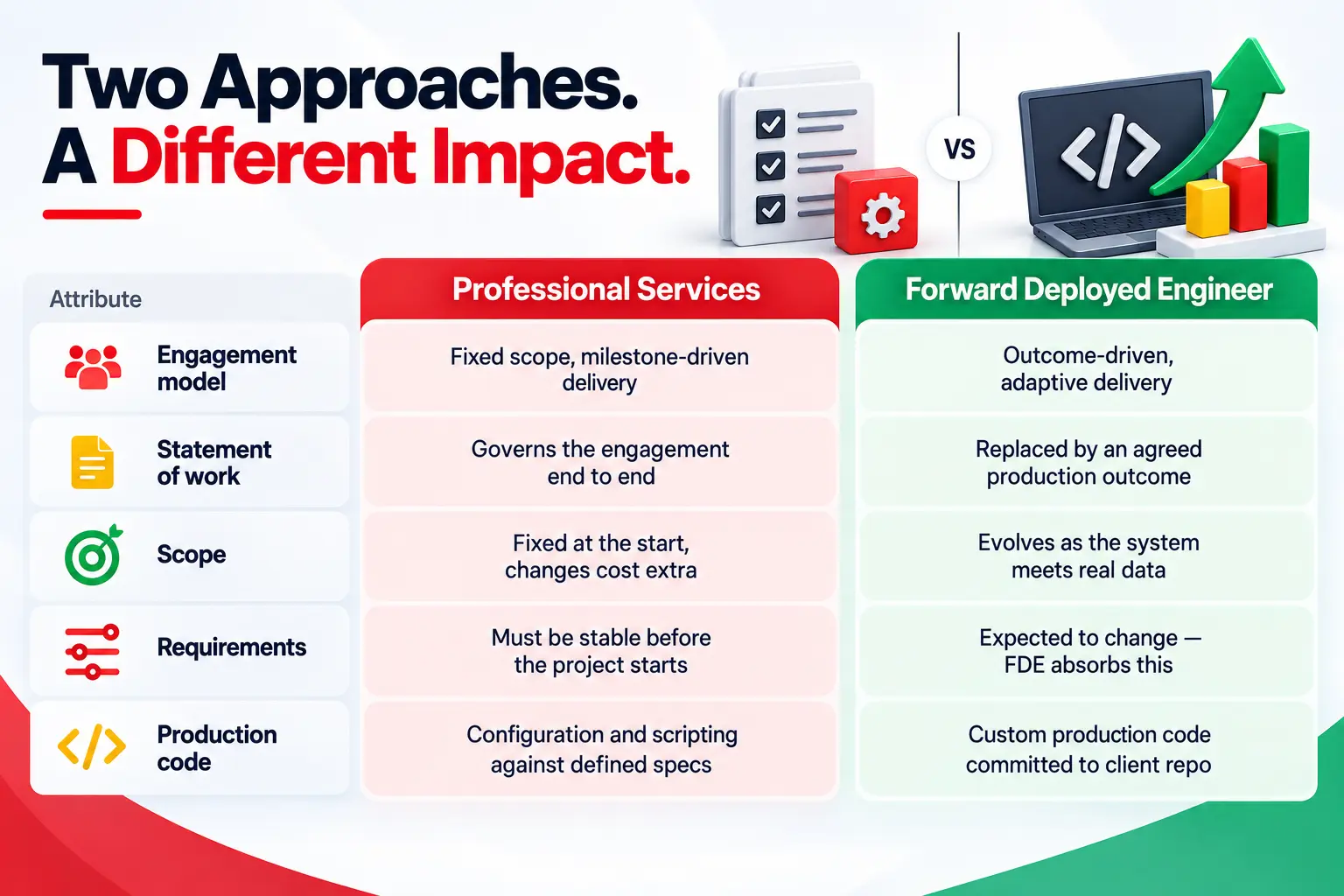
Professional services engagements are governed by a Statement of Work.
The statement or SOW describes what needs to be created, when it should be done, and how much the change will cost.
When those conditions do not hold, the SOW becomes a liability. The Hertz versus Accenture lawsuit is the clearest example of what happens when a rigid SOW meets unexpected complexity.
FDE Is Built Around Production Outcomes
FDE engagements are built on the assumption that requirements will change. When an FDE works inside a client's environment and starts connecting software to live data, edge cases appear that no requirements document ever captured.
FDEs also manage technical debt actively during the engagement. Professional services teams often lock into specifications written before the project started and accrue technical debt by following those specs even when they no longer match the real environment. FDEs refactor as they go, which produces a more maintainable system at handoff.
Attribute
Professional Services
Forward Deployed Engineer
Change requests
Treated as scope changes with added cost
Absorbed into the delivery
Pricing
Fixed fee or milestones, often padded 30% to 50%
Outcome-based or story-point pricing
Accountability
Accountable to SOW milestones
Accountable to production performance
Success criteria
Milestones completed on time and in budget
System running in production with measurable results
Handoff
Completed deliverables per SOW
Code, runbook, and operational knowledge transfer
Professional services fits when:
Requirements are stable and well documented
The implementation approach is well understood
Scope can be defined upfront without significant risk
Milestones are a valid measure of success
FDE fits when:
Requirements will evolve once the system meets live data
Customer data is likely to change the solution design
The last mile of the integration is technically difficult or unknown
Production performance defines success, not milestone completion
FDE vs Staff Augmentation vs Other Engineering Roles
The term Forward Deployed Engineer gets mixed up with several adjacent roles. Each of those roles has a real and legitimate purpose. But they are not the same thing, and buying one when you need another creates predictable problems.
Staff augmentation is the most common source of confusion. Augmented engineers embed inside a client team and look, from the outside, like an FDE. The difference is ownership. Staff augmentation supplies capacity.
The client owns the backlog, the direction, and the outcome. An FDE owns the problem end to end, independently defines the architecture, and drives the deployment regardless of internal bottlenecks.
The staff augmentation market is projected to reach $10.34 billion by 2030, which reflects how much demand there is for additional engineering capacity. But capacity and outcome ownership are different purchases.
Role
Primary Responsibility
Production Code
Customer Environment
Deployment
Outcome Ownership
Forward Deployed Engineer
Custom deployment and complex integration
Yes — direct codebase commits
Yes — VPC, live data, real systems
Yes — owns it end to end
High — accountable for production system
Staff Augmentation Engineer
Execution of client-defined backlog
Yes — directed by client
Yes — if the client grants access
Partial — as directed by client
None — client owns the outcome
Solutions Architect
System design and feasibility strategy
No — sandbox prototypes only
Limited — early discovery sessions
No — hands off to delivery teams
Low — accountable for design, not execution
Solutions Engineer
Technical pre-sales and product fit
No — demo environments only
No — vendor demo environments
No
None — quota-driven sales role
Implementation Consultant
Configuration and standardized system rollout
No — scripting and UI configuration
Partial — controlled environments
Partial — against SOW milestones
Medium — accountable to SOW only
Implementation Engineer
Technical deployment via established playbooks
Minimal — repeatable scripts
Partial
Yes — against defined spec
Medium — to defined spec only
Customer Engineer
Post-sale technical support and adoption
Variable — troubleshooting existing code
Yes — post-sale support context
No
Medium — accountable for adoption and retention
Quick reference for terminology:
Implementation consultant: implementation guidance and configuration, not net-new production code
Implementation engineer: technical deployment against repeatable playbooks
Solutions architect: system design and architecture, not production execution
Solutions engineer: technical pre-sales and product fit demonstrations
Customer engineer: post-sale technical support and adoption work
Staff augmentation: additional engineering capacity under client direction
FDE: embedded production engineering with full outcome ownership
Is Forward Deployed Engineering Just Professional Services With a New Name?
Palantir created the FDE model specifically to solve the shelfware problem. Enterprise software that was technically functional but never got adopted because no one stayed accountable for making it work inside the real environment.
The FDE role exists because advisory work and scoped delivery consistently fail at the last mile of complex deployments.
That said, some vendors use the FDE label for work that is functionally consulting or professional services. The job title does not guarantee the delivery model. Three contract tests can tell you whether a vendor is offering genuine, according to users on Reddit, many feel that FDE work is just major rebrand.
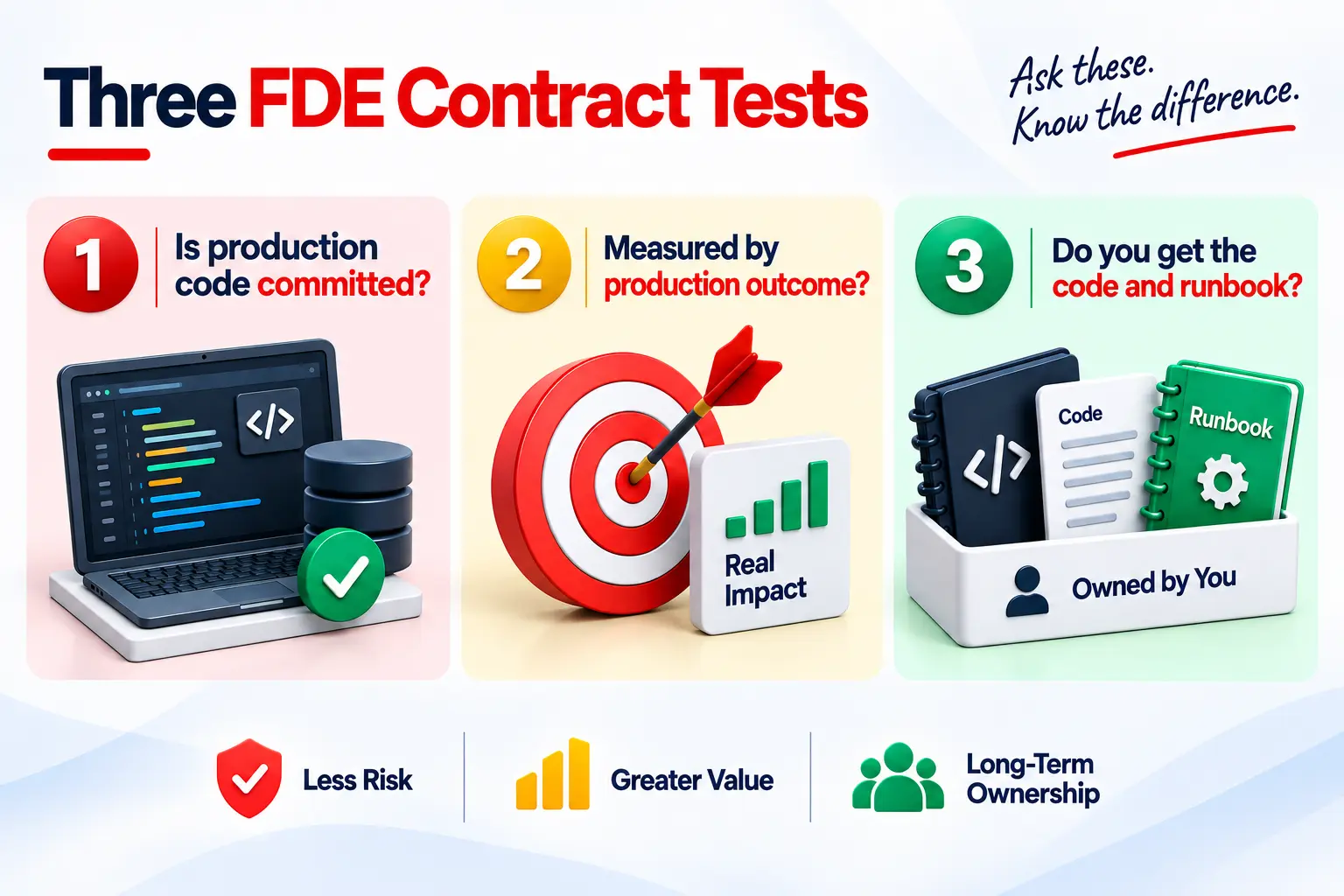
Three Contract Tests
Does the engineer commit production code to the customer's repository? A professional services team configures existing software. A genuine FDE writes custom, production-grade code directly into the client's technology stack. If the answer is no, it is not FDE work.
Is success measured against a production outcome rather than project milestones? Professional services success is defined by delivering a specification on time. FDE success is defined by whether the deployed system drives measurable business value in live production. If the contract measures deliverables rather than outcomes, it is professional services.
Does the customer receive the code, documentation, and operational runbook? A defining characteristic of real FDE work is the transfer of operational resilience to the client. Code ownership, the runbook, and the intellectual property all move to the client at the end of the engagement. If the vendor retains ownership or the handoff is just a document, it is not FDE.
If a vendor calls it FDE but none of these three tests are met, it is professional services with a new label. The contract and delivery model matter more than the job title.
Book a Free Consultation
Share your details and our experts will reach out to discuss your goals.
When Forward Deployed Engineering Is the Wrong Choice
FDE is not the right model for every situation. Buying it when the problem does not require it wastes budget and often produces worse outcomes than the right model would have.
Choose consulting when the problem is organizational or strategic. If the core issue is cross-departmental alignment, executive buy-in, or a technology strategy that does not exist yet, a consultant is the right first step. FDEs cannot fix political problems through engineering.
Choose professional services when requirements are fixed, and implementation is predictable. A routine SaaS CRM configuration with no custom integration does not need an FDE. The premium cost is not justified when the work is standardized and the requirements are already documented.
Choose staff augmentation when you need additional engineering capacity. If your internal team has a clear roadmap and strong technical leadership and just needs more typing hands, staff augmentation is cheaper and more direct.
Reconsider FDE when there is no internal owner for the resulting system. FDEs build for handoff. If there is no internal team prepared to own and maintain the system after the engagement ends, the production outcome will degrade quickly. The client must have someone ready to receive the transfer.
Reconsider FDE when you cannot grant access to live production systems and data. FDE work requires deep access to the client's environment. If security constraints, legal restrictions, or procurement rules prevent that access, the FDE model cannot function. The access is not a preference. Access is a requirement.
How Much Does a Forward Deployed Engineer Engagement Cost?
Pricing structure is not just a financial detail. Pricing structure determines who carries the execution risk and what incentives the vendor has during delivery.
Model
Common Pricing
Client Pays For
Cost Driver
Consulting
Monthly retainer or fixed project fee
Time and expertise
Hours of advisory engagement; client pays separately for implementation
Professional Services
Fixed fee or milestone-based
Delivery of defined scope
Estimates padded 30% to 50%; change orders added when scope shifts
Staff Augmentation
Hourly or daily rate
Engineering capacity
Longer projects cost more; vendor incentivized by hours, not outcomes
FDE
Outcome-based, story-point, or phase pricing
A working, deployed production system
Vendor revenue tied to delivery; execution risk stays with the vendor
The FDE's internal salary, which ranges significantly at top AI labs, is separate from the engagement cost the client pays. The client pays a managed outcome fee that covers the engineer, supporting infrastructure, and specialized tools. For a deeper breakdown of FDE compensation and engagement cost structures, see our dedicated guide on how much a Forward Deployed Engineer engagement costs.
Where Entrans Fits
Entrans operates as a Forward Deployed Engineering partner. Not a consulting firm. Not a staffing agency.
We’ve even delivered this model across more than 200 enterprise engagements. In one case, our FDEs embedded inside a procurement enterprise, wired an LLM extraction layer directly into a legacy ERP, and reduced manual invoice reconciliation by 80 percent. That is the difference between a demo and a deployed system.
What that looks like in practice:
Named engineers: you work with specific people, not a rotating resource pool
Work in the client's environment: inside your VPC, against your live data and systems
Production commits: code goes directly into your codebase
Agreed production outcome: success is defined as a working system in production, not a milestone completed
Code and runbook handoff: you own everything at the end of the engagement
Knowledge transfer: your internal team is ready to maintain the system after we leave
Deploy FDE engineers who work inside your environment and stay accountable for the production outcome.
Frequently Asked Questions
1. What is the difference between a Forward Deployed Engineer and a consultant?
A consultant diagnoses problems and delivers recommendations. Their job ends when the strategy is handed over. A Forward Deployed Engineer writes production code inside the client's environment and stays accountable until the system runs in production. The consultant delivers advice. The FDE delivers a working system..
2. ,What is the difference between an FDE and a Solutions Architect?
A Solutions Architect works on the strategic what and why. They design the system architecture, prove that a platform is theoretically capable of solving the problem, and build sanitized proof-of-concepts. Their work happens before production. An FDE takes that architecture, opens a code editor, and builds the actual system inside the client's real environment against live data.
3. Is a Forward Deployed Engineer the same as staff augmentation?
No. Staff augmentation supplies additional engineering capacity under client direction. The client owns the backlog, the technical direction, and the production outcome. The augmented engineer executes tasks the client defines. An FDE owns the technical problem end to end.
4. Who owns the code in a Forward Deployed Engineering engagement?
The client owns the code. At the end of a genuine FDE engagement, the custom code, intellectual property, and operational runbook are transferred to the client. This is one of the three contract tests that separates real FDE work from rebranded consulting.
5. When should you hire a consultant instead of an FDE?
Hire a consultant when the problem is still undefined. When you need to diagnose the issue, build the business case, align multiple stakeholders, or map the strategic direction before any engineering begins. Consultants are also the right choice when the problem is primarily organizational or political rather than technical.
6. When should you choose Professional Services instead of an FDE?
Choose professional services when requirements are stable and fully documented before the project starts, when the implementation approach is well understood and predictable, and when the technology being deployed is standardized rather than custom. A routine CRM configuration or a standard cloud migration with no unusual legacy integration is a professional services engagement.
Hire Forward Deployed Engineers
Build and deploy complex enterprise systems with engineers who own production delivery from discovery to handoff.
20+ Years of Industry Experience
500+ Successful Projects
50+ Global Clients including Fortune 500s
100% On-Time Delivery
Thank you! Your submission has been received!
Oops! Something went wrong while submitting the form.
Free Project Consultation
Trusted by Enterprises & Startups
Top 1% Industry Experts
Flexible Contracts & Transparent Pricing
50+ Successful Enterprise Deployments
Aditya Santhanam
Author
Aditya Santhanam is Co-founder & CTO of Entrans Technologies, spearheading AI-driven cloud and data solutions. A 13-year tech veteran, he leads innovation in generative AI, AI agents and MLOps. He also co-founded Infisign (identity security) and Thunai.AI (enterprise AI agents)
Related Blogs
Forward Deployed Engineer vs. Consultant vs. Professional Services
Compare a forward deployed engineer vs consultant vs professional services. Learn when to choose each model based on scope, execution, and production ownership.







-1.svg)