Agentic Unconference 2026 - September 19, Chennai
View Event →


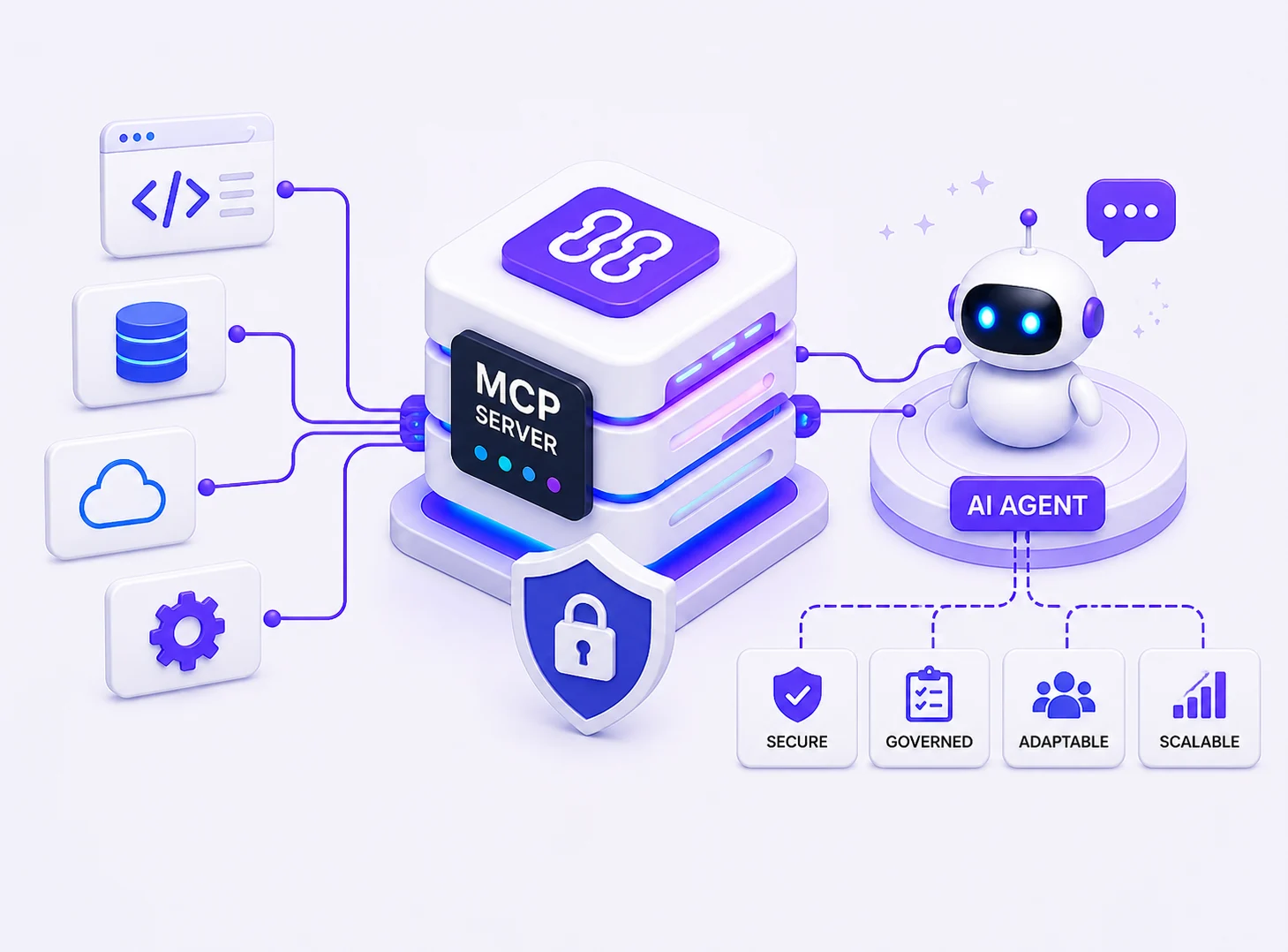
Model Context Protocol (MCP) connects Large Language Models (LLMs) to enterprise systems. As a specialist MCP development company, we help you replace brittle custom APIs and read-only RAG pipelines. Any MCP Client can use it, including Claude Desktop, an IDE extension, or a custom AI Agent platform.
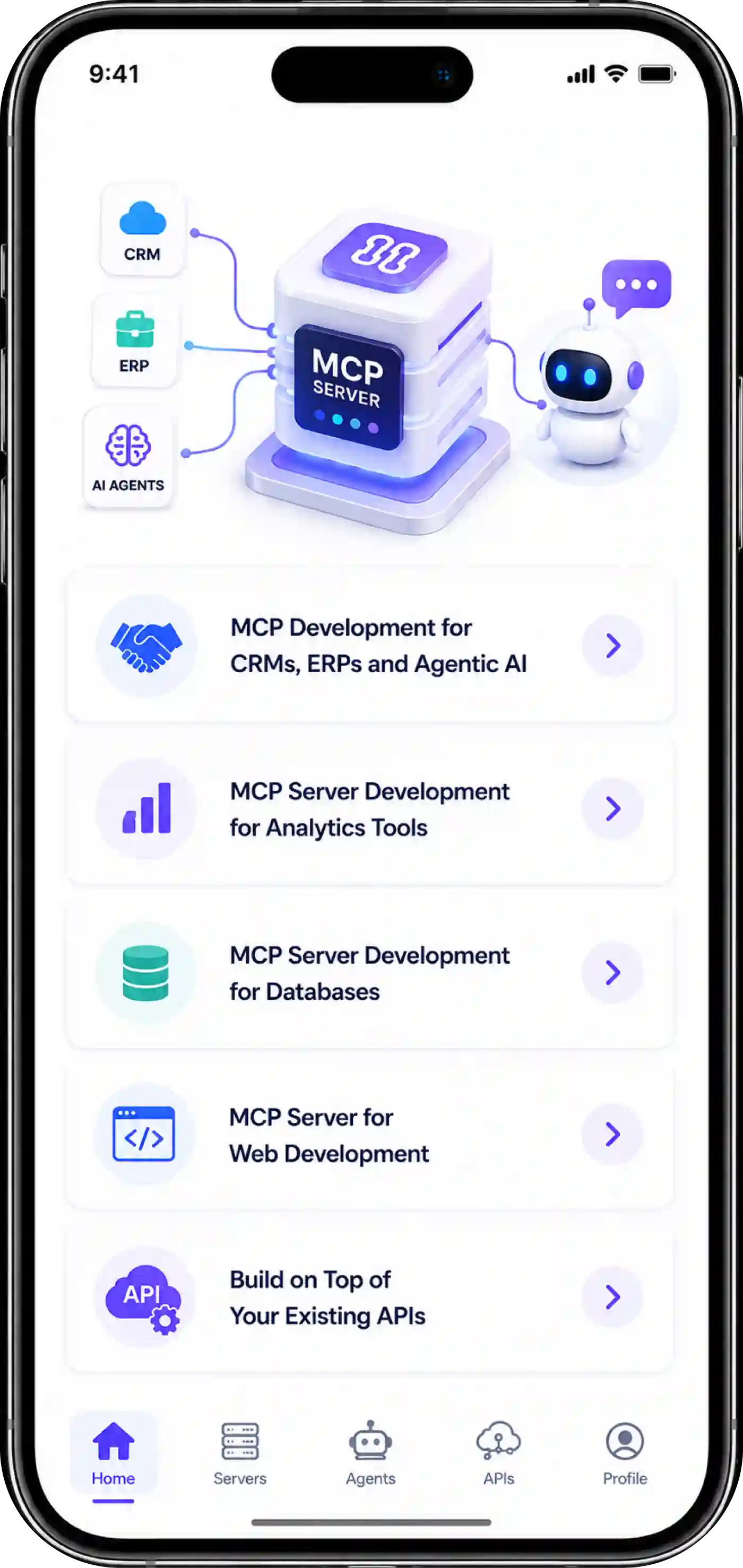

Our server development approach wraps BAPIs and Apex REST endpoints instead. This keeps inventory, discounting, and approval rules inside the system of record. The MCP Server stays a thin, authenticated proxy. It is never a backdoor into production data.
We do not let an agent write free-form queries. Instead, we develop an MCP server that exposes parameterized reporting Tools and semantic layers. This turns agent intent into optimized, read-only queries. Your performance and your budget stay protected.
Our MCP server developer team chunks and formats your documents. We often pair the server with a vector database, such as Pinecone or Weaviate. This lets agents retrieve tightly bounded context. No agent has to wade through raw file dumps.
For customer portals, chatbots, and internal tools (like Slack and Jira). Our MCP server for web development brings everything into one layer. It connects REST APIs, GraphQL APIs, and Webhooks, with built-in Database Integration. Any web-based AI Agent can trigger workflows and pull live data.
We help enterprises develop an MCP server on top of the REST, SOAP, or GraphQL APIs they already run in production. Our accelerated MCP server development framework uses AI-assisted schema discovery. It maps existing endpoints into outcome-level Tools.
Our expert team of developers follows this process in MCP development to design, build, and deploy every MCP Server we ship for enterprise use.

We use AI-assisted analysis to audit your APIs, data stores, and workflows. Then we scope the narrowest useful domain. We aim for three to five outcome-level Tools, not dozens of raw endpoints. This is the first and most important step in how to develop an MCP server agents can actually use.

Every tool gets a strict Pydantic or Zod schema. We write explicit descriptions and bound every parameter. This lets an LLM invoke the tool correctly on its first try. We favor composable tools over one-to-one CRUD wrappers. This keeps the tool budget lean and protects the context window.

Resources are pre-filtered and formatted read-only data, not raw JSON dumps. Prompts are bundled as Standard Operating Procedures. Every AI Agent follows your governance rules from its first interaction. That means more than a tool schema. It means the process behind it too.

We wire OAuth 2.1 with PKCE into every request. We validate audience claims to stop confused-deputy attacks. We implement Capability Negotiation and Protocol Lifecycle handling. Tools can be added or dropped without breaking active MCP Client connections. Session Management uses tenant-bound state keys to stop context bleed.

Backend failures get mapped to structured, fuzzy-matched error messages. The agent reads them and self-corrects. It never sees an opaque stack trace. Before any AI Agent connects, we run the MCP inspector. Then we run a dedicated chaos-testing phase against malformed inputs and unexpected types.

New MCP servers get containerized and deployed on Streamable HTTP. We avoid legacy STDIO and stateful Server-Sent Events (SSE). This lets your servers scale behind standard load balancers and API gateways. All traffic routes through a central gateway. That gateway enforces RBAC and blocks unsanctioned Shadow MCP connections.
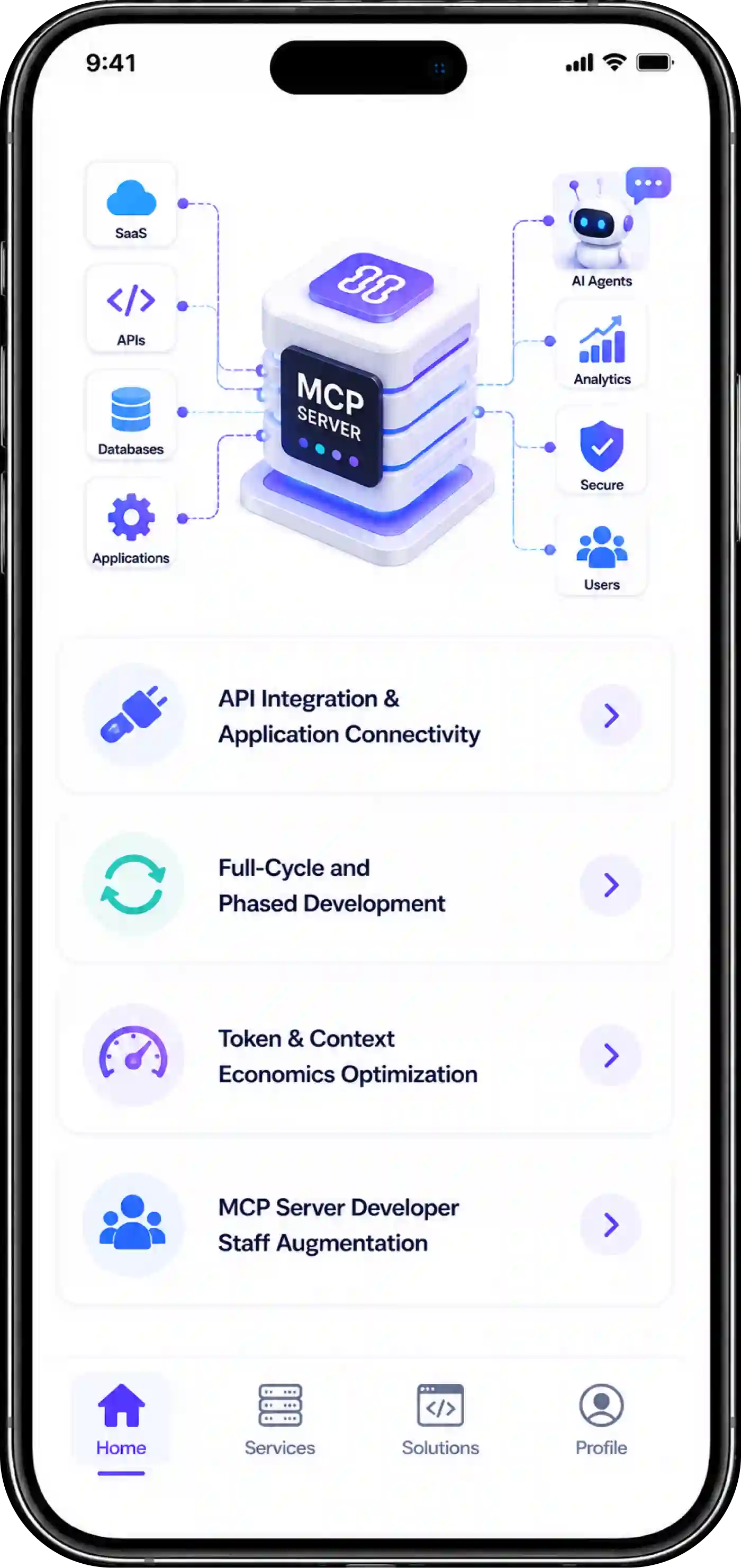
Our custom MCP server development services connect your MCP server to the systems your business already runs on. We keep disruption low. We aim for measurable gains in agent reliability.

We handle API Integration across REST APIs, GraphQL APIs, and Webhooks. We connect MCP servers directly to your internal applications through Database Integration. Security validation, rate limiting, and audit logging get built into every connection from day one.

We handle end-to-end MCP server development, from discovery and architecture to tool design, deployment, and post-launch support. For large environments, we recommend a phased rollout. Start with one high-value workflow. Expand tool coverage once telemetry confirms it works.

We apply lazy tool discovery and Code Mode-style orchestration. This cuts upfront token overhead, sometimes by more than 90%. We continuously monitor latency, tool call volume, and context token spend. We tune the system as agent behavior evolves in production.

Our certified MCP server developer team embeds with yours. We accelerate delivery and lower your risk. Our engagement models flex to fit your needs. Choose a short, deadline-driven project or long-term MCP server development services support.
MCP server development services cover the design, security hardening, and deployment of a standardized MCP Server. That server exposes your internal Tools, Resources, and Prompts to any connected AI Agent. The process spans domain modeling, schema design, identity and Session Management, testing, and governed production deployment.
Custom MCP server development services give you fine-grained access control. You get domain-specific business logic. Your data never leaves your perimeter. Generic, public MCP servers cannot offer these advantages. Custom builds also cut token overhead and improve reliability, compared with wrapping every raw API endpoint as a tool.
Use Streamable HTTP instead of local STDIO. Validate every input against a strict schema. Treat the server as stateless, so requests can spread across auto-scaling pools. Skipping these steps is the most common reason early MCP servers fail once real traffic and multiple MCP Clients arrive.
Public, open-source servers work fine for prototypes. They rarely meet enterprise security bars for RBAC, data residency, and audit logging. An experienced MCP server developer builds outcome-level tools scoped to your compliance needs. That beats granting broad, off-the-shelf access to production systems.
A standards-compliant MCP Server can connect to Claude, OpenAI's ChatGPT, Google Gemini, and Microsoft Copilot. It can connect to most other AI Agent Platforms and AI Coding Agents too. MCP is designed to be model-agnostic. Build the server once. Any compliant MCP Client can use it.