> Blog >
Forward Deployed Engineers vs. Staff Augmentation: Which Model Gets Your AI Into Production?
Compare forward-deployed engineer vs. staff augmentation models for AI projects. Review TCO math, contract terms, and hybrid setups to ship faster.

Forward Deployed Engineers vs. Staff Augmentation: Which Model Gets Your AI Into Production?

4 mins
November 20, 2026
Author
Aditya Santhanam
Talk To Our Experts
TL;DR
  • Ownership separates FDEs from staff augmentation: Staff augmentation adds developers to clear your existing backlog, while forward-deployed engineers partner with business teams to shape requirements, build AI systems, and own production KPIs. 
  • Compare total project costs, including developer rates, management time, rework, and delays before choosing a model.
  • Hybrid pods blend leadership with build speed: Pairing one senior FDE lead to own discovery and evaluations with augmented developers for parallel coding gives teams both architectural ownership and cost-effective execution.
  • Contract terms should match your bottleneck: Choose hourly staff augmentation when your roadmap is already defined, or switch to milestone-based FDE contracts with clear acceptance criteria and formal handover deliverables when pilots stall.
  • What if more developers do not help in getting your AI solution up and running? This challenge is experienced by many companies. Despite having knowledgeable engineers, they continue to struggle with implementing the ideas for their AI solution. 

    The option of forward-deployed engineers vs. staff augmentation makes a tangible impact on the process. Staff augmentation increases the workforce to perform the existing tasks, whereas FDEs collaborate with your team in finding issues, building, and implementing solutions. 

    Which option will suit your company? 

    This blog explains clearly what differs between them.

    Table of Contents ▾

      What Staff Augmentation is, and Where it works well

      Staff Augmentation is a hiring model that brings in developers from outside to support existing teams. It often involves dedicated developers, typically on an hourly or monthly rate, where your management assigns tasks, work, priorities, and the roadmap.

      Where it shines

      The above model is effective in cases where there is clarity regarding the project scope and the team has an excellent technical leader. An illustration of such cases could be an organization with a set development backlog that requires more developers to meet deadlines. Staff augmentation also works well for maintenance, debugging, and other tasks that do not require AI.

      Strengths

      • It provides strict cost control and the ability to scale headcount up or down quickly.
      • Client control over product priorities.

      What a Forward-Deployed engineer actually does

      Compared with staff augmentation, the key difference with forward engineering is ownership and independence. Rather than relying on a backlogged process, the forward-deployed engineer becomes part of your system and team, conducts active discovery with your business owners, creates and deploys the solution, and then passes the baton.

      • Outcome-driven ownership: While, in the case of dedicated developers vs. forward-deployed engineers, regular hiring solves tickets, the FDE is accountable for only one specific and measurable business outcome, and not a ticket queue.
      • End-to-end execution: With the help of FDE-as-a-service and staff augmentation model, you will have engineers who can help you to connect technical architecture and business benefits seamlessly without the burden of internal management.

      The 7 differences that matter to an engineering leader

      The choice of whether you use staff augmentation or a forward-deployed engineer is not limited to developers. It impacts who determines priorities, who owns delivery, and how many resources your team would have to spend managing all of this.

      In the context of AI projects, this question becomes even more relevant. While a certain model might work in a demo, it doesn’t mean that it will be deployed. Here is how FDE vs. staff augmentation compares across seven operational areas. 
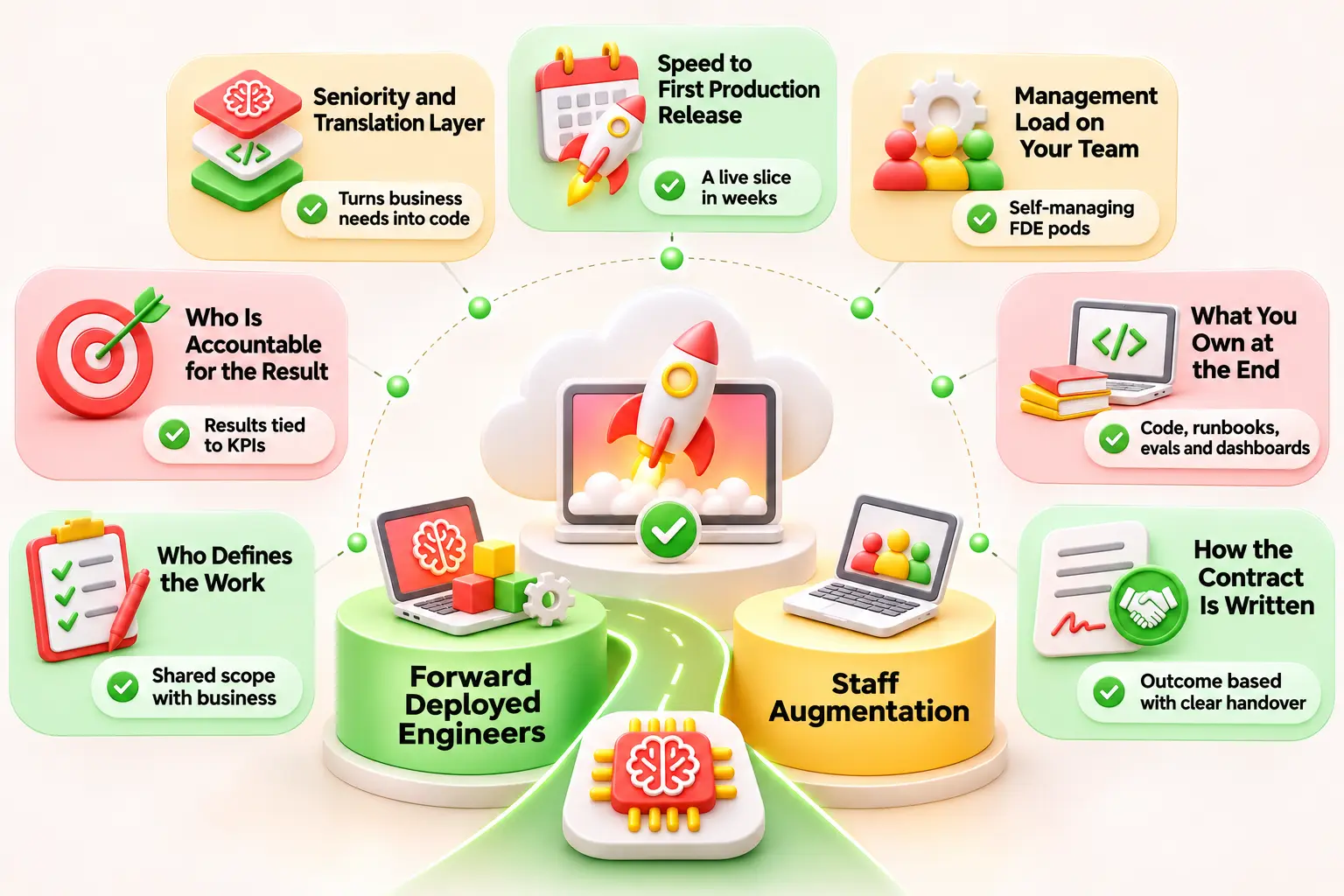
      Seven key differences between FDE and staff augmentation

      1. Who defines the work

      For staff augmentation, your own people will define the tickets and the scope. Those extra developers will then tackle the backlog. On the other hand, FDEs will collaborate with the business owners to understand the problem and define the scope.

      What this means for you

      Opt for staff augmentation when the work is clear and opt for FDEs when the problem still needs shaping. 

      2. Who is accountable for the result?

      Staff augmentation normally measures time logged and tasks completed. FDE projects may link delivery to a specific KPI, testing, and a production deliverable.

      What this means for you

      Ownership should be set when results are more important than input.

      3. Seniority and the Translation layer

      FDEs are designed to be senior, bridging the gap between dirty data, fuzzy business objectives, and production code. While dedicated developers might be very talented coders, they may not necessarily possess this broader skill of problem-solving.

      What this means for you

      FDEs will not hold your hand with architecture problems. Use FDEs when your AI initiative needs both technical and business expertise.

      4. Speed to the First production release

      The pace at which augmentation can be done is contingent upon your backlog, onboarding, and technical assistance. A functional development engineer pod can get you from a discovery phase in week one, a working slice in weeks two through four, and testing and rollout thereafter.

      What this means for you

      Cut months off your prototype-to-production timeline. 

      5. Management load on your team

      The augmentation of the staff requires constant guidance from your technical lead. FDE pods will handle day-to-day activities concerning the set objectives, requiring less task-by-task guidance.

      What this means for you

      Think about the available time for your team to manage external developers.

      6. What you own when the engagement ends

      The two teams should provide operational code. The FDE engagement should also provide runbooks, evaluations, dashboards, and internal owners who have been trained.

      What this means for you

      Identify handover items before starting.

      7. How the Contract is written

      Staff augmentation is often done on a time-and-materials basis. The FDE agreement may contain objectives, acceptance criteria, phases of delivery, and transfer clauses.

      What this means for you

      Align the agreement with your desired outcome rather than merely with the team size.

      Cost comparison: One 6-month AI build modeled both ways

      The comparison between forward-deployed engineers and staff augmentation based on sticker rate does not paint an accurate financial picture. Even if the AI staff augmentation seems less expensive, internal management overheads, reworks, and delays in launching production will soon nullify that benefit.

      To ground this FDE vs. staff augmentation cost comparison in real-world market figures, we use verified benchmark ranges rather than arbitrary estimates:

      • Entrans FDE Pricing Benchmarks: In our breakdown of forward-deployed engineer cost, contracted FDE rates run $60 to $250/hour (with high-end AI integration at 150–250/hour), while dedicated FDE pods typically range from $15,000 to $40,000/month.
      • Published Market Rates: Ryz Labs lists senior FDEs and AI pod engineers at $7,000 to $15,000/month per engineer (depending on seniority, with mid-level at $7K–$ 10 K and senior at $10K–$15K). By contrast, Hire Overseas reports full-time US FDE base salaries between $185,000 and $310,000/year (roughly $15,400 to $25,800/month before benefits and overhead).

      Worked example: Three-person AI team over six months

      Cost item Staff Augmentation FDE-as-a-Service
      Team and duration 3 engineers, 6 months 1 scoped engagement, 6 months
      Published rate used $155/hour midpoint $27,500/month midpoint
      Direct engineering cost $446,400 $165,000
      Internal manager time $26,000 $10,400
      Rework allowance $44,640 $8,250
      Estimated TCO $517,040 $183,650
      Assumed time to production 6 months 4 months

      Add the cost of delay

      Let us consider that there will be a loss of $25,000 for each month that the AI solution is not operational. There is a two-month delay in augmenting the staff, which is another $50,000 in costs due to delays.

      Based on the above assumptions, the FDE approach has a lower TCO and an earlier production time. The actual cost will depend on the scope, size of the team, rates, and time of delivery. The above analysis demonstrates the importance of including management costs and production delays in the budget for FDE vs. staff augmentation approaches.

      Signs your staff augmentation engagement needs an FDE

      Staff augmentation is useful when your workforce knows what they have to do and can deliver it. Moving an AI pilot to production requires cross-functional problem-solving that ticket-takers rarely provide. 

      However, what do you do when your project with AI technology gets stuck again and again? Below are some factors that will help you make this decision.

      8 signs to watch for

      • Pilot stuck past 90 days: Your demo was fantastic months ago, but your actual users still cannot interact with the product.
      • Engineers idle waiting on requirements: Developers take a break between sprints as there is no technical translation of business rules.
      • Data or system access blocks progress: Access to data or to the system gets you stuck for weeks, due to API access, legacy databases, or data pipelines.
      • Nobody owns accuracy or evals: There is no automated evaluation harness measuring hallucinations, latency, and edge case drift.
      • Business users do not adopt: The solution exists, but your users do not use it because it does not fit their process.
      • Your tech lead is the bottleneck: Your senior internal architect is spending too much time creating tickets and reviewing PR from outside.
      • Scope changes every sprint: Any demo for any stakeholder brings a big change in prompt, architecture, or the model.
      • Security review has stalled: Your security team is blocking the deployment due to the lack of guardrails, audit logs, or documentation.

      How to Score Your Team

      With this score, you know exactly what your trade-off looks like for balancing dedicated developers and forward-deployed engineers:

      • 0–2 signs - Keep Staff Augmentation: You have great product leadership and architecture internally. All you need is more engineering bodies to burn through a very clear backlog. 
      • 3–5 signs - Add an FDE Lead: You’ve got good builders, but you don’t have the glue between business process and production engineering process. Drop a senior FDE leader who owns Discovery and Evaluations, while your augmented developers do execution. 
      • 6+ signs - Move to a Full FDE Engagement: More heads on the problem will make it worse, not better. Go to an independent FDE pod that owns the business metrics, gets past data and security roadblocks, and delivers the full production release.

      When staff augmentation is the better choice

      Pick staff augmentation for capacity. Pick FDE when the blocker is getting AI live. Skip the FDE model and stick with AI staff augmentation, traditional dedicated developers, or permanent hires in these five scenarios:

      • You have a clearly defined roadmap and backlog: If the requirements, acceptance criteria, and edge cases have been captured in tickets, then there is no need for an engineer to perform business discovery. All you need is a set of dependable hands to develop according to the plan.
      • The work is standard, non-AI software engineering: UI re-development, API integration, cloud migration, and maintenance fit existing software paradigms. Hiring dedicated developers instead of forward-deployed engineers for known CRUD and infrastructure tasks is more cost-effective without compromising on speed.
      • An experienced in-house AI lead already exists: If you already have a competent in-house ML engineer or AI architect who controls your evaluation pipelines, data access, and system architecture, employing an FDE will create redundancy. Strengthen your existing in-house lead with junior engineers that he or she can command directly.
      • Your budget only supports pure capacity: In case cash flow constraints force you to stick to a rigid hourly rate card, and you have enough management capacity to handle the additional coordination burden, traditional augmentation will allow you granular budgeting.
      • You want long-term permanence for a core competency: Outsourced models, both as FDE services and as staff augmentation, are by nature meant to be temporary. In case some AI expertise is at the heart of your proprietary product and needs years of sustained R&D effort, go for full-time in-house hires.

      Can you combine both? The hybrid FDE pod (Combining FDE Leadership with Staff Augmentation)

      You do not always have to choose between an FDE and staff augmentation. A hybrid approach can help you combine the two. The lead FDE is responsible for the business objective, while the augmented engineers provide the necessary coding skills to develop and deliver the solution. 

      Your internal team then manages the system post-launch. When you need senior architectural ownership alongside cost-effective build velocity, blending AI staff augmentation with a dedicated forward-deployed engineering team gives you the best of both worlds.

      How the Hybrid Execution Loop Works

      Instead of choosing dedicated developers vs. forward-deployed engineers in isolation, structure your delivery around three distinct layers of ownership:
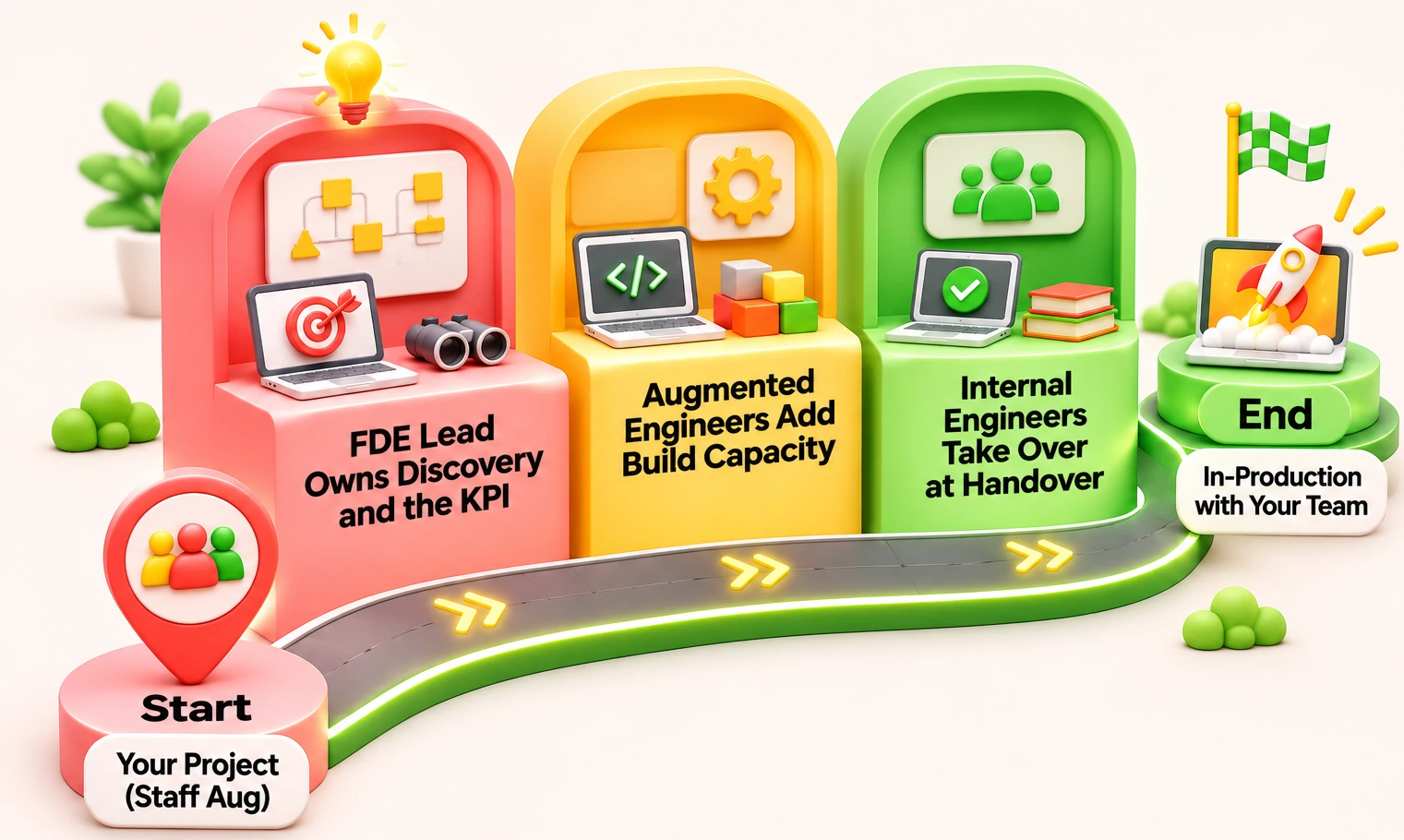
      How FDEs, augmented developers, and internal engineers work together
      1. The FDE Lead owns discovery and the KPI: An FDE is placed inside your business unit to own discovery and the KPI, and translate complicated workflows into technical requirements and build the testing harness.
      2. Augmented engineers add build capacity: The mid-to-senior augmented developers are responsible for parallel execution of work like building UI components, writing data connectors, and shipping tickets after the architectural roadblocks have been cleared by the FDE.
      3. Internal engineers take over at handover: Your internal staff starts following the build process from day one and co-owning the code review process post-handover.

      Pod Size by Project Type

      • Small AI pilot: 1 FDE lead and 1–2 developers.
      • Enterprise AI project: 1 FDE lead, 2–4 developers, and 1 QA engineer.
      • Large, multi-system project: 1 FDE lead, 4–6 developers, QA support, and internal subject experts.

      These are suggested team sizes. Actual needs depend on project scope and system complexity.

      Who Reports to Whom?

      FDE Lead is answerable to the engineering/business sponsor of the client. Augmented engineers are answerable to the FDE Lead for day-to-day activities. Internal engineers work with the pod and assume ownership post-handover.

      How to move from Staff augmentation to an FDE engagement without restarting

      Shifting to the FDE model does not mean that the effort put into augmenting the staff will go down the drain. You get to reuse the code, you keep all your talented developers, and you take advantage of what you've accomplished thus far.

      The FDE vs. staff augmentation debate is not only one of staffing. It also includes problem discovery, delivery ownership, and a clear pathway to production.

      It works best as a structured, five-step pivot that preserves every usable asset your team has already built.
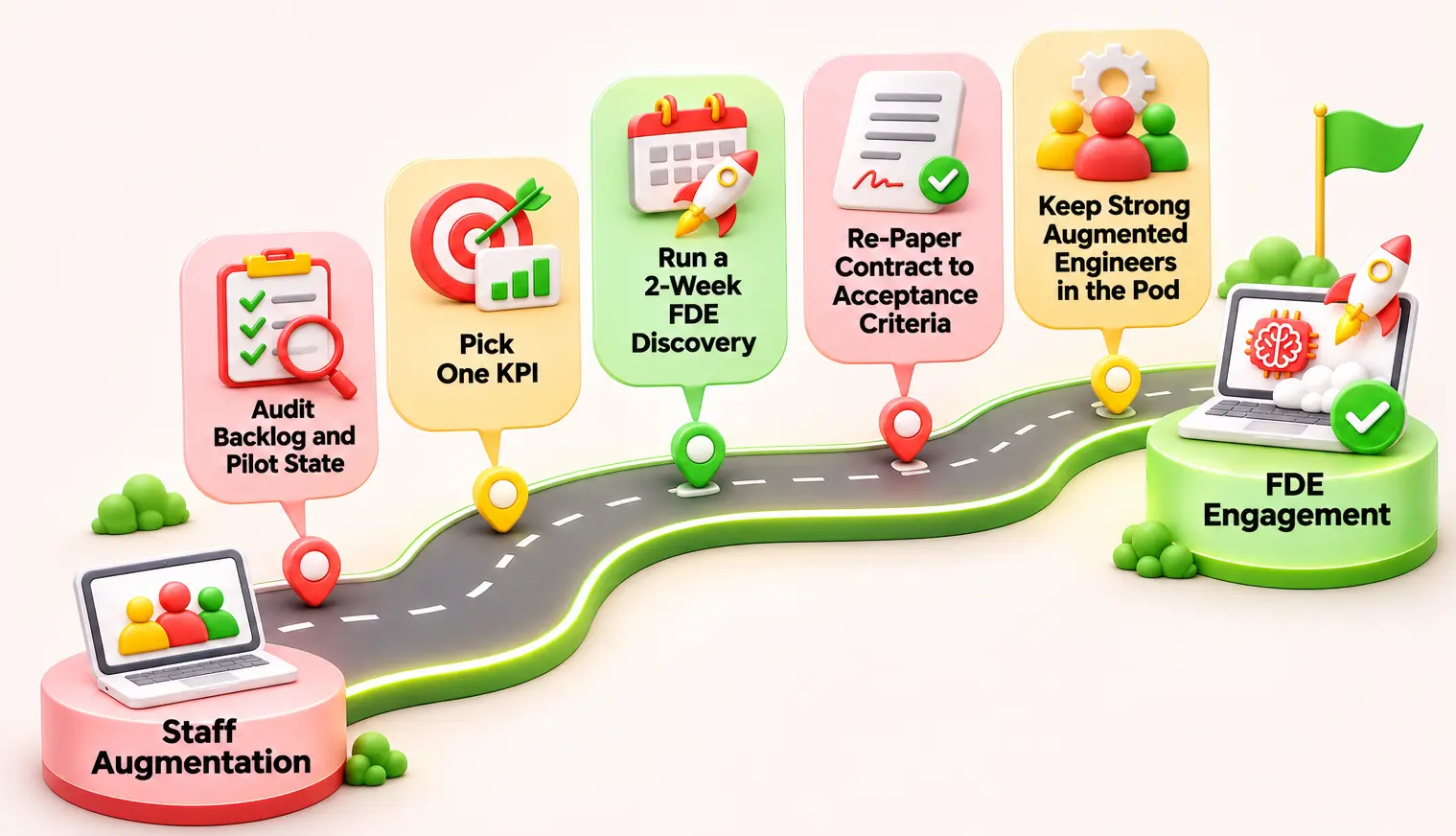
      Five steps to move from staff augmentation to an FDE engagement

      5 Steps to Make the Shift 

      1. Audit the backlog and current pilot state 

      Before adjusting the number of engineers, make sure that a senior architect audits all current repositories, prompt pipelines, data connectors, and open tickets. Identify what is working in terms of the infrastructure and what is not, to understand clearly what can be salvaged.

      2. Pick one primary production KPI

      Forget about feature lists and think of one measurable KPI related to the business, like reducing the processing time of invoices by 60%, getting a 92% accuracy in retrieval in the internal knowledge base, or closing 40% of Tier-1 tickets independently. All decisions should align with the KPI.

      3. Run a focused 2-week FDE discovery sprint

      Hire a senior FDE for 2 weeks along with the business owners and internal tech lead. Instead of writing fictional tickets, the FDE will audit edge cases of live data, develop a baseline evaluation suite, get rid of possible security or API bottlenecks, and establish a week-by-week plan to production.

      4. Re-paper the contract from hours to acceptance criteria

      In switching your business model from a forward-deployed engineer to a staff augmentation role, modify your statement of work. Go from unending hourly invoicing to acceptance criteria with explicit evaluation metrics and actual deliverables for handoff.

      5. Keep strong augmented engineers inside the pod

      Do not lose all context by replacing everyone; keep your best augmented engineers and place them within the new pod structure led technically by the FDE. They will do the work, but you can discover stakeholders and design the evals with the FDE.

      Protecting Existing Work: A Zero-Loss Knowledge Transfer Plan

      To guarantee that nothing created during the FDE vs. Staff Augmentation stage is lost, implement the following 3-point hand-off policy during the first week:

      • Codebase and Architecture Walkthrough: The current developers create a 60-minute video walkthrough including the directory structure, environment variables, deployment instructions, and known issues, along with an updated ARCHITECTURE.md file.
      • Prompt, Data, and Eval Inventory: List all the existing prompts, vector store schemas, fine-tuning datasets, and test cases within one version-controlled directory so that the FDE will be able to benchmark existing levels of accuracy.
      • Shared Pod Rituals: Conducting shared daily standups and a Slack channel during the first 2 weeks of the FDE’s time with you, matching the new hire with your best developer to review initial pull requests.

      Contract terms to compare before you sign

      While looking at forward-deployed engineers vs. staff augmentation from a practical point of view, one needs to consider the Statement of Work (SOW). The typical AI Staff Augmentation contract protects you with an hourly rate card and headcount, while FDE as a service vs. staff augmentation contract ties the vendor to results, knowledge transfer, and good exit clauses.

      Staff Augmentation vs FDE: Contract Terms

      Before signing an agreement for dedicated developers vs. forward-deployed engineers, compare how both models handle seven critical contractual clauses:

      Contract dimension Staff Augmentation / Dedicated Developers  Forward Deployed Engineer (FDE) Engagement 
      Billing Basis  Time and materials with a minimum commitment period (per hour or monthly rate per developer). Fixed Pod Retainer or milestone billing (per production slice).
      Acceptance Criteria  Approval of timesheets and completion of client-assigned Jira tickets or pull requests. Completion of automated test benchmark criteria (accuracy, latency, guardrails) and live user adoption KPIs. 
      IP and Code Ownership  Ownership by the client of all work-for-hire code written within your repositories. Ownership by the client of custom code, prompts, and evals, with well-defined licensing around any existing vendor accelerators.
      Knowledge Transfer  In an informal/ad hoc manner, the tech leads gather context via their PRs. Deliverables: runbooks, architecture diagrams, evaluation suites, and shadowing of internal owners.
      Replacement SLA  Vendor replaces the poor-performing developer in 1-2 weeks; however, your team handles the onboarding ramp-up period. Called senior lead guaranteed with quick bench replacement (usually 5-10 days) and no billing during transition.
      Security and Access  Standard developer access to staging/dev environments under your internal RBAC policies.  Scoped, auditable access to production data pipelines, InfoSec review sign-offs, and compliance guardrails. 
      Exit and Transition  Simple notice period (typically 15–30 days) with no formal operational handover requirement.  Structured 2-to-4-week offboarding phase ensuring internal engineers independently run and monitor the live AI system. 

      Is forward deployed engineering just staff augmentation with a new name?

      No. It’s a reasonable worry. Both approaches allow for having external engineers on your team. They both involve coding, testing, and dealing with your systems.

      However, the key difference is who owns what. With staff augmentation, developers will be used to perform work that your team will specify and manage. With forward-deployed engineer, he/she will help your business and technical teams to formulate the problem and implement the solution.

      True FDE vs staff augmentation models differ completely in execution, much like how a forward-deployed engineer vs a consultant differs from traditional advisory work.

      Watch for these five red flags before signing any FDE as a service vs staff augmentation contract:

      • Hourly timesheet billing: You pay for hours rather than deliverables.
      • No business discovery: Engineers do not interact with end users or question poor assumptions.
      • Ticket-driven sprints: Your own internal tech lead continues to write every user story.
      • Missing evaluation ownership: No one keeps track of accuracy, latency, or edge cases.
      • Zero handover plan: Vendor does not provide any runbooks or training upon exit.

      If you spot three or more signs, you are looking at rebranded staffing.

      How Entrans delivers both models

      Choosing between a forward-deployed engineer and staff augmentation should never force you into a one-size-fits-all contract. At Entrans, we support both models so your engineering team gets the exact level of ownership your roadmap needs. 

      • Dedicated developers for pure capacity: When you have a clear backlog and strong internal leads, hire dedicated developers to speed up delivery. We deliver matched profiles in 24–48 hours, giving you vetted AI staff augmentation under your direct control.
      • FDE as a Service for Production Delivery: In the context of FDE as a service vs. staff augmentation for failing AI pilots, our FDE as a service pods integrate seamlessly within your process flow. Unlike dedicated developers or forward-deployed engineers, who just close tickets, our pods own an actual KPI from discovery to handoff: a proven concept, through our enterprise finance AI invoice and GRN reconciliation example.

      Whether you need extra hands to clear a backlog or embedded engineers to own a live KPI, Entrans gives you the exact model to ship faster. Book a consultation with us.

      Share :
      Link copied to clipboard !!
      Get Your AI Project Into Production
      Build and deploy AI solutions with engineers who take ownership from start to finish.
      20+ Years of Industry Experience
      500+ Successful Projects
      50+ Global Clients including Fortune 500s
      100% On-Time Delivery
      Thank you! Your submission has been received!
      Oops! Something went wrong while submitting the form.

      FAQs

      1. What is the difference between a forward-deployed engineer and staff augmentation?

      Staff augmentation provides developers to perform the tasks assigned by your team and managed by your team. FDE collaborates with your team to identify the problem, develop the solution, and implement the solution.

      2. Is a forward-deployed engineer more expensive than staff augmentation?

      The FDE may be charged more per month because of their seniority and ownership of deliveries. Nevertheless, costs will be influenced by management time, rework, and the speed of reaching production status.

      3. When is staff augmentation the better choice?

      Staff augmentation is a suitable choice if you already have a plan, a set of specific tasks, and an internal project manager who will be handling everything. Opt for it if you simply require additional programmers and not project management.

      4. Can one engagement combine FDEs and staff augmentation?

      Absolutely. The lead on an FDE project is capable of owning the goals and delivery of that project, whereas augmented developers provide coding and testing capability. 

      5. What happens when an FDE engagement ends? Do we lose the knowledge?

      Absolutely not. If our handover is done well, we include all the code, runbooks, test data, system information, and training for your internal engineering team.

      6. Can an FDE work alongside our existing vendors and contractors?

      Yes. FDEs can collaborate with your internal engineers, vendors, and contractors. They can share responsibilities, coordinate technical decisions, and have the same delivery goals.

      7. Is forward-deployed engineering just rebranded staff augmentation?

      No. While staff augmentation provides engineering resources, FDEs own problem discovery, solution delivery, and production outcomes. It's all about accountability.

      Need Skilled Developers for Your Project?
      Find the right developers and get your project moving faster.
      Free Project Consultation
      Trusted by Enterprises & Startups
      Top 1% Industry Experts
      Flexible Contracts & Transparent Pricing
      50+ Successful Enterprise Deployments
      Aditya Santhanam
      Author
      Aditya Santhanam is Co-founder & CTO of Entrans Technologies, spearheading AI-driven cloud and data solutions. A 13-year tech veteran, he leads innovation in generative AI, AI agents and MLOps. He also co-founded Infisign (identity security) and Thunai.AI (enterprise AI agents)

      Related Blogs

      FDE Security and Compliance Checklist: How to Give Forward Deployed Engineers Safe Access to Production

      Read More ↗

      Offshore and Remote Forward Deployed Engineers: How the FDE Model Works Across Time Zones

      Learn how offshore forward-deployed engineers deliver across time zones. Explore hybrid pod roles, 4-hour overlap rules, security guardrails, and costs.
      Read More ↗

      Forward Deployed Engineers vs. Staff Augmentation: Which Model Gets Your AI Into Production?

      Compare forward-deployed engineer vs. staff augmentation models for AI projects. Review TCO math, contract terms, and hybrid setups to ship faster.
      Read More ↗