Over 80% of enterprise RAG systems fail in production due to flawed data hygiene and weak retrieval pipelines rather than LLM limitations.
Hybrid search combined with cross-encoder reranking yields a 33% to 40% boost in answer accuracy compared to dense vector search alone.
Moving from fixed-character chunking to parent-child indexing prevents context loss and increases retrieval recall by up to 15%.
Continuous production evaluation using automated frameworks like RAGAS ensures hallucinated claims are caught before impacting end users.
Most enterprise RAG systems fail in production. Not because the model is weak. They fail because the retrieval pipeline was never built for real-world data.
Research shows that 80% of enterprise RAG systems hit critical failures in production. Only 20% reach lasting success.
This guide covers every layer of the problem. From why retrieval errors turn into wrong answers, to the seven fixes that close the gap.
Table of Contents▾
Why RAG Systems Give Wrong or Incomplete Answers
Studies have found that RAG errors are 73% due to problems in the retrieval and data pipelines. And not the language model itself.
Meaning, knowing what causes the problem is the first step towards solving it.
Wrong retrieval leads to wrong generation: If the retrieval fails to retrieve the correct documents, then the model will be working on incorrect information. An incorrect input would always lead to an incorrect output. Silent failures are the worst type of failure. There is no error signal that is triggered.
Retrieval accuracy and answer accuracy: Retrieval accuracy tracks whether the right documents were fetched. Answer accuracy tracks whether the final response is correct. A system can fetch the right document and still give a wrong answer. This happens because of the Lost-in-the-Middle effect. Models tend to skip evidence that sits in the center of the context window.
Better LLM will not help with bad retrieval: Improving the model itself will not solve retrieval issues. In case incorrect documents are retrieved, the model will simply not have access to correct information. In fact, more expensive models may even be more certain that it is right, when incorrect.
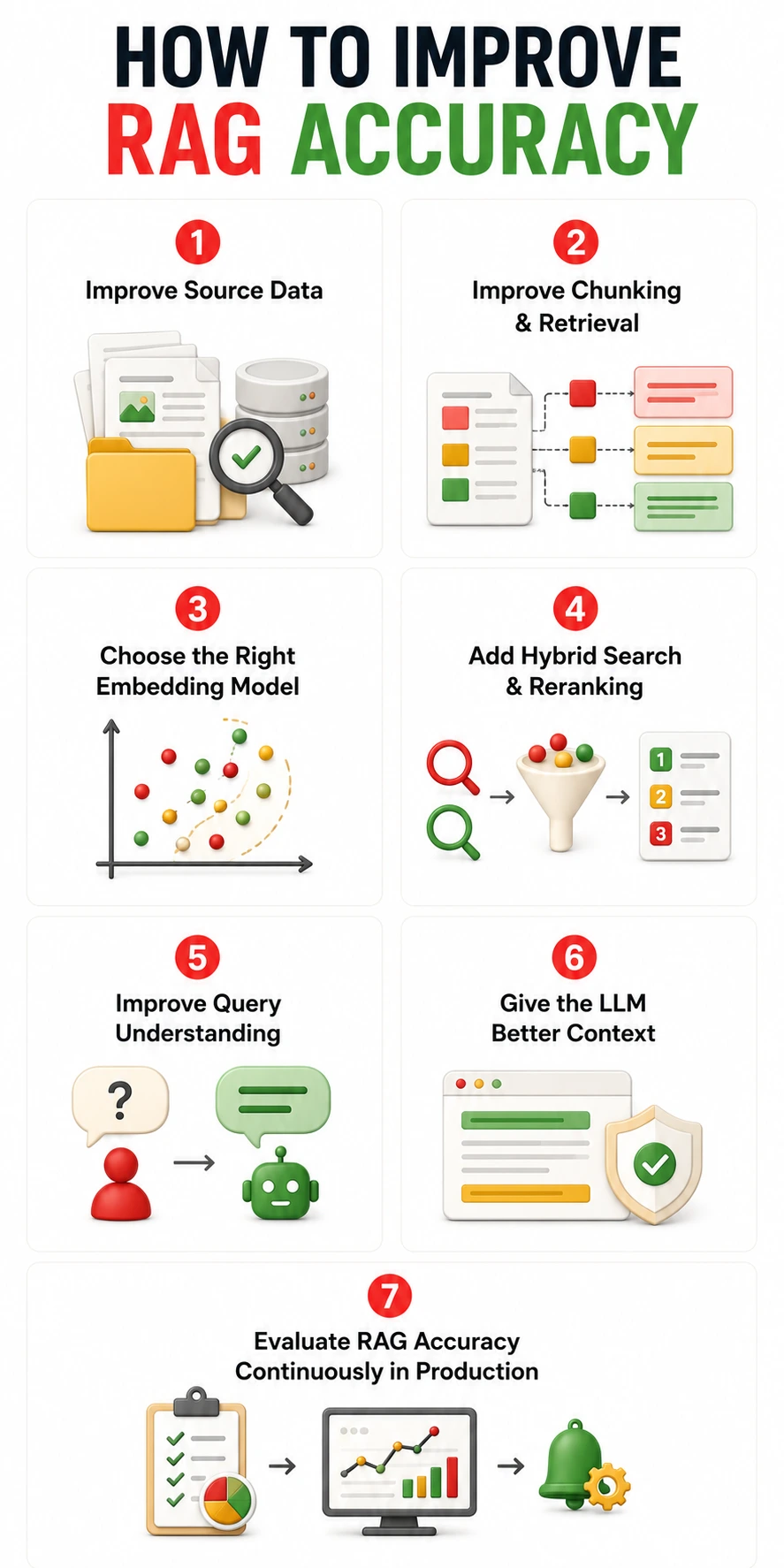
Fix 1: Improve the Quality of Your Source Data
When going about how to improve RAG accuracy, source data quality sets the ceiling for everything else. RAG pipelines over well-managed data reach accuracy rates of 85% to 92%.
The same pipelines over poorly managed sources reach only 45% to 60%. That gap comes entirely from data hygiene.
Remove outdated, duplicate, and conflicting content: Redundant, Obsolete, and Trivial content, known as ROT, sends bad facts into the pipeline. Removing ROT and replacing it with clean, trusted files cuts context noise and can boost answer accuracy by up to 35%.
Preserve metadata and document structure: Files indexed without metadata give the retrieval layer nothing to filter on. Adding domain tags, author names, security levels, and version numbers lets the system filter before it runs any vector search.
Keep production knowledge sources continuously updated: Knowledge bases change all the time. A pipeline that was accurate at launch will get worse if the index is not kept in sync. Automated expiration schedules remove old documents before they pollute retrieval results.
Fix 2: Improve Document Chunking and Context Retrieval
Basic chunking splits text by a fixed character count with no regard for meaning. In production, how a document is chunked controls what the model gets to work with.
Bad chunking cuts apart related ideas before the model ever sees them and matters when improving RAG accuracy.
Choose chunk sizes based on content and use case: Small chunks of 128 to 256 tokens improve how well the search matches the right passage. Larger parent chunks of 512 to 2048 tokens give the model enough context to write a full answer. Fixed-character chunking is the wrong default for most enterprise content. Fixed-character chunking cuts paragraphs mid-sentence and separates ideas that belong together.
Preserve context across related chunks: Parent-child chunking separates how the system searches from how it reads. Small child chunks are searched for precision. When a match is found, the full parent section goes to the model. This method has shown a 10% to 15% improvement in context recall compared to flat chunks.
Compare chunking methods against actual questions: Develop a test set of between 100 to 500 validated questions and answers prior to testing out any chunking approach. Without a constant benchmark, there is no way of knowing whether the new route works.
Fix 3: Choose the Right Embedding Model
Embedding models control how language and domain logic get mapped into a math space.
Teams often pick top models from public benchmarks and assume they will work on private data. In production, when attempting to improve RAG accuracy technical terms and domain logic often expose gaps that benchmarks never catch.
Match embeddings to your domain and content: General-purpose models handle broad language well but struggle with private technical terms, internal codes, and part numbers like SKUs.
Know when larger embedding models are worth paying for: High-dimensional embeddings will be more accurate, but they require higher memory usage and introduce latency. The fine-tuning of a base model on 1,000 to 5,000 domain-specific pairs increases retrieval recall by 15% to 30% compared to the stock model.
Look into embedding quality before deployment: Run any new model against the test dataset before going live. Public benchmark scores do not predict how a model will perform on private enterprise data. Measure context recall and context precision with the new model while keeping all other pipeline settings the same.
Fix 4: Add Hybrid Search and Reranking
Using only dense vector search is one of the most common flaws in RAG systems. Dense vectors are good at finding conceptually related content but miss exact matches for error codes, part numbers, and proper names.
Adding hybrid search and a cross-encoder reranker fixes both problems in a two-stage pipeline and in turn improves RAG accuracy for your AI workflows.
Combine semantic search with keyword search: Hybrid retrieval runs dense vector search and sparse keyword search, such as BM25 or SPLADE, at the same time. The two result lists are merged using Reciprocal Rank Fusion. In this process, both keyword-matched and concept-matched candidates get included in the final list of candidates.
Re-rank the results for improved relevance of the context: Cross-encoder re-ranker reads both the user’s query and the candidate contexts. The score is calculated by applying the full attention on each token. Results from production experiments have revealed that including a cross-encoder re-ranker increases the accuracy by 33% to 40%.
For when hybrid retrieval works better than vector search on its own: Use hybrid search in any situation where there are precise codes, product names, and internal terminology in the knowledgebase. By doing this, analytical searches improve in accuracy by 52%.
Fix 5: Improve Query Understanding Before Retrieval
User inputs are often vague, poorly worded, or dependent on earlier parts of a conversation. Sending these straight to retrieval causes missed results and bad context matches.
When going about how to improve RAG accuracy, a query preprocessing layer that turns raw inputs into clear search requests before retrieval runs helps overall by letting workflows:
Rewrite ambiguous queries: Query rewriting tools look at conversation history and replace unclear pronouns with specific terms. For example, the sentence "What was its margin in the next quarter?" becomes "What was the operating margin of Apple in Q4 2024?" before vector search.
Convert large queries into several retrievals: The idea behind sub-query decomposition is to break down a multi-component query into different searches that occur in parallel. Once all the retrievals are done, the outputs are then consolidated and sent to the model as a whole. This way, the model sees the complete view of the picture.
Use query expansion for different terminology: Hypothetical Document Embeddings, or HyDE, close the gap between short questions and long document-style answers. The system asks the model to write a sample answer to the question. Then it uses that sample's embedding as the search vector instead of the original question.
Fix 6: Give the LLM Better Context and Guardrails
Retrieval quality controls what the model can see. One element in RAG accuracy is prompt structure which controls what it does with that information.
Even if your search finds the right information, bad instructions (prompts) can ruin the answer. The AI might miss key details, make things up, or give a vague answer.
Put Key Facts at the Top and Bottom: AI models tend to ignore information hidden in the middle of a long passage. This is known as the "Lost in the Middle" problem. To fix this, place the most important piece of information at the very beginning, the second most important piece at the very end and minor extra details in the middle.
Tell the model to answer using only the context retrieved: The system prompt rules must ask the model to answer only using the retrieved context, cite the source of each fact used, and not answer at all if the context is insufficient.
Deal with insufficient or conflicting context: In case there is not enough context, the model should be instructed that it does not know. This ensures that incorrect answers are never produced through fallback rules such as “if no context, say you do not know.”
Fix 7: Evaluate RAG Accuracy Continuously in Production
RAG systems cannot be tested once before launch and left alone. Knowledge bases change constantly and user query patterns shift over time.
RAG accuracy drops if nobody is watching. Continuous evaluation catches silent failures before they affect a large group of users. Some ways to roll out this fix to improve RAG accuracy would be:
Build a realistic practice dataset: Before changing your system, build a practice test using 100 to 500 real question-and-answer pairs. This test must match what real users actually ask. Include messy, confusing, and tricky questions alongside easy ones. If your test only has perfect questions, you won't catch mistakes when real people ask hard ones.
Test search and content generation separately: Your system does two main jobs: searching for information (retrieval) and writing the answer (generation). You need to test both steps on their own. If an answer is wrong, checking them separately tells you if the system searched for the wrong facts or just wrote a bad response. Automated testing tools grade three main things:
Track accuracy after every modification: Test your system before and after making any change, such as updating your search model, breaking up text differently, or tweaking your prompts. Only make one update at a time. If you change several things at once, you won't know which change helped or broke your results.
How to Measure RAG Accuracy Before and After Each Fix
There is no better way of improving RAG accuracy than knowing what works except changing one component at a time and measuring its performance in regard to a fixed test set.
Changing multiple parameters such as chunking, embeddings, and prompts at once would make it impossible to find out what has led to certain results.
1. Retrieval metrics: Recall@K, Precision@K, and MRR
Context Recall measures how much of the required information has been found by the retrieval layer.
If the value is less than 0.90 then the retrieval layer lacks facts for generating an appropriate answer and it needs to increase in order to improve RAG accuracy.
Context Precision flags systems where irrelevant chunks rank above relevant ones. A score below 0.85 points to weak reranking or poor similarity scoring.
Mean Reciprocal Rank measures whether the right chunks are ranking high enough to make it into the model's context window.
2. Generation metrics: Faithfulness, relevance, and correctness
Faithfulness, also called Groundedness, divides the number of checkable facts in the response by the total number of claims made.
A score below 0.95 means the model is making claims not backed by the retrieved context and in turn means very low RAG accuracy and often hallucinated information.
Answer Relevance measures how closely the generated response matches what the user actually asked.
In high-risk fields like healthcare or legal, Groundedness must stay at 0.98 or above to stop unverified claims from spreading.
3. Human evaluation vs automated RAG evaluation
Automated tools like RAGAS and TruLens scale to thousands of live queries and catch drops in RAG accuracy performance fast.
Human review gives better signal on complex, domain-specific answers that automated scores can miss.
The best approach uses both. Use automated scores to watch for regressions. Use human review to check the test set and audit low-confidence outputs.
Metric Name
What It Measures
Context Relevance
Proportion of retrieved context sentences directly relevant to the user query
Context Recall
Ratio of ground-truth reference statements captured across retrieved passages
Context Precision
Weighted rank calculation penalizing systems when irrelevant chunks outrank relevant ones
Faithfulness / Groundedness
Number of verifiable factual claims in response divided by total claims made
Answer Relevance
Semantic similarity of generated response back to the core prompt intent
Mean Reciprocal Rank (MRR@K)
Average reciprocal rank of the first relevant document across queries
Common Reasons for RAG Inaccuracy and the Fix to Apply
Fixing production RAG failures or RAG accuracy starts with knowing whether the problem is in the source data, the retrieval setup, or how context is built for the model. The diagnosis points to the fix.
1. The right documents are not being retrieved
This may be due to a small retrieval candidate pool, a dense only search where exact matches are missed and relevant documents are ranked way below the acceptable threshold for usage.
The solution would be to apply hybrid search where BM25 is combined with dense retrieval with cross-encoder reranker on the top 100 candidates.
2. Relevant documents are retrieved but ignored by the model
This is the Lost-in-the-Middle effect. Key evidence lands in the center of the context window where the model pays less attention. The model reads the start and end well but skips what is in between.
The method to increase RAG accuracy here is to place the top-ranked chunks at the start and end of the prompt and use context compression to cut noise around the key facts.
3. Answers contain information that is not in the knowledge base
This is a hallucination. The model pulls from its training data instead of the retrieved context. The system prompt has no rules telling it to stay grounded or refuse when context is missing.
The way to improve RAG accuracy here is a strict system prompt rules that require a source citation for every claim and a clear refusal when the retrieved context is not enough.
4. Answers are incomplete despite relevant context being available
This happens when a question spans multiple topics across separate chunks and a single retrieval pass cannot gather all the needed evidence.
The fix for improving RAG accuracy here is splitting queries into parallel sub-queries that each retrieve on their own. The results are then combined before the model writes its answer.
RAG Failure Mode
Likely Root Cause
Recommended Fix
Hallucination on unindexed topics
Knowledge base lacks source documents
Add strict fallback instructions and active freshness tracking
Relevant context not retrieved
Low retrieval candidate limit
Deploy hybrid search and add a cross-encoder reranker over top-100 candidates
Query spans multiple entities across disparate chunks
Deploy query decomposition to generate parallel sub-queries and aggregate results before generation
Context ignored by the model
Lost-in-the-Middle context window effect
Place top-ranked chunks at prompt boundaries and apply context compression
How to Build a Production-Ready RAG Accuracy Improvement Process
Good AI systems need a clear, step-by-step plan. If you just guess and make random changes, your system won't work well in the real world. Here is how to do it right:
Start with a clear starting point: Before you change anything, clean up your old, duplicate, or useless data. Then, make a practice test with 100 to 500 real questions and correct answers to see how your AI performs right now.
Test one change at a time: Do not change everything at once. Instead of cutting your text into random pieces, organize it by ideas and paragraphs. Upgrade your basic search to a smarter search that looks for both exact words and the deeper meaning at the same time.
Keep an eye on quality, speed, and cost: Use software tools to watch your AI while it is running. Set up automatic alarms to warn you if the AI starts giving wrong answers, making things up, or taking too long to reply.
Improving RAG Accuracy by Partnering With Entrans AI Experts
Teaming up with Entrans Technologies makes sure your AI is easy to use, grows with your business, and gives the right answers.
Whether you need to clean up your data, organize your files better, or build advanced AI tools, our expert engineers know exactly how to help.
We work with some of the biggest retail companies in the world. Plus, we have high-level safety certifications (ISO 42001) for our own AI software.
We know how to filter out bad information and help your AI find exactly what it needs better than most.
Get expert support to clean your data pipelines, stop hallucinations, and improve accuracy.
20+ Years of Industry Experience
500+ Successful Projects
50+ Global Clients including Fortune 500s
100% On-Time Delivery
Thank you! Your submission has been received!
Oops! Something went wrong while submitting the form.
Frequently Asked Questions About Improving RAG Accuracy
1. How can I improve RAG accuracy?
Start with source data. Remove ROT content and add active metadata management. Then improve your chunking strategy to match your content type. Add hybrid search and a cross-encoder reranker. Layer in query preprocessing and strict system prompt rules. Finally, set up continuous evaluation in production using a tool like RAGAS or TruLens.
2. Why is my RAG system giving incorrect answers?
About 73% of RAG errors come from the retrieval and data pipeline. Not the language model. The most common causes are stale or conflicting source data, chunking that cuts apart related content, dense-only search that misses exact keyword matches, and prompts that do not enforce grounding. Check retrieval metrics first before touching the generation layer.
3. Does better chunking improve RAG accuracy?
Yes. Moving from flat fixed-length chunks to parent-child indexing has shown a 10% to 15% improvement in context recall. Layout-aware parsing adds further gains for structured documents like tables and technical manuals where standard text tools destroy the original structure.
4. What is the best chunk size for RAG?
There is no single best size. Small child chunks of 128 to 256 tokens improve retrieval precision. Larger parent chunks of 512 to 2048 tokens preserve enough context for the model to write a full answer. The right approach depends on content type. Structured documents do well with parent-child chunking.
5. Should I use a reranker in my RAG pipeline?
Yes. Cross-encoder rerankers deliver an average accuracy gain of 33% to 40% over bi-encoder retrieval alone. They help most on complex analytical queries, which see up to 52% relative improvement, and multi-hop queries, which see 47%. On modern GPU hardware, reranking 100 candidates adds only 15 to 40 milliseconds of latency. That is a very cost-effective trade-off.
Hire AI Engineers to Scale
Access pre-vetted developers to optimize hybrid search, chunking, and RAG pipelines.
Free Project Consultation
Trusted by Enterprises & Startups
Top 1% Industry Experts
Flexible Contracts & Transparent Pricing
50+ Successful Enterprise Deployments
Arunachalam
Author
Arun S is co-founder and CIO of Entrans, with over 20 years of experience in IT innovation. He holds deep expertise in Agile/Scrum, product strategy, large-scale project delivery, and mobile applications. Arun has championed technical delivery for 100+ clients, delivered over 100 mobile apps, and mentored large, successful teams.
Related Blogs
Vector Database Use Cases: 15 Real-World Applications and Examples
Explore 15 vector database use cases, real-world examples, tools, performance results, and practical guidance for choosing the right vector database.
AI Automation Examples: 25 Real-World Use Cases Across the Enterprise (With Results)
Explore 25 enterprise AI automation examples across 9 functions with real performance results, 3 end-to-end workflow breakdowns, and a quick-win framework.







-1.svg)