Compare LangGraph vs Google ADK for enterprise AI agents. Evaluate state management, multi-agent orchestration, cloud portability, and total costs.

Agentic Unconference 2026 - September 19, Chennai
View Event →




88% of senior executives are raising their AI budgets to fund agentic projects. Among teams already running agents in production, 66% report real productivity gains. 57% report real cost savings.
But there’s a catch. With more than 40% of agentic AI projects getting canceled or shelved by 2027 - cost overruns and governance failures are usually why.
The framework you build on decides which side of that number you land on. In 2026, the choice has narrowed to two: LangGraph and Google’s Agent Development Kit, or ADK.
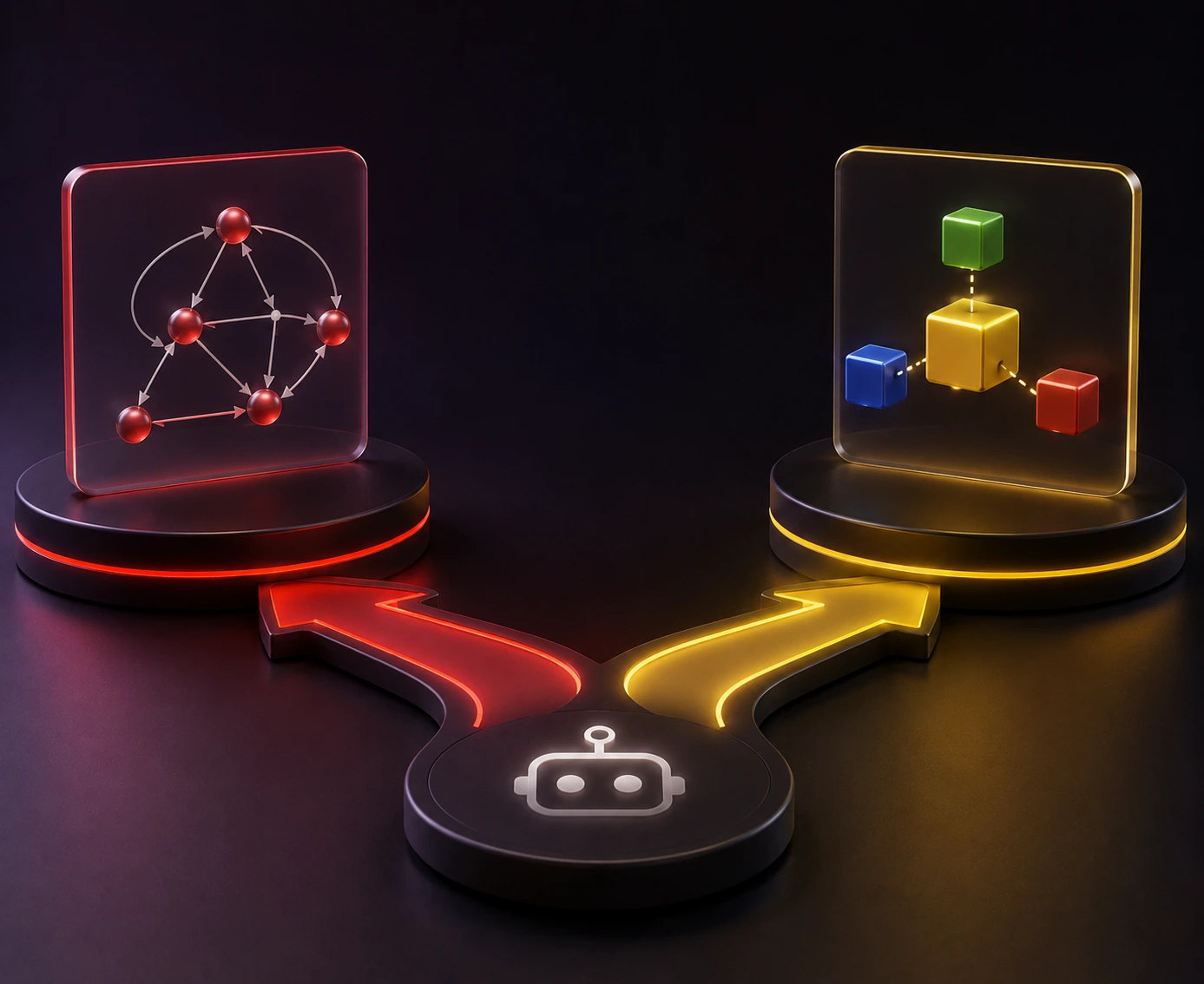
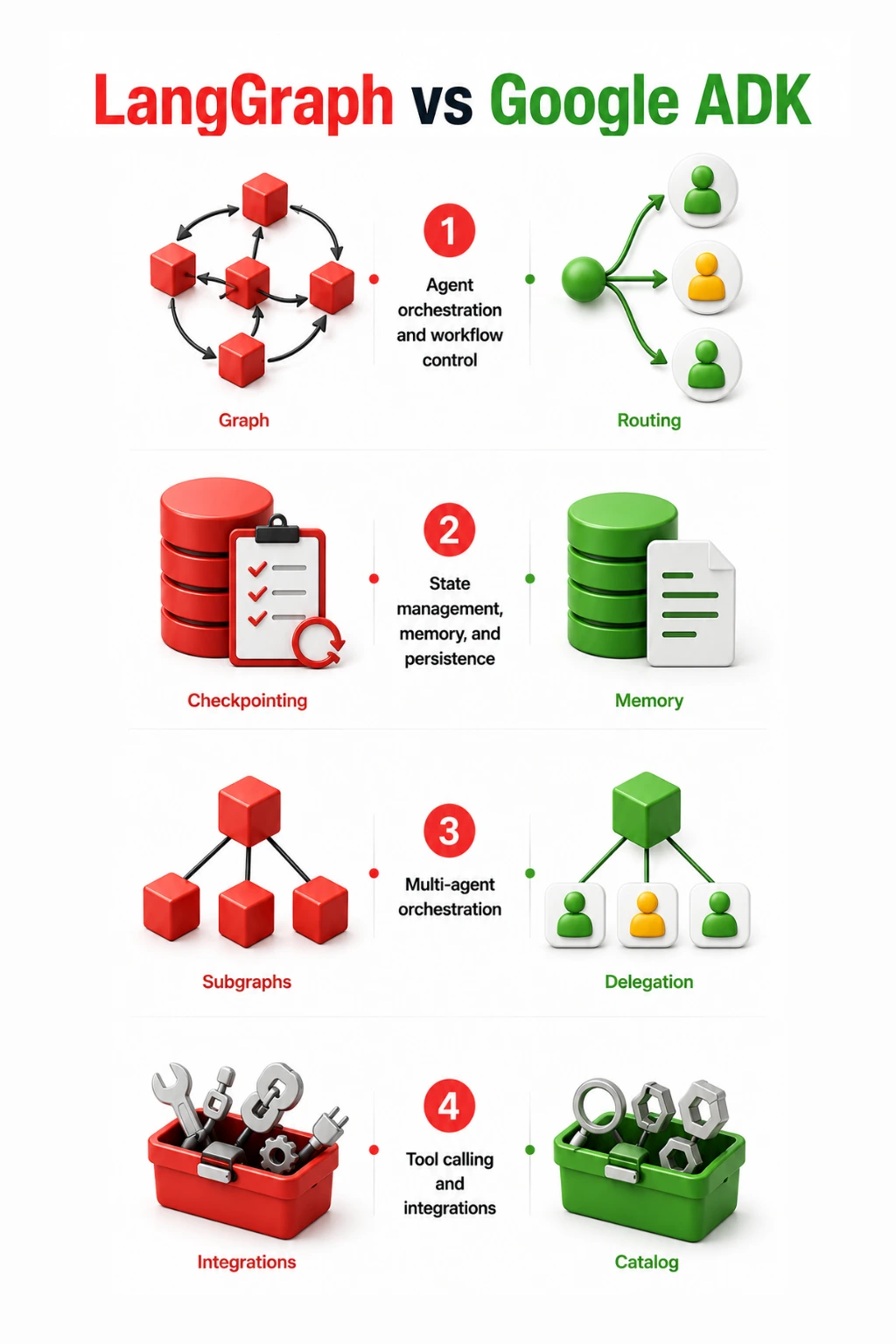
The split between these two frameworks comes down to one question. Do you want to draw a map of every possible agent action? Or do you want to write a script and let the framework handle the routing? LangGraph draws the map. Google ADK writes the script.
Both frameworks are ready for production. But they work very differently under the hood. Here’s how they compare across the eight capabilities that matter most.
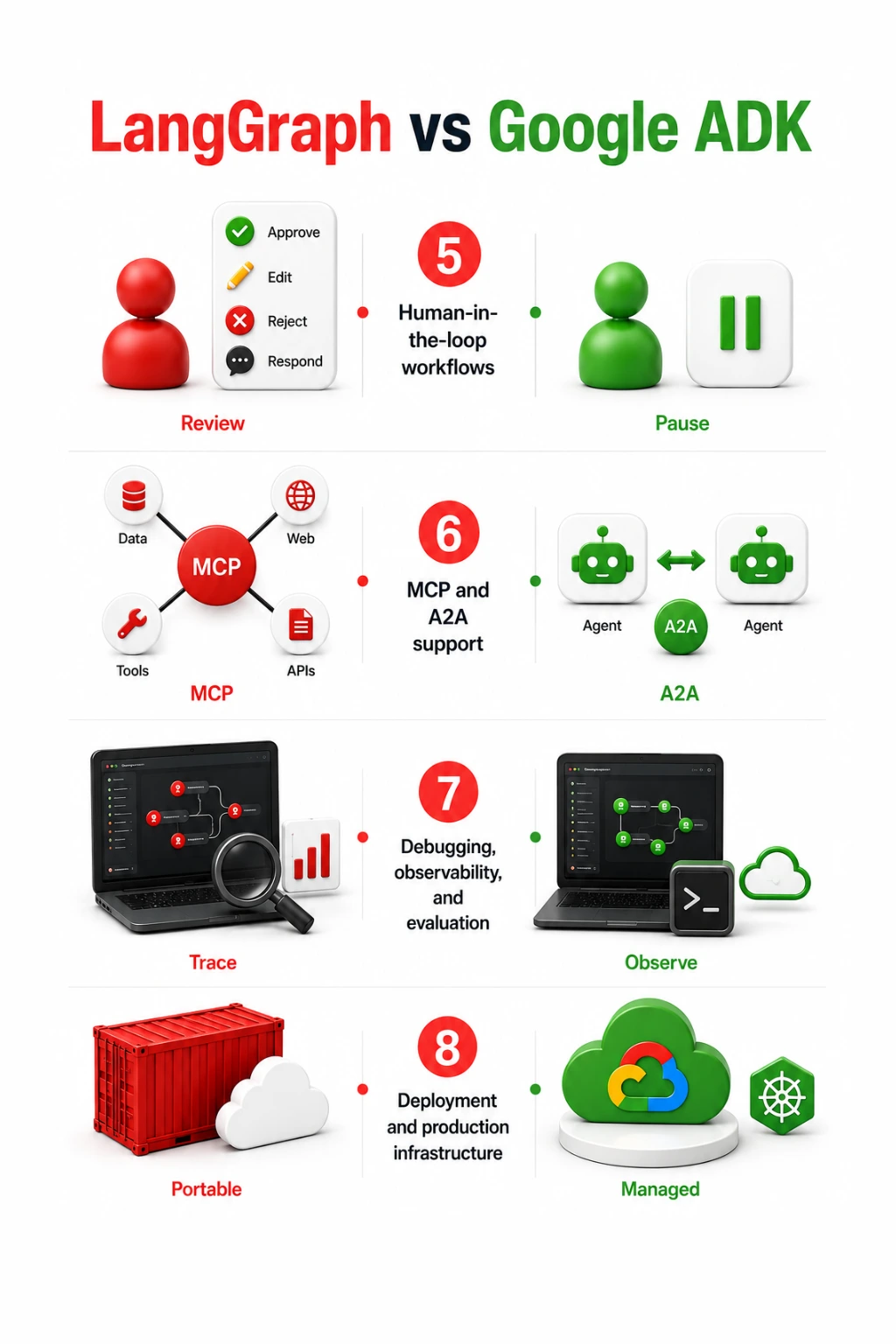
Enterprise deployment adds new demands: governance, security, and scale. These go well beyond developer experience. Four questions matter most here.
LangGraph gives you more low-level control. Execution follows a strict state machine, so compliance teams can check exactly why a node ran. That’s why regulated fields like finance and healthcare tend to prefer it. Google ADK’s abstractions work fine for most workflows. But they can hide what happened during fast, LLM-driven routing. That makes ADK a bit harder to audit.
Security is now the top cause of agentic AI failures. Over-permissive tool access, prompt injection, and unauthenticated MCP servers are common culprits.
Google ADK plugs straight into Google Cloud IAM for authentication and authorization. LangGraph supports JWT and Keycloak SSO through its paid platform. But your team has to build and maintain that security layer yourselves.
LangGraph is cloud-agnostic by design. It’s just a library, so it runs unchanged on AWS, Azure, or your own servers. Google ADK is open-source and technically portable too.
But its best features – Vertex AI sessions, BigQuery, Agent Engine – tie you to GCP. That becomes a real problem if you need multiple clouds.
LangGraph resumes interrupted work through persistent checkpointers. You call the same thread ID, and it picks up from the last successful step. Your team still has to build the distributed locking, though. Google ADK handles failures differently.
Its ReflectAndRetryToolPlugin catches tool failures like timeouts. It feeds the LLM context on what went wrong, then retries or falls back automatically. The parent workflow never crashes.
Google ADK wins on speed, hands down. A working multi-agent MVP takes about 100 lines of code. Its local Web UI lets your team trace and test agents without any backend setup. LangGraph asks for more upfront work.
You need to design state schemas and graph topology before the agent does anything useful.
LangGraph’s learning curve is steep. Engineers have to shift their thinking to graph theory and state machines.
That means more boilerplate for simple, linear tasks. ADK’s style feels more familiar. Define a class, attach a tool, call a method. Most software engineers pick it up fast.
LangGraph startups usually move to the managed LangGraph Platform once traffic gets bursty. It handles long background tasks and scaling automatically.
ADK startups lean on Vertex AI Agent Engine for near-instant scale. But they need active cost monitoring, or idle endpoints can rack up surprise bills.
LangGraph avoids cloud lock-in, but creates framework lock-in. Move a complex StateGraph elsewhere, and you’re rewriting the orchestration logic from scratch.
ADK creates lighter framework lock-in, but pulls you toward GCP. If staying multi-cloud matters long-term, LangGraph is the safer bet, even with the slower start.
The best framework depends on what the agent actually needs to do. Here’s how six common use cases shake out.
Google ADK’s built-in audio and video streaming makes it the stronger fit here. Real-time, multimodal support conversations are its strength.
LangGraph handles structured flows with strict escalation points well. But it lacks ADK’s out-of-the-box streaming.
ADK connects smoothly to BigQuery and Google Workspace. That makes it efficient for pulling CRM data, building reports, and automating outreach across Google’s ecosystem.
LangGraph is the clear leader here. Its cyclical graph architecture is built for iterative retrieval: retrieve, check relevance, re-query.
That’s exactly the loop deep research and RAG systems need to run again and again.
ADK’s built-in code execution tools help here. So do its Pydantic-based output handlers.
They return clean, programmatic data for dashboards, with fewer parsing errors than a general orchestration layer.
Pair ADK with Vertex AI Agent Engine and Google’s Application Integration services.
IT teams can build onboarding, ticketing, and provisioning workflows that plug straight into existing ERP and identity systems.
Large systems need many specialized agents working together without going rogue. LangGraph’s supervisor routing and strict state management keep the whole system coherent, in ways looser models struggle to match.
Mapped against use case, the recommendation is fairly consistent:
The framework you pick locks in more than orchestration logic. It shapes your future model and cloud choices too.
LangGraph is built on LangChain, which gives it the broadest multi-model support in the industry. Route complex reasoning to GPT-4o.
Route long-context work to Claude. Route simple classification to a local Llama model. All inside one graph. That vendor-neutral layer protects your architecture from any single provider’s release cycle.
ADK uses LiteLLM to support 100+ providers. But it’s built to get the most out of Gemini specifically: native audio processing, advanced multimodal reasoning, and a two-million-token context window.
If your team is already on GCP and Vertex AI Model Garden, that alignment removes almost all integration friction.
LangGraph gives you close to frictionless portability. Move from AWS to Azure to an air-gapped on-prem cluster with minimal rework.
ADK gives you strong model flexibility through LiteLLM, but weaker cloud portability. Lean on Vertex AI Agent Engine for deployment, and switching providers later means real re-engineering.
The real cost of a framework shows up once you move from prototype to production. It’s not licensing. It’s infrastructure and maintenance.
Both frameworks are free and open-source. LangGraph uses the MIT license; ADK uses Apache 2.0. The real cost lives in the infrastructure around them.
LangGraph Platform starts around $35 a month and scales with compute and seats. ADK costs build up through Vertex AI node-hours and Cloud Run usage.
LangGraph asks for more upfront design work: state schemas, graph topology. That investment pays off later in maintenance that’s easier to predict and audit.
ADK deploys faster at first. But complex error-recovery and routing logic across dozens of agents can get tangled without strict discipline.
LangGraph usually needs a LangSmith Enterprise license for RBAC and high-volume trace storage.
That’s a real added cost. ADK routes its OpenTelemetry data straight to Cloud Trace and Cloud Logging. For teams already paying for GCP support, that’s often bundled in already.
In one benchmark of a 9-agent parallel workflow, ADK produced less than half the output tokens LangGraph did. That meant a 6% lower execution cost, at nearly the same latency. But weigh that against a different cost: migrating off GCP later, if a cloud change is ever forced on you.
Side by side, the cost picture looks like this:
LangGraph is the stronger pick in a few specific, recurring situations.
ADK earns its place when speed, streaming, and deep integrations matter more than fine-grained control.
The right answer comes down to three things: scale, existing cloud commitments, and workload type.
As a quick reference, here’s how company profile maps to framework choice:
Partnering with Entrans Technologies to navigate the complexities of LangGraph and Google ADK ensures your AI initiatives are both scalable and user-centric.
Whether you are building human-in-the-loop workflows or deploying complex multi-agent architectures, Entrans brings deep, AI-first engineering expertise to the table.
With Fortune100 retailers as clients and our own enterprise AI solution that is ISO42001 certified, we understand using LangGraph and Google ADK more than most companies.
Want to see what we can do for you? Book a free consultation call!

Neither one is better across the board. LangGraph wins for complex, stateful, multi-cloud workflows where auditability matters most. ADK wins for speed, Google Cloud integration, and Gemini-native features. Your choice should depend on your workload and cloud strategy, not a general ranking.
If your enterprise already runs on Google Cloud, ADK usually gets you to production faster, with less integration overhead. If you need strict auditability or multi-cloud portability, LangGraph is usually the safer pick.
LangGraph is a low-level, graph-based state machine. It gives you explicit control over every transition. Google ADK is a higher-level, code-first framework. It’s built around pre-built agent classes and hierarchical delegation, and it favors development speed.
Yes, both support multi-agent systems natively. LangGraph composes agents as subgraphs that share state. ADK treats multi-agent hierarchies as a core feature, through its Task API and sub_agents configuration.
Both are production-ready, with their own managed deployment paths: LangGraph Platform and Vertex AI Agent Engine. LangGraph tends to suit long-running, mission-critical workflows that need durable state. ADK tends to suit fast, Google Cloud-native production deployments.
Google ADK is usually faster for early-stage startups. It has less boilerplate and built-in local tooling. Startups building a genuinely complex reasoning product may still be better off with LangGraph’s long-term flexibility.

-1.svg)