Explore 8 legacy system modernization trends shaping enterprise IT in 2025-2026, from GenAI automation to outcome-based contracts and cloud-native migration.

Agentic Unconference 2026 - September 19, Chennai
View Event →





Your old systems are really holding you back. You probably think this is not true. It is true. Your old systems were good for a time. Now they are not good anymore. It is time to do something. It is time to make them modern. Legacy systems have done their job. Now it is time to move on to things.
It is time for modernization. Your legacy systems are the problem. Modernization is the answer. End-to-end AI-driven legacy modernization solutions can help to streamline this transition and unlock new efficiencies. Legacy system modernization is no longer a back-end project; it is a core business strategy. Legacy system modernization trends make innovation faster, reduce risk, and create a technology foundation that is supported for AI-driven business growth.
In this post, we will see the current legacy system modernization trends to be followed for a secure and faster measurable value realization.
Legacy systems are a problem for companies that want to innovate, use AI, grow, and change digitally. Most companies, around 85%, say that their old systems make it hard to use AI. By 2026, companies in industries will feel pressure to update their old systems and rigid structures. These old systems and structures limit how fast a business can move and use up 80% of the IT budget.
Many companies know that tearing down these complicated systems is hard and requires special skills. Because of this, 98% of companies plan to work with partners to modernize their systems. Legacy systems are really holding them back. Companies need to update these systems to move. AI adoption is also being slowed down by these systems. The old systems are a hurdle for many companies. Developing a comprehensive digital modernization strategy, an enterprise legacy AI roadmap can be improved to give organizations a clearer path forward during this transition.
Legacy systems, which were built for mainframe logic, were designed for structured, predictable, and human-readable batch processes. Several factors contribute to this continued dependence:
For many enterprises, these systems still perform their original functions reliably. However, they struggle to support modern requirements such as AI integration, API connectivity, scalability, and real-time analytics.
They fail the AI readiness test in three different areas.
Enterprises are now using Artificial Intelligence to analyze their code. It helps them generate documentation for systems that do not have any. They can also identify dependencies and vulnerabilities. This speeds up code refactoring and even automates testing and Quality Assurance.
The main goal of using AI for modernizing systems is to reduce the work people have to do. It helps to finish projects and makes the whole transformation process cheaper. Enterprises use AI to analyze codebases. AI also helps to generate documentation. It identifies dependencies and vulnerabilities in the code. This makes refactoring and testing easier. AI helps to automate testing and Quality Assurance. The use of AI in legacy modernization helps to lower costs.
Cloud adoption is no longer optional for enterprises seeking scalability and resilience. In 2025, organizations are moving beyond basic cloud hosting and embracing cloud-native operating models. They enable faster deployments, improved uptime, lower infrastructure overhead, and better support for AI workloads.
Security vulnerabilities in outdated systems have become a major modernization trigger. As cyber threats grow more sophisticated, enterprises are under pressure to modernize systems that expose operational and regulatory vulnerabilities.
Generative AI (GenAI) has officially shifted from a fun experimental tool into an essential worker for enterprise upgrades. Instead of replacing human engineers, GenAI acts as a high-speed translator and mapmaker, cutting project timelines by up to 40% and making the entire transformation incredibly predictable. Enterprises are now using GenAI-powered platforms to accelerate legacy code translation, automated refactoring, and code documentation. The biggest strength of GenAI is that it can analyze massive legacy codebases and generate modernization recommendations. This shift is driving 40% to 50% acceleration in overall modernization timelines. Utilizing a practical guide on legacy app modernization with the GenAI enterprise guide can help maximize the return on these technological investments. Key application areas include:
Enterprises are also using GenAI to:
What makes this trend significant is that GenAI is no longer viewed as an option; it has become a core modernization capability integrated into enterprise transformation workflows.
Enterprise modernization is going to a new phase in 2026 with the rise of Agentic AI and autonomous AI systems. Agentic AI systems analyze systems and make decisions. Execute tasks with little human help.
AI systems are being used for things like
These intelligent agents work alone in environments.
AI agents scan the codebase. They see how data actually flows. They do not rely on people to map out workflows.
If an AI agent gets stuck while updating an application, it does not stop. It
- figures out what went wrong
- tries a way
- finds a solution
- and tries again.
This approach changes what human engineers do. They do not do hands-on work. Instead they
- oversee specialized agents
- Make sure the work is of quality.
These agents do tasks, like
- refactoring code
- writing test scripts
- checking for compliance.
Human experts then check the work. This ensures everything is correct. It also means humans do not have to do hard work.
Cloud-native architectures have become the fundamental requirement for AI-ready enterprise systems in 2025. To fully leverage data pipelines, real-time analytics, and advanced AI models, systems must be entirely cloud-native.
As a result, mainframe-to-cloud migration is accelerating rapidly, with organizations standardizing on major hyperscale platforms like AWS, Azure, and Google Cloud Platform (GCP).
To build a true foundation for AI, modern architectures rely heavily on three core pillars:
The trend is moving towards deploying generative AI and autonomous agents, but they are hitting massive roadblocks. Both of them depend on data. Organizations know clearly that outdated data architectures cannot support modern AI workloads and allow us to scale. This makes data modernization a priority use case in enterprise modernization programs.
Traditional platforms such as Teradata and Oracle were built for structured reporting and batch analysis. But they fail to meet the flexibility, scalability, and real-time processing demands that are required to support modern generative AI, machine learning, and advanced analytics.
Enterprises are now shifting toward cloud-native platforms such as Snowflake, Databricks, and Google Cloud to build a future-ready ecosystem.
Legacy environments often contain data silos across departments, inconsistent schemas and formats, and slow-batch processing pipelines. These limitations directly affect the AI model performance, inference speed, and governance. Many enterprises are now moving away from tightly coupled legacy data warehouses towards cloud-native architectures for elasticity and AI integration. Commonly used modernization paths are
Teradata → Snowflake
Oracle Data Warehouse → BigQuery
On-prem Hadoop ecosystems → Databricks Lakehouse
Legacy ETL pipelines → Modern ELT and streaming architectures
Organizations are investing heavily in data quality and observability, AI-ready metadata management, real-time analytics pipelines, master data management, and governance frameworks for AI compliance.
We at Entrans treat data modernization as a strategic AI initiative rather than a migration project.
Entrans helps enterprises:
By combining modernization expertise with AI-driven automation, Entrans enables organizations to accelerate migration timelines while minimizing operational disruption.
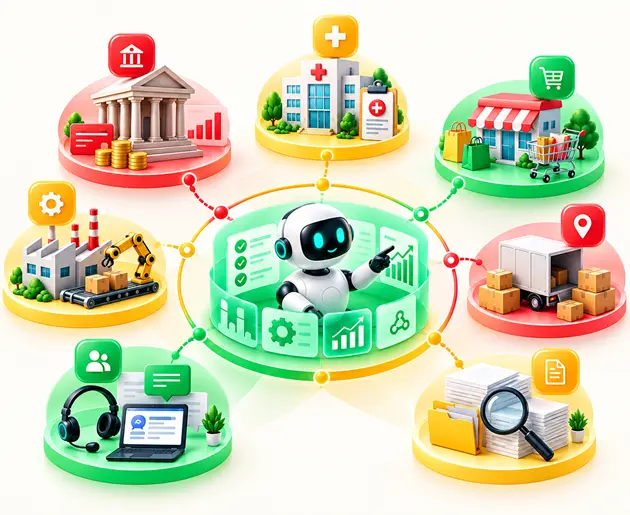
A one-size-fits-all approach does not work nowadays. For each industry, we need a separate modernization to achieve its target goals. In this way, healthcare, financial services, and manufacturers are leading this shift as they modernize legacy systems while balancing compliance, security, uptime, and AI readiness.
In healthcare, modernization is not only about efficiency, but it is also about patient outcomes. Legacy Electronic Health Record (EHR) platforms often suffer from
Poor interoperability between systems, high maintenance costs, limited support for AI and analytics, slow access, and compliance challenges.
Healthcare modernization initiatives now prioritize
Organizations are increasingly modernizing legacy healthcare applications to support predictive diagnostics, intelligent automation, and AI-driven operational efficiency. Learning how to successfully modernize healthcare legacy systems, Generative AI can be improved to help medical institutions meet modern data security standards while improving patient care pipelines.
Financial institutions are accelerating modernization programs to replace decades-old core banking systems that limit agility and innovation. Many banks are still using legacy old systems, but the urgent need for mobile banking and fraud detection is on the rise and has forced a wave of core banking system upgrades.
Modernization efforts in finance now focus on:
Manufacturing modernization is increasingly centered around connecting operational technology (OT) systems with enterprise IT platforms.
Manufacturers are modernizing to enable:
OT/IT convergence allows manufacturers to combine both ML operational data with enterprise analytics and AI platforms that create more intelligent and efficient production environments.
At Entrans, modernization programs are tailored to the operational realities of each industry vertical.
By combining domain expertise with AI-driven modernization methodologies, Entrans helps organizations accelerate transformation while maintaining compliance, security, and operational continuity.
Modern legacy modernization is no longer just about rewriting code faster. In 2025, enterprises are combining DevOps practices with AI-driven automation to reduce delivery risk while accelerating releases. AI-powered CI/CD pipelines now support automated code validation, intelligent test generation, anomaly detection, deployment optimization, and predictive rollback recommendations. That is exactly what happens when you combine DevOps (the team and tools that build and ship software) with Artificial Intelligence.
When modernizing older software systems, teams the main constraint faced usually worry about two things: going too slow or breaking something important. AI solves both problems by making the transition faster.
Monolithic applications are increasingly replaced with composable, modular architectures built for agility and scale. Today’s trend is to move away from tightly coupled legacy systems and towards microservices, API-first platforms, and headless architecture.
The Strangler Fig pattern is one of the commonly used modernization strategies, where legacy functionality is replaced by modern services at once. This approach reduces operational risk, minimizes downtime, and allows enterprises to modernize continuously without disrupting business-critical operations.
It is also becoming central to modernization initiatives. They make it easier to integrate modern applications, automate workflows, and support omnichannel digital experiences. An API (Application Programming Interface) is like a universal translator that lets different software programs talk to each other. By designing these translators first, teams can break apart the old system into smaller chunks without losing connection to important business data.
At the same time, headless architecture adoption is growing across industries, especially in customer-facing platforms. By separating the frontend experience from backend systems, enterprises gain greater flexibility to deliver personalized digital experiences across web, mobile, and emerging channels.
Traditional time-and-material (T and M) contracts are increasingly replaced by outcome-based modernization models focused on measurable business impact, delivery accountability, and predictable ROI. Enterprise buyers are demanding real, measurable business results before they sign on the dotted line. The industry is rapidly shifting toward outcome-based modernization contracts, where IT partners are judged and paid based on what they actually deliver, not just the hours they log.
Large-scale modernization initiatives often involve significant budgets, business-critical systems, and multi-year transformation roadmaps. Enterprises want greater confidence that modernization investments will deliver tangible business value rather than open-ended consulting engagements.
As a result, modernization contracts increasingly include:
Enterprises increasingly prefer incremental modernization programs with clear milestones, instead of high-risk, large-scale replacement initiatives. Entrans aligns its modernization programs around measurable business outcomes rather than purely resource-based execution. Its phased modernization approach combines system assessment, AI-assisted transformation, automated testing, cloud modernization, and continuous optimization within milestone-driven delivery frameworks.
Making the legacy modernization trends turn them into a realistic business strategy requires a new achievement. To ensure your organization stays on the winning edge, your modernization roadmap needs to change.
Modernization initiatives should now be designed with AI integration in mind from the beginning. Enterprises modernizing legacy systems should prioritize:
Ensure your technology partners are actively pairing DevOps with AI. This guarantees automated testing and instant rollbacks, drastically cutting down project timelines and delivery risks.
Entrans incorporates the latest enterprise modernization trends into our modernization frameworks to help organizations modernize faster while minimizing operational risk. We combine GenAI-assisted code analysis, refactoring, and documentation.
Want to know more about how we build a modernization roadmap tailored for enterprise growth? Book a consultation call with us.

Enterprises are modernizing legacy systems to reduce operational costs, improve cybersecurity, and support AI-driven digital transformation. Upgrading the systems makes it possible to stay competitive, eliminate technical debt, and move quickly as market demands change.
GenAI acts like a high-speed translator that can instantly read obsolete programming languages and convert old systems into modern code. This automates the most tedious parts of a rewrite, slashing project timelines by up to 40% while preventing human error.
Cloud-native modernization is important for building scalable, flexible, and AI-ready systems using microservices, containers, and serverless architecture. They help in lowering infrastructure costs and release software updates smoothly.
The biggest challenge in legacy modernization projects is managing dependencies and outdated code. Many enterprises also struggle with poor documentation, skill gaps, and migration risks.
Companies move from traditional Time and Materials (T & M) contracts to achieve business outcomes, predictable costs, and faster delivery. Modern companies are shifting toward outcome-based contracts that tie vendor payments directly to business results and real milestones.

-1.svg)