Learn how to modernize healthcare legacy systems with generative AI. Explore HIPAA compliance, FHIR migration, and ROI for healthcare enterprises in 2026.

Agentic Unconference 2026 - September 19, Chennai
View Event →


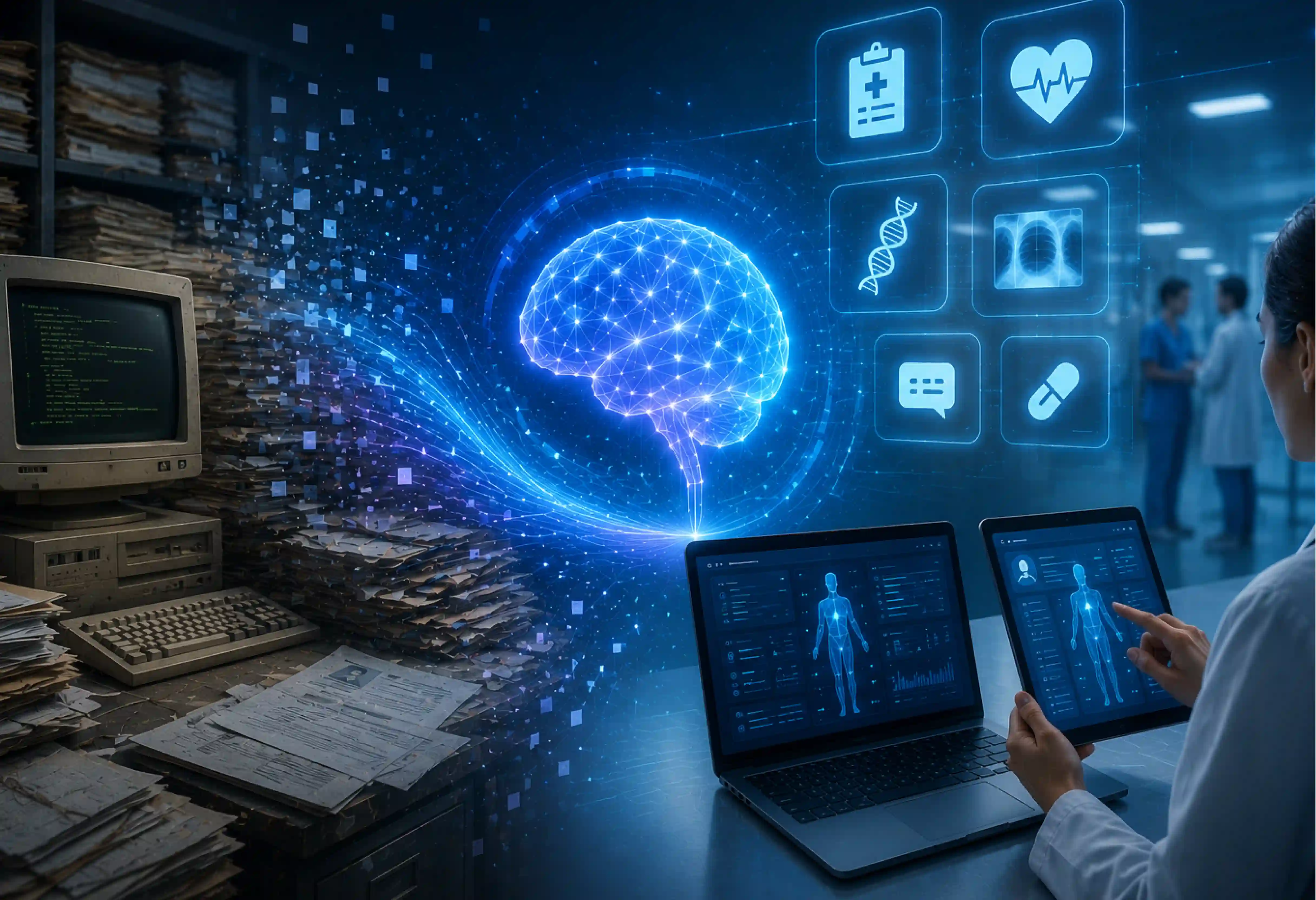


On average, healthcare institutions spend up to 80% of their IT budgets. For too long, fragile legacy systems have locked away critical patient data, blocking the adoption of life-saving AI diagnostics. Generative AI is changing this reality by converting decades of technical debt into microservices. This is done by accelerating modernization timelines by 50%. Modernizing healthcare legacy systems with generative AI is the new foundation for offering modern medicine to patients by streamlining workflows and making it faster.
In this post, we will highlight the importance of modernizing healthcare legacy systems with generative AI. It helps to build a reliable foundation designed to support your clinical teams.
The healthcare industry has gone to new heights where foundational technology is failing the very people it is designed to protect and heal. Outdated Electronic Health Record (EHR) systems are no longer slowing down operations; they have gone beyond the limit of patient care, innovation, interoperability failures, security breaches, and the inability to deploy AI diagnostics tools.
Almost 70% of their IT budgets are spent on maintaining legacy code. Many healthcare organizations also struggle to integrate modern capabilities such as AI diagnostics, predictive analytics, telemedicine platforms, and real-time patient monitoring because their legacy infrastructure cannot support modern data architectures. To address these systemic inefficiencies, implementing targeted AI-Driven legacy modernization solutions can be improved to systematically update aging infrastructures while preserving vital operational continuity.
Core hospital operations, billing systems, laboratory systems, patient records, and insurance workflows are deeply interconnected. Many factors that glue up the legacy systems in place are the fear of downtime, which can affect patient care, heavy customizations in older platforms, budget constraints, and competing operational priorities.
Then what makes us think about moving away from legacy systems? The answer is disconnected data. Legacy EHR platforms often cannot communicate effectively with newer systems, external providers, pharmacies, laboratories, or insurance platforms. Issues raised due to this are
Modernizing healthcare systems is more complex than standard enterprise transformation because patient care continuity cannot be interrupted. Healthcare organizations must modernize while maintaining compliance, uptime, and clinical reliability. Successful modernization strategies often include,
Digital transformation is the need of the hour due to its predictive AI diagnostics and virtual care. But hospitals cannot build a modern digital ecosystem on a crumbling technological foundation. There are certain legacy platforms listed below that need to be identified and dismantled.
Electronic Medical and Health Record (EMR/EHR) platforms serve as the central nervous system of modern clinical care. Many hospitals still operate heavily customized or outdated instances of platforms such as Epic, Cerner, and Meditech. The challenges faced with legacy EHR platforms are poor interoperability with newer applications, complex upgrade cycles, slow user interface and clinician workflows, and limited cloud compatibility. Legacy systems often become hard to scale as they are not designed for real-time analytics or modern healthcare ecosystems. IT teams also spend substantial resources maintaining custom integrations and legacy infrastructure instead of improving innovation.
The Modernization Block:
These older setups lack complete, built-in support for standard FHIR (Fast Healthcare Interoperability Resources) APIs. This limitation makes it nearly impossible to feed structured patient clinical histories directly into modern, real-time clinical decision-support algorithms.
Revenue Cycle Management (RCM) systems handle billing, claims processing, coding, and financial reporting. Legacy Revenue Cycle Management (RCM) platforms lack the real-time processing capabilities required to cross-check claims data instantly against shifting payer rules. They can handle static logic. Reports say that nearly 11.8% of hospitals collectively spend more money each year for processing or correcting administrative billing errors.
The Modernization Block:
Legacy billing systems are isolated from clinical charting workflows. Because they cannot communicate dynamically with clinical databases to automatically pull documentation, administrative staff must handle charge capture and data validation manually.
Picture Archiving and Communication System (PACS) has served as the digital backbone for radiology, cardiology, and pathology departments. Traditional legacy PACS depend on heavy, localized on-premises hardware storage and old DICOM network protocols.
Challenges faced on legacy PACS systems are yielding slow image retrieval times and limited cloud storage capabilities. This results in vendor lock-in issues and inconsistent imaging formats.
The Modernization Block:
Healthcare systems generate massive amounts of visual data, out of which 97% of hospital data goes unused. Legacy PACS lack the scalable cloud-computing infrastructure and pipeline integrations necessary to apply computer-vision AI tools.
Healthcare organizations generate enormous amounts of clinical data but still rely on outdated reporting systems and fragmented analytics tools. This gives us delayed reporting cycles, limited real-time visibility, and difficulty scaling enterprise-wide insights.
So without real-time insights, healthcare organizations struggle to optimize operations, improve patient outcomes, monitor financial performance, or manage clinical risks.
Expectations of the patient have changed significantly and have given more preferences. Many healthcare organizations still use outdated patient engagement platforms that provide poor digital experiences. The main thing is that early patient portals were designed primarily as a static, compliance-focused window to display basic lab values, but now the customer expectations have changed, really.
The Modernization Block:
Legacy communication frameworks cannot securely pass data back and forth to active EHR databases. Without conversational API integration layer tools, organizations cannot safely implement modern, secure AI chatbots or automated SMS check-ins to handle routine triage and scheduling questions.
In healthcare, Generative AI (GenAI) is usually pictured as an AI assistant writing patient messages or a tool helping a doctor summarize clinical notes. While those use cases save valuable minutes, they only scratch the surface. They don't fix the underlying problem: healthcare is still running on a deeply outdated technological foundation.
GenAI is fixing traditional software development by acting as an automated interpreter, translator, and documentation engine. Navigating a complete legacy to an AI modernization initiative can be helped by reviewing established frameworks that transition older architectures into high-performance platforms. The four pillars of GenAI legacy Modernization are
Healthcare systems still run on outdated programming languages and architectures that are difficult to maintain and scale. Legacy applications may contain millions of lines of code developed over many years.
GenAI tools can analyze older codebases and assist developers by:
AI-assisted code translation allows healthcare organizations to preserve critical clinical logic while improving long-term sustainability.
Interoperability remains one of healthcare’s biggest challenges. Many legacy healthcare systems use outdated integration methods that make secure and efficient data exchange difficult. However, older data repositories store lab values, diagnoses, and vitals in flat, non-standard text files.
GenAI platforms can automatically read unformatted database registries, recognize clinical data types, and instantaneously wrap that information into clean, compliant FHIR JSON schemas.
Healthcare data is highly unstructured. Valuable patient insights—such as exact allergy reactions, behavioral health notes, and social determinants of health—are often trapped inside free-form physician text boxes.
GenAI uses context-aware Named Entity Recognition (NER) to scan messy, free-text clinical notes. It can distinguish a past diagnosis from a family history and map those clinical concepts directly to standard medical vocabularies like SNOMED-CT or ICD-10.
Legacy healthcare systems often suffer from outdated documentation. Poor documentation leads to modernization risks. GenAI can automatically generate:
GenAI engines can process millions of lines of an undocumented legacy tech stack and auto-generate clear, human-readable documentation. The AI outlines system dependencies, maps data flows, and explains what each custom code block accomplishes.
Healthcare organizations handle massive volumes of protected health information (PHI), making security, privacy, and interoperability during modernization efforts. Any modernization initiative involving healthcare applications, infrastructure, or data platforms must preserve HIPAA compliance throughout the transformation lifecycle. In an era defined by evolving privacy rules, expanding data liquidities, and sophisticated cyber threats, organizations must align their engineering roadmaps with four foundational healthcare pillars: HIPAA, HL7, FHIR, and HITRUST.
The Health Insurance Portability and Accountability Act (HIPAA) forms the absolute baseline legal standard for protecting Electronic Protected Health Information (ePHI). Healthcare organizations must ensure:
Even temporary migration environments can introduce compliance risks if proper safeguards are not implemented.
Healthcare systems cannot function effectively without seamless data exchange. HL7 (Health Level Seven) standards have long served as the foundation for healthcare interoperability between hospitals, laboratories, imaging systems, pharmacies, and payer platforms.
Many legacy systems still rely heavily on older HL7 interfaces that are difficult to scale and maintain. As healthcare ecosystems expand, custom interface maintenance, data mapping inconsistencies, and fragile interface dependencies are operational issues. Healthcare modernization initiatives should aim to standardize integration frameworks, reduce interface complexity, and enable scalable API-driven architectures. HL7 modernization becomes especially important when integrating cloud platforms, telehealth systems, remote monitoring tools, and external care networks.
Fast Healthcare Interoperability Resources (FHIR) is rapidly emerging as a modern standard for healthcare data exchange. It is becoming critical for enabling patient data portability and mobile healthcare applications. The reason why legacy systems struggle with FHIR is that they were never designed for API-based interoperability. Organizations often face challenges such as incompatible data structures, limited API support, and poor metadata standardization.
FHIR also plays a major role in supporting modern patient engagement and digital health experiences. By improving patient data accessibility, accelerating application integration, enabling AI and analytics initiatives, and reducing interoperability costs.
Generative AI (GenAI) is emerging as a powerful accelerator for healthcare modernization initiatives. Forward-thinking healthcare organizations are deploying large language models (LLMs) and advanced code-generation tools to solve their core technical debt. Using GenAI to refactor the code, IT teams are finally dismantling the legacy structures that have held back clinical innovation for a generation. For technical leaders planning out their deployment roadmap, reviewing a detailed legacy app modernization with the GenAI enterprise guide can be improved to avoid common engineering bottlenecks during implementation.
Many foundational Electronic Medical Record (EMR) systems rely on deeply embedded legacy codebases written in languages like MUMPS (M), COBOL, or early iterations of C++. Modernizing these kinds of systems may take much more time.
Modernizing healthcare legacy systems with generative AI can analyze legacy EMR applications and assist with:
Specialized LLMs fine-tuned on legacy programming languages can ingest thousands of lines of monolithic code. AI acts as a bridge to parse ancient logic, generate technical documentation, and translate core functions into modular, modern microservices.
Interoperability is one of healthcare’s biggest challenges. However, legacy systems store data in completely flat, unstructured text files or highly proprietary SQL schemas that don't match the modern FHIR standard. Manually writing code translation for each legacy data file is a time-consuming job.
Modernize healthcare legacy systems with generative AI to analyze unstructured legacy databases and map them correctly into FHIR resource equivalents, such as Patient, observation, or medication request.
Revenue Cycle Management (RCM) handles the complex financial pipeline of medical billing, claims submission, and denial management. Older RCM runs on rule-based systems that do not sync with changing insurance policies.
Instead of relying entirely on static, hard-coded billing rules, organizations can embed GenAI engines to act as intelligent, real-time interpreters. The AI ingests unstructured payer policy PDFs, contract updates, and clinical charts, automatically flagging coding discrepancies, missing pre-authorizations, or potential compliance issues before the claim is sent out.
Almost 80% of the healthcare data, such as physician notes, pathology reports, discharge summaries, and audio files, is entirely unstructured. If a doctor notes that a patient has "no signs of heart failure," a basic legacy tool might flag "heart failure" as an active diagnosis, skewing analytics and risk stratification.
Medical LLMs read unstructured clinical text with genuine contextual understanding. They can extract critical clinical metrics, lifestyle factors (like social determinants of health), and complex family medical histories, turning raw narrative text into structured, searchable data tables.
Healthcare modernization often requires migrating enormous volumes of sensitive patient data from legacy systems into newer platforms. Manual migration processes are time-consuming, error-prone, and risky.
GenAI-assisted migration tools can validate migrated records, detect anomalies and inconsistencies, automate data mapping, and generate migration documentation.
Healthcare organizations are facing pressure to modernize aging technology infrastructure while improving operational efficiency. Legacy Electronic Health Records (EHRs), billing systems, clinical imaging platforms, and analytics environments are becoming increasingly expensive.
Generative AI (GenAI) has fundamentally changed the economics of digital transformation. By acting as an intelligent automation layer, GenAI replaces slow, manual coding and data translation with automated, context-aware engineering pipelines. The financial argument for replacing legacy technology is no longer just about avoiding a system crash—it is about capturing verifiable, short-term return on investment (ROI).
Traditional legacy modernization decreases its speed during the discovery and code-analysis phases, where engineers spend months manually reviewing ancient, undocumented code lines. Research from NTT DATA denotes that specialized AI coding models accelerate application modernization timelines by 40% to 50%.
Maintaining age-old patches, knowing ancient code, fixing system errors, and spiling up 80% of hospital IT budgets. McKinsey-baked data shows that AI-augmented modernization drives a 40% of reduction in technical debt costs.
Healthcare institutions are prime targets for cyberattacks because legacy infrastructure often depends on obsolete security protocols and can no longer receive vendor protection patches. Shifting from on-premises legacy data structures to cloud-native architectures allows systems to enforce automated, zero-trust security controls like mandatory multi-factor authentication (MFA) and continuous logging.
Legacy platforms store data in isolated, proprietary databases, locking organizations out of modern AI breakthroughs. This lack of interoperability prevents healthcare organizations from fully adopting AI-powered clinical solutions.
Modern interoperable systems support:
Without modernization, many healthcare organizations cannot effectively deploy these advanced capabilities.
Healthcare is a high-risk industry where a single technical misstep can lead to catastrophic data leaks or disrupt patient care. Upgrading aging systems with GenAI comes with distinct structural challenges.
Large language models need high-quality data. However, passing unencrypted Protected Health Information (PHI) through commercial cloud AI models creates severe compliance risks. If the patient record is fed into public or multi-tenant AI systems, this can cause data exposure.
In Entrans, we handle this by implementing Zero-Data-Retention (ZDR) architecture. Our AI governance model includes private and secure AI environments, data anonymization and masking, and encrypted modernization pipelines. We follow security-first delivery models designed to protect PHI while supporting compliant modernization workflows.
Healthcare ecosystems are highly interconnected. EHR systems, laboratory applications, and imaging platforms, billing systems, patient portals, and analytics tools rely on tightly coupled integrations. Common challenges faced in integration are hardcoded interfaces, unsupported middleware, custom HL7integrations, fragmented APIs, and lead to vendor lock-in.
Entrans avoids high-risk, direct system connections by deploying a secure Abstraction Layer. We use GenAI to automatically build and manage an intermediary middleware platform. This middleware converts old, proprietary data structures into clean, standardized FHIR (Fast Healthcare Interoperability Resources) APIs, allowing modern cloud tools to communicate seamlessly with legacy databases without placing a strain on core systems.
Yes. The hospital never gets closed, and it should always be operational. A small data conflict can freeze active user sessions, locking doctors out of patient charts, delaying pharmacy orders, and putting patient safety at risk.
Entrans reduces disruption risk by modernizing incrementally instead of attempting big bang migrations. Effective approaches include parallel environment testing, AI-assisted migration validation, blue-green deployment strategies, and automated testing pipelines. Modernize healthcare legacy systems with generative AI, in tagged phases with continuous testing and rollback planning.
Healthcare modernization initiatives must comply with evolving regulations and standards, including:
Entrans follows clear governance frameworks that include human-in-the-loop processes, compliance validation checkpoints, security audits, and traceable modernization workflows.
Moving your healthcare system away from outdated technology is no longer just about fixing old code—it is about getting your data ready for the future. Generative AI (GenAI) is changing the game by accelerating code refactoring, automating document processing, and uncovering clinical insights. To select the most qualified vendor for this transition, learning how to evaluate an AI consulting company's legacy system modernization capabilities can be helped by verifying their specific technical competencies and regulatory compliance frameworks.
Choose a healthcare legacy modernization partner with GenAI that has an established history of safeguarding protected Health Information (PHI). They should establish how they protect data across every phase of the project. Moving your healthcare system away from outdated technology is no longer just about fixing old code—it is about getting your data ready for the future. Generative AI (GenAI) is changing the game by accelerating code refactoring, automating document processing, and uncovering clinical insights.
Interoperability is one of the most important goals of healthcare modernization. Evaluate the healthcare legacy modernization partner’s experience on HL7 and FHIR for modern web-based data exchange. An experienced partner knows how to use GenAI to accurately map chaotic, unstructured legacy data fields into structured, compliant FHIR resources without losing critical clinical context.
Request specific case studies and client references from past healthcare projects. Look for documented metrics that prove they can deliver, such as accelerated timelines using GenAI code conversion and measurable drops in post-implementation bugs.
Ask the healthcare legacy modernization partner how they manage algorithmic risk. They should have established protocols for bias mitigation, clear explainability models (so clinicians can see how the AI concluded), and strict hallucination checks built directly into the software pipeline.
System downtime impacts patient care. Check for a healthcare legacy modernization partner that possesses proven Zero-downtime migration capabilities. This means utilizing advanced deployment strategies like blue-green deployments, real-time data replication, and event-driven architectures. By running the new system in parallel to the old one and shifting traffic gradually, they ensure that clinical workflows remain completely uninterrupted.
Legacy healthcare systems can put your data at risk. Entrans helps to modernize healthcare legacy systems with generative AI using a security-first, AI-driven approach designed for highly regulated healthcare environments.
We don’t let technical debt compromise patient care. Book a consultation call to know more about it.

Generative AI modernizes legacy systems by automatically translating outdated codebases (like COBOL) into modern languages. They also auto-generate the required technical documentation. A phased, security-first modernization strategy helps reduce downtime and operational risk.
Legacy systems increase maintenance costs, licensing, interoperability challenges, and induce security risks. Modernization enables better patient experiences, connected healthcare ecosystems, and faster innovation.
Yes. GenAI can modernize EHRs by converting unstructured clinical notes into structured formats and building intelligent search layers over older databases. It can also generate real-time patient summaries and automate routine chart documentation for doctors.
Fast Healthcare Interoperability Resources (FHIR) provides a standardized framework and universal web APIs to transfer data seamlessly. It improves interoperability and supports modern digital healthcare services.
Yes. Using phased modernization approaches, parallel testing environments, and rollback strategies, we can minimize downtime and lead to uninterrupted patient care.

-1.svg)