Explore the process for picking enterprise AI governance consultants. See what the four types of services are and what you need to ask when choosing them.

Agentic Unconference 2026 - September 19, Chennai
View Event →




Do you know that the most expensive pitfall in AI compliance isn’t picking an incorrect partner; it is hiring the wrong type of partner altogether? When selecting an enterprise AI governance consultant, four distinct industries have individuals with the same job title but entirely different results.
In this blog post, we go beyond the vendor’s point of view to explore what the buyer should really be looking at.
Buying AI governance is one of the most confusing things, as it depends on four distinct solutions. Choosing the wrong category can be an expensive mistake. In fact, enterprise risk research shows that unaddressed AI non-compliance incidents can cost organizations up to $6 million in legal, operational, and regulatory damages. Most organizations evaluating AI governance consulting services need one of four distinct solutions.
These four categories address completely different operational needs. When searching for AI governance consultants, knowing whether you need high-level advisory, software tools, or deep technical remediation determines your budget, timeline, and ultimate success.
Entrans belongs to the engineering category, offering both AI governance assessment and technical remediation services. We built this guide to help you evaluate AI governance companies, and we explicitly highlight where Entrans is not the right fit for your organization.
One should know about each category before comparing enterprise AI governance consultants. Below are the four options that may show up in an AI governance consulting search; however, each provides a different type of service. The easiest way to see the difference is to ask four questions:
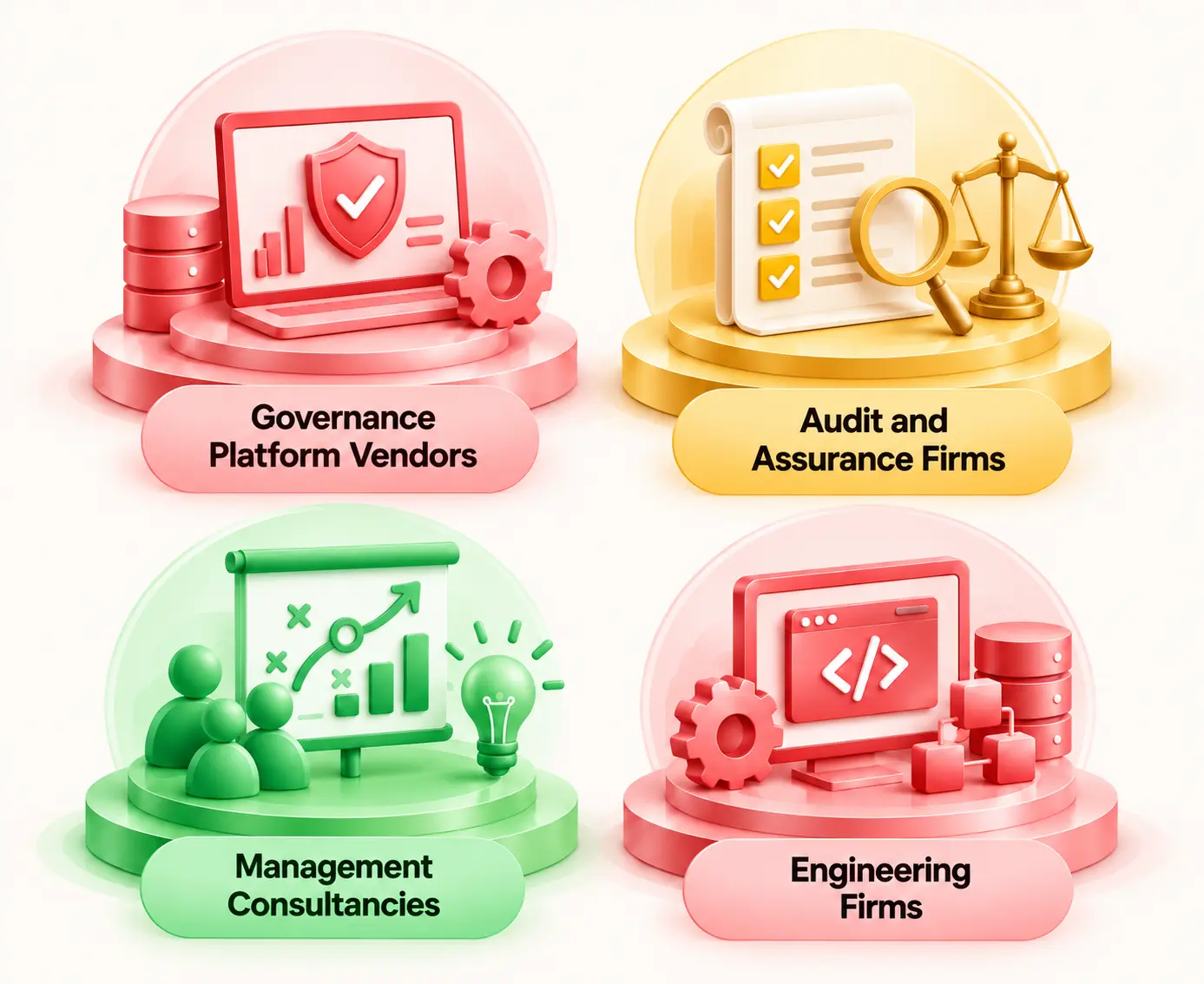
Governance platform vendors sell software that helps to inventory AI assets, monitor models in production, enforce policy rules, and generate continuous compliance reports at scale. They are primarily useful when governance processes and ownership are already defined.
Governance platforms are strong at recording, enforcing, and reporting controls once those controls have been defined. They can also support AI inventory, monitoring, workflows, approvals, and reporting across a large estate.
They cannot decide your operating model, classify your risk tiers, or produce evidence your pipelines never emitted. A platform bought before ownership is decided produces a configured tool and no change. As practitioners on developer forums like Reddit frequently point out, buying a software tool without internal process ownership results in expensive shelfware.
Teams usually select the platform, configure workflows and controls, connect data sources, and roll it out across relevant AI systems.
They fit when the operating model already exists, and the main problem is scale, consistency, and visibility using automated AI governance tools.
The audit and assurance providers independently review AI governance controls and processes, as well as evidence, according to certain standards or requirements. Their role lies more in evaluation, assurance, certification assistance, and providing opinions than in creating controls themselves.
Audit and assurance firms are strong at independent examination, conformity assessment, and producing an opinion or attestation that regulators, customers, or boards may require.
Independence restrictions prevent them from engineering the underlying code or building the evidence trails they audit.
The team defines the scope, examines controls and evidence, identifies findings, and produces an assessment, report, opinion, or attestation.
Ideal when board members, regulators, or enterprise clients require an objective opinion or official certification, especially with upcoming regulations enforcing strict penalties like the EU AI Act's fines of up to 7% of global turnover.
Strategic advisory firms that help organizations define their AI operating models, establish risk governance charters, manage organizational change, and align executive leadership. Their work typically covers operating models, policies, ownership, risk structures, and governance roadmaps.
These enterprise AI governance consultants excel at designing operating models, aligning executive priorities, structuring cross-border governance programs, and managing organizational change.
They deliver strategic roadmaps and policy frameworks rather than instrumented code, requiring internal developers or outside technical partners to execute.
The work may include stakeholder interviews, current-state reviews, governance design, role definition, policy development, and a phased roadmap.
The right fit when your primary blocker is organizational, such as unclear leadership ownership or conflicting risk appetites.
Engineering firms build the technical controls that make AI governance work inside production systems. Their work can include evidence capture, pipeline controls, evaluations, lineage, monitoring, and guardrails for AI systems and agents.
Specialized technical teams that instrument evidence directly into data pipelines, build lineage and evaluation infrastructure, and deploy agent guardrails. Leading analysts predict that 70% of enterprise decisions made by automated systems will soon require explicit explainability (XAI) and guardrails built directly into software workflows.
They do not issue formal audit opinions, certify regulatory compliance, provide legal counsel, or resolve executive alignment disputes.
Hands-on development, pipeline instrumentation, gate integration into deployment workflows, and technical remediation.
Essential when your policies are defined, but the underlying technical evidence and guardrails are missing. If you are learning how to choose an AI governance partner, knowing if your gap is strategy or engineering is critical.
The Entrans Perspective
In Entrans engagements, the most common misdiagnosis at the outset is an organization buying a platform when its actual blocker was uninstrumented pipelines, which the platform then reports on accurately but cannot fix.
The question is not simply which vendor has more capabilities. The better question is which category matches the work that is actually missing.
Most enterprise teams waste months hiring the wrong type of expert because they misdiagnose a technical gap as a policy issue or an organizational dispute as a software problem. The right category usually becomes much clearer once you describe what is going wrong.
The table below is designed to help with how to choose an AI governance partner without assuming that every problem needs a vendor. In some cases, the first step is simply to make an internal decision, document what already exists, or fix a process before bringing in AI governance consulting services.
Choosing between enterprise AI governance consultants can get confusing when every provider uses similar language. A better way to compare AI governance companies is to ask the same questions and look at how directly they answer.
These questions are meant to help buyers assess AI governance consulting and AI governance consulting services without relying on a vendor's sales presentation. The full question set can also be turned into a fillable checklist for teams that want to score their conversations internally.
First, find out where the limits are drawn for the partner. It should be possible for an honest provider to delineate what is included in its scope and what is not.
Policy may seem to be well-defined on paper while the production system tells another tale. What occurs when there is no technical evidence?
It is important to know when a provider offers both assessment and remediation services. You need to ask the question directly instead of making assumptions.
A proposal can sound impressive without telling you what actually happens after the contract is signed. Ask for the shape of the engagement in practical terms.
Past work tells you more when you can see what the provider actually produced rather than only hearing about outcomes.
If you only have time to ask three questions during an initial vendor screening, prioritize these three. They immediately separate hands-on specialists from generic consultancies:
The above questions make choosing an AI governance partner about comparing sales claims and more about testing what each provider can actually do.
Prior to evaluating the different enterprise AI governance consultancies, one needs to understand the nature of the consultancy engagement. The duration of the engagement and its cost can range widely depending on whether the project might comprise just one AI use case or a whole multinational AI governance framework.
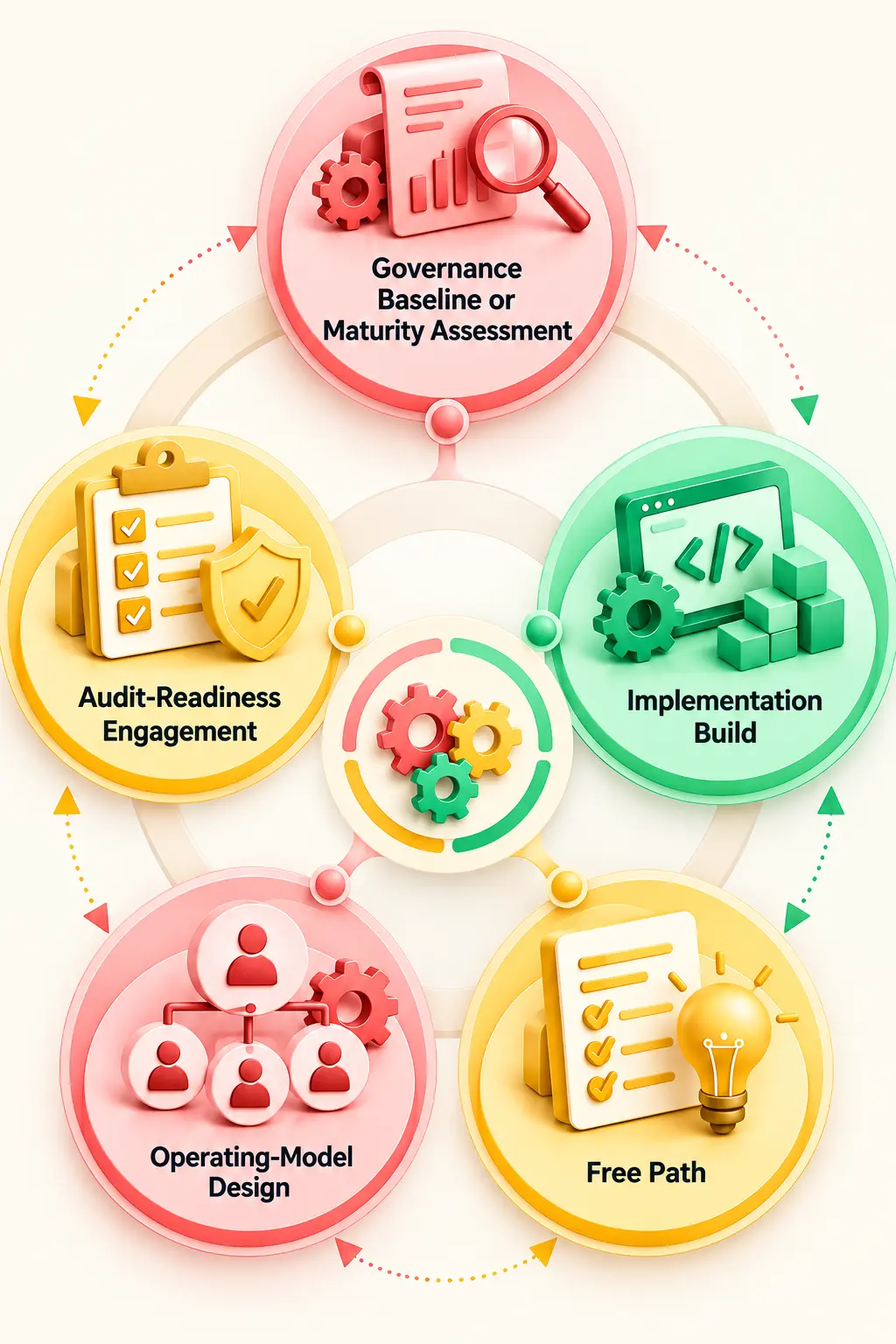
When you do need external expertise, AI governance consulting services fall into four primary engagement shapes, each spanning distinct timeframes and cost drivers:
When evaluating an AI governance consulting services proposal or navigating an AI governance tools comparison, watch out for three critical billing traps:
Entrans fits when the governance policy is already in place, but the technical evidence is missing. That includes models already running in production without lineage, AI agents that need guardrails, audit-readiness engineering, and governance controls that need to be built into delivery pipelines.
We excel when your policies exist, but the underlying technical evidence does not. Entrans is an engineering firm that specializes in instrumenting production models lacking lineage, deploying active agent guardrails, and building continuous evaluation controls directly into delivery pipelines. By integrating these technical controls with enterprise-grade cybersecurity and compliance frameworks, we ensure your governance is functional and production-ready rather than just passive paperwork.
We do not issue formal audit opinions, certify regulatory conformity, or offer legal counsel on risk classification. Furthermore, if your primary blocker is executive alignment or organizational design, a management consultancy or audit firm is the better first call. We sell both the initial risk assessment and the subsequent engineering remediation. We ensure your governance investment builds lasting operational confidence rather than an expensive, unused policy document.
Learn how to diagnose your core needs first, and demand early technical deliverables. Book a consultation call with us.

An AI governance consultant helps organizations bridge corporate strategy, regulatory compliance, and technical execution to ensure AI systems are safe, compliant, and ethical. They can also support compliance, assessments, monitoring, documentation, and ongoing governance as AI systems evolve.
Choose an AI governance partner who has AI expertise, regulatory knowledge, technical capabilities, and implementation experience. Cross-check their evidence of how they have handled governance in real-world environments, not just frameworks or presentations.
Ask how they assess AI risks, implement controls, measure effectiveness, document evidence, and handle changes to AI systems. Also clarify their experience, responsibilities, deliverables, timelines, technology requirements, and what happens after implementation.
You need a platform if your operating model and ownership are already defined and you simply require software to automate inventory and monitoring at scale. You need a consultant or engineering partner if you first need to design policies, align executive leadership, or manually instrument data pipelines to produce the underlying evidence.
Yes, a firm can assess your governance and help address the gaps it identifies. However, clarify the scope, methodology, independence, and validation process so the assessment remains credible.
AI governance costs vary significantly based on the number and complexity of AI systems, scope, regulatory requirements, and level of implementation support. Ask vendors for a clear breakdown of deliverables, effort, ongoing fees, and any additional platform or integration costs.
A standard AI governance assessment or maturity review generally takes 3 to 6 weeks to complete. Full-scale implementations such as building active guardrails, setting up evaluation gates, and achieving full audit readiness typically span anywhere from 8 to 16 weeks.
Yes, organizations with strong internal leadership and mature engineering capacity can establish governance independently using self-serve assessment rubrics and evaluation scorecards.

-1.svg)