Explore nine AI governance challenges that stall enterprise programs and get actionable first steps to fix organizational, risk, and engineering bottlenecks.

Agentic Unconference 2026 - September 19, Chennai
View Event →





Do you know the reason most enterprise AI initiatives suddenly grind to a halt just before reaching production? The real truth is that they break inside the engineering pipeline. Most organizations struggle with persistent AI governance challenges because they mistake an engineering bottleneck for a compliance issue.
In this blog, we will see the nine common challenges across organizational, risk-surface, and engineering layers and learn the exact first steps to get unstuck today.
AI governance stalls when the controls a policy requires cannot be produced by the existing delivery pipeline. More often, we can face challenges when a policy says what must happen, but the teams building and running AI systems have no practical way to make it happen. There is no technical architecture that allows the use of these by the engineering and business teams.
The key issues in deploying AI governance don't all come from the same source, according to industry analysts at Gartner projecting that up to 80% of governance programs fail due to a lack of integration with core operational workflows.
To address the actual issue of AI governance, we break down the friction into three different layers:
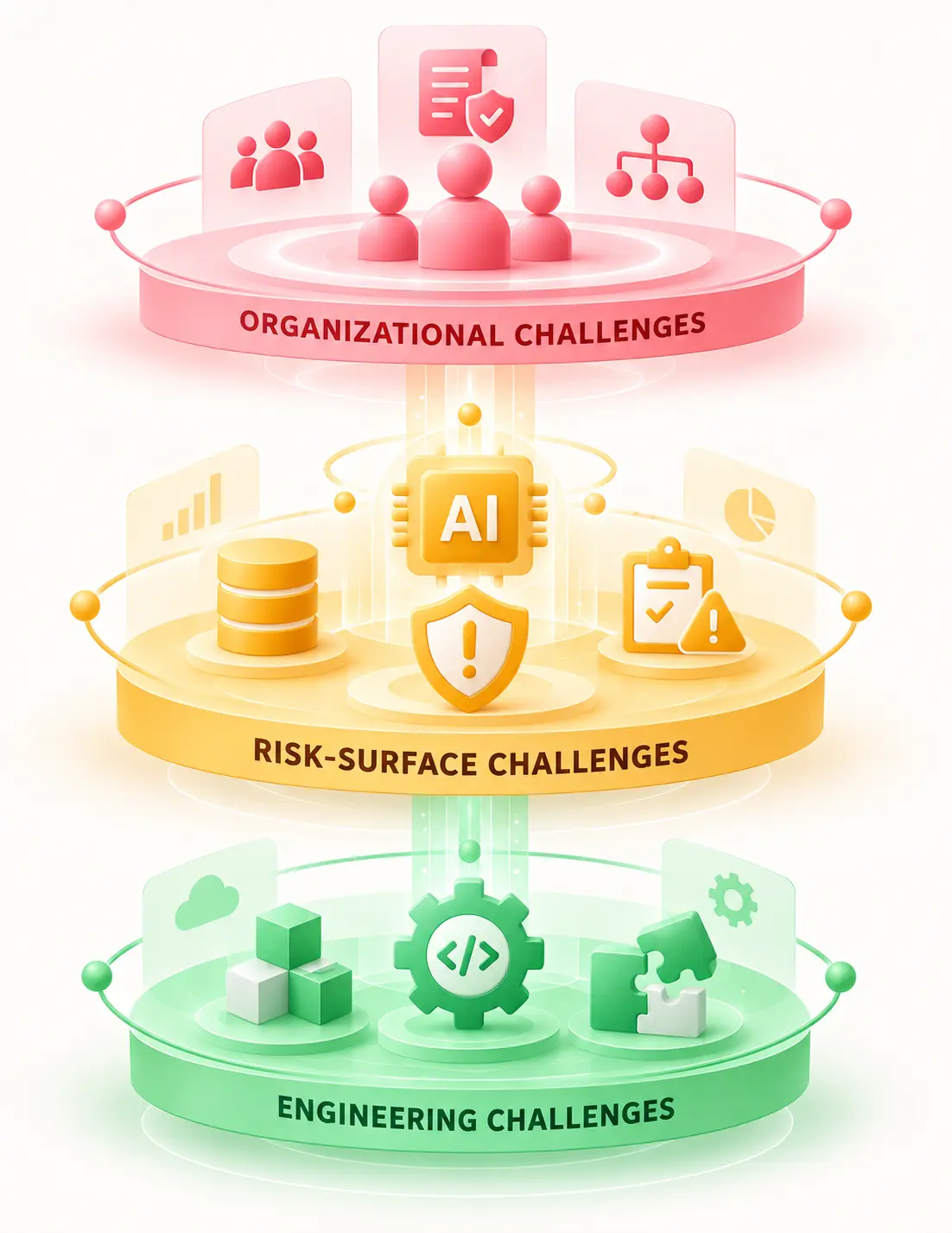
Most discussions of enterprise AI governance challenges cover the first two. They talk about ownership, policies, risk, compliance, and shadow AI. Those issues matter, but they leave out the engineering layer where many governance requirements actually have to work.
That third layer is where a policy can fall apart.
For each challenge, the goal is not just to describe what goes wrong. Each solution contains a first step that is to be taken by teams to get started in solving the problem without creating any further work on their governance agenda.
Many AI governance challenges start inside the organization, long before a model reaches production. The policies may be sensible, but unclear ownership, slow reviews, and weak decision rights can leave governance disconnected from how AI work actually gets done.
Everyone has their part in the job, but no one has ownership of the entire process. The Legal function looks after policies, Security assesses controls, the Data team manages data, while the Delivery team builds the solutions. When someone asks who owns AI governance, the answer is unclear.
The central AI governance problem is that traditional corporate hierarchies were not designed for it, leaving enterprise leaders struggling to adapt frameworks like the NIST AI Risk Management Framework (AI RMF) to assign multi-departmental accountability. Companies assume ownership will sort it out.
This explicitly answers who owns AI governance by defining four key roles across leadership who can handle documentation and auditability.
Engineering teams wait weeks for approval to deploy minor model updates or simple internal tools, creating massive development backlogs. They go through the same deployment process. For example, a low-risk internal assistant can end up in the same queue as a customer-facing agent handling sensitive information.
Approval gates are usually created when the enterprise has just a few products. It starts breaking down when the AI estate scales up across various teams, regions, and use cases.
Tier your review gates by risk level so low-risk internal applications skip the queue and bypass heavy compliance reviews reserved for high-risk, customer-facing models.
An AI committee publishes guidelines and best practices. The governance group cannot influence project timelines. But still, the product teams ignore them to hit feature delivery deadlines.
Governance committees often act as advisory boards without budget control or real leverage over engineering roadmap priorities.
Anchor governance to an existing corporate authority like the enterprise risk committee rather than creating an isolated advisory group. This gives governance a route into existing business decisions. For further detailed analysis, check out how this governance model can fit into an existing GRC structure.
Some problems that may arise with enterprise AI governance could start with the basic fact that the company is unable to see everything that is happening with AI within its surroundings.
Employees adopt AI tools, copilots, plugins, and agents available to the public but without any review process. The security survey shows that only 25% of the enterprises actually have clear visibility into employee AI usage. The consequence is that there is an issue of AI governance that remains off the record.
Users find faster ways to get work done, but the process is taking a long time.
Start with discovering egress traffic monitoring and network layer mapping, because you cannot govern an inventory you do not know exists. Look across identity, SaaS, procurement, network, and endpoint data to find AI tools already in use.
The governance cycle ends at the organizational boundaries while the risk of AI goes beyond that to the vendor’s model, data pipeline, and platform. The model origin might be unknown to you, as well as how the vendor uses your data. This practice keeps changing over time.
Traditional governance stops dead at the organizational boundary, but third-party risk flows right through it.
Extend vendor-management questionnaires to cover model provenance, model updates, data use, retention, and downstream providers using frameworks like ISO/IEC 42001 for Artificial Intelligence Management Systems.
Traditional governance often assumes a model produces an output and a person decides what happens next. Agents change that.
Autonomous agents take actions such as issuing API calls, modifying production databases, or triggering transactions rather than merely generating text for human review. This triggers live governance issues.
A Forbes article in August 2026 noted the importance of managing agent behaviors, identity management, and access control, and OWASP has created separate content on agentic security as well as the OWASP Top 10 Agentic Applications list.
Treat agent behavior and permissions as a distinct governance surface.
The most stubborn AI governance challenges are fundamentally engineering problems that surface in the production delivery pipeline.
Compliance teams demand lineage, evaluation metrics, and approval trails or audit records, but production pipelines never captured them- a gap frequently discussed in MLOps developer forums, where engineers struggle to retrofit observability onto existing codebases.
Many AI systems were designed without governance in place. The inclusion of evidence collection as an afterthought may be the biggest expense of the project.
Instruments should be the new model right from the beginning. For existing property, try starting off with systems that have greater risk.
When an incident occurs, the engineering teams cannot pinpoint which exact model version, training dataset snapshot, or prompt template produced the output.
Without continuous tracking, teams accumulate versioning debt that makes tracing root causes nearly impossible. Once systems scale, that missing history becomes an AI governance problem.
Version the artifacts first. Then create your governance requirements based on what information your systems can capture.
Governance can be defined as a policy issue, but then it’s the engineers who have to do the grunt work, and they already have overloaded delivery pipelines. Someone has to implement the logging, provenance, versioning, evaluation, and evidence workflows.
Leadership plans for legal and policy reviews while assuming technical evidence generation comes "for free."
Include costs of evidence-gathering directly in the program budget. Where engineering capacity is not dedicated, there is no funding for the governance mandate.
Not all AI governance challenges are created equal. Some issues can be fixed in the meantime, while some need budget and engineering time. But some problems cannot be solved by governance at all because they require an executive decision.
This process of triage will assist in separating the key challenges in implementing AI governance from those that should be addressed by leaders. The idea is straightforward: fix what is broken, invest where needed, and escalate those things that must be decided at the organizational level.
Three of the challenges are indeed structural: authority over the order of deliveries, ownership of data across units, and differing appetites for risk. A process fix cannot resolve these issues alone. It requires someone with the proper authority to decide.
This is important to note. Enterprise AI governance challenges become difficult when teams take months trying to process information to make decisions that require decisions from the leadership. What they need to do is solve the problems that can be solved, fund the engineering process, and escalate the structural issues.
Sometimes the AI governance challenges can create more work without fixing the underlying AI governance problem. When teams feel pressure to show progress quickly, they can reach for policies, platforms, and approval processes before settling the decisions that make governance work.
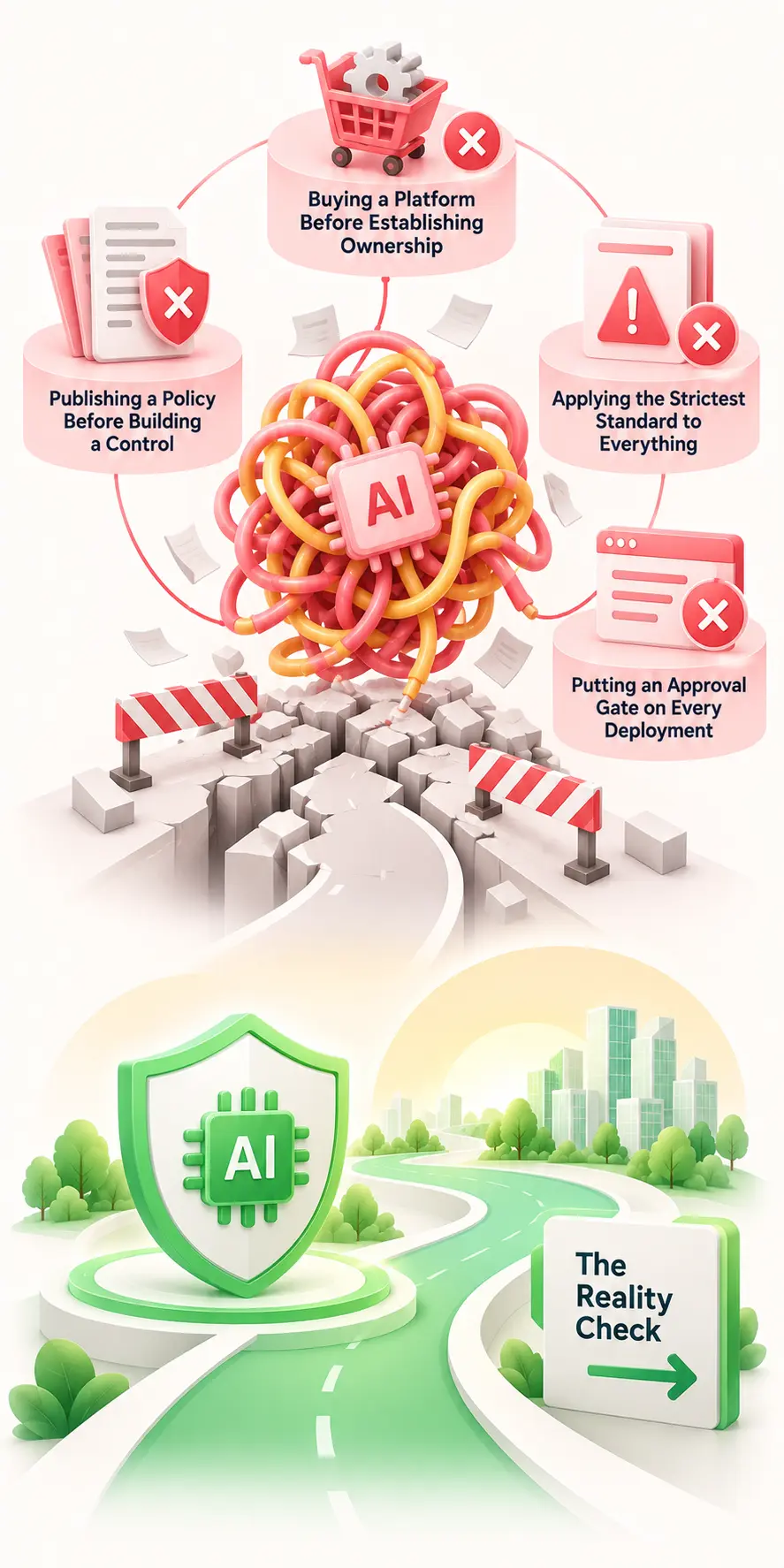
This diagnosis highlights the structural key challenges in implementing AI governance, but it has its limits. It has diagnosed the nine challenges; it cannot tell you whether your specific use case is high-risk. A governance program can also surface a dispute over data ownership, but the program itself cannot settle that organizational dispute. Those decisions need the right business authority.
If there are problems associated with AI governance, even with the existence of policies and procedures, the first thing that should be done is to identify how things are actually being done.
Entrans diagnoses stalled programs through a targeted diagnostic methodology:
Since this test checks the code against real-world controls, it does not fall into the trap of producing hypothetical regulations that cannot be enforced. The resulting blocker matrix is clearly ordered into the following categories: solvable quick wins, engineering tasks, and structural blockers. The structural blockers are raised directly to executive management and not buried in working group worksheets.
To see where your AI pipeline lacks critical evidence logs or compliance controls, get a scoped review of where your program is stuck. Our targeted diagnostic tests your live workloads against enterprise policies to surface actionable, executive-ready next steps.
Learn how we analyze whether your roadblocks are quick fixes, technical tasks, or structural executive decisions. Book a consultation call with us.
The biggest AI governance challenges comprise organizational friction, unmanaged risk surfaces, and technical/engineering gaps. The biggest hurdles are fragmented accountability, "shadow AI," vendor black boxes, and an inability to enforce safety rules directly.
AI governance programs fail primarily because of a structural disconnect. They often fail when policies move faster than the systems and teams responsible for putting them into practice. Without clear ownership, usable controls, evidence, and engineering capacity, governance becomes another process that teams work around.
Ownership for AI governance is unclear because it can span business, risk, security, data, legal, and engineering teams. A clear accountable executive, risk classifier, control implementer, and evidence custodian can help close that gap.
Shadow AI refers to the deployment of AI technologies without following an official governance process within the organization. This is important since you can neither assess, secure, nor govern what you do not know about.
Traditional models simply generate text or code for human review, but autonomous agents take direct operational actions. Since AI agents have access to resources and perform actions on their own, governance also needs to include permissions, actions, approvals, and escalations.
An AI governance platform could be useful in gathering evidence, managing workflows, and controls, but it cannot solve the question of ownership or executives’ disputes. If the platform is purchased without establishing the operating model, then it might end up being configured and the governance issue remaining.
First, start by doing governance work for specific business and risk requirements. Calculate the cost of the required evidence collection and telemetry work directly into initial engineering development plans. Cost the evidence and control work instead of treating governance as a policy-only project.
Some common AI governance challenges include unclear ownership, shadow AI discovery, risk-tiered approvals, vendor reviews, evidence capture, and artifact versioning. Disputes about delivery jurisdiction, cross-department data ownership, or significant discrepancies regarding risk tolerance often require executive action.


-1.svg)