Discover 9 actual AI governance practices to learn what works, what doesn’t work, and how to develop efficient and auditable controls without big tech excesses.

Agentic Unconference 2026 - September 19, Chennai
View Event →





AI governance seems quite simple until an organization needs to determine the ownership of AI, which AI systems require governance, and what data should back up production decisions. That is when things get more interesting. These AI governance examples examine nine programs and deployments to show what happened after governance moved from policy documents into real operations.
This blog will look at nine documented programs and deployments to uncover what worked, what failed, and what the evidence shows when the examples are placed side by side.
An AI governance example is a clearly defined system that shows how an organization operationalizes its rules, roles, controls, reviews, surveillance tools, and oversight in order to manage risk from using AI. This serves to show how ethics concepts like fairness, transparency, and data provenance have been achieved.
An AI governance model is essentially the document that details the guidelines and standards that have been applied in order to come up with a way of governing AI. An AI governance example is an illustration of how an organization governs itself in practice.
When readers search for AI governance examples, they often mix three different things:
This blog focuses strictly on the third category: AI governance policy examples in active deployment using famous AI governance case studies and failures to illustrate why those safeguards exist.
Not every story qualifies as an AI governance case study. Our selection criteria include examples based on four basic tests:
Examples that failed these tests were left out. This keeps the discussion centered on AI governance in organizations, rather than turning the section into a list of policies, frameworks, or headline-making incidents.
For the purpose of assessing the effectiveness of AI governance in organizations, it is essential that these profiles be constructed as practical guides and not simply as an anecdotal set. AI governance is never merely a policy but is a dynamic process.
AI governance examples can look very different on the surface. Analyzing AI governance examples through a standardized lens makes it much easier to identify patterns you can adapt for your own organization.
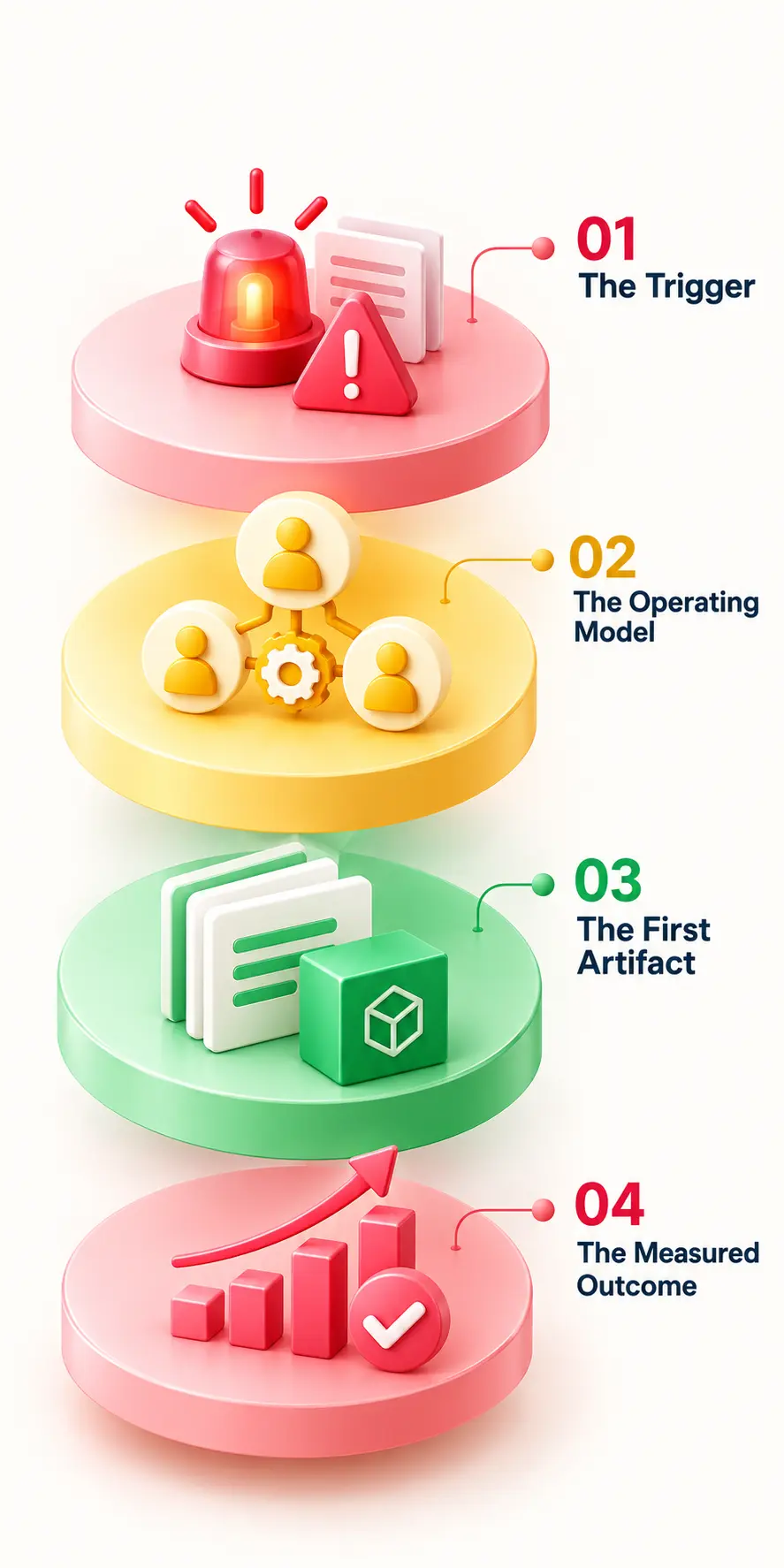
Every profile in this guide is mapped against four core dimensions to ensure direct comparability. This makes it easier to see what actually changed inside the organization, rather than simply collecting interesting stories.
As you review these AI governance policy examples, keep a critical perspective on what gets published. There is also a survivorship problem. Published governance programs are more likely to be successful enough to become case studies.
Meanwhile, AI governance failures that receive public attention are usually specific incidents, not detailed accounts of governance programs that failed internally.
So these examples should be read as documented evidence, not as a complete picture of AI governance in organizations.
To quote AI governance examples, they come from companies that have been running AI programs at enormous scale. They are well documented, though not just plug-and-play templates.
The examples below use the same four dimensions: trigger, operating model, first artifact, and outcome.
Microsoft’s responsible AI work grew from its company-wide AI principles and the need to put those principles into day-to-day product development. High-profile algorithmic missteps and the rapid rollout of generative models forced Microsoft to establish a company-wide standard to replace ad-hoc product safety checks.
Microsoft uses a federated model with strong leadership oversight. A centralized Office of Responsible AI sets policy, while dedicated Responsible AI Leads are embedded within engineering teams.
The Microsoft Responsible AI Standard (v2), a comprehensive internal operational framework translating abstract ethics into checkable engineering requirements.
Microsoft's scale is the important result to note. Its 2026 transparency report says nearly 20,000 engineers, policymakers, and customers received responsible AI training.
The useful lesson is the move from principles to engineering requirements. The limitation is scale. A 5,000-person firm must recognize that it will not require Microsoft’s levels of councils, offices, and specialists. Mid-sized organizations should extract the core requirements rather than copying the entire governance overhead.
The AI principles development was undertaken by Google in 2018 as a response to public pressure from controversies surrounding its military contracts. The AI principles are meant to guide the use of AI technology in Google’s operations.
An Executive AI Ethics Board paired with a dedicated Responsible AI team that conducts risk reviews for custom models and enterprise deployments. Reviewers assess potential benefits and harms, bring in specialists in areas such as privacy, security, and fairness, and recommend technical evaluations or adjustments.
The starting point is not simply a policy document. Google's AI Principles are backed by a mandatory internal review matrix for high-risk applications. They act as the decision criteria by creating a working record around a specific AI project, analysis, recommended adjustments, technical evaluations, and eventual decisions.
Hundreds of project reviews are conducted annually, resulting in model adjustments, restricted feature rollouts, or halted deployments for non-compliant use cases.
The key example of AI governance policy is the linkage of principles and decisions taken for a specific project. Yet once again, Google’s worldwide product portfolio makes its structure hard to replicate within a 5,000-person enterprise.
IBM established its AI Ethics Board in 2019, at a time when dedicated AI regulation was still developing. Anticipating enterprise client demands for explainability and strict regulatory compliance across business intelligence tools.
IBM uses a layered structure. A Policy Advisory Committee provides senior oversight. The AI Ethics Board handles centralized governance and review. AI Ethics Focal Points sit within business units and act as the first point of contact for individual use cases. An employee Advocacy Network helps spread the work across the company.
An internal Use-Case Risk Assessment protocol and automated audit readiness guides.
Scaled ethical reviews across thousands of client engagements and product builds while maintaining a centralized audit log.
IBM demonstrates why governance does not have to mean one central committee reviewing every AI project. Business-unit focal points can handle initial triage. Still, the full IBM structure is much larger than what most 5,000-person enterprises need.
A 6,000-employee healthcare network wanted to deploy LLM-powered patient triage assistants but faced strict HIPAA data leak risks and clinical hallucination concerns. Healthcare needed to focus on clinical validation, privacy, interoperability, and ownership. Manufacturing had further issues related to OT-IT integration, sensors, latency, legacy systems, safety, and roll-back.
We structured a cross-functional AI Risk Committee consisting of the Chief Medical Officer, Lead Engineer, and Compliance Officer, meeting bi-weekly. They analyzed the risks of each use case. This keeps governance tied to actual delivery work.
The starting point was a structured readiness and governance view of the use case. The work mapped ownership, data boundaries, validation needs, security controls, human oversight, and operational requirements before the system moved further toward production.
Cut safety review times for new clinical AI features from 8 weeks to 10 days while achieving zero HIPAA compliance violations during external audits. The reported delivery work also included a 60% reduction in onboarding time in a related governance workflow.
The lesson is not to recreate Microsoft's or IBM's governance machinery. For a 5,000-person enterprise, a smaller model built around use-case inventory, risk classification, ownership, evidence, and production gates may be more practical.
Examining AI governance failures offers crucial lessons in risk management. They show more than what went wrong. Most public failures are not caused by missing code, but by missing operational safeguards, inadequate testing, or bypassed approval controls.
The examples below cover three different failure patterns: discriminatory outcomes, inappropriate data use, and governance controls that existed but did not stop harmful deployment.
The EEOC claimed that the iTutorGroup software automatically screened out female candidates above 55 years of age and male candidates above 60 years of age, impacting over 200 eligible applicants. For this AI governance failure, they agreed to pay $365,000 to settle the case.
The FTC accused Rite Aid of using facial recognition technology without properly assessing its accuracy and false positives. It argued that the system discriminated against individuals living in areas where the population was mostly made up of Blacks and Asians.
The ICO in the UK determined that Clearview had collected images of UK citizens on the internet and social media platforms and then stored them in their facial recognition database. An enforcement notice was issued by the regulator, as well as a fine of £7.5 million in 2022.
These cases show why AI governance policy examples cannot stop at written policies. A policy needs evidence, testing, ownership, monitoring, and escalation. In AI governance in organizations, the real question is not whether a control exists. It is whether the control actually stops a risky system from moving forward.
The best cases of AI governance are more than just descriptions of policy and committee structures. They demonstrate how governance works from the point of view of someone who must actually sign off on an AI system. The following documents should thus be read as redacted actual documents.
Below are three real, redacted artifacts from enterprise deployments. These AI governance policy examples highlight how real-world risk management operates in practice.
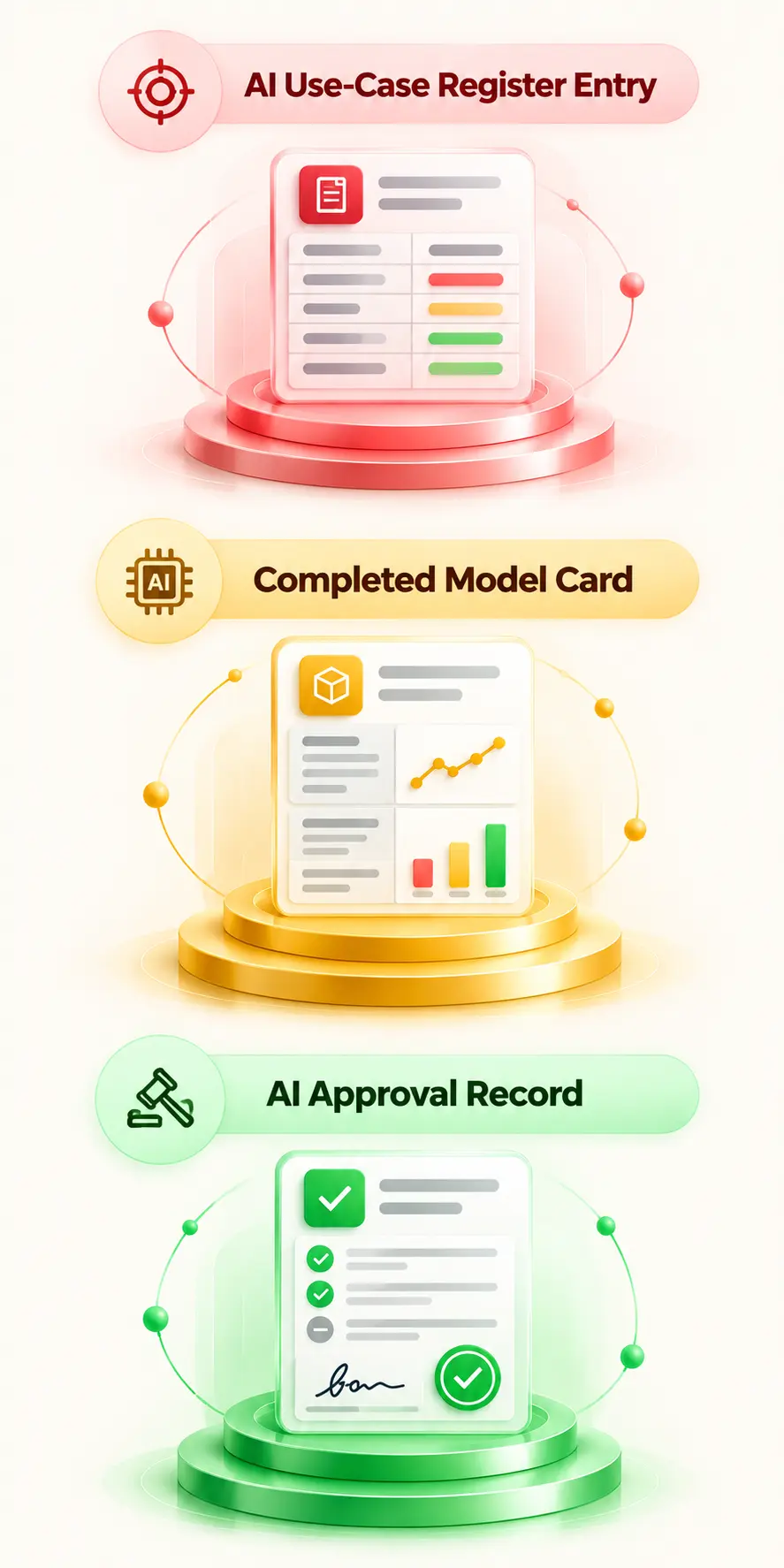
Analyzing these concrete AI governance examples shows how structured artifacts bridge the gap between high-level policies and daily execution.
Comparing real-world AI governance examples reveals clear structural trends across different organization sizes. The point is not to find one governance model that every enterprise should copy. The stronger AI governance case studies show how the trigger, ownership model, first control, and measurable result change from one organization to another.
AI governance examples can show what has worked or failed. They have their clear limits, especially when the available evidence comes from large companies or publicly reported incidents.
Instead of importing rigid big-tech templates, Entrans builds custom programs aligned with robust cybersecurity and compliance standards, tailored directly to an enterprise’s actual operating scale. We use the same questions that make the examples above useful:
Trigger: An urgent operational catalyst, such as shadow AI adoption, pending regulatory audits, or unsafe LLM deployments.
Operating model recommendation: Rather than importing Microsoft's, Google's, or another company's structure, Entrans maps decision ownership, risk responsibilities, review points, and technical stakeholders to the client's size and AI estate.
First artifact: The first deliverable is tied to the use case. Depending on the situation, that can be an AI use-case inventory, risk classification, governance assessment, control register, or evidence record.
Measured outcome: Drastically reduced safety review cycles (e.g., cutting review times from eight weeks to ten days) with zero audit violations.
By starting with a customized operating model and an actionable first artifact, Entrans bypasses the trap of copying impractical tech-giant blueprints. Teams gain immediate runtime controls that evolve naturally alongside their AI adoption maturity.
Learn how we help you skip the administrative bloat, turning abstract ethical standards into actionable runtime controls that keep your AI deployments fast, safe, and fully audit-ready. Book a consultation call with us.

AI governance examples include AI use-case registers, risk assessments, model reviews, approval workflows, monitoring controls, and documented ownership. Some of the real programs at Microsoft, Google, IBM, and other enterprises show how these controls can work.
A real program connects policies with day-to-day processes for reviewing, approving, monitoring, and documenting AI systems. It uses pre-deployment bias checks, continuous performance monitoring, and clear audit records for every algorithm in production.
Major Tech giants such as Microsoft, Google, and IBM maintain highly structured, well-documented programs. Their scale means their structures should be treated as reference points rather than templates for every organization.
Examples include biased automated hiring, facial-recognition problems, and inappropriate collection or use of personal data. These AI governance failures show why testing, privacy reviews, monitoring, and approval controls need to work in practice.
An AI use-case register typically records the use case, business owner, data involved, risk classification, controls, review status, and deployment stage. It logs every proposed or active model along with its business owner, technical specifications, and training data sources.
There is no single timeline because results depend on the organization's size, AI estate, trigger, and governance model. Early controls can appear within weeks, while broader governance programs may take months to establish and measure.
No. Because copying massive corporate templates creates unnecessary bureaucracy for smaller teams without addressing your specific data flows.
Companies rarely publish their internal operational blueprints, and those that do tend to share heavily polished success stories. Furthermore, most program failures happen quietly behind closed doors, leaving only major public lawsuits or regulatory fines as visible case studies.

-1.svg)