Modernize legacy systems with COBOL to Java migration. Learn proven approaches, costs, AI strategies, and best practices for a successful migration.


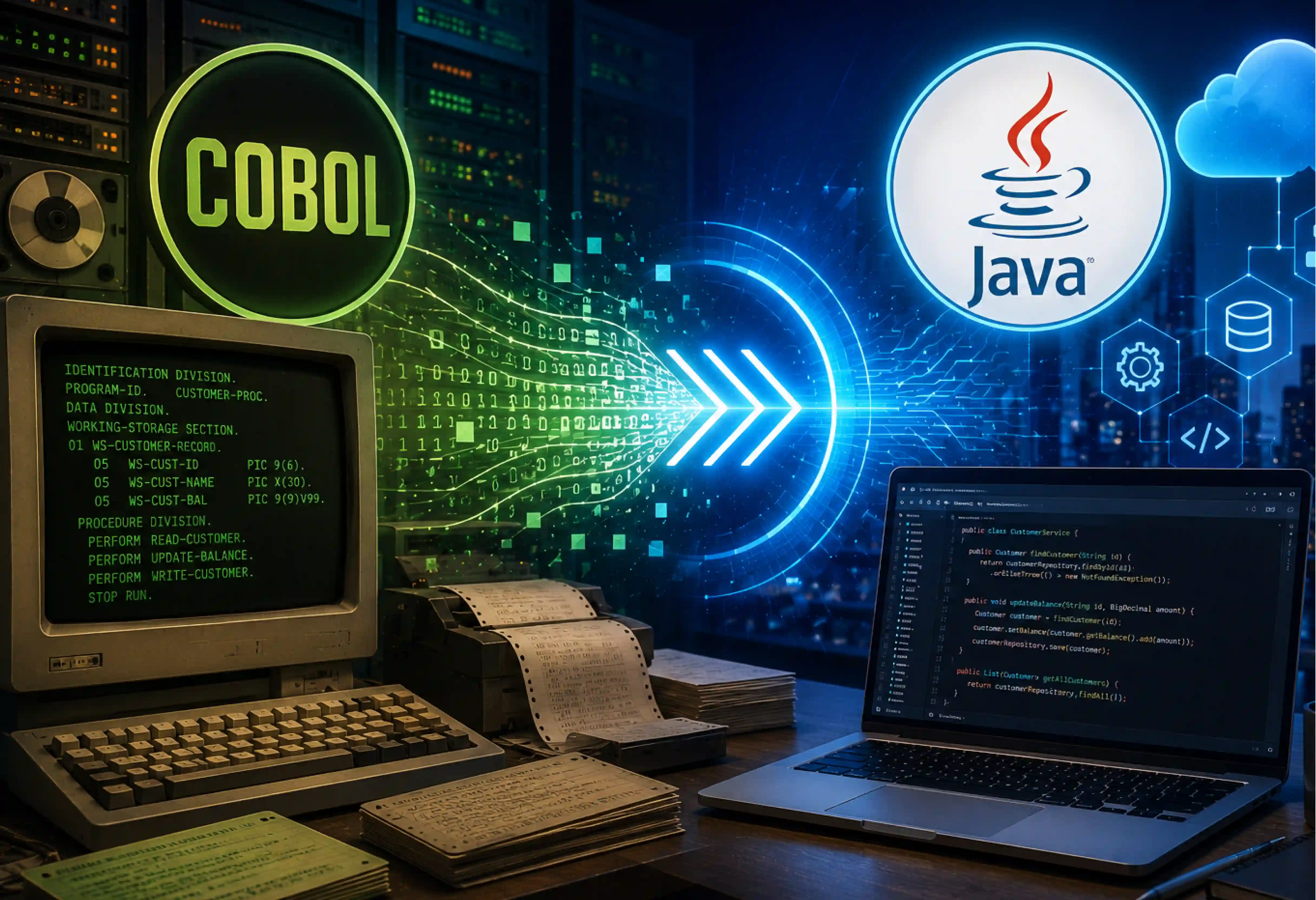


In fact, the use of the COBOL programming language has proved to be quite useful. It helps in making applications that have been quite successful in the commercial world for many decades now. But how do you feel about how these applications change over time? Every year, they become difficult to maintain and hard to integrate with new applications.
Many leaders believe that COBOL-to-Java migration means years of work. They also think it requires an expensive budget to carry it out. But that is not true. New AI-assisted migration techniques make it possible to move faster. At the same time, they keep business rules intact.
This post will guide you through the process to be carried out for COBOL-to-Java migration. It covers its available approaches and various factors.
COBOL to Java migration means converting existing applications. One change the language from COBOL to Java without altering the existing logic.
The primary purpose of this process is to
The Common Business Oriented Language, or COBOL, has been the most commonly used programming language for enterprise applications. It has held this role through all these years. COBOL has handled all the transactions of the banking sector. It has dealt with insurance policies. It has even made bookings for flights. But maintaining it increases the cost. Moving from COBOL to Java is an urgent strategic necessity.
It has become difficult to find skilled developers in COBOL programming because there is a reduced number of such programmers. Few engineers show interest in learning mainframes. In contrast, the Java programming language has become one of the most popular languages in the world.
Running a mainframe is exceptionally expensive. Hardware upgrades, software licensing, specialized support, and ongoing operations keep adding up. Whereas Java applications can run on commodity servers or cloud platforms. This gives more flexibility in managing costs and scaling resources.
The need for speed when releasing new versions is essential. You need this speed to compete in the market. Conventional COBOL-based systems may take longer to develop and test. This is particularly true when they affect several interdependent systems. Java enables the latest development approaches. These include DevOps and continuous integration/continuous delivery.
The issues associated with this problem arise due to the use of AI-generated models and technologies, including predictive analytics, and the real-time capabilities of business applications. The refactoring of the monolithic code from COBOL to Java enables programmers to split the application components into microservices.
It seems like linking COBOL applications with innovative ones is tough. Java provides connectivity with innovative cloud services, REST APIs, Kubernetes, and CI/CD.
COBOL applications often contain decades of accumulated business logic, making changes difficult to understand and implement. Due to a shortage of skills and platforms, COBOL poses an audit and continuity risk. This is extremely dangerous in the case of BFSI, insurance, and government, as security is the most trusted thing here.
There is no single right approach to modernize legacy applications. Depending on portfolio size, codebase complexity, organizational risk tolerance, and target cloud architecture, the right approach is to be chosen. The 4 main migration strategies are discussed below.
This is the fastest and cost-effective option for carrying out large migration programs. Rule-based converters and migration 'factories' translate COBOL to Java at scale. This migration approach focuses on preserving existing business logic and delivering functional equivalence with minimal manual effort.
Best suited for applications where long-term maintainability by native Java developers is essential, but manual reverse-engineering is too slow.
Produces non-idiomatic Java ("JOBOL"), retains procedural structures, and leaves monolithic debt intact.
AI has become a major decision-making tool in carrying out COBOL modernization. Large language models and multi-agent workflows translate COBOL, review generated code, propose code changes, generate unit tests, and provide reasoning for old business logic. Such an approach generates readable code; however, it requires testing, security review, and governance.
Maintainability for years to come by native Java developers is crucial, but reverse engineering manually takes too long.
Generates idiomatic Java, auto-documents business rules, and refactors procedural code into modular classes.
Requires human validation, can introduce non-deterministic errors/hallucinations, and requires token budget management.
A manual rewrite will recreate the application using Java as opposed to rewriting the existing application code. The development team reviews the business requirements and then rearchitects and refactors the application using contemporary patterns for application development.
It is the most flexible and maintainable strategy but is also the most expensive and risky option. This is because most legacy COBOL applications have a large number of rules in the business which may be difficult to remember while rewriting the application.
Reserved for high-value core domain systems where business rules need redesigning.
Delivers cloud-native, clean architecture, eliminates obsolete business rules, and maximizes performance.
Extremely expensive, slow, and carries high business risk of missing undocumented edge cases.
Hybrid migration strategy is the most chosen approach as it combines the strengths of multiple approaches. Automated conversion creates the first version of Java applications. AI tools improve code quality and documentation, and engineers manually modernize the most complex or business-critical modules.
Large-scale enterprise systems that cannot tolerate downtime.
Balances speed with architectural modernization; enables incremental cloud migration without big-bang risk.
Middleware complexity, potential latency overhead across hybrid layers, and higher setup costs.

Automated conversion tools convert COBOL syntax directly into Java statements without underlying procedural design. The result is JOBOL - Java code that retains COBOL structures such as global variables and monolithic files. This code is difficult to read and challenging for Java developers to maintain. Basically, JOBOL can carry legacy design patterns into a new platform.
Preventing JOBOL requires shifting focus from simple translation to structural modernization:
Migration success cannot be judged based solely on whether or not the software is functional. Companies need to develop acceptance criteria for maintainability, readability, code quality, and even test coverage.
Using various measures, including code complexity, code duplication, documentation, and compliance with the Java programming style, makes it possible to be sure that the program that has been ported is ready for development rather than mere execution on another system.
COBOL to Java migration would be a shift in the business logic, database, and processes. An iterative process is essential for a successful migration, where the process will be end-to-end to ensure business functionalities through cloud-native Java.
Create a portfolio: lines of code, dependencies, data stores, batch and JCL, and integrations. Identify dead code and extract hidden business logic buried in procedural routines. This assessment helps prioritize the migration roadmap.
Identify the deployment place for the Java applications and how you will build them. Make an identification about the architecture of the application that will have clouds, containers, microservices, or modular monoliths. The migration technique that you will select must meet the goals of your organization. Select the right migration technique based on the migration method, application complexity, and organizational priorities.
Convert old data formats into newer relational or NoSQL databases, such as VSAM files, EBCDIC files, or DB2 databases to PostgreSQL and MySQL. Preserve the numerical precision while converting the data formats.
Convert COBOL functions to Object-oriented Java programs while maintaining their functionality. Convert the resulting code to an object-oriented design and enhance its readability by removing procedural aspects from it.
Run unit, integration, regression, and performance testing to prove that the Java application results in the same business impact as the original COBOL application. Critical business processes must be validated by business people before implementation.
Replace old interfaces with new APIs wherever possible. Integrate the Java application with databases, clouds, messaging services, analytics applications, and other enterprise applications to meet today’s business requirements.
Roll out the Java applications into the destination cloud platforms (AWS, Azure, GCP) or into the on-premises Kubernetes platforms. Do not make the entire replacement of the application in one shot.
Instead, begin with the less risk-prone parts and see how they work in production, then slowly move to the more critical parts. This will help us minimize the downtime and give teams sufficient time to solve issues.
Migration is not complete after deployment. Monitoring the application performance, refactoring old design patterns, adding more testing activities, and keeping code quality high are key to making sure that the Java application still meets business needs.
The migration process of COBOL to Java is one of those complicated modernization processes that companies can choose to perform. It is important to be aware of the main challenges involved and have proper solutions in order to develop a usable Java application. COBOL to Java migration challenges include:
Many COBOL applications contain business rules that have evolved over decades. Missing a small piece of code can affect business operations. To overcome this, make a thorough assessment of the application, involve business experts, document critical workflows, and validate migrated applications with extensive regression testing.
Legacy systems often lack documentation. It is difficult to understand how applications interact with databases, batch jobs, and external systems. To overcome this, make use of code analysis tools to discover the dependencies and generate documentation from the source code. Ask about the code with experienced developers and business users and document it.
Automated line-by-line converters create “JOBOL”- Java code that mimics procedural COBOL syntax. Java developers find this converted code unreadable by defeating long-term maintainability goals of the migration. To overcome this, refactor translated code into object-oriented designs, establish code review standards, and use AI-assisted reviews to improve maintainability.
Since most of the legacy applications support business-critical operations, minimizing downtime is very important. To overcome this, use phased deployments, parallel runs, and rollback plans. Start with lower-risk modules before transitioning mission-critical workloads.
Enterprises find it pressure to modernize quickly while keeping costs under control. Choosing the right migration strategy can also be a factor to increase costs and extend project timelines. These problems can be avoided by choosing the migration strategy according to the complexity, value to the business, and objectives of modernization for each application. This problem can be addressed by opting for the hybrid approach, which usually delivers tangible results.
COBOL to Java migration costs can range from tens of thousands to several million dollars. The migration cost totally depends on the size and complexity of the application.
The cost factors include
Enterprises should consider long-term maintenance, developer productivity, infrastructure savings, and future scalability.
AI has become a valuable accelerator in COBOL to Java AI migration. AI is used to convert code, understand legacy applications, and automate repetitive tasks. To get the best results through AI, review the code with human expertise, do thorough testing, and adhere to strong governance throughout the COBOL to Java migration services.
A successful COBOL to Java migration requires more than code conversion. Following COBOL to Java migration best practices helps preserve business logic, improve code quality, and lower project risk.
Moving from legacy mainframe to modern Java applications is a major milestone, but it doesn’t end on day one of production deployment. So managing operational changes, training the teams, and optimizing performance ensure your organization captures the full value of its digital transformation.
Check and confirm whether critical business workflows, reports, batch jobs, and transactions produce the same results as the legacy COBOL system. This validation helps to detect issues that might escape during testing.
Check the application performance, response times, resource utilization, and error rates after it is moved to production. Frequent monitoring helps to identify issues early and helps the application run reliably under production workloads.
Make a document about architecture diagrams, API specifications, and operational runbooks. Well-documented systems are easier to maintain and support.
Provide training to team members to make them familiar with new Java applications, development tools, deployment processes, and monitoring platforms. Knowledge transfer reduces dependency on legacy expertise.
Define coding standards, code review practices, release management processes, and quality metrics. Regular governance keeps the application maintainable and aligned with business objectives.
A successful COBOL-to-Java Migration requires more than code conversion. All its logic, data integrity, performance, and integration with modern systems all need careful attention. Partnering with Entrans brings in legacy modernization expertise with AI-assisted delivery to help enterprises move from COBOL to Java with lower risk and faster outcomes.
Learn more about how we help enterprises transform legacy COBOL applications into modern Java systems while maintaining business continuity and accelerating time to value. Book a consultation with us.
COBOL code is converted to Java through automated transpilation, AI-assisted refactoring, or manual re-architecting to convert procedural logic into object-oriented code. The migrated application is then tested and optimized to preserve business logic and improve maintainability.
AI can automatically analyze and draft Java code, but it cannot fully automate migrations without human oversight. It will not replace COBOL developers; it empowers them by translating their deep domain knowledge into modern Java architecture.
Migrations usually fail due to undocumented business logic, poor data type translation, inadequate testing, unrealistic timelines, or treating migration as a code conversion exercise. A phased approach with strong governance improves success rates.
Java is one of the most common replacements for COBOL, especially for modernization projects. Modern cloud-native technologies like microservices, PostgreSQL databases, and Python AI pipelines are also replacing legacy mainframe infrastructure.
Small to mid-sized applications typically take 6 to 12 months, while large enterprise-wide mainframe modernizations can span 18 to 36+ months. Timelines depend heavily on the portfolio size, the chosen migration strategy, and the extent of automated dual-run testing required.


-1.svg)