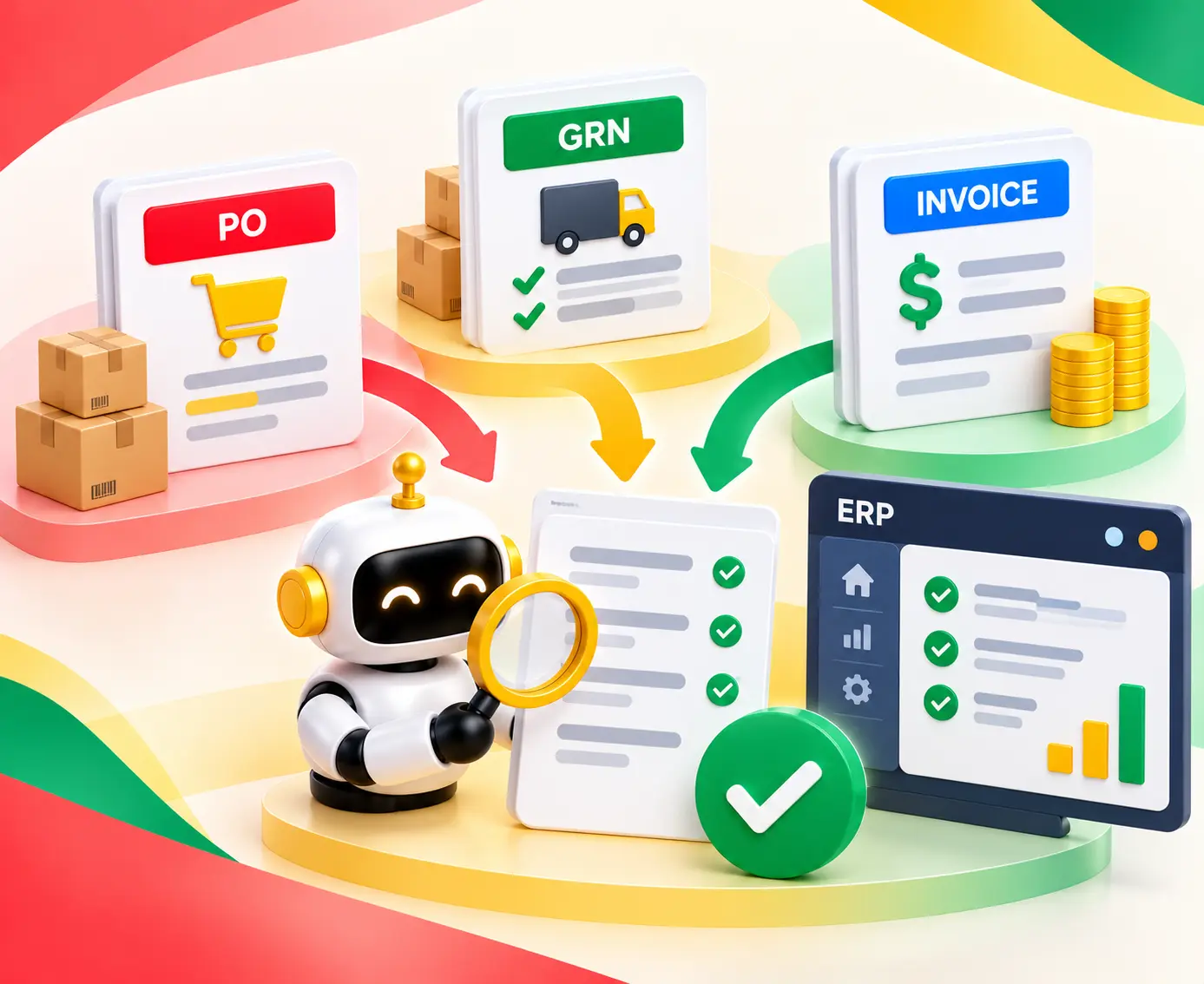
Discover how AI in lending automates loan approvals, credit decisioning, and collections while keeping risk models compliant and scaling safely.

Agentic Unconference 2026 - September 19, Chennai
View Event →


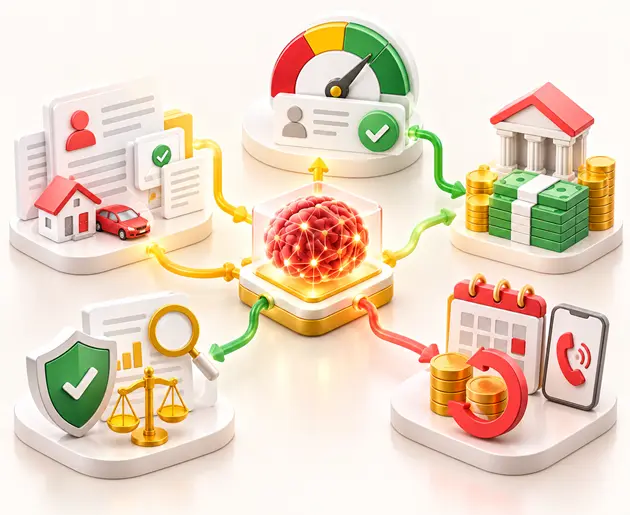


Imagine quick loan approval in just a few seconds, while sleepless auditors appreciate your risk models. Is this a dream-like scenario? Not anymore. Modern AI in lending is turning it into reality. This technology is transforming credit risk assessment, loan application review, loan approval, and collections. With the help of AI, we can automate mundane tasks and facilitate decision-making.
This blog will explain in detail how AI adds value across the loan lifecycle and what it takes to use it safely.
AI in lending involves the use of AI technologies that aid in assessing applications, analyzing documents, making decisions on giving credit, and handling repayments.
It is based on the use of machine learning credit scoring models, document AI, LLMs, and AI agents. The performance can be enhanced through continuous monitoring, for instance, by handling model drift in credit scoring.
AI Credit scoring involves analysis of the borrower’s details to estimate credit risk. Document AI uses application forms and financial documents for gathering information, while LLM assistants reply to queries and generate summaries. AI agents are capable of coordinating processes involving multiple steps.
AI Credit scoring evaluates the data related to the client to assess credit risk probability. Document AI collects data from the application and financial documents, while LLM assistants provide answers and write summaries. This will aid in automating the process of loan application and processing.
Research shows increasing interest, along with practical constraints. In a 2023 survey conducted by Fannie Mae, 65% of mortgage lenders were aware of AI and machine learning technology, whereas 22% had already implemented it to some extent. Operational efficiency was the most common reason for implementation, being mentioned by 73% of lenders.
As shown in a 2026 survey by the Mortgage Bankers Association, state mortgage regulators, and BCG, almost all participating organizations had one or two use cases of AI in production. At the same time, regulatory uncertainty was listed by close to 60% as an impediment to further use of this technology. Financial institutions can be helped by establishing clear MLOps and model governance in banking to navigate these regulatory constraints.
No, not entirely. AI will not replace human mortgage lenders and loan officers. Even if AI mortgage underwriting technology can speed up the document processing process and AI credit decisioning can perform all the usual checks, humans still play an essential role.
Human mortgage lenders will be concerned with various types of borrowers, compliance with regulatory requirements, and assisting customers in achieving significant life milestones. Moreover, the CFPB mentions that lenders are to provide particular explanations regarding credit rejections, despite the presence of AI.
AI in the lending process can be used at every stage, from the borrower's application until they repay their debt, and in cases of delinquency. Every phase has its purpose. Some require quick checking of documents, while others require risk assessments.
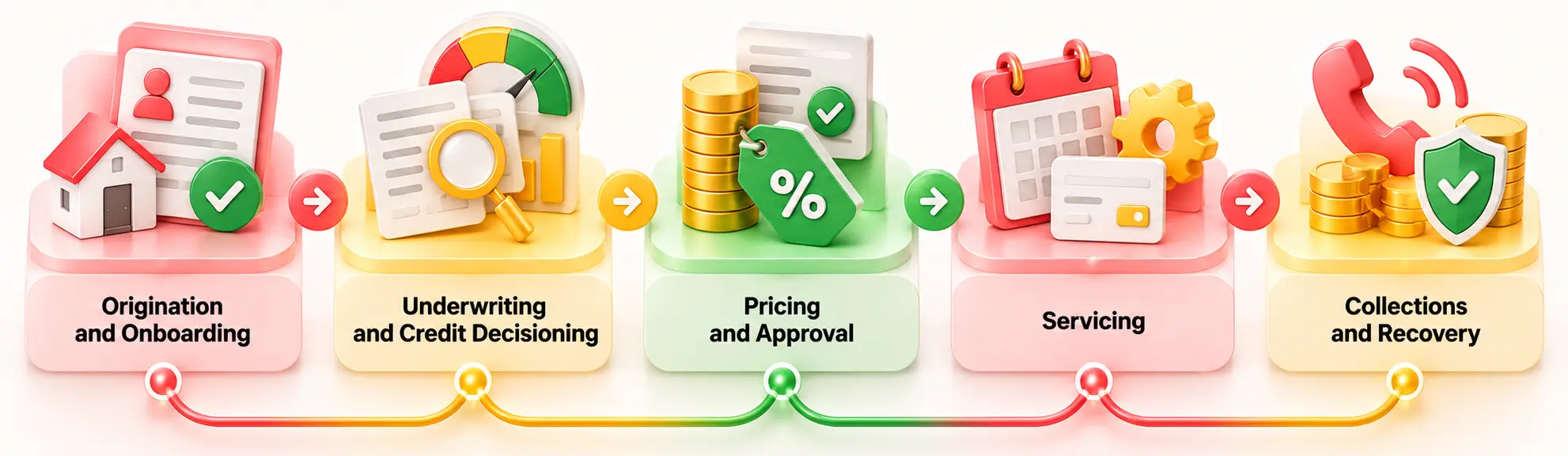
Initially, the use of AI can assist potential borrowers in prequalification for loans, gathering required documents, and filling in the blanks. Document AI will help in gathering details from pay stubs, bank statements, income tax returns, and application forms. Identity verification and fraud models will be able to highlight any mismatch between the details and even suspicious applications.
Lenders can use an AI-based scoring system to evaluate the ability of borrowers to repay loans. The system can analyze the credit history, current debts, income, and cash flow of a person. In places where using alternative data is legal, lenders can do that to get a more detailed idea about people who have no credit history.
The underwriting of the loans via the use of AI will help the lender assign the right risk classes for the loan as well as give pricing of risk according to their policies. The workflow will help in routing the application to the right teams, fulfilling the requirements, and speeding up the process where required. Final approval criteria must remain simple.
Once the borrower is approved for a loan, AI can assist in the management of repayments and assist in answering standard queries. The payment model will be able to identify any defaults in repayment or any shifts in cash flow that could point towards financial distress. The self-service assistant will be able to inform on the dates for payments and where the assistance is available.
AI for debt collections will be able to predict which accounts are going to make payments, identify those accounts that could benefit from help, and assist in developing plans for making contact. Language models could aid in message creation, but the lenders have to make sure that approved templates and messaging are used before sending anything. In the USA, the FDCPA and Regulation F have to be considered when developing debt collections workflows.
Even though artificial intelligence in loans can make it easier to make decisions regarding the loan, there needs to be justification for these decisions. As per the ECOA and Regulation B, adverse action notices must include reasons for denying the credit.
It is noted in the guidance issued by the CFPB that despite the use of complicated AI tools, the requirement of providing specific reasons still holds. Lenders are advised to conduct tests for disparate impact, develop an inventory of the models, perform drift testing, etc.
In addition to having a credit score prediction model, an AI-powered lending platform requires the implementation of a cohesive system for processing borrower data. The purpose of each element of such a system is quite particular: some elements collect financial data, whereas others refer unusual cases to humans.
In addition to that, the correct architecture helps the lenders incorporate AI systems into their existing lending systems. Therefore, the team will be able to automate certain processes without compromising decision-making, data security, and compliance.
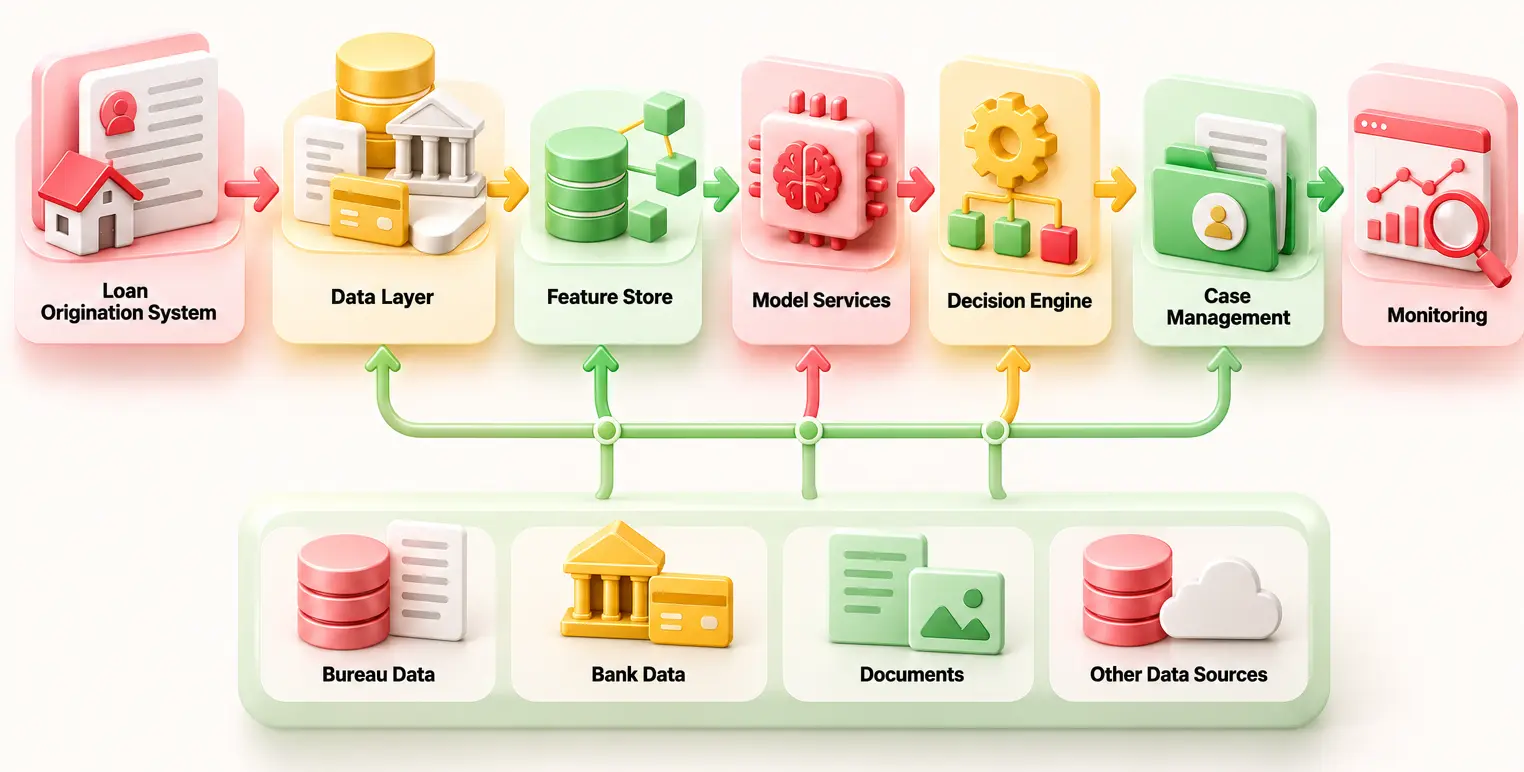
The loan origination system (LOS) is where the lending journey begins. This will help in capturing applications, recording details of borrowers, tracking missing documents, and managing application statuses.
The artificial intelligence lending platform interacts with the LOS system through APIs and obtains the data that has been approved. Operational efficiency can be improved by learning from building a cloud native lending platform during core modernization efforts.
The data layer collects all the data from the credit bureaus, bank statements, ID documents, income proof, and transaction data. Document AI helps to collect information from scanned documents and financial statements. Data validation is used to detect any missing fields, inconsistent fields, and duplicates.
The Feature Store stores pre-prepared features of data to be used by the model service. This could include, but is not limited to, income behavior, debt-to-income ratios, loan repayment history, and cash flow behavior. Access controls can restrict the usage of borrower data.
Model services cater to performing particular jobs within the lending process. Credit risk, fraud, and cash flow scoring based on machine learning algorithms are ways of assessing AI-based risks. The document AI solution includes data extraction, and the language model can help summarize the document and analyze the application.
The decision engine brings together the model’s results, the lender’s policy, and the approval criteria. An application that satisfies predefined conditions proceeds automatically. However, a marginal result, discrepancy within a document, or any possible case of fraud prompts further investigation. AI-based loan approval must be in line with approved decision rules.
The case management tool sends those applications that need further processing to the relevant lending unit. The reviewers shall have access to all the information, modeling data, and reasoning behind sending an application for further analysis.
This way, the staff receives more information and makes decisions based on their authority levels. This is important for complex and controversial cases.
After implementation, monitoring of the accuracy of the model, data quality, decisions being made, and performance variations is expected to take place. Drifts in the model can be detected from variations either in the behavior of borrowers or in the data coming in.
The audit trail captures both input and output data as well as the rules and overrides used in making decisions. This requires linking all the components using secure APIs and having established access protocols.
Each model must have an owner, an approved use case, and expected performance levels. Given this framework, AI in lending will not only speed up processes but also make credit decisions reviewable and compliant with the lending company's policies.
Deciding how to deploy AI lending technology shapes your institution’s speed to market and long-term risk profile. Building custom algorithms on your stack offers maximum control over proprietary IP, but demands heavy engineering overhead. Conversely, buying a pre-built AI lending platform accelerates deployment and reduces upfront risk.

The cost of AI within lending will depend on the use case scenario, quality of data, complexity of the AI system, and human intervention needed. A pilot program for automated loan processing will normally require lower investments than an AI platform that performs all AI credit tasks.
The incorporation of AI into the loan origination process goes beyond simply training and testing. The lenders have to validate the use of the AI technology with actual lending activities to ensure that the decisions are within acceptable levels of risk, and also to be ready for running the system post-implementation.
It is through phased implementation that the team can realize challenges before scaling.
Choose one of the financial services that can be consumer loans or mortgages. Pick your objective, which can be extraction of documents and credit scoring using AI technology. Calculate the existing time spent on it, errors, acceptance rate, and processing cost. Define the success parameters before building the model.
Train/Configure your model using data from previous applications. Test the accuracy, consistency, explainability, and performance of the model on different kinds of borrowers. Test how the model handles incomplete document applications and strange applications.
Run the AI algorithm in parallel with the process or with only a couple of people. Compare the results with the current decision-making process. Let the humans make decisions, but note where they make mistakes and measure the KPIs first.
Incorporate the authorized system into the workflow process. Set up audit trails, model drift notification, contingency plan, and periodic reviews. Conduct training of loan officers and assign ownership.
For a deeper dive into moving your systems from initial sandbox testing to full enterprise deployment, read our guide on AI-pilot-to-production. Careful staging ensures your AI lending platform delivers fast AI loan approval while maintaining bulletproof regulatory compliance.
Even with advanced AI credit scoring, many lending initiatives stumble. Here is where things typically break down:
AI in lending needs ongoing monitoring, clear explanations, and human review before decisions affect borrowers.
A loan process does not only require the development of an AI model. It requires a workflow that links the borrower’s information, document validation, credit evaluation, and current lending systems. Modernization across these systems can be helped by partnering with tailored digital transformation services for banking and financial services to streamline deployment.
Entrans offers assistance to lending organizations in improving their processes through the use of AI-based automation and software engineering. The process may include document processing, data verification, workflow routing, and exception management, among others.
Overdue loan management entails regular follow-ups, monitoring of payments, and communication with the debtor. Entrans could facilitate such a workflow by directing tasks according to the level of delinquency, monitoring the follow-ups, and communicating the right message for approval before sending it out. The proper controls would allow the lenders to use AI in debt collection processes. Read our loan delinquency case study.
Entrans helps SMB lending platforms test, check data flows between connected applications, and identify defects before changes reach production. AI credit scoring and AI loan approval workflows also need regular testing for accuracy, fairness, and explainability. It has also achieved 45% shorter loan-processing cycles.
Ready to turn AI use cases into production-ready workflows, from loan approval to collections, with the testing and oversight needed to build trust. Book a consultation call with us to learn more.

AI helps lenders check loan applications, review financial records, assess credit risk, and spot fraud. It can also speed up loan processing and help teams manage overdue payments.
Yes. Algorithms make rapid initial decisions by analyzing bank statements, tax returns, and credit histories instantly. However, human review is needed for borderline cases or complex financial profiles.
No. Complete replacement is not possible because complex mortgages require human empathy and regulatory oversight. Instead of replacing lenders, AI handles repetitive paperwork so human experts can focus on complex advisory work.
Fairness depends entirely on the historical data used to train the underlying models. If past data contains human biases, the system can unintentionally discriminate against qualified borrowers unless regularly audited.
AI helps lenders sort overdue accounts, plan follow-ups, and send payment reminders. It can also guide the next step for each case, while keeping sensitive decisions under human review.
The 30% rule is not a single, widely accepted AI standard. In some business settings, it refers to the idea that AI may handle part of a task, while people review the results and make key decisions.
AI in lending can cost from tens of thousands of dollars for a small pilot to hundreds of thousands or more for a large rollout. The final cost depends on the use case, data quality, system links, security needs, and ongoing support.