> Blog >
Data Science Consulting Services: What You Get, What It Costs, and How to Choose a Partner
Explore data science consulting services, project costs, timelines, use cases, and tips for choosing a partner that delivers measurable business results.

Data Science Consulting Services: What You Get, What It Costs, and How to Choose a Partner

4 mins
October 30, 2026
Author
Arunachalam
Talk To Our Experts
TL;DR
  • Data science consulting helps businesses identify valuable use cases, build predictive models, and turn data into better business decisions.
  • A typical project moves through use-case discovery, data preparation, model validation, deployment, and ongoing monitoring.
  • Costs can range from $10,000 for a small proof of concept to $200,000 or more for an enterprise solution, depending on complexity and data readiness.
  • Choose a partner with production deployment experience, MLOps capabilities, clear IP ownership, strong security practices, and measurable business outcomes.
  • What separates market leaders who predict customer moves from businesses constantly fighting unexpected fires? The secret lies in custom data science consulting services that transform raw data into precise strategic advantages. From choosing the right use cases to building and deploying machine learning models, the right partner can help you move beyond guesswork. 

    This blog explains what data consulting services you actually need, how much you should budget, and how to choose a partner who understands your business goals.

    Table of Contents ▾

      What are Data science consulting services?

      Data science consulting services are provided by external experts to assist the firm in formulating the problem, preparing and analyzing the data, and developing and validating the predictive model.

      The data science consulting services are specialized and enable businesses to move from data to valuable insights and make good business decisions. 

      Machine learning consulting services and data science outsourcing are some other services that are also offered by data science consulting firms.

      When you need a data science consultant (and when you do not)

      Data Science Consulting will be the right choice if there is a problem in your company that needs more than just dashboards and standard data analysis. Yet not all issues in data necessitate consultation.

      Data Science Consultant may be useful in situations like:

      • Unclear use case: When you have too much data, but do not know how to use it. This implies that you have no clue about what business issue to solve or how to measure success. The data science consultant will assist you in identifying the true needs of your business via predictive modeling.
      • Absence of special skills: Predictive modeling, Machine learning consultation, or advanced analytics skills that your team presently lacks are required.
      • Pilots become entrapped in the process because the model works perfectly in tests but not with actual data.
      • Third-party review: Another method that can be used to ensure validity and precision is having someone else validate, test the hypotheses, and assess the feasibility of the value proposition of the model.
      • Temporary skills: Outsourcing data science helps to get experts without having to put together a team.

      Data science consulting is not needed if:

      • Standard reports or dashboards: If your only requirements include regular dashboards and SQL queries, then standard business intelligence software will suffice.
      • Broken data pipes: If your databases are in shambles and the data collection process is not working, you should engage data engineers before considering the services of data science consultants. Clean storage will come before any fancy math.

      The most important part is recognizing the problem you have.

      What a data science engagement includes

      Data science consulting is not simply about developing a model. Normally, an idea will be taken from the stage of problem formulation through implementation and monitoring.

      The specific needs will depend on what your aims are, how good your data is, your system infrastructure, and your capabilities. A firm's overall analytics capabilities can be helped by establishing an AI data readiness assessment before model development. 
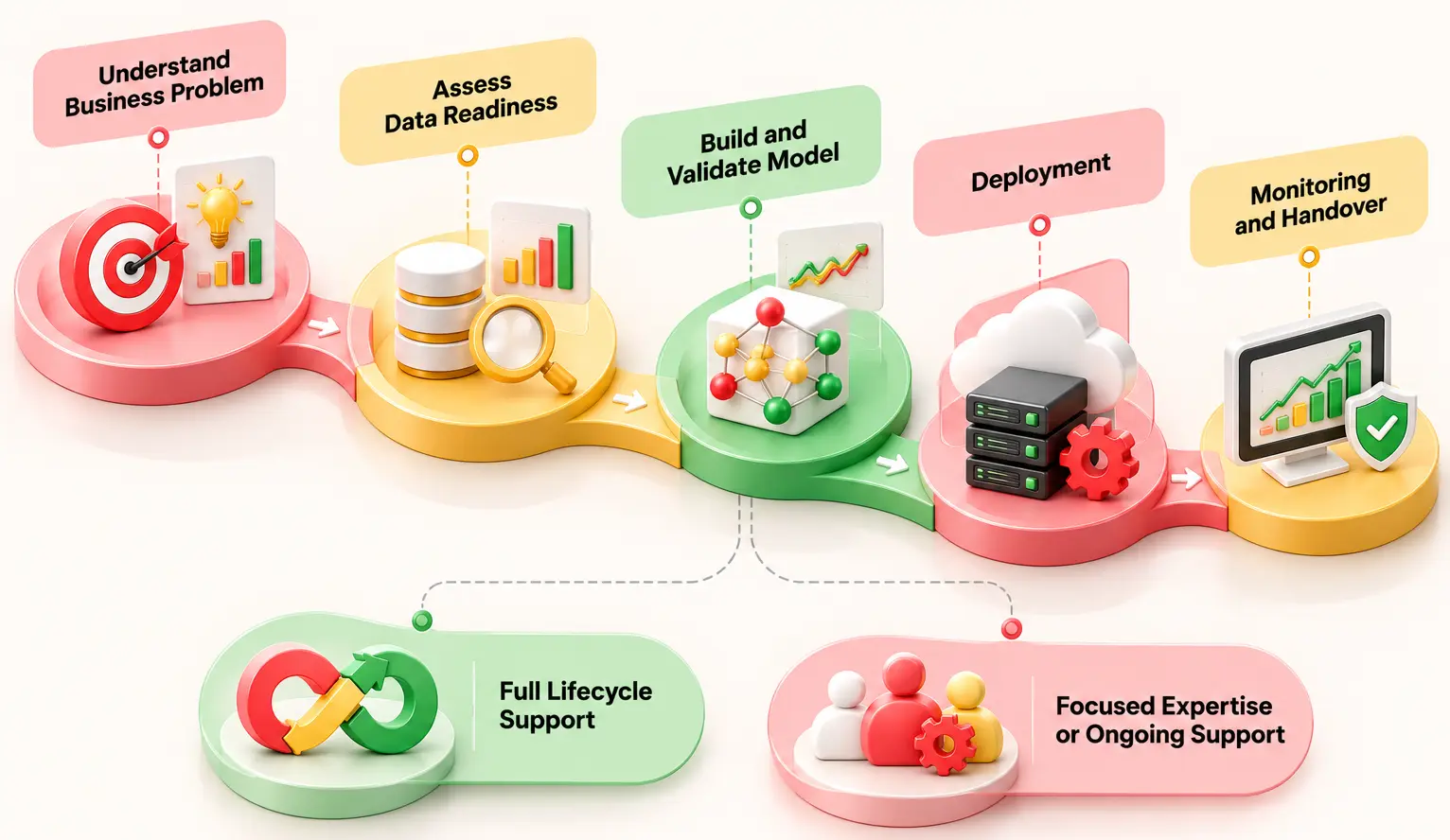
      Key services included in a data science engagement

      Phase What Happens
      Strategy and use-case discovery  Finding where predictive models create actual business value instead of wasting time. 
      Data readiness assessment  Checking if existing storage and tables are clean enough for statistical work. 
      Feature engineering  Turning raw variables into smart numerical signals that algorithms can read. 
      Modeling  Building, training, and testing machine learning models on historical data. 
      MLOps and deployment  Moving tested code out of local notebooks and into live production environments. 
      Monitoring and maintenance Tracking model accuracy over time to catch drift before mistakes happen. 
      Team enablement Teaching internal staff so your team can maintain the system independently. 

      Process of data engagement

      Data science consulting process from problem identification to deployment and monitoring
      1. More often than not, the data science consultant will know about the problem before deploying the tool or algorithm.
      2. The second phase will entail checking whether there is enough data for solving the problem.
      3. After model validation, the process moves further into deployment, monitoring, and handover.

      Some data science consulting firms provide data science consulting services from start to finish, but other data science consulting firms deal only with certain aspects of the process. The data science consulting firms can also help businesses in terms of data science as a service or outsourcing data science.

      Consulting vs. Data science as a service vs. Outsourcing vs. In-house

      It will be left to you to select the type of partnership that best suits you, depending on your budget and internal capabilities. Companies often compare the advantages of data science consulting with those of other types of partnerships, which may include data science as a service or outsourcing data science.

      Collaboration with reputable data science consulting firms or machine learning consulting firms alters the way projects are carried out.

      Factor Data Science Consulting Data Science as a Service (DSaaS) Data Science Outsourcing In-house Team
      Scope Strategy, assessments, and expert guidance Productized analytics  End-to-end development  Long-term roadmap 
      Pricing model Project-based or hourly  Subscription  Milestone or fixed fee  Salaries and overhead 
      IP Ownership Client owns  Shared or vendor  Client owns  Client owns 
      Speed Fast start  Medium  Fast  Slow
      Control High Medium Low Maximum
      Best For Complex initial projects Standard predictive tasks Complete hands-off builds Permanent data products

      Which One To Opt For?

      • Data science consultancy will be the best option for you if you require guidance, an objective viewpoint, or a business case.
      • If you seek ongoing support from specialists and do not want to form a team, then data science as a service is the right option for you.
      • Data science outsourcing is recommended when you have a particular task that you cannot perform in-house.
      • An in-house team should be your choice when data science is a core competence of your business and the cost of building the team is affordable.

      Some companies use both models. For instance, a company may hire a consultant to plan a certain project, outsource its implementation at first, and later hand over all responsibilities to its own team. It all depends on your goals and whom the work should belong to.

      Common use cases by industry

      A Data Scientist can help firms solve real-world problems from the surrounding environment, whether through making predictions for demand in the future or fraud detection. Use cases will vary based on the needs of the field, access to data, and corporate objectives. The services of data science consultants enable companies to figure out where their analytics and ML skills can be applied.

      1. Retail and E-commerce

      Prediction models are used for forecasting demand and managing the stock of products in the store. Pricing models will assist to fix prices depending upon various demands, season, and buying trends. Prediction models for churn analysis may help to find out consumers who do not buy anymore.

      2. Banking and financial services

      Credit risk analysis, detection of fraud, and lending decision-making are achieved by banks through data science services. For instance, machine learning models could be used to identify any suspicious transactions. Credit risk models will assist in estimating the possibility of repayment, while validation will help in evaluating the model performance.

      3. Manufacturing 

      Predictive maintenance is used by manufacturers to identify equipment that is prone to failure before it causes any production problems. The model can identify any anomalies using the data collected through sensors, maintenance logs, and the present operating environment of the equipment.

      4. Insurance and healthcare

      In claims processing, data science is used by insurance companies to identify fraud, predict claim severity, process claims, and even predict the workload. Forecasting could help hospitals and other health care facilities in determining the staff needs, while analytics could help in identifying the issues in the system. It is important to note that sensitive data should be treated appropriately.

      5. Telecommunications and subscription businesses 

      Churn prediction can help determine which customers will most likely end their service agreement. Through churn prediction, firms can gain insights regarding the behaviors and complaints of customers, their billing, etc.

      Turning use cases into business results

      Data science consultancy services may prove extremely helpful in ranking these opportunities according to the level of readiness of the data, its value, and implementation effort. Moreover, data science consulting firms may assist in building, deploying, and monitoring models.

      How a data science project runs: phases and timelines

      Consultation in Data Science takes place in an organized way. A normal project goes through clear phases from planning to maintenance. The time required varies depending on the cleanliness of the data, the size of the team, and the complexity of the model.
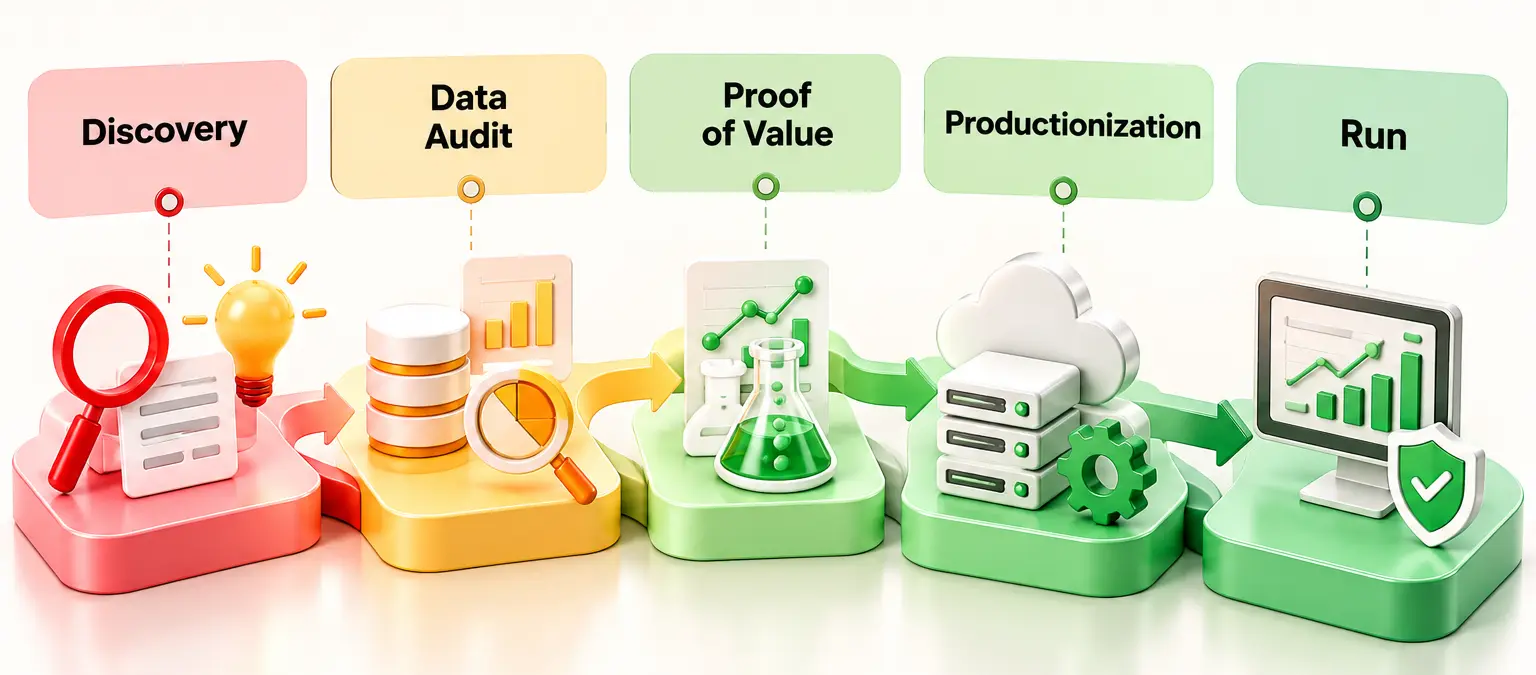
      Data science project phases and timelines

      1. Discovery and Use-case selection (1-2 weeks)

      The data scientist plays the role of working with the business team and the technical team to define the problem, understand the success metrics, and identify the use case. The scope of the project and the business value are also defined in this phase. The operational maturity can be increased through enterprise MLOps and GenAI Ops best practices during the planning phase.

      • Assumptions: Data is accessible, and stakeholders are available for weekly workshops. 

      2. Data Audit and Preparation (2-4 weeks)

      The data is analyzed with respect to validity and shortcomings, and the data set is then prepared. This can take some time owing to the fact that the data may be present in multiple databases.

      • Assumptions: Early access to the database without any delay.

      3. Proof of value (2-4 weeks)

      Data scientists create the first model and try it using the metrics agreed on. This is done to see if the suggested solution can provide results.

      • Assumptions: Baseline data quality meets basic threshold standards. 

      4. Productionization and Deployment (3 - 6 weeks)

      The team integrates the model into the business systems, deploys it, and satisfies the security and access requirements. It may take a while to deploy the model depending on legacy systems or the approval process.

      • Assumptions: There is cloud access and API endpoints.

      5. Run and Maintain (ongoing)

      This stage involves monitoring on a daily basis, accuracy checking, and retraining models as fresh data flows in. Data science consulting firms normally give documentation to their internal employees to operate the system safely.

      What affects the timeline?

      These calculations are made considering one use case, the availability of required data, and a project team. Outsourcing data science and machine learning consultation will reduce skill gaps but won’t fix data dependency and approval issues. Use these figures for estimation only.

      How much does data science consulting cost

      Predictive analytics budgeting should involve knowledge of the engagement model and total cost of ownership. Costs will depend on complexity, size, and data maturity.

      Pricing Models

      Vendors offer several pricing structures:

      • Fixed-Fee Pricing Model: Most effective for auditing and scoping of data at the beginning of the project.
      • Time & Material (T&M) or Retainer: The most effective for development and data science as a service.
      • Milestone Payment Pricing:  Pricing model will be based on completion of milestones.
      • Retainer per month: Fees charged for continued provision of data science services.
      • Outcomes-Based: The fees will be partly outcome-dependent.

      What determines the total cost?

      Three factors significantly influence your budget:

      • Data preparedness: Lack of data, formatting issues, and lack of integration increase the preparation time.
      • Complexity of the model: The creation of a single model is less costly than the construction of multiple models that need to communicate.
      • Deployment and monitoring: Integration and monitoring of models, as well as additional training, raise costs.

      What do published price ranges tell us? 

      These differences are also reflected in the rates that are published by the industry; for example, companies such as ScienceSoft and Beetroot point out projects that cost from $10,000 for a small proof of concept to $200,000 or more for an enterprise solution.

      The use of a data science consultant or a machine learning consulting service will generally cost between $100 and $300 per hour.

      How to choose a data science consulting partner

      The choice of the right partner will determine whether your machine learning investment will bear fruit or become another prototype.

      Selection Checklist and Red Flags

      Consider execution benchmarks as you search for important red flags before executing any contract:

      • Production Execution Benchmarks: The vendors should have run their algorithms in production rather than leaving the models stuck in research notebooks.
      • Red Flag: Laboratory benchmarking alone.
      • MLOps Capabilities: Assess how well the team manages the deployment, monitoring, retraining, and updates of the algorithms.
        • Red Flag: Lacking strategy for dealing with data drift and algorithm maintenance in the long run.
      • Domain Knowledge: Confirm deep familiarity with your specific industry workflows, edge cases, and compliance rules. 
        • Red Flag: Treating all business problems as generic mathematical exercises without sector-specific context.
      • IP and Model Ownership: Demand clear contractual terms granting full client ownership of all code, custom weights, feature engineering scripts, and trained model files. 
        • Red Flag: Shared IP clauses or vendor lock-in mechanics using proprietary black-box wrappers.
      • Knowledge Transfer and Enablement: Require hands-on training and comprehensive documentation so internal teams can take full ownership. 
        • Red Flag: Engagement structures designed to make internal staff permanently reliant on external hand-holding.
      • Security Standards: Insist on strict compliance certifications (such as SOC 2 Type II or ISO 27001), encrypted data pipelines, and clear data privacy governance. 
        • Red Flag: Vague security protocols or reluctance to complete security assessments.

      10 questions to ask before signing an RFP

      1. Have you put such models into practice?
      2. Which Key Performance Indicators (KPIs) should be considered to determine the success of the business?
      3. Which criteria will be used to measure the level of preparedness of the data?
      4. Which technologies will be utilized, and why?
      5. How will you validate the models' accuracy and robustness?
      6. How will you deploy the models and monitor their performance?
      7. Who will own the code, the models, and the intellectual property?
      8. How will you secure our sensitive data?
      9. What support and maintenance costs will we face?
      10. How will you transfer your expertise to our team?

      Measuring the ROI of data science work

      In addition to providing accurate predictions, data science initiatives should enable an organization to save time, earn money, avoid losses, or make informed decisions. To calculate the ROI of a project, it is important to define the expected results at the start of development and monitor them afterward.

      • Define KPIs for each of your models: Tie your models to metrics. This means that you can set up a KPI on improving forecast accuracy for your demand forecasting model and on reducing churn for your churn prediction model.
      • Document the baseline: Gather data on performance before implementation of the model. Note numbers like processing time, cost of operations, errors committed, and conversion rates. Without a baseline, it is impossible to know whether the model brought any real change.
      • Test on unseen data: Apply a holdout test to see how the model works on unseen data. Evaluate its performance against the current procedure or any baseline model before proceeding to the next step.
      • Monitor Adoption and Use: Count the frequency of employees’ use of the recommendations from the model, the number of decisions that are accepted, and the locations where predictions are overridden. An accurate model is useless when it is not used.
      • Evaluate complete financial gain: Measure the benefits compared to development, deployment, cloud, monitoring, and maintenance expenses. Consider the time that your internal team spends assisting with the solution.
      • Evaluate results post-launch: Data science consulting services must have provisions for evaluations of business KPIs, model performance, and user feedback. This would help you evaluate declining results and know when the model needs an update.

      The focus should be on determining impact rather than accuracy. The consultant should be able to help determine the metrics of business impact at the outset and provide regular updates regarding their achievement.

      Where data science projects fail

      Many predictive projects run into roadblocks before delivering real value. Knowing common failure points helps you protect your investment:

      • Missing business owner: Algorithms built without active stakeholder guidance solve the wrong problems. Successful data science consulting always links math directly to operational goals.
      • Poor data hygiene: Teams attempt complex modeling on messy, incomplete databases. Proper data science services prioritize data cleaning before writing any algorithm code.
      • Models trapped in local notebooks: Experiments that never leave a data scientist's laptop generate zero business return. Specialized data science consulting firms focus on moving code into live production.
      • Ignoring model drift: Algorithms degrade over time as customer behavior changes. Without ongoing monitoring, automated systems quickly make costly mistakes.
      • Zero internal adoption: Even accurate predictions fail if employees refuse to trust or use them. Partnering with a skilled data science consultant. Transforming data into business outcomes is not only about developing a predictive model. Entrans combines efforts from data engineering, machine learning, AI, and MLOps teams to assist companies in moving from their hypotheses to actual solutions. Entrans' Data Science consulting service includes everything from use-case identification to monitoring. It ensures teams embrace new workflows and tools.

      The above problems can be solved using data science consultancy services by ensuring ownership, data quality assessments, production planning, and continuous monitoring. Nevertheless, success will also depend on business participation post-launch.
      Open Popup

      How Entrans delivers data science

      Transforming data into business outcomes is not only about developing a predictive model. Entrans combines efforts from data engineering, machine learning, AI, and MLOps teams to assist companies in moving from their hypotheses to actual solutions. 

      System performance can be improved by integrating robust data engineering and advanced analytics pipelines to handle large-scale information. Entrans' Data Science consulting service includes everything from use-case identification to monitoring.

      The data engineering teams of Entrans construct pipelines that collect data from different sources and prepare it for analysis. The data scientists can now go ahead and build models for prediction, classification, recommendation, and anomaly detection. 

      The MLOps team will ensure that the models are deployed and their performance is monitored. Long-term reliability can be supported through dedicated DataOps and MLOps services to maintain pipeline efficiency. 

      The work can also extend to existing analytics systems. For example, Entrans helped a global enterprise modernize its cloud data engineering platform, connecting data from ERP and point-of-sale systems. The project cut query times by 50%, from minutes to milliseconds.

      For machine learning projects, Entrans also covers model validation, application connections, and production monitoring. This helps teams address deployment challenges early rather than leaving a model stuck in testing. 

      Businesses can engage Entrans for a defined project or bring in specialists to support existing teams. If you need additional expertise, explore Entrans' data science and machine learning talent to see how its data scientists can support your project. 

      Ready to transform raw predictions into real business outcomes and build scalable intelligence? Connect with Entrans to jumpstart your data transformation.

      Share :
      Link copied to clipboard !!
      Turn Your Data Into Business Results
      Build, deploy, and monitor data science solutions that support your business goals.
      20+ Years of Industry Experience
      500+ Successful Projects
      50+ Global Clients including Fortune 500s
      100% On-Time Delivery
      Thank you! Your submission has been received!
      Oops! Something went wrong while submitting the form.

      FAQs

      1. What is data science consulting?

      Data science consulting is a service where external specialists help a company turn data into predictions or decisions. Consultants define the business problem, assess data, build and validate models, and help deploy them into products or workflows, often while training the client's team.

      2. What is data science as a service (DSaaS)?

      Data science as a service gives businesses access to expert skills, tools, and support without building a full in-house team. It can cover data analysis, model development, deployment, and ongoing maintenance.

      3. What services are included in data science consulting?

      Data science consulting covers use-case planning, data preparation, model building, testing, deployment, and monitoring. Some data science consulting firms also help train teams and manage models after launch. 

      4 . How long does a data science project take?

      A small data science project may take 8–12 weeks, while larger projects can take several months. The timeline depends on data quality, model complexity, and system access. 

      5 . How much does data science consulting cost?

      Projects typically range from ten thousand dollars for simple prototypes up to two hundred thousand dollars for enterprise builds. Hourly rates for a skilled data science consultant usually sit between one hundred and three hundred dollars.

      6. What data do we need to get started?

      Begin with data related to your business challenge, for instance, sales data, customer behavior, or transaction data. Your data scientist can evaluate the quality, availability, and relevance of your data before beginning their work.

      7. What is the difference between AI, ML, and data science?

      Data science involves using data to recognize patterns and aid decision-making within a business. Machine learning involves training machines by feeding them data. On the other hand, artificial intelligence involves the development of intelligent systems capable of carrying out activities that require human intelligence.

      Hire Data Scientists and ML Engineers
      Get skilled data science and MLOps specialists to build and deploy production-ready models.
      Free Project Consultation
      Trusted by Enterprises & Startups
      Top 1% Industry Experts
      Flexible Contracts & Transparent Pricing
      50+ Successful Enterprise Deployments
      Arunachalam
      Author
      Arun S is co-founder and CIO of Entrans, with over 20 years of experience in IT innovation. He holds deep expertise in Agile/Scrum, product strategy, large-scale project delivery, and mobile applications. Arun has championed technical delivery for 100+ clients, delivered over 100 mobile apps, and mentored large, successful teams.

      Related Blogs

      3-Way Matching in Accounts Payable: A Complete Guide

      Automate 3-Way Matching in Accounts Payable with AI. Learn how invoice matching works, common exceptions, ERP integration, and automation benefits.
      Read More ↗

      Data Science Consulting Services: What You Get, What It Costs, and How to Choose a Partner

      Explore data science consulting services, project costs, timelines, use cases, and tips for choosing a partner that delivers measurable business results.
      Read More ↗

      AI in Lending: Loan Approval, Credit Decisioning and Collections That Pass Model Risk Review

      Discover how AI in lending automates loan approvals, credit decisioning, and collections while keeping risk models compliant and scaling safely.
      Read More ↗