Learn how gen AI governance helps you control third-party models you didn't build. Protect your prompts, data retrieval pipelines, and app workflows today.

Agentic Unconference 2026 - September 19, Chennai
View Event →





Imagine waking up to discover your AI system was leaking context or breaking workflows without your team touching a single line of code. Spooky? It happens every day. If you use external LLMs, traditional risk management crumbles; you can’t fully control them. You only control the prompts, data retrieval, and guardrails. Welcome to the frontier of gen AI governance; it needs a different lens.
This blog will explain what you can control and how to manage what you cannot.
Generative AI governance refers to the process through which organizations control their AI systems based on models that have neither been trained nor owned, and the organization has no control over the deployment schedule of the models. It covers model changes, prompts, retrieval, usage, vendor risk, data handling, monitoring, and accountability.
Traditional model governance assumes something quite straightforward: you created the model, so you know its content.
You can record the training data set. The performance of the model can be evaluated using the test data set. Model versioning can be controlled, and the readiness of the model to be taken into production can be defined.
Generative AI changes that assumption.
In the case of an enterprise using an external foundation model, it might be possible that the enterprise does not have all the knowledge about the data used to train the model. Moreover, the owner of the model controls the weights of the model and can update the service provided by the model at any point in time.
This isn't just a minor tweak to your risk strategy; it’s a complete shift in control. Effective LLM governance requires recognizing that you are managing living, external services rather than static internal assets.
So when an AI runs on external foundation models, it raises four distinct governance challenges.
Traditional compliance demands complete transparency into training datasets, feature weights, and data lineage. Commercial models lock such information behind proprietary walls.
Performing thorough foundation model due diligence means shifting focus from inspecting training code to scrutinizing provider transparency reports, safety benchmarks, and architectural guardrails.
The premise behind a legacy risk assessment is that once you build a model, it will remain in place until you release a patch. External third parties will continuously update the hosted models or quietly discontinue the endpoint services. Building a resilient generative AI governance framework involves real-time monitoring and red-teaming of the model.
For most GenAI use cases, the usable control space is centered on prompts, system directives, retrieval sources, grounding rules, output validation, and access controls.
Because the underlying model belongs to someone else, managing third-party model risk is as much a legal and vendor management challenge as a technical one. Your internal genAI policy must explicitly address vendor data-retention policies, opt-out mechanisms for training on your prompts, uptime SLAs, and liability boundaries for copyright or privacy infringements.
This is where gen AI governance starts to differ from conventional model governance.
Many legacy platforms, including frameworks like Dataiku’s six pillars, are model-governance pillars retrofitted onto GenAI.
While covering those basics is necessary, it is not sufficient. Modern governance must go deeper by directly managing the dynamic, probabilistic nature of third-party generative systems:
Generative AI governance is not simply traditional model governance with a new name.
The familiar controls still matter. But the enterprise now governs a system where some of the most important components sit outside its direct control.
That is why LLM governance, foundation model due diligence, prompt controls, retrieval governance, and third-party model risk need to sit alongside the usual AI governance controls.
The real question is no longer only: Can we govern the model?
Standard enterprise governance frameworks such as Dataiku’s classic six pillars were built around a simple assumption: you build, train, and own the model. But when your applications run on external foundation models, those conventional controls must be adapted to fit a third-party reality.
Here is how to recalibrate the six core control areas when your intelligence layer is hosted outside your firewall.
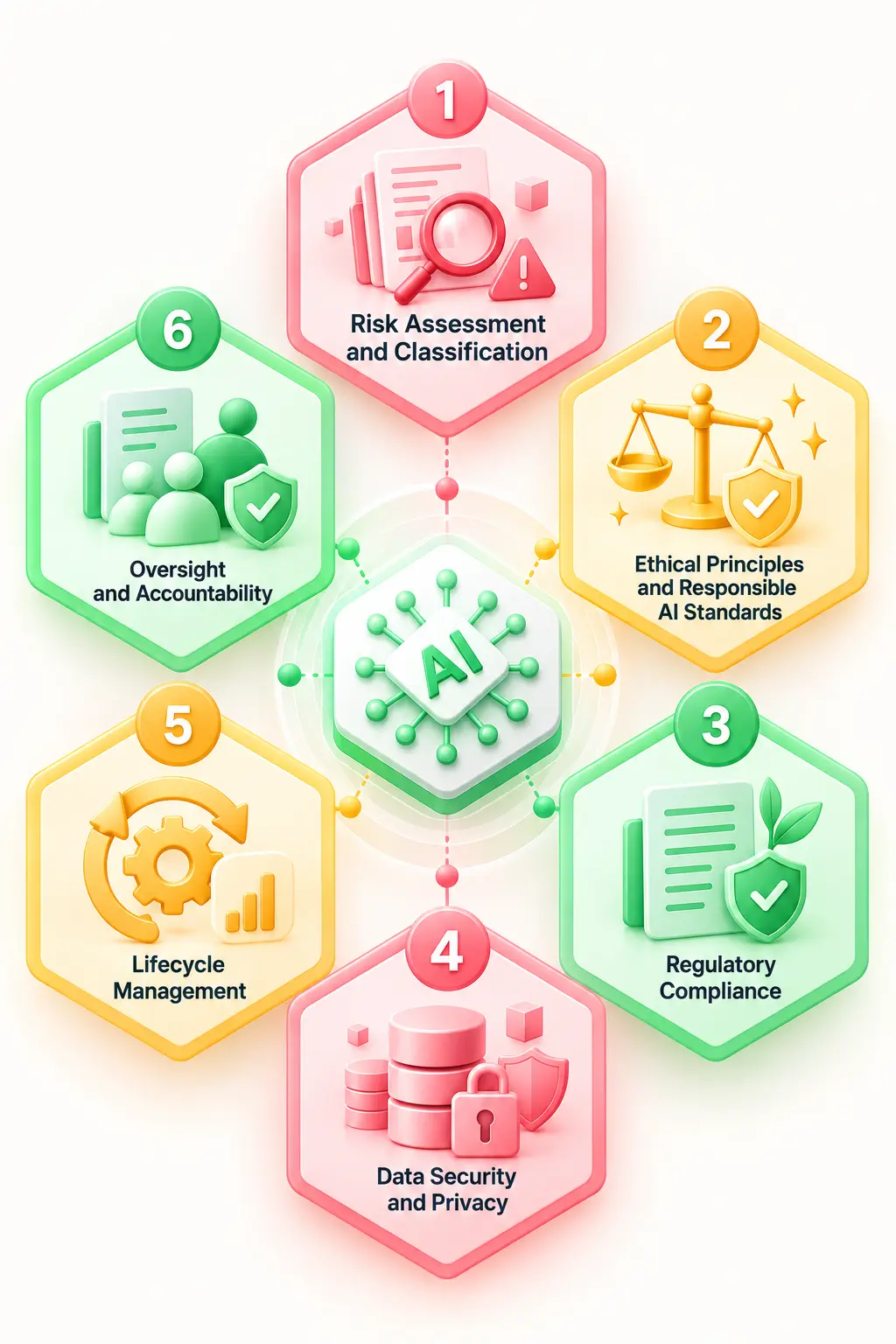
In traditional machine learning, risk is evaluated by looking inside the model: inspecting feature weights, analyzing training data distribution, and auditing algorithm mechanics.
When managing third-party model risk, you cannot classify risk by model internals because those internals are opaque. Instead, risk must be classified strictly by use case and output consequence:
Your genAI policy should categorize risk based on what happens when an output is wrong, rather than how the model generates its answers.
Your responsible AI requirements still apply, but the control point moves.
You cannot rewrite the alignment choices built into a vendor's foundation model. What you can govern is how your organization deploys that model.
This would include prompts you generate, data you access, instructions you give to the system, users who can use it, and actions it can perform.
It should be noted that a genAI policy would address practical issues associated with the deployment of AI systems rather than just laying down some general principles. Who are the people allowed to use it? For what purposes? What kind of data can be used? When is human approval required?
Your objective should be to manage the portion of the AI system that is under your control.
Using an external foundation model does not shift your regulatory obligations to the external model provider. In the case of the EU AI Act, obligations may pertain to either the provider or the deployer, based on their respective position and the nature of the AI system deployed. You will need to clarify your position and regulatory obligations in the governance process and the obligations that apply to your deployment; see AI Governance Frameworks for the broader regulatory context.
This is one of the most practical questions in third-party model risk:
What leaves your environment when someone uses the model?
A prompt may contain customer information, internal documents, source code, financial details, or other sensitive data.
Your governance process should establish:
This is where foundation model due diligence becomes part of day-to-day governance.
A provider's security documentation may answer some questions, but the enterprise still needs to connect those answers to its own use case and data requirements.
Lifecycle management breaks down most severely under third-party deployment. Traditional lifecycles move predictably from feature engineering and training to versioned deployment and scheduled retraining.
With hosted foundation models, the base asset evolves on the provider's schedule, not yours. Managing this shift requires a new lifecycle approach centered on real-time prompt monitoring, automated fallback handling, and continuous context validation.
Now, coming to the final part, who owns the AI system when the most important component belongs to a vendor?
The answer cannot simply be the model provider.
Your organization still owns the business use case, the data it sends, the prompts it creates, the users it gives access to, and the decisions made from the system's output.
A clear accountability structure should therefore name owners for the use case, risk classification, data access, vendor relationship, technical controls, monitoring, and evidence.
The model may sit outside your organization.
Accountability for how you use it does not.
Evaluating an AI provider isn’t like buying standard SaaS. When auditing external model vendors, managing third-party model risk requires asking sharp questions upfront and knowing what to do when vendors stay quiet. This raises a major gap in vendor diligence for model providers
As part of your genAI governance process, ask the provider:
Not every question will get a useful answer.
Training data provenance is a common example. A provider may disclose broad categories without identifying specific sources or datasets. Your generative AI governance framework needs a clear position on whether a use case can proceed without that information.
With third-party model risk, not every safeguard can be technical. Version changes, data handling, incident reporting, service commitments, and indemnity often depend on contractual terms.
That makes the contract part of your LLM governance controls, not just a procurement document.
It is the second major governance gap and the most operationally severe. One of the biggest third-party model risk issues is simple: your application can stay the same while the model behind it changes.
A provider may update or retire a model version. Your production system then starts behaving differently, even though your team has changed nothing. The evaluation results you relied on may now be stale, and your approval record may refer to a model that no longer behaves the same way.
That changes how LLM governance needs to work.
When this is possible from the service provider, version pinning should be part of foundation model due diligence. Ensure that you have a regression testing tool suite that you can always use when there are any changes in the model.
Your gen AI governance should also include a rollback strategy to the previous version of the model or even the fallback model.
Approval, therefore, cannot be a one-time gate. For third-party models, it needs to become a standing evaluation with defined triggers for re-testing and review.
There is a limit, though. Version pinning is not always available, and providers control their deprecation timelines. Some model-change risk will therefore need to be accepted and monitored rather than fully controlled.
With a third-party foundation model, your team does not control the model weights or training process. But you do control the pieces around it: the system prompt, retrieval layer, context assembly, and guardrails.
These are not just configuration details. They are the artifacts that shape how your AI system behaves in production, so they need a place in your gen AI governance program.
To effectively manage third-party model risk, your engineering teams must treat context components as first-class, version-controlled artifacts:
When you cannot see how a foundation model was built, behavior becomes your main source of evidence. As an alternative to using white-box testing, you should test the model using domain-specific evaluation datasets, perform adversarial and jailbreak testing, watch out for its output in the production phase, and collect reviews from humans at a particular rate.
Bias testing must be done with particular care, since one cannot verify the training data used to train the model. Test the model with relevant users and use cases, and record what you see and how you deal with it.
Behavioral testing can put limits on risks, but will not eliminate them. There is no way of testing the model in a black-box fashion.
A good GenAI program should be honest about where its control can’t work. If you adopt a foundation model that is built by another party, you take on their alignment and safety decisions for the model. It might not always be possible for you to verify the process behind such decisions. It may be impossible to version-pin or even find out where your data came from.
Contracts also create another gap. They may not cover the specific risks your legal or business teams are concerned about. Those terms need careful review rather than assumptions that a vendor contract has removed the risk.
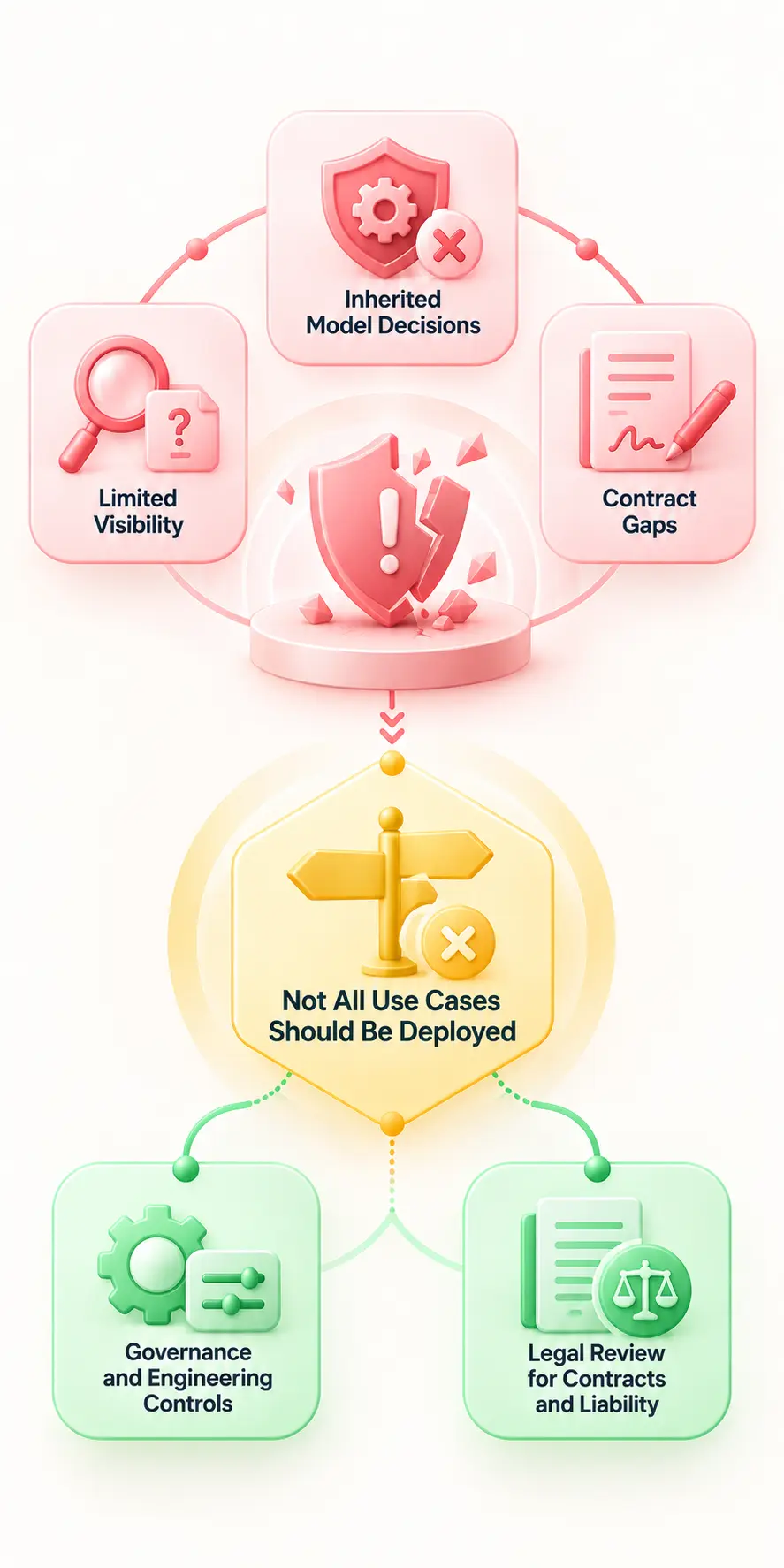
This leads to an uncomfortable but necessary conclusion: some use cases may not be suitable for a third-party model at all.
If your generative AI governance framework cannot reach a decision not to deploy when the evidence does not support the risk, governance becomes a box-checking exercise.
The boundary matters here. This section covers governance and engineering controls. Contract terms, indemnity, liability, and related legal questions belong with qualified counsel. Entrans can help model the decision, surface the trade-offs, and document the evidence without supplying a legal position.
Entrans does not treat AI governance as an after-the-fact compliance audit. We embed real-time controls directly into your engineering pipeline while building your use case.
Through our tailored Gen AI consulting services, our team evaluates your core foundation model deployments to clearly distinguish between the controls you manage directly and the behavior you inherit from the model vendor.
The next step is to construct a regression evaluation suite around the constructed system, consisting not only of the foundation model but also of the model, prompts, retrieval, context, and guardrails by Entrans.
This allows detecting version changes and having a fallback strategy in case of any changes in the underlying model. The result is a per-deployment control map that distinguishes between technical risks, contractual risks, and accepted risks.
This approach also solves a common problem with governance, namely making clear what risks are acceptable. If there is evidence that the use case should not proceed, then the control map will highlight the decision not to deploy.
For GenAI implementations where the evaluation and guardrails were developed along with the use case, and not as an afterthought, Entrans has observed a 60% reduction in onboarding times.
We govern third-party AI with clear ownership, practical controls, and evidence you can stand behind. Know what you control, know what you inherit, and know when not to deploy. Book a consultation call with us.
Generative AI governance defines the rules and controls on how GenAI models are selected, used, monitored, and managed. These include prompts, outputs, and context pipelines to remain secure, accurate, and compliant.
Traditional AI governance focuses on auditing static, predictable algorithms and training sets, whereas GenAI governance must manage non-deterministic outputs, third-party models, dynamic prompts, and real-time context retrieval.
Yes. Your enterprise takes responsibility for delivering every output to customers or internal teams. Governance should clearly separate what you control, what you inherit, and what risk you accept.
Ask about training data, testing methods, model versions, data retention, input usage, subprocessors, security, and incident notifications. Also ask how behavioral changes and model deprecations will be communicated.
A provider update can silently shift model behavior, which can break structured outputs, degrade response accuracy, or instantly invalidate your existing compliance and evaluation records.
We can evaluate a model by doing behavioral testing, which includes running domain-specific benchmark suites, conducting adversarial red-teaming, sampling live outputs for human review, and continuously monitoring production metric distributions.
Yes, because a system prompt edit can drastically alter safety parameters and output behavior just as significantly as updating underlying code or changing a model.
Yes. If the provider terms, data practices, model behavior, or available controls create risks that the business cannot accept, a do-not-deploy decision may be the right governance outcome.


-1.svg)