> Blog >
The AI Governance Audit: What Gets Inspected, What Evidence You Need, and What to Do If You Do Not Have It
Passing an AI governance audit takes real proof, not just policies. Learn what auditors inspect, the evidence you need, and how to fix missing records.

The AI Governance Audit: What Gets Inspected, What Evidence You Need, and What to Do If You Do Not Have It

4 mins
September 25, 2026
Author
Jegan Selvaraj
TL;DR
  • An AI governance audit checks whether controls were actually applied, with evidence showing what happened across data, models, deployment, and pipelines.
  • Auditors map controls to established frameworks like ISO 42001, NIST AI RMF, and the EU AI Act to inspect everything from data lineage to human sign-offs.
  • Never forge missing approval records; instead, reconstruct technical logs where possible, disclose remaining gaps transparently, and attach a dated remediation plan.
  • Achieving audit readiness means building automated pipelines that capture logs natively during development, making compliance a routine byproduct of daily operations.
  • Most companies think that their policy documents are enough to protect them from any problems until the AI governance audit occurs. The real test starts when someone asks for the evidence behind those claims. Who approved the model? What data was used? Which tests were run? What happened when monitoring flagged an issue?

    This guide explains what an AI governance audit typically inspects, which records matter, and what to do when those records do not exist. 

    If you are still building your governance foundation, start with our AI Governance Guide to understand the wider governance picture before preparing for an audit.

    Table of Contents ▾

      What an AI Governance Audit Is

      An AI governance audit is an independent examination of whether the controls an organization claims to operate over its AI systems were actually applied. The auditor looks for records created during execution such as model lineage, approval logs, and evaluation metrics rather than evidence reconstructed after the fact.

      There can be an AI governance program that has good policies, defined roles, and an AI governance audit checklist, but which will lack something if no one can explain what occurred throughout the AI system’s life cycle.

      Here, it arises between an AI governance audit and other types of review. To prepare effectively, you must separate three distinct types of reviews that teams frequently conflate: 

      Review Type Primary Focus Typical evidence Who performs it
      Internal governance audit Evaluates whether the governance function adheres to company policies, risk tiers, and baseline controls An updated AI model inventory, internal sign-off logs, and policy compliance records. Internal audit or an independent internal review team.
      AI Model Audit or Validation Tests technical mechanics, model performance, dataset quality, and bias metrics for a specific algorithm. Testing results, model documentation, data records, validation findings, performance results. Model validation, risk, or technical specialists.
      External AI Conformity Assessment Certifies that the entire system of the organization is in compliance with official standards, for instance, ISO 42001 and the EU AI Act. Documented processes, control records, proof of functioning, corrective action. Accredited external third-party auditor or registrar.

      To summarize,

      • An internal governance audit reviews the operations of the governance function itself.
      • An AI model audit assesses a particular model or system. 
      • An AI conformity assessment checks whether any specific requirements are met in a system, such as the ISO 42001 requirement.

      Use of an AI governance audit checklist allows the team to check that the process for capturing these artifacts is embedded in the automated pipeline.

      This is because AI governance audits typically do not fail because of a lack of documentation of policies but rather a lack of evidence of policies being implemented.

      What the Auditor Actually Inspects

      AI governance audit is not limited to auditing policies and documentation. The auditor goes through the entire life cycle of AI and audits whether the controls have been implemented. Typically, an AI governance audit checklist is based on four layers: 

      • Data layer
      • Model layer
      • Deployment layer
      • Pipeline layer

      Here is what an auditor examines at each stage to verify your audit evidence for AI systems:
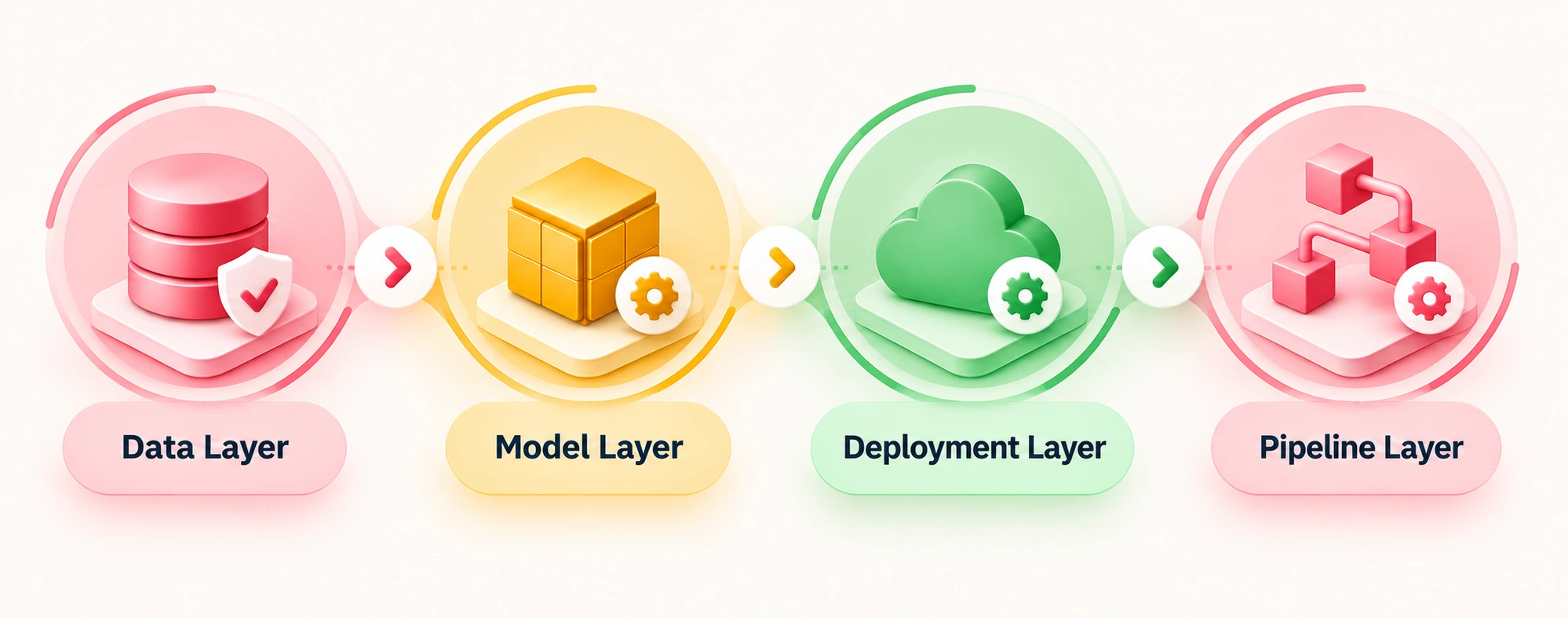
      Four layers of an AI governance audit: data, model, deployment, and pipeline

      1. Data Layer: Provenance & Compliance

      The auditor reviews how the data enters your model to make sure that it is compliant and authorized.

      • Provenance: Clear records showing where training and fine-tuning datasets originated. Even the source, along with legal rights, usage consent, and licensing terms, are also noted.
      • Consent and licensing: What are the sources that enable the corporation to gather, analyze, train, or access data?
      • Lineage and Quality: Proven lineage of data transformations from initial inputs to final training datasets, along with the demonstration of the cleansing process.
      • Retention and Privacy: Strict adherence to data retention policies, data masking methods, and privacy measures (for example, removing PII information).

      For an audit of an AI model, it is required to establish the link between a model and its dataset, along with demonstrating the data processing process.

      2. Model Layer: Validation & Performance

      In the process of an AI model audit, there is a requirement for the examination of the model itself and the evaluation of algorithmic mechanics, history of testing, and risk management measures in place before deployment.

      • Documentation & Model Cards: Full model card outlining intended use case, limitations, input/output schema, and architecture details.
      • Evaluation & Bias Benchmarks: Timestamped evaluation of accuracy, fairness, bias mitigation, toxicity constraints, and robustness.
      • Version Control & Reviews: A complete version history tracking model weight changes alongside formal sign-offs from independent model risk reviewers.

      An audit requires documentation that can be traced, not simply a claim of having done the testing. This becomes significant where a particular audit query is tied to a specific version of the model.

      3. Deployment Layer: Operational Governance

      It defines the way the model will perform in production and how human oversight will be sustained in a live environment.

      • Approval Records & Access Controls: Verified sign-off logs matching the system's risk tier, combined with role-based access control (RBAC) policies for live model endpoints.
      • Monitoring & Incident Logs: Real-time logging configurations that track concept drift, latency spikes, and hallucination rates, backed by documented incident investigation records.
      • Rollback Capability: Demonstrated technical capability to instantly degrade, pause, or roll back a failing production model to a known safe state.
      • These records form a large part of the audit evidence for AI systems. 

      4. Pipeline Layer: Automated Control Enforcement 

      This is the layer traditional audit checklists often overlook as it gets less attention. The question here is simple: does the pipeline apply the control automatically, or does someone have to remember to do it? 

      As one example, there might be a requirement in a policy that every production instance of the model must have an approved record. The pipeline can look for an approved record before production, while an individual is also able to check.

      The auditor may therefore inspect:

      • Whether required evidence is generated during model development and deployment
      • Whether approval gates are built into release workflows
      • Whether model and data versions are recorded automatically
      • Whether monitoring and incident records are captured without manual intervention
      • Whether a deployment can proceed when a required control or evidence artifact is missing

      Maintaining an updated AI model inventory maps these four layers ensures that the team is always audit-ready without last-minute documentation mistakes.

      The Evidence Checklist

      If an AI governance audit is conducted on your system, it requires clear and contemporary evidence showing that the operational control was running at the time of its implementation. 

      The higher-level governance framework will guide you regarding what you should govern but will rarely define what type of artifacts the auditor would require from you for the AI model audit or AI conformity assessment. The best fit for this purpose would be the evidence checklist.
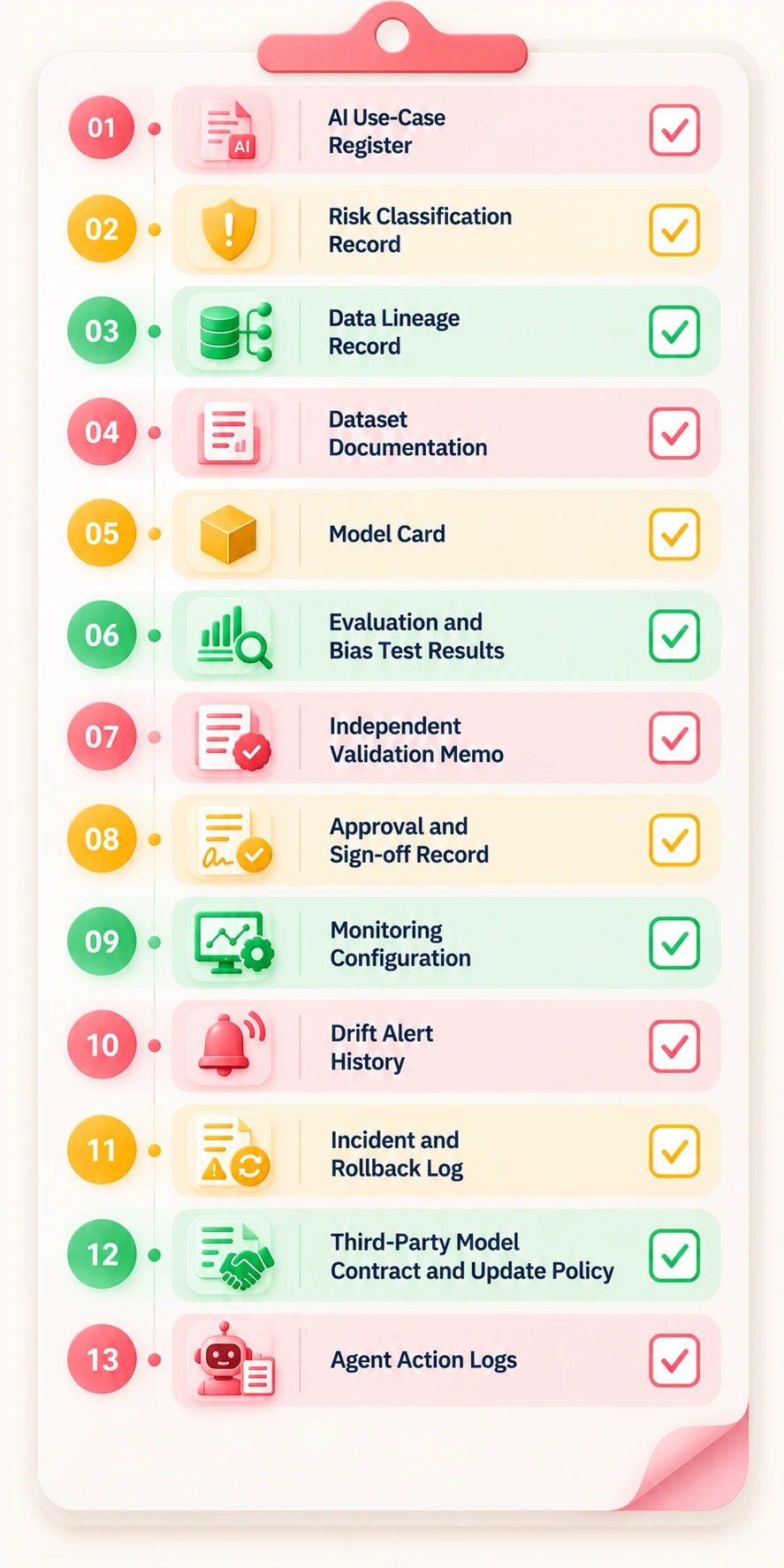
      AI governance audit evidence checklist showing the key artifacts required to prove operational controls

      The table below serves as an actionable AI governance audit checklist, mapping the primary audit evidence for AI systems across their lifecycle, where these records live, and how often they are missing in real-world audits.

      Evidence Artifact What it is Who produces it Where it normally lives How often it is missing in practice
      AI use-case register Centralized list of AI systems along with purpose, owner, status, and risk tier. AI Governance Lead / Product Managers Central AI model inventory platform or database Rarely missing, but frequently outdated or incomplete regarding shadow AI.
      Risk classification record Formally assigned risk tier based on business impact, data sensitivity, and regulatory exposure. Risk owner or governance team Governance portal or GRC tool Occasionally missing; often exists as informal notes rather than a signed record.
      Data lineage record Traceability map linking raw data sources, transformations, and final training/RAG datasets. Data Engineers / MLOps Data catalog (e.g., Atlan, Monte Carlo) or pipeline logs Frequently missing for fine-tuning datasets and RAG context pipelines.
      Dataset documentation Metadata detailing data sources, consent terms, licensing rights, PII scrubbing, and cleaning steps. Data Scientists / Legal Model registry or documentation repo Frequently missing; licensing and consent terms are rarely logged alongside data.
      Model card Technical spec outlining intended use, architecture, input/output schemas, and operational limits. ML engineers Model registry (e.g., MLflow, Hugging Face) Reliably present for core internal models; often missing for embedded vendor tools.
      Evaluation and bias test results Timestamped benchmarks measuring model accuracy, toxicity, fairness, latency, and stress performance. ML Engineers / Data Scientists CI/CD pipeline output or testing framework logs Reliably present for initial training, but missing for continuous prompt changes.
      Independent Validation Memo Objective review report evaluating conceptual soundness and technical limitations before launch. Model Risk Management (MRM) Risk management archive / Document repository Frequently missing outside highly regulated sectors like banking and healthcare.
      Approval & Sign-Off Record Formal, timestamped authorization from business, technical, and compliance owners matching risk tiers. Designated Approval Gatekeepers JIRA tickets, GRC workflow tools, or deployment logs Consistently missing; decisions are made, but no formal record ties sign-off to test results.
      Monitoring Configuration Active monitoring setup defining alert thresholds for data drift, concept drift, and performance drops. MLOps / SREs Observability platform (e.g., Prometheus, Arize, Evidently) Occasionally missing; monitoring is often set up late or lacks defined thresholds.
      Drift Alert History Logged history of triggered performance/drift alerts, including resolution timelines and actions taken. MLOps / On-call Engineers PagerDuty, Datadog, or incident management logs Frequently missing; alerts trigger in Slack, but investigation steps are rarely documented.
      Incident & Rollback Log Post-incident reports detailing AI failures, root-cause analyses, containment actions, and rollback execution. Incident Response / SRE Incident management portal Rarely missing for major outages, but subtle AI failure logs are seldom retained.
      Third-Party Model Policy Vendor SLAs, API terms, updates/deprecation tracking, and fallback plans for external models. Procurement / Legal Enterprise contract repository Frequently missing; teams rarely track underlying vendor model updates or changes.
      Agent Action Logs Audit trails capturing autonomous tool calls, database queries, and external actions taken by AI agents. Software Engineers Application logging infrastructure Almost always missing; agent actions are rarely logged with execution context.

      In Entrans engagements, the artifact most consistently missing is the contemporaneous approval record. The decision to ship was made, but nothing recorded who approved the model against which evaluation result, leaving teams to reconstruct the paper trail from commit histories and calendar invites during an AI governance audit. 

      The trail then has to be reconstructed from commit history, calendar invites, and other scattered records. The trail then has to be reconstructed from commit history, calendar invites, and other scattered records. 

      For an AI conformity assessment, the exact evidence will depend on the standard and scope being assessed. The same principle still applies: records created during the work are far easier to verify than records assembled after an auditor asks for them. 
      Open Popup

      Which Standard Your Auditor Will Map To

      The standard your auditor uses depends on the purpose of the review, your industry, and the requirement being tested. 

      ISO 42001

      • ISO/IEC 42001 is used as the international benchmark for formal AI governance audit certification. 
      • An AI governance audit mapped to ISO 42001 will look at documented processes, controls, records, and evidence that the management system operates as required. 
      • It differs from an AI model audit, which may examine a specific model rather than the wider management system.

      NIST AI RMF

      • NIST AI RMF gives internal audit and risk teams a practical vocabulary for reviewing AI risks and controls. The framework is voluntary and is not itself a certification standard.
      • Most internal audit teams adopt it to evaluate model safety and trustworthiness using the NIST AI RMF.
      • An AI governance audit checklist may map evidence to areas such as Govern, Map, Measure, and Manage. 

      EU AI Act

      • The EU AI Act serves as the mandatory AI conformity assessment baseline for any high-risk models deployed in the European market. 
      • The relevant review can examine technical documentation, risk management, data governance, testing, monitoring, and other required records. 
      • The exact requirements depend on the AI system and its classification under the Act.

      SR 11-7

      • SR 11-7 is the foundational standard for model risk management in US banking, where model validation is already an established audit line.
      • An AI model audit can build on these existing practices while adding controls for newer AI systems where needed.

      For example, the framework mainly dictates the vocabulary and presentation format, not the underlying operational requirements. The core audit evidence for AI systems, from your AI model inventory to risk logs, remains largely identical across all four standards. 

      So the user can focus on building a clean evidence pipeline without the fear of choosing the wrong framework.

      To explore how these standards map side-by-side in detail, read our complete guide on AI governance frameworks comparison.

      What to Do When the Evidence Does Not Exist

      Missing evidence does not mean starting the AI governance audit process from scratch. The first step is to sort the gaps by risk tier and decide. 

      • What needs attention now
      • What can be rebuilt
      • What needs to be recorded as a known gap

      Start With the Highest-Risk Systems

      Prioritize your AI model inventory by risk tier. Focus your immediate effort on high-impact production models such as customer-facing agents or regulated decision systems and address lower-risk internal tools later. 

      Separate Reconstructable Evidence From Missing Decisions

      Some records can frequently be recovered from technical sources already in place. Lineage information, for instance, can be found in pipeline source code, warehouse information, version control systems, and deployment records.

      However, some evidence can never be created in good faith. A contemporaneous approval cannot be forged after the model has been deployed. The issue becomes greater when a fabricated approval is presented as existing at that time during an audit of the AI model.

      Disclose Gaps Transparently

      An auditor respects honesty over fabricated compliance. Disclosing a known documentation gap alongside a clear, dated remediation plan produces a materially better result during an AI conformity assessment than presenting reconstructed records as contemporaneous. Admitting where controls were skipped shows operational maturity and control over your environment.

      The Correct Remediation Sequence

      When facing missing evidence across an AI model audit, follow this sequence to regain control:

      1. Instrument new models immediately: Add automated logging to active delivery pipelines so your evidence gap stops growing today.
      2. Remediate top-tier workloads: Rebuild technical artifacts for your highest-risk models first.
      3. Formalize accepted risk: Document lower-risk legacy gaps clearly as "accepted risk," assign a business owner, and attach a realistic future remediation deadline.

      Preparing for the Audit: A Readiness Sequence

      Preparation for an AI governance audit should begin before an auditor defines the scope. A brief preparatory checklist will reveal the current status of the evidence and the areas requiring action.

      Step 1: Inventory and Classify

      Build the AI model inventory and classify each system by risk to establish an accurate AI model inventory. This gives you a clear audit scope and shows which systems need closer review.

      • Output: A complete, risk-tiered use-case register with named business owners. 

      Step 2: Run a Dry Test

      Pick three high-risk systems and test them against your AI governance audit checklist. Check data lineage, model documentation, approvals, monitoring, incidents, and other audit evidence for AI systems.

      • Output: A dry-run gap assessment report highlighting missing technical evidence. 

      Step 3: Close or Disclose

      Fix the gaps such as lineage or model cards that can reasonably be closed before the audit. For the rest, document the gap, assign an owner, and record a dated remediation plan rather than recreating evidence.

      • Output: Clean audit evidence for AI systems paired with a formal gap-disclosure record. 

      Step 4: Assign an Evidence Custodian

      Give one person responsibility for gathering and explaining the evidence. The auditor should not have to ask three teams to find one approval record.

      • Output: A single point of contact ready to support an AI conformity assessment or AI model audit. 

      The Common Preparation Mistake

      The greatest blunder comes when one prepares documents for the audit rather than constructing the pipeline that would generate these documents as work is done. A pack of documents might help one sail through the first review; however, the process of generating documentation does not change anything, and the same problem will resurface in the next AI model audit/AI conformity assessment.

      The Limits of an Audit

      The AI governance audit could establish whether the identified controls have been implemented and whether there are records to back that up. This does not imply that the AI system itself is good, right, accurate, or fit for its intended purpose. An auditable process may lead to an error-free report for a flawed use of the AI system.

      Passed Controls Do Not Equal a Good Model

      Passing an AI governance audit proves your operational controls ran; it does not prove your model is accurate, fair, or ethically sound. A clean audit on a fundamentally flawed use case is entirely possible if you documented every flawed decision with precision.

      Audit Readiness Is Not Governance

      Having an AI model inventory, complete documentation, and strong audit evidence for AI systems does not automatically mean the business has meaningful control over what reaches production. 

      An organization can pass an AI model audit or AI conformity assessment by maintaining immaculate spreadsheets, yet still lack meaningful, real-time control over what software reaches production. 

      Audit readiness shows that a defined process can be demonstrated. Governance goes further by shaping which AI systems are approved, how risks are managed, and what happens when conditions change.

      Know Our Scope Boundary

      Our goal is to help you build automated pipelines that naturally capture audit evidence for AI systems and keep your AI model inventory continuously updated.

      It is important to state our boundary clearly: Entrans is an engineering and delivery consultancy, not an audit or assurance firm. We do not issue formal audit opinions or certify regulatory conformity. When an independent, official opinion or certification is required, that evaluation belongs with a certified audit firm or an accredited registration body.

      How Entrans Runs an Audit-Readiness Engagement

      At Entrans, we approach audit readiness by picking three representative AI systems across your risk tiers and testing each against our comprehensive evidence checklist. For every artifact, we determine whether it exists, can be legitimately reconstructed, or is permanently missing. 

      Thus, the outcome is a list of evidence gaps with corresponding remediation costs and ownership. When evidence cannot be gathered before the audit date, the engagement also identifies the disclosure language to ensure that the gap is documented clearly rather than reconstructed.

      In instances where lineage gaps cover multiple source systems, Entrans can leverage its more than 6,000 ready-to-integrate connectors to understand how data flows through these systems. The Holy Name healthcare relationship serves as an example of this in a regulated environment.

      The key difference is where the work happens. Rather than assembling a document pack just before an audit, the engagement works toward having the pipeline emit the required evidence as AI systems move through development, approval, and deployment. That helps prevent a process that passes one audit but leaves the same evidence gaps for the next one. 

      To see how we integrate evidence emission directly into your delivery architecture, explore our DataOps and MLOps services. 

      Learn how we turn audit readiness from a stressful scramble into a routine byproduct of daily delivery. Book a consultation call today.

      Share :
      Link copied to clipboard !!
      Prepare Your AI Systems for Audit
      Identify evidence gaps and build audit-ready governance controls into your AI delivery pipelines.

      FAQs

      1. What does an AI auditor ask for?

      An AI auditor typically requests your AI model inventory, training data provenance records, technical model cards, and documented risk assessments. They also ask for evidence covering data, models, deployment, approvals, monitoring, incidents, and access controls.

      2. What is the difference between an AI audit and model validation?

      An AI audit evaluates the broader governance ecosystem, such as examining policies, access controls, data pipelines, and operational compliance. Model validation tests the technical performance, statistical accuracy, and conceptual design of a specific algorithm.

      3 . Which standard will our auditor use?

      Auditors typically assess systems using established frameworks like ISO/IEC 42001 (AI Management System), NIST AI RMF, or the EU AI Act’s conformity assessment standards. The standard changes the review criteria and documentation, while much of the underlying evidence remains similar.

       4. What if we do not have the evidence an audit requires?

      Reconstruct what you can from technical logs, version control, and pipeline histories. Start with the highest-risk systems, reconstruct only evidence that can be supported by reliable records, and document the remaining gaps. A dated remediation plan is better than presenting reconstructed records as though they were created at the time.

      5. How do we prepare for an AI governance audit?

      Create an AI Model Inventory, categorize the systems by risk, and test some of the systems against your AI Governance Audit Checklist. Name an evidence owner and resolve any gaps before starting the audit process.

      6 . How often should AI systems be audited?

      The frequency should depend on risk, regulatory requirements, system changes, and the level of ongoing monitoring. Higher-risk or frequently changing systems may need more frequent reviews than stable, lower-risk systems.

       7. Does passing an AI audit mean our AI is safe?

      No, passing an audit simply confirms that your documented governance controls were applied as intended. It does not guarantee that a model is completely error-free, unbiased, or morally fit for purpose in every real-world scenario.

      Hire AI Governance Engineers
      Build audit-ready AI pipelines with engineers experienced in governance, evidence capture, monitoring, and controls.
      20+ Years of Industry Experience
      500+ Successful Projects
      50+ Global Clients including Fortune 500s
      100% On-Time Delivery
      Thank you! Your submission has been received!
      Oops! Something went wrong while submitting the form.
      Free Project Consultation
      Trusted by Enterprises & Startups
      Top 1% Industry Experts
      Flexible Contracts & Transparent Pricing
      50+ Successful Enterprise Deployments
      Jegan Selvaraj
      Author
      Jegan is Co-founder and CEO of Entrans with over 20+ years of experience in the SaaS and Tech space. Jegan keeps Entrans on track with processes expertise around AI Development, Product Engineering, Staff Augmentation and Customized Cloud Engineering Solutions for clients. Having served over 80+ happy clients, Jegan and Entrans have worked with digital enterprises as well as conventional manufacturers and suppliers including Fortune 500 companies.

      Related Blogs

      Generative AI Governance: How to Govern Models You Did Not Build

      Learn how gen AI governance helps you control third-party models you didn't build. Protect your prompts, data retrieval pipelines, and app workflows today.
      Read More ↗

      The AI Governance Audit: What Gets Inspected, What Evidence You Need, and What to Do If You Do Not Have It

      Passing an AI governance audit takes real proof, not just policies. Learn what auditors inspect, the evidence you need, and how to fix missing records.
      Read More ↗

      AI Governance Best Practices: The 90-Day Implementation Sequence

      Looking for practical guidelines for governing AI? Consider a 90-day plan that includes workload inventories, automated guardrails, and safe scaling.
      Read More ↗