Looking for practical guidelines for governing AI? Consider a 90-day plan that includes workload inventories, automated guardrails, and safe scaling.

Agentic Unconference 2026 - September 19, Chennai
View Event →





AI Governance doesn't work because of insufficient knowledge about the ways of governing AI. And now, what about the very first step to take? All the AI governance frameworks include the following components: inventory management, risk management, policy-making, approval, monitoring, and auditing. Rather than checking whether something was done in an all-or-nothing approach, taking into account the AI governance guide in the 90-day plan will help you discover the invisible workloads, automate collection, and gate level correctly.
This blog will serve as your guide in creating an actionable road map to build a governance model.
AI governance implementation is the ordered work of inventorying AI use cases, classifying their risk, instrumenting evidence, and gating approvals, in that order. When one looks for best practices on AI governance, there are numerous pieces of advice available, but the problem is figuring out what should be done first. Every single framework suggests performing the same ten actions: create a committee, make policies, develop inventory systems, measure performance. You need to find an answer to the question below.
AI governance strategies built in the wrong order can create more paperwork without giving the business better control.
That gap is missing from most AI governance best practices guides.
Changing from static AI policy design to an operational AI governance maturity model means moving the discussion from what to build to when to build it. To develop a robust model, an organization needs to concentrate on making advancements in the following three distinct phases:
Where governance is not seen as an exercise in ticking boxes but as a sequence of steps, small teams can govern while allowing innovation to flourish.
To build a resilient AI governance maturity model, activities cannot be treated as a menu of independent choices. In AI governance implementation, there is a need for sequencing, in that every activity depends on the preceding one. There can be no risk classification without knowing what AI use cases exist. There can be no approval gate without understanding risk. There can be no monitoring where there are no instrumentation activities. There can be no auditing of non-audited actions.
Below are the ten foundational practices, ranked based on dependency:
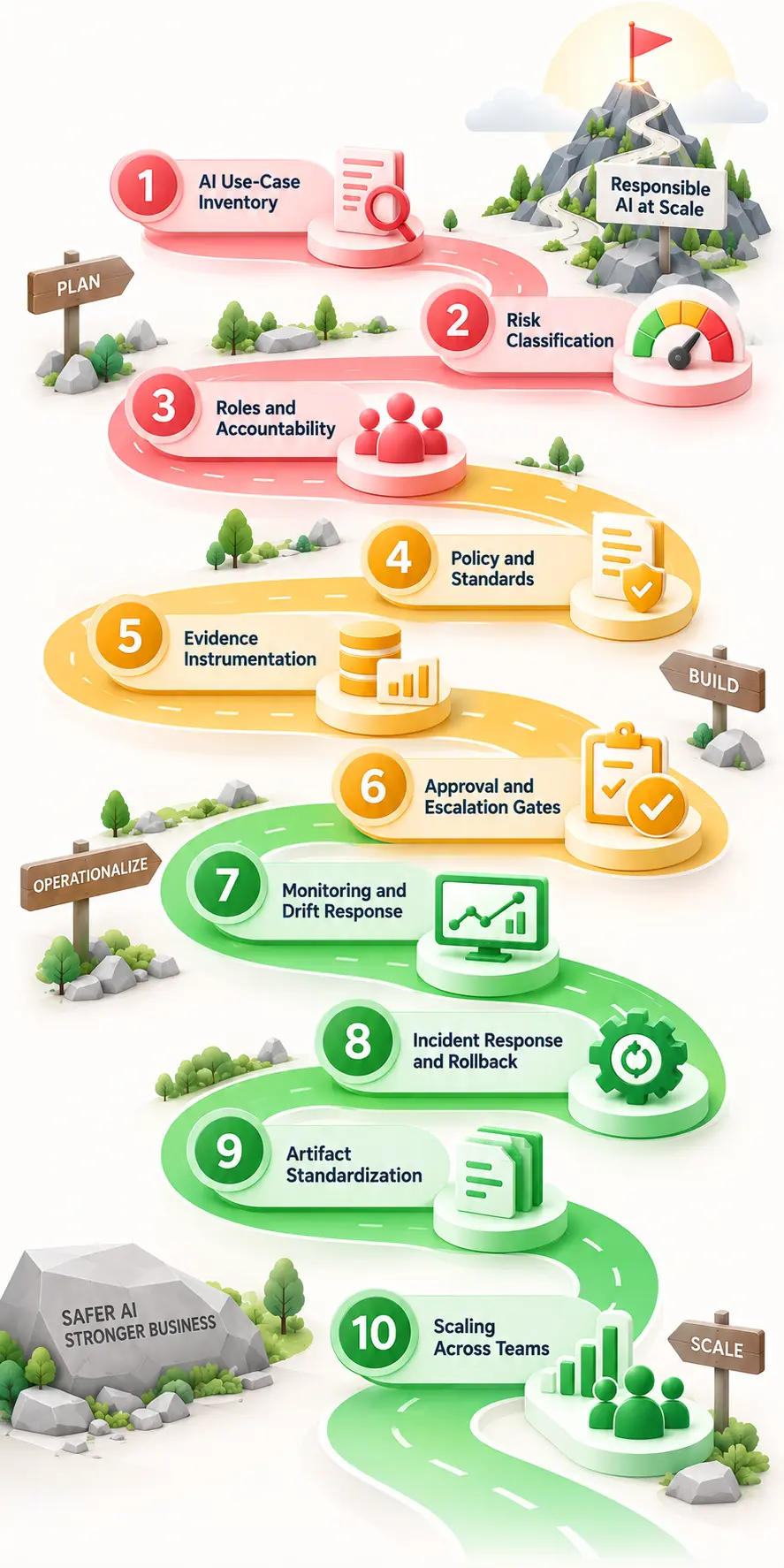
A centralized log mapping every active model, system where AI is being used, what it does, who owns it, and where it runs.
None. This is the foundational prerequisite (Starting point) for all subsequent governance steps.
A hierarchical structure that classifies AI applications based on characteristics like their significance, data sensitivity, autonomy, exposure to regulations, and vulnerability.
A complete AI use case inventory to evaluate real workloads.
Assign a clear ownership matrix assigning business decisions, controls, evidence, technical, and risk oversight responsibilities for each tier.
Both use cases and risks, which define the level of oversight and domain expertise required for each system.
Actionable guidelines establishing acceptable boundaries, safety checks, and data compliance rules.
Roles and accountability, ensuring named owners review, refine, and enforce those rules in practice.
Automated mechanisms built into pipelines to capture test results, data lineage, and decision logs.
Policies and risk requirements that define what evidence matters.
Put review points around higher-risk AI before deployment or material changes.
Risk classification, ownership, policies, and required evidence, which provide sign-off committees with objective data for decision-making.
Real-time tracking of model performance, data drift, and unexpected behaviors in production.
Approval and escalation gates to ensure only benchmarked models enter live environments.
Define how teams investigate AI incidents to pause, degrade, or revert unsafe AI outputs.
Continuous monitoring to detect anomalies and trigger response mechanisms before harm scales.
Unified templates for model cards, risk assessments, and compliance reports across teams.
The controls and evidence requirements already established.
Self-serve tooling, training, and automation to expand AI governance strategies across business units without asking every team to rebuild it from scratch.
A working governance process, standard artifacts, and clear ownership.
Laying out activities by operational dependency turns standard best practices for enterprise AI governance into an actionable execution path. However, it does not imply that the first practice carries greater weight than the others. Rather, it implies that the subsequent practices carry less weight when there is no preceding input available. In this case, a governance team can create an extensive policy on day one, but that does not mean production AI needs governance.
Here is where the idea of an AI governance maturity model could come in handy. What must be measured is not the number of policies or committees, but their very existence as dependencies.
The same rule applies to AI governance KPI. Counting the number of policies developed tells nothing about whether the company knows the number of inventory use cases of AI, how many have been risk-classified, and whether the high-risk ones have all evidence and approvals needed.
The final step consists of turning this process into phases for a small centralized group.
This is the phase most AI governance best-practices guides move past too quickly. The first month of an AI governance implementation is where most initiatives fail before they even start. Most frameworks skip straight past this phase, jumping right into drafting expansive policies or evaluating vendor platforms. So before writing policies, setting approval gates, or buying governance tools, you need to know what AI is already doing across the business.
Now, you need to surface every model, embedded feature, and vendor API across the organization. Start with three groups: AI already in production, AI currently being built, and AI being used outside formal processes or approvals.
Before cataloging active workloads, ensure your infrastructure and team capabilities are prepared using an AI readiness assessment checklist. Keep the first version simple. The goal is to build a reliable shared register, not a perfect database.
The shared register should include:
Ask engineering, product, operations, security, and business teams what they are actually using. Shadow AI can sit outside the systems your central team already knows about.
Avoid generic, abstract severity definitions like "High/Medium/Low" based purely on technical complexity. Instead, classify risk by business impact:
Risk categories should reflect the decisions the AI supports, the people affected, the data involved, and what happens when the system gets something wrong. If you are still working out which governance framework fits your environment, the AI Governance Frameworks guide breaks down how NIST AI RMF, ISO 42001, and the EU AI Act differ. For a practical look at calibrating risk tiers and impact scores to your operational reality, explore our guide on enterprise AI governance.
An inventory without ownership quickly becomes a list that nobody maintains. Every use case should have someone responsible for keeping its information current.
At this stage, AI governance KPIs should tell you whether the inventory is taking shape: number of use cases identified, percentage with an owner, percentage classified, and number of unknown or shadow use cases still being investigated.
The deliverable is deliberately narrow: One AI use-case register with an owner and a risk tier against every entry. Nothing else is required at this stage.
Restraint is critical during this initial push. To keep your team focused and deliver on time, explicitly avoid these common distractions:
The first 30 days are about finding the AI use case inventory that exists, understanding its business impact, and putting a name and risk tier against each use case.
Achieving this single baseline moves your organization up the AI governance maturity model faster than months of committee meetings, providing the baseline needed to track meaningful AI governance KPIs in the phases ahead.
In this phase, the AI governance implementation starts to become a real operating process. It is also where the work can become expensive quickly. The goal is to make evidence part of the process for new models and work through the existing estate based on risk.
Before fixing older systems, ensure that every new model captures necessary compliance data from day 1. Every new AI system should produce the evidence needed to understand and review it as it moves through development and into production.
Record where the model came from, what data or systems it uses, which version is running, and what changed between releases.
Evaluation metrics covering accuracy, bias checks, and latency.
Clear technical descriptions detailing intended use, inputs, and known limitations.
Digital sign-offs from business, legal, or technical reviewers.
Start with the highest-risk systems identified in the AI use case inventory. Lower-risk systems can move through a lighter review path until there is a reason to do more.
Group existing models by risk tier and identify what evidence is missing from each group. Estimate the work and cost for the highest-risk items first rather than trying to price a full estate-wide retrofit.
Low-risk AI should not sit in the same approval queue as systems that can affect customers, financial decisions, sensitive data, or high-impact business processes. Use lighter gates for lower-risk use cases and deeper review for higher-risk ones.
The risk tier from the first 30 days should drive the level of evidence, review, approval, and escalation required. This keeps the AI governance strategy connected to how the business actually uses AI.
Measure the percentage of new models producing required evidence, percentage of high-risk systems with complete approval records, number of retrofit items by risk tier, and the estimated cost of addressing the highest-risk gaps.
The deliverable has two parts:
All new models automatically capture compliance evidence upon deployment, paired with a triaged retrofit backlog that clearly outlines remediation costs for top-tier production models.
Establishing these automated checks and tiered gates elevates your position on the AI governance maturity model, moving beyond basic best practices for AI governance toward a streamlined, scalable process.
By Day 60, you should be aware of what AI is available, who owns the AI, how risky it is, and what kind of evidence it creates by Day 60. These elements are then assembled into a control loop over the next 30 days. This stage marks the transition point for AI governance implementation from control development to control testing.
Monitor changes in model behavior, performance, data, deployment, and risk signals according to the different levels of requirement per risk category. Do not consider all models the same and require them to be monitored to the same extent.
Where an AI generates errors or acts beyond its designated application, there must be knowledge about who will investigate, who will have the authority to stop it from functioning, and who will make the decision to put it back to work.
A response plan is incomplete if the team cannot actually stop or reverse the affected system. Test the rollback process on the business unit selected for the first control loop.
Governance work needs a clear route to the person or group funding the program. Reports should show what is covered, where material gaps remain, what incidents occurred, and what additional decisions or resources are needed.
Useful AI governance KPIs include:
A policy stored in the documents repository is not evidence of the governance of AI. The relevant question is whether the company can recognize the AI, assess the risks, provide evidence, solve the problems, and make the decisions in a reasonable amount of time.
Keep the board view brief and action-focused: AI in use, risks inherent in the material, whether control measures are working, changes in place, and leadership decisions to be made. There is no need for a whole new executive dashboard to be created when the CIO dashboard reporting framework can be utilized.
The first 90 days will show you the gaps in your process and then use this information to revise the levels of risk, level of evidence required, approval process, monitoring process, and ownership.
The deliverable is deliberately practical:
One working governance control loop running in a business unit, plus a defensible report for the person or group funding the program.
The control loop should show that a use case can be identified, monitored, reviewed when conditions change, escalated when needed, and rolled back when required.
A fully operational control loop running on at least one pilot business unit complete with live drift monitoring, automated rollbacks, and a defensible KPI report delivered to executive funders.
For a three-person AI governance implementation team, you need to start small. Start with two things:
Everything else can wait a quarter. Deliberately defer drafting enterprise-wide policies, procuring expensive vendors, retrofitting legacy systems, and forming a formal steering committee. These eat up bandwidth without lowering immediate risk. Until then, hold off on the enterprise-wide policy, governance tooling acquisition, retrofitting of legacy models, and formation of a governance committee. All of that can wait until you have more bandwidth and a better understanding of what needs to be governed.
The objective in times of scarcity is not to govern all of the models that have ever been developed by the organization. The objective is to establish a defensible stance with respect to the models that are currently being delivered.
Start AI governance implementation from scratch if your organization runs Model Risk Management (MRM) under frameworks like SR 11-7. A mature MRM function gives you an immediate head start, though traditional model validation wasn't built for modern artificial intelligence.
There may be shortcomings within traditional model risk management processes regarding generative AI prompts, foundation-model vendors, training-data provenance, permission to retrieve data, agent actions, or data produced by changing AI systems. These areas require dedicated control mechanisms.
However, standard MRM breaks down when handling dynamic, non-deterministic systems. Traditional frameworks struggle with generative AI outputs, real-time drift, complex third-party API dependencies, and continuous deployment loops. Applying best practices for enterprise AI governance means building on top of MRM, not merely copying it.
To advance along the AI governance maturity model, move from Level 2 (repeatable but siloed) to Level 3 (defined and standardized) across the six dimensions described earlier.
This would be a practical approach to improve AI governance in organizations: starting with your existing control environment and filling in the gaps related to AI, rather than developing a new program altogether.
AI governance implementation rarely fails because teams do not care about governance. Organizations often fall into predictable traps that stall momentum and alienate engineering teams.
Here are five distinct failure modes where governance breaks down:
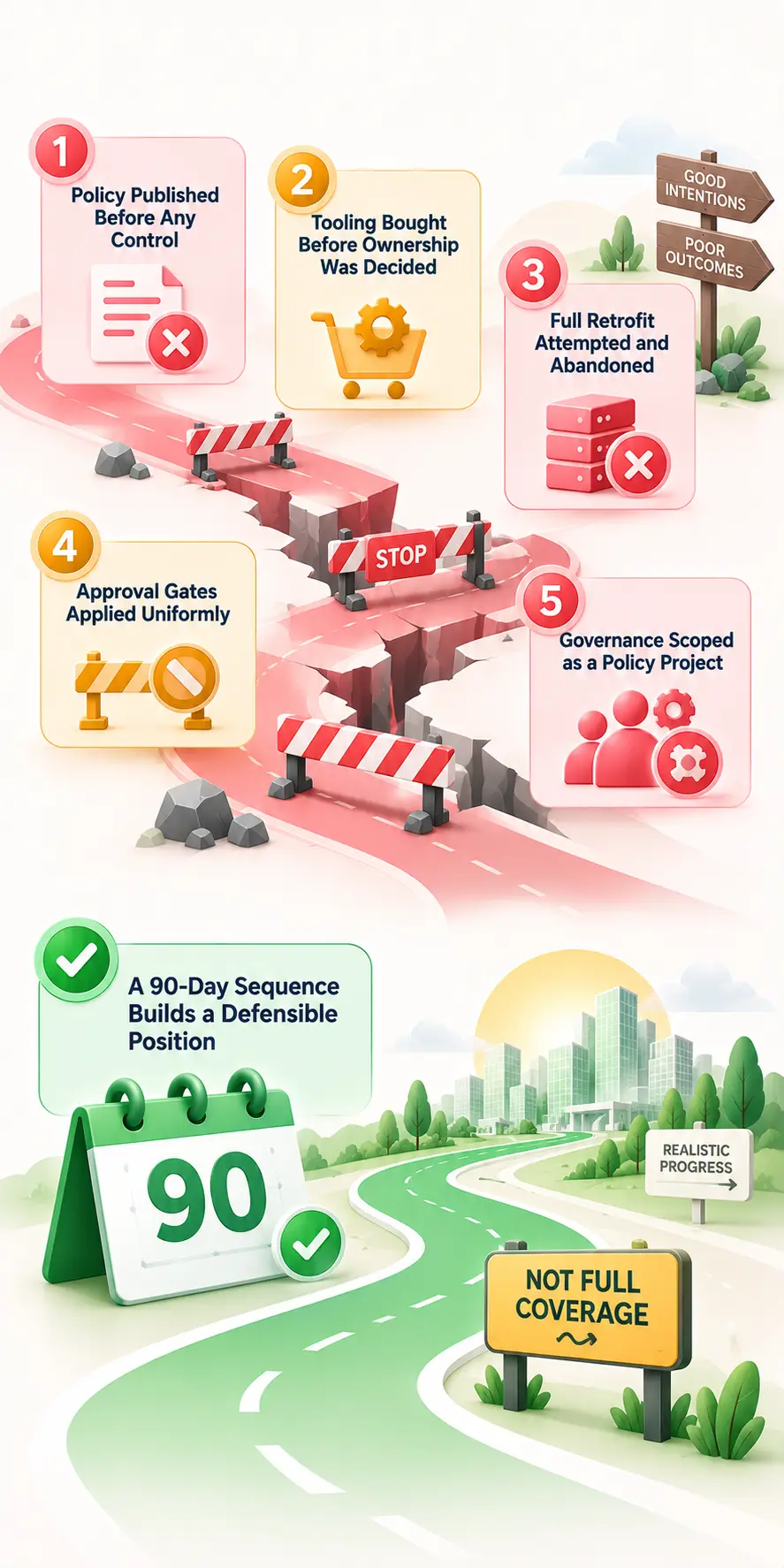
Companies often draft exhaustive compliance documents before establishing any technical guardrails. It gets published before anyone can track AI use cases, record approvals, or monitor changes. The document exists, but the day-to-day controls do not.
Purchasing expensive monitoring platforms before assigning clear responsibility leads to unused software. When no team owns the configuration, alerting, or maintenance, software becomes shelfware that fails to advance your AI governance maturity model.
As teams attempt to capture all of the models currently in production, they immediately encounter incomplete documentation, unknown ownership, and legacy systems that weren’t designed to be tracked in this way. Work is delayed even as the riskiest items remain uncaptured.
Applying heavy enterprise-grade risk reviews to every low-stakes pilot creates massive delivery bottlenecks. When governance feels like an arbitrary wall, engineering teams actively route around it to maintain velocity.
Leadership supports the architecture, but no funds are provided to carry out the necessary engineering for lineage, logging, testing, monitoring, and evidence. An AI governance strategy can never be effective if there is only paper control.
Over-governance can be equally destructive. Stop attempting to document everything at once, purchasing technologies without having decided on the operating model, and forcing every application of AI through the same process. The best practice of good AI governance should provide teams with insights into areas that need action, rather than generating work for its own sake.
A realistic 90-day AI governance strategy produces a defensible position on high-priority models, not total estate coverage. Any roadmap promising complete coverage overnight simply isn't costing the engineering retrofit honestly.
At Entrans, we approach AI governance implementation by scoping reviews to a single production use case and the pipeline behind it.
We inventory the evidence your current system emits, evaluate those artifacts against your internal control requirements, and cost the exact delta. This keeps the AI governance implementation grounded in how the system actually runs.
Where possible, evidence emission is automated rather than left as manual documentation. This is where Entrans applies 70% workflow automation to reduce the amount of recurring manual work involved in evidence capture.
This targeted review helps organizations refine their broader AI governance strategy using practical operational realities. By establishing clear controls and realistic AI governance KPIs on one live workload, you create a repeatable blueprint for company-wide AI governance improvement.
The final deliverable is a cost remediation backlog sequenced over 90 days. The work can then feed into an AI governance strategy, AI governance KPIs, and the broader AI governance maturity model.
For teams also working across data and ML pipelines, Entrans connects this governance work with its DataOps and MLOps services; evidence requirements can be considered within the delivery pipeline itself.
AI governance does not need to start with a massive policy program. Learn how we build evidence around it, and use the next 90 days to close the gaps you can actually cost and fix. Book a consultation call with us.
AI governance best practices are practical frameworks and automated guardrails that help you track, test, and manage AI models safely without stalling your delivery speed. They include clear ownership, risk-based approval, data and model lineage, monitoring, and keeping evidence of key decisions.
AI governance implementation requires a 90-day sequence, usually enough to secure your active production pipelines and establish a defensible risk posture. Full coverage usually takes longer because older systems may need additional evidence, controls, and engineering work.
Start with the AI use case inventory and evidence instrumentation for new models entering production. Defer broad policy work, tooling purchases, full retrofits, and formal committees until you have more capacity and a clearer view of the gaps.
AI governance strategy defines your risk tolerance, compliance goals, and overarching policies on paper. AI governance Implementation turns that strategy into working controls, evidence, monitoring, approval steps, and day-to-day processes.
Automate your evidence collection directly within existing CI/CD pipelines so developers don't have to fill out manual paperwork. Use risk-based gates so low-risk AI does not go through the same process as higher-risk systems.
Teams with established model risk management can reuse much of their classification, validation, documentation, and review discipline. AI governance still needs additional controls for areas such as foundation models, prompts, data lineage, retrieval, and agent actions.
Measure AI governance by tracking KPI such as inventory coverage, evidence completeness, approval status, monitoring coverage, and remediation progress. Use these measures with an AI governance maturity model to show where controls are working and where gaps remain.


-1.svg)