Oracle E-Business Suite to Fusion Cloud Migration: Options, Roadmap, and How to Choose a Partner
Planning to migrate Oracle E-Business Suite to Fusion? Compare your three paths, see what carries over, and get a phased roadmap plus partner checklist.
Oracle E-Business Suite to Fusion Cloud Migration: Options, Roadmap, and How to Choose a Partner
4 mins
August 14, 2026
Author
Jegan Selvaraj
TL;DR
Moving from EBS to Fusion is a re-implementation, not an upgrade. The two run on different data models, so custom PL/SQL, Oracle Forms, OAF personalizations and workflows have to be rebuilt as Fusion configurations or OIC and Visual Builder extensions.
Oracle has extended EBS 12.2 support to 2037, so there is no forced deadline. That turns this into a business decision between three paths: re-implement to Fusion, upgrade to 12.2, or lift-and-shift EBS to OCI.
Only setup data, selected transactions and controlled customizations such as DFFs actually move. Historical data usually stays in a low-cost archive on Autonomous Data Warehouse, Oracle EBS Accelerator, or Fusion Data Intelligence for audit and reporting.
Plan for 6 to 18 months and budget the invisible work. Data cleansing, integration redesign, parallel period close testing, training and hypercare routinely cost more than the licences.
Are you on the right EBS system for the next ten years? Although Oracle is still providing extra support for EBS 12.2, now is the perfect time to consider other options. Oracle Fusion Cloud offers an ideal chance to enhance ERP processes, data, integration, and automation. But you cannot simply copy and paste the legacy EBS custom code into Oracle Fusion Cloud. Both EBS and Fusion Cloud run on different database structures.
This blog breaks down the true differences in upgrading and explains how to migrate Oracle E-Business Suite to Fusion.
Table of Contents▾
What Oracle EBS to Fusion Cloud migration really means (a re-implementation, not a lift-and-shift)
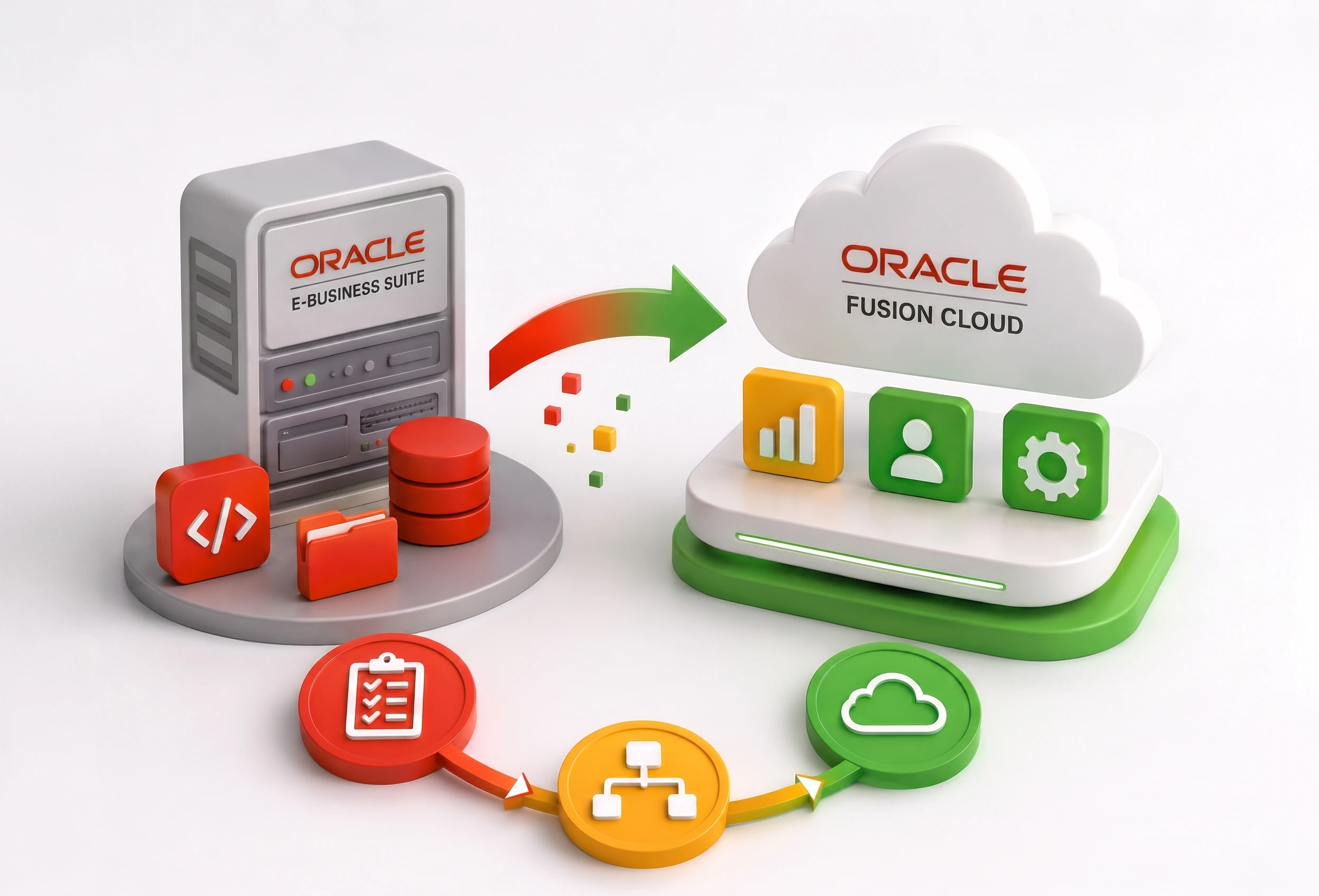
The process of moving the Oracle EBS application, data, customization, and processes to the Oracle Fusion Cloud Application is referred to as Oracle E-Business Suite (EBS) to Oracle Fusion Cloud Applications Migration.
It necessitates the design of business processes. It requires mapping the change of the core data model. It involves the replacement of legacy customizations with built-in SaaS features. The primary objective is to migrate to a new ERP system while retaining all core functionalities.
Why migrate from EBS to Fusion Cloud (and the honest timing picture)
Moving from Oracle EBS to Oracle Fusion Cloud is more than upgrading the technology. It is necessary to assess whether the existing ERP is still compatible with the company’s operating model, requirements, integration strategy, and plans.
Legacy ERP to Cloud ERP: EBS continues to run business-critical processes. However, maintaining the on-premises ERP infrastructure is labor-intensive. Oracle Fusion Cloud shifts the ERP model toward a cloud-based application suite. In this model, Oracle delivers regular application updates.
Enhanced user experience: Fusion Cloud provides a contemporary user interface for finance, procurement, supply chain, HR, and many other business functions. Users can access these applications in the cloud without using the traditional EBS interface. This streamlined experience makes it easy for users to adopt the platform.
AI and automation: Fusion Cloud supports newer automation and AI capabilities. Businesses utilize these capabilities in areas such as financial analysis, invoice processing, procurement, forecasting, supply chain operations, employee workflows, and reporting.
Support Global Business Operations: Businesses that operate in several countries have diverse requirements. These include currency management, taxation, financing arrangements, procurement, and regulatory reporting.
The Fusion Cloud facilitates global business processes. It enables an organization to meet such varied needs through an ERP system based on the cloud. This is particularly the case for organizations that wish to enter new markets.
Improve Analytics and Reporting: The Fusion Cloud enables advanced analytics and reporting. This allows the finance and business teams to access information about their operations.
Modernize Integrations: The EBS environment often relies on external interfaces. These can be used for applications, databases, and reports. These interfaces should be assessed and redesigned during the move to Fusion Cloud. This process is especially helpful for replacing old or unmaintainable interfaces.
Your three paths: re-implement to Fusion, upgrade EBS 12.2, or lift-and-shift to OCI
In assessing the different options available for Oracle E-Business Suite (EBS) modernization, there are usually three distinct routes that we have to take into consideration: re-implementing to Fusion, upgrading EBS 12.2, or executing a lift-and-shift to Oracle Cloud Infrastructure (OCI).
When to choose
The technology decision should follow the business objective.
Looking for
Choose
Long-term ERP modernization
Fusion Cloud
The business is ready to rethink processes, retire unnecessary customizations, and move toward a SaaS ERP model.
To buy more time
EBS 12.2
The business can continue using EBS while developing a longer-term roadmap for Fusion or another ERP direction.
Cloud migration
OCI
Moving EBS to OCI can separate the immediate cloud move from the larger ERP transformation.
Strategy Decision Matrix
Path
What it is
Effort and Cost
Re-implement to Fusion Cloud ERP
Full SaaS business transformation. Redesigns workflows to native SaaS processes and replaces custom PL/SQL code with cloud configurations or OCI PaaS extensions.
High
Upgrade to EBS 12.2
From legacy EBS (such as 12.1) to 12.2 through the adoption of Oracle's Continuous Innovation framework. Customized code, forms, and logic are kept intact.
Medium
Lift-and-Shift EBS to OCI
Moving your exact EBS application and database onto OCI virtual machines using automation tools (e.g., EBS Cloud Manager) without changing functional setups.
Low
EBS vs Oracle Fusion Cloud ERP: what actually changes
Transitioning from Oracle E-Business Suite (EBS) to Oracle Fusion Cloud ERP shifts your enterprise technology from a customized on-premises framework to a standardized SaaS model. Key operational and technical shifts include:
EBS
Oracle Fusion Cloud
Deployment
EBS relies on self-managed infrastructure and runs on on-premises or in hosted environments
Fusion Cloud operates on a SaaS model with zero downtime updates.
Architecture
They rely on customer-managed configurations, custom code, and extensions
It relies on modern cloud architecture with standard application capabilities
Extensibility Model
EBS supports deep, custom code changes within the core application
Fusion enforces standardized business workflows
Reporting and Business Intelligence
EBS uses legacy Oracle Discoverer, BI Publisher, or external data warehouses
Fusion features embedded operational analytics through Oracle Transactional Business Intelligence (OTBI) and real-time dashboards
User Interface and User Experience
EBS features legacy Forms-based screens and classic web interfaces
Fusion offers a mobile-first, role-based user interface equipped with embedded AI recommendations and automated workflows
Existing EBS customizations generally cannot be copied directly into Fusion. They must be rebuilt.
EBS and Fusion use different data structures. Data must be mapped, transformed, cleansed, and loaded into the appropriate Fusion structures.
Fusion Cloud offers a more modern, browser-based experience.
What carries over, and what does not (the customization reality)
EBS assets such as Setup and configuration data, selected transactional data, and controlled customizations such as Descriptive Flexfields (DFFs) can move to Fusion Cloud.
API hook customizations, Oracle Application Framework (OAF) personalizations, Oracle Forms customizations, Workflow customizations, custom reports, and uncontrolled schema customizations will not be migrated automatically.
Use Fusion application's standard features as much as you can, reengineer the workflows to use the native ones, and rebuild your differentiators as external extensions via Oracle Integration Cloud (OIC)/Oracle Visual Builder Studio.
Reconfigure and rebuild where needed using Fusion extensions such as Oracle Integration Cloud (OIC) or Oracle Visual Builder Studio.
A phased EBS to Fusion migration roadmap
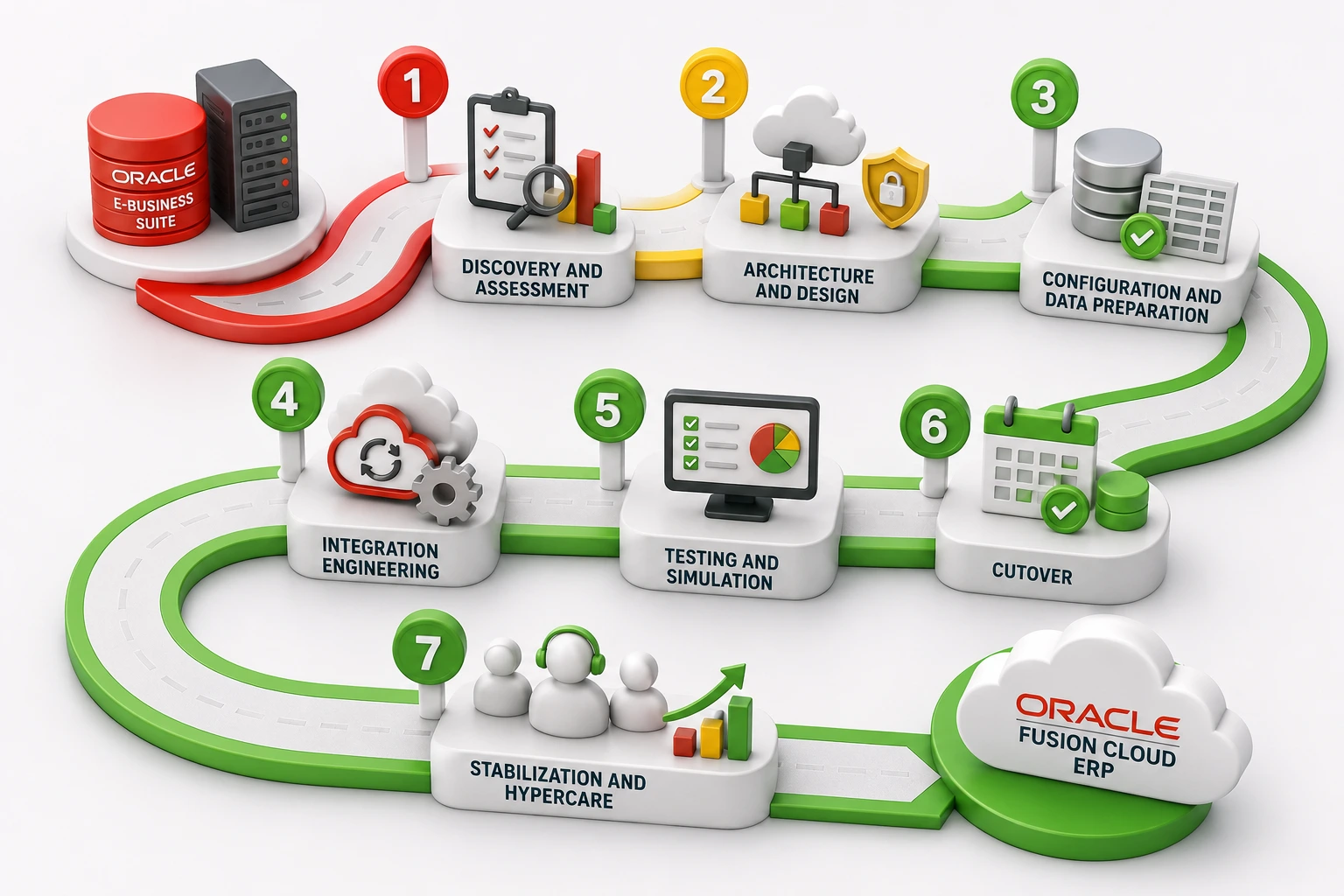
Migrating from Oracle EBS to Fusion Cloud ERP is a complex process of business transformation that cannot be accomplished through a straightforward migration process since Fusion SaaS operates under an entirely different architecture. The following roadmap will allow you to reduce disruptions and make a smooth transition, and to carry out the Oracle EBS to Fusion Cloud migration step by step
Step 1: Discovery and assessment
Before coding or configuring cloud infrastructure, begin fostering business leadership through scope, time horizon, and foundation architecture. Take stock of existing business processes, integrations, customizations, reports, extensions, and dependencies within the environment.
Classify them as either Retire (implement standard Fusion process), Reconfigure (native Fusion configuration), or Extend (rebuild on Oracle Cloud Infrastructure Platform-as-a-Service). Cleanse legacy master data (vendors, customers, chart of accounts) to prevent importing dirty data into the cloud.
Step 2: Architecture and design
After understanding the current state, define how the business should operate in Fusion Cloud.
Identify your target Cloud Chart of Accounts (COA) structure and choose the integration middleware.
Create your IAM framework, roles and access controls, and data residency compliance. Your target architecture needs to include the following areas: data residency, IAM framework, reporting, security, and integration architecture patterns.
Create event-driven architectural patterns for cloud and on-premises integration.
This creates clearer boundaries between Fusion and Connected applications.
Step 3: Configuration and data preparation
Once the design is finalized, implement Fusion Cloud based on the processes agreed upon. The data preparation steps should be done simultaneously with configuration, not after. Perform cleansing, mapping, transformation, and enrichment of EBS data before uploading it to Fusion. FBDI templates and Oracle Data Integrator may assist in data transportation and transformation according to the scope of migration.
Step 4: Integration engineering
EBS environments often have years of connections to external applications. Those interfaces need to be assessed rather than copied blindly into the new environment. Use Oracle Integration Cloud (OIC) to build the required integrations around APIs and event patterns. Design for error handling, retries, monitoring, and operational visibility from the beginning. Implement real-time REST/SOAP API patterns alongside asynchronous event-driven queues.
Step 5: Testing and simulation
Execute end-to-end business scenario tests across all connected platforms and modules. Testing should go beyond checking whether individual functions work. Test the end-to-end business process from order-to-cash, procure-to-pay, record-to-report, and financial close. In some cases, run a parallel period financial close test on Fusion vs. EBS.
High-volume testing for transactions, integration, reporting, and batch is also required. Automated regression testing may be helpful in repeating the tests under varying configurations.
Step 6: Cutover
It is important to set clear milestones for data freezing to give teams an exact timeline of when the flow of transactions ceases from EBS and when the data loading starts. Validation scripts will help to validate the count, balance, and key data relationships.
Time-bound reconciliation windows should be set to confirm critical information prior to the completion of the migration.
Step 7: Stabilization and Hypercare
SaaS implementation does not end at go-live. Incidents, performance problems, integration problems, end-user inquiries, and data inconsistency need to be tracked during hypercare. Defining an SLA and a triage process will allow you to define priorities depending on the impact to your business.
Root cause analysis needs to be included in this stage as well. Solving the root cause will bring more value than solving the symptoms over and over again.
Once the stabilization is achieved, it is time to implement a quarterly testing practice to avoid new problems caused by the Fusion Cloud updates.
What happens to your legacy EBS data (historical reporting and retention)
Migrating from EBS does not mean that historical data can simply disappear. By doing the correct audit requirements and historical reporting, we can plan the migration.
To bridge this gap, Oracle provides three primary architecture patterns:
EBS Archival on Autonomous Data Warehouse (ADW): Retain historical EBS data in ADW with APEX and use prebuilt reports for ongoing access.
Oracle EBS Accelerator: Provides prebuilt ETL pipelines to rapidly extract legacy EBS schemas into a structured cloud data warehouse without manual mapping.
Fusion Data Intelligence (FDI): Combine EBS and Fusion data for consolidated reporting through Oracle Data Integrator (ODI) and Oracle Analytics Cloud.
Executing this historical data strategy requires solving four core data-engineering hurdles:
Master-Data Harmonization: Aligning legacy vendor, customer, and Chart of Accounts keys with new cloud hierarchies.
Historical vs. Current Handling: Establishing clear time-based cutoffs to prevent duplicate transaction counting.
Security Alignment: Porting legacy EBS Data Access Sets and security profiles over to Fusion’s Role-Based Access Control (RBAC) structure.
Cost, Timeline, and ROI (realistic, not vendor-speak)
An EBS-to-Fusion Cloud migration is a major ERP program.
Cost: The Budget will be dependent on several factors, including modules, business organizations, countries, users, volume of data, integrations, customization, testing, training, and post-go-live support. Licensing costs are just one component of the overall budget; data handling, integration, testing, and change management could prove costly too.
Timeline: The period required for a targeted migration could be several months, whereas a multi-national enterprise environment migration could take as long as 12 to 18 months. Many factors could cause an extended time period, such as customizations and poor data quality.
ROI: The business case should go beyond cloud hosting savings. Consider lower EBS maintenance effort, fewer customizations, simpler upgrades, improved process efficiency, automation, better analytics, and reduced dependency on legacy technology.
Hidden costs: Data cleaning, archiving of past data, integration redesign, user training, testing, running parallel processes, and after-go-live support are all easily forgotten in budget considerations.
Better ROI calculation: Evaluate the total cost of ownership for remaining on EBS and switching to Fusion over 3-5 years. This includes initial migration costs, ongoing Fusion costs, human resource needs, and tangible business gains.
Testing, Change management, and Adoption
Finance, procurement, supply chain, HR, and other teams may have to function differently, which makes it important to conduct tests and ensure user readiness to make the transition process successful.
Testing
Perform integration testing of full business process flows instead of individual function modules.
Verify validation, integrations, reports, roles, workflow, and security.
Run integration test cases like procure-to-pay, order-to-cash, and record-to-report.
Do regression, volume, performance, and security testing.
Perform financial close activities in parallel where needed and compare EBS and Fusion outputs.
Use automated regression testing for repeatable test cases before every release.
Change Management
Mapping of the changes in the responsibilities for each business role as a result of the move to Fusion.
Identification of the processes which are being re-engineered as opposed to merely copied from EBS.
Development of role-based training programs for Finance, Procurement, Supply Chain, Administrators, and other roles.
Communication of the move schedule and expected benefits.
User Adoption
Users should start using it before going live. Give business teams access to realistic scenarios and hands-on practice so they become familiar with new workflows.
Following a strong approach combines business-led testing, practical training, clear communication, and post-go-live support. This makes users confident to work in Fusion Cloud starting from day one.
How to choose an EBS to Fusion migration partner
A technical re-implementation to Fusion SaaS fails if business users reject standardized processes. Consider the below qualities to choose a successful EBS to Fusion migration partner.
Look for a partner with hands-on experience who has experience across EBS modules and Oracle Fusion Cloud ERP.
Ensure they bring proprietary or prebuilt accelerators for automated PL/SQL code auditing, data extraction, and rapid File-Based Data Import (FBDI) mapping.
The migration partner should do a customization assessment and identify which can be retired, reconfigured, or rebuilt in Fusion.
Check their experience with data profiling, cleansing, mapping, transformation, validation, and historical data retention.
Look for experience with Oracle Integration Cloud, APIs, event-driven integrations, and third-party systems.
The fusion cloud migration partner should handle end-to-end testing, regression testing, financial reconciliation, performance testing, and cutover rehearsals.
Check whether the partner uses migration tools, automated testing, data-validation frameworks, and reusable assets to shorten delivery timelines.
Choose a partner familiar with your industry processes, compliance needs, reporting requirements, and regulatory retention rules.
Where EBS to Fusion migrations go wrong (and how to de-risk with Entrans)
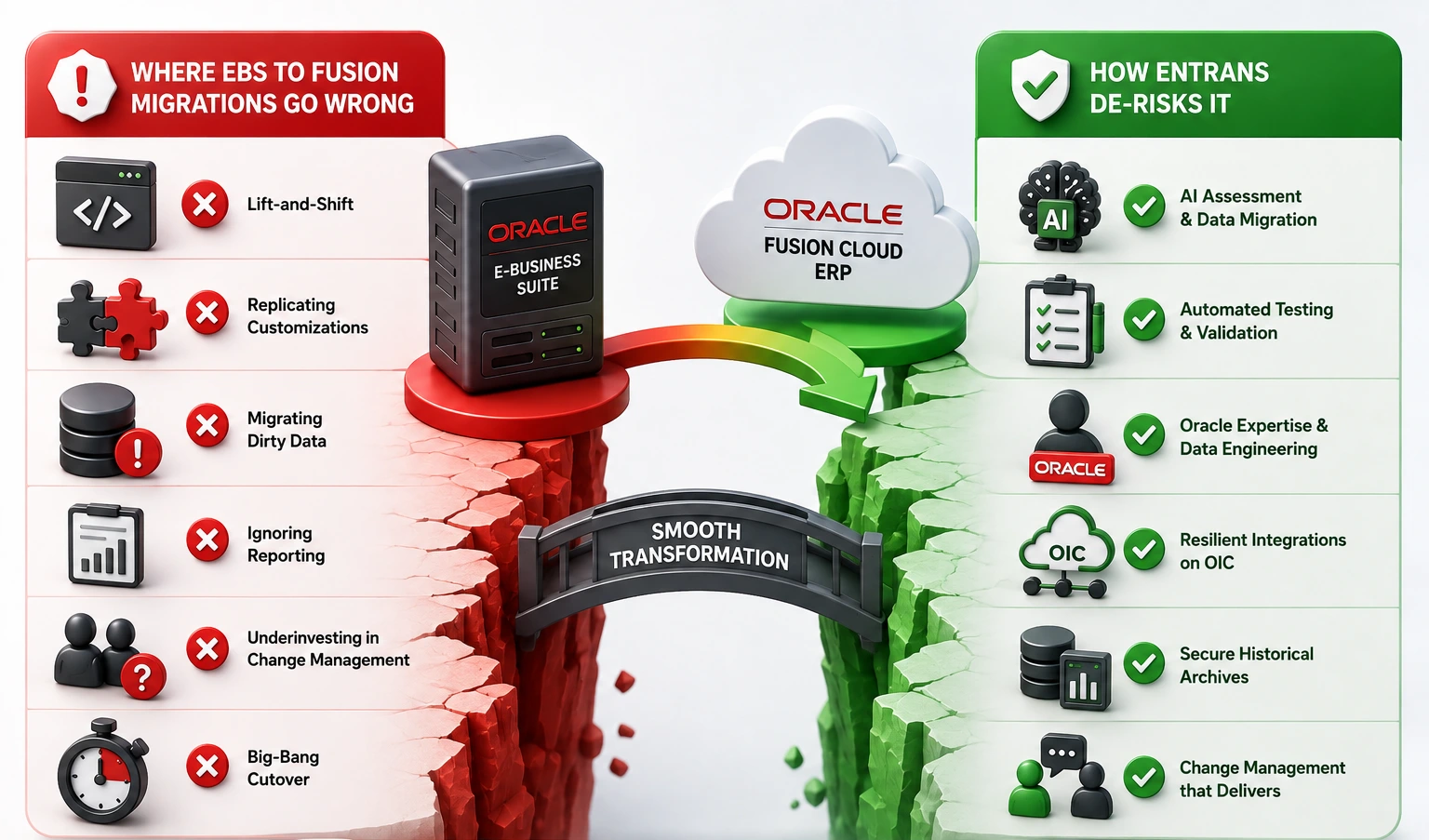
Moving from Oracle E-Business Suite (EBS) to Oracle Fusion Cloud ERP is a complete business re-implementation. Some common failure modes are listed below
Treating SaaS as a Lift-and-Shift: Attempting to copy legacy PL/SQL code, custom database schemas, and obsolete forms directly into Fusion.
Replicating Every Customization: Forcing SaaS modules to fit legacy habits instead of adopting native, out-of-the-box best practices.
Migrating Dirty Data: Importing duplicate supplier keys, incomplete customer files, and un-cleansed master records into the new cloud schema.
Ignoring historical reporting: Without a legacy-data strategy, teams may lose convenient access to historical reporting and audit information.
Underinvesting in change management: New Fusion workflows require user training, communication, and hands-on preparation.
Using a big-bang cutover: Moving everything at once can increase business disruption and make troubleshooting harder.
How Entrans de-risks it
At Entrans, we de-risk your cloud transformation using specialized tools, automated accelerators, and deep data-engineering expertise:
We bring in the AI-assisted assessment and data migration, automated testing and validation, Oracle expertise, and data-engineering capabilities to tackle the migration complexity earlier.
With our pre-built testing frameworks, we automate regression suites and parallel period close reconciliations to ensure financial precision.
Our engineers build resilient integrations on Oracle Integration Cloud (OIC) and architect secure historical archives using Autonomous Data Warehouse and APEX.
Ready to modernize your Oracle ecosystem without operational risk? Book a consultation call to build a predictable roadmap to Fusion SaaS.
Entrans runs the full migration: customization assessment, data migration, OIC integrations, testing, cutover, and hypercare.
20+ Years of Industry Experience
500+ Successful Projects
50+ Global Clients including Fortune 500s
100% On-Time Delivery
Thank you! Your submission has been received!
Oops! Something went wrong while submitting the form.
FAQs
1. Is Oracle E-Business Suite being discontinued?
No. Oracle EBS is not discontinued. It is focusing on its future development on Fusion Cloud applications by providing active feature innovations, advanced AI tools, and Core R&D investments. Oracle has extended its support for EBS 12.2 till 2037.
2. Is EBS to Fusion a lift-and-shift or a re-implementation?
It is a re-implementation because Fusion applications run completely on SaaS architecture. One needs to redesign business processes, configurations, customizations, and integrations according to Fusion Cloud.
3. How long does an EBS-to-Fusion Cloud migration take?
A typical Oracle EBS-to-Fusion Cloud migration takes between 6 and 18 months. The migration timeline depends on scope and complexity, data volume, customizations, integrations, testing, and business-process changes.
4. Will our EBS customizations work in Fusion Cloud?
No. EBS customizations usually cannot be moved directly to Fusion Cloud. They need to be reviewed, replaced, or rebuilt with Fusion features, and built again.
5. What happens to our historical EBS data after we migrate?
Only master data and operational transactions are typically migrated into Fusion Cloud. Historical transactions data is usually retained in a low-cost archive database on OCI. It can be migrated to Fusion Cloud when needed for ongoing operations and reporting.
6. Should we migrate to Fusion Cloud, upgrade EBS 12.2, or move EBS to OCI?
Move EBS to OCI if you need immediate cost savings and infrastructure modernization. The right path depends on business goals, customization levels, costs, integrations, and cloud strategy.
Hire Oracle EBS and Fusion Engineers
Add Fusion functional consultants, OIC integration developers, and Oracle data engineers directly to your migration team.
Free Project Consultation
Trusted by Enterprises & Startups
Top 1% Industry Experts
Flexible Contracts & Transparent Pricing
50+ Successful Enterprise Deployments
Jegan Selvaraj
Author
Jegan is Co-founder and CEO of Entrans with over 20+ years of experience in the SaaS and Tech space. Jegan keeps Entrans on track with processes expertise around AI Development, Product Engineering, Staff Augmentation and Customized Cloud Engineering Solutions for clients. Having served over 80+ happy clients, Jegan and Entrans have worked with digital enterprises as well as conventional manufacturers and suppliers including Fortune 500 companies.
Related Blogs
Forward Deployed Engineering Services Companies: How to Choose the Right Partner
Learn how to choose the right forward deployed engineering partner, compare providers, evaluate vendors, costs, engagement models, and key red flags.






-1.svg)