Loop engineering turns unreliable AI agents into production-ready software builders with Observe-Act-Verify-Refine cycles, tests, and human guardrails.

Agentic Unconference 2026 - September 19, Chennai
View Event →




Do you know why AI agents fail when the work gets bigger, but they can generate code in seconds? The real answer is not the model; it is what happens after the first response. One should get them working reliably to achieve consistent results. Enter Loop engineering, which bridges the gap between AI output and enterprise-grade software standards. This takes real-time evaluation, error handling, and state management into agent DNA.
In this post, we explain why loop engineering is not a buzzword. See how investing in it helps AI agents deliver production-ready results.
Loop Engineering refers to the process of developing agentic workflows (loops), which allow artificial intelligence programs to continuously plan, perform, evaluate, and refine themselves through feedback.
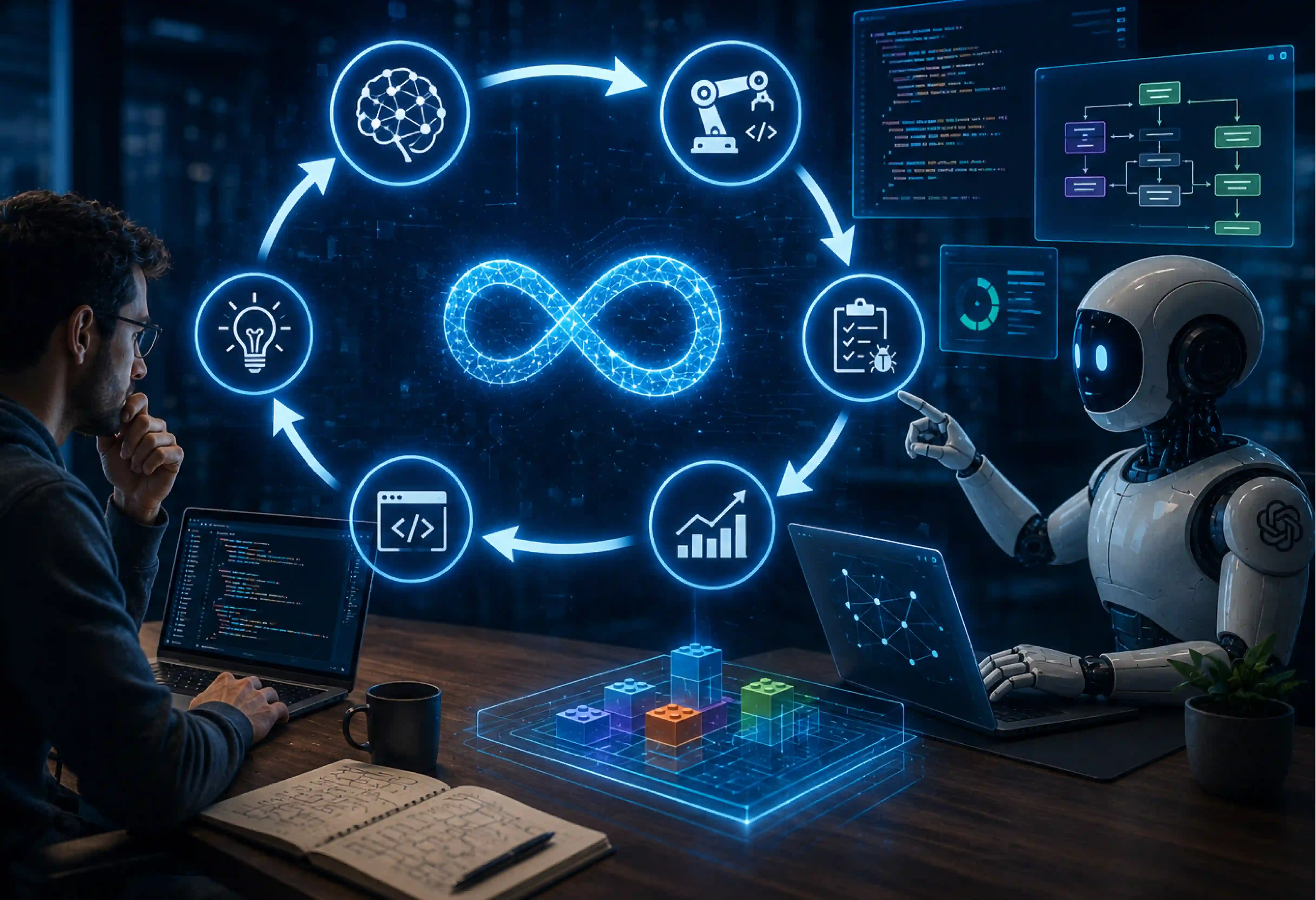
Observe→ Act→ Verify→ Refine
Instead of relying on a single prompt and its output, loop engineering works on structured feedback cycles where AI agents write code, run tests, review results, and retry tasks automatically.
Through this process, AI agents can handle and complete complex engineering tasks with greater consistency, quality, and production readiness.
By moving from manual prompting to the loop engineering process, enterprises will be able to turn unpredictable AI outputs into a reliable and self-correcting software delivery engine. The key benefits we get from loop engineering are
Standard Generative AI relies on “one-shot” prompts. This works well for short tasks but falls apart during complex, multi-step software development and also requires human review. Loop engineering eliminates this human bottleneck. The system tunes itself and fixes its own work until it succeeds.
The initial development of artificial intelligence technology involved the practice of prompt engineering. This entailed the user creating very specific instructions to elicit a response from the machine. However, such a process is quite suitable for small tasks, but in software development, it does not work. The evolution of software engineering was
Prompt Engineering (Manual inputs) → Context engineering (Fine-tuned inputs) → Harness Engineering (Tool Execution) → Loop Engineering (Autopilot)
Context engineering is the process of shifting the focus to feed the AI the right external data, retrieval-augmented generation (RAG), system rules, and codebase history.
Harness engineering is a process of equipping AI with active tools by allowing it to read files, run terminal commands, and call external APIs instead of just generating text.
Loop Engineering is the subsequent step towards the use of artificial intelligence in software creation. As opposed to producing one output, which brings the entire process to an end, AI agents engage in a process that revolves around a loop of planning, implementation, verification, evaluation, and revision until quality criteria are fulfilled.
We cannot expect loops to pass all the time; there are certain test cases such as
To build reliable AI software, you cannot just give a model a prompt and hope that it will do the rest. One needs to build an environment that forces it to work on a self-correcting basis. This continuous cycle is the Agent Loop. The determined steps are
Every agent loop begins with a clear objective. An agent loop is activated when a definite goal is created, which could range from creating a new feature to bug fixing. Definite goals enable the agent to understand what success will entail.
It is vital that before an agent even writes any piece of code, we must know its location and what it is doing. Divide the goal into smaller pieces. The loop identifies the system specifications, directory file trees, relevant source files, git commit histories, and error output from previous loop failures. This roadmap helps in avoiding unnecessary retries later in the loop.
The agent moves from ideation to real-world impact. With the help of predefined software tools, it writes code, updates configurations, generates tests, or performs other assigned tasks. This action transforms the LLM from a passive test generator to an active system component that is capable of interacting directly with developer environments.
This is the most important step in loop engineering. The output is automatically validated. It is done through unit testing, integration testing, security scanning, and quality assurance to ascertain whether the output meets the preset requirements.
If there is any problem, the agent continues to analyze the feedback, find out the reason for the problem, and make the necessary adjustments. Instead of waiting for another cue, this becomes the input.
This process of execution and validation will continue until one of the two conditions occurs: either the agent satisfies the predetermined success criteria or hits a retry limit that is preset by the system.
The output undergoes inspection by engineers/approvers and is then put in the production environment. Once the inspection is done, the code goes into the deployment pipelines where AI agents may hasten the process, with the humans retaining control of the decision-making process.
Depending on the complexity and risk level of a project, loops can be categorized into three levels and patterns to balance reliability, speed, and safety.
This is the simplest form of loop engineering. One AI performs a single action like generating a function. This is a great approach to use when working on independent tasks, such as implementing utilities, bug fixing, documentation, or test cases. This stage is commonly used by teams to bring AI into their software development processes in a simple way.
Choose this loop when generating boilerplate code, inline code completion, and quick refactoring.
The agent works against a defined test suite in an isolated sandbox. It iterates itself and goes through multiple edits, reading error logs and updating code until all unit tests pass.
Choose this loop when doing bug fixes, unit test generation, or localized feature development with clear acceptance criteria.
As the name suggests, the multi-agent loop assigns different responsibilities to specialized AI agents. One AI does planning, another writes code, while the other performs testing.
Choose this loop when you need to carry out end-to-end feature builds, complex framework migrations, or automated repository maintenance.
Let’s understand clearly the difference between loop engineering vs. Prompt engineering and agentic workflows through the table below.
Moving away from manual prompting obviously delivers clear financial returns and operational gains.
Most of the important tasks, such as bug fixes, refactoring, and writing test cases, are reduced by 30 to 50%. By doing automated verification, the effort spent on manual testing and code reviews is reduced, allowing engineers to focus on architecture and product innovations. Overall, by using loop engineering, the development cycles have become shorter.
The above metrics help organizations quantify efficiency gains, identify optimization opportunities, and demonstrate the business impact of AI-driven software development.
The common challenges faced when applying loop engineering are:
Enterprises are deploying loops to tackle repetitive, complex engineering workflows at scale.
When a monitoring tool detects a production bug, it triggers an agent loop. The agent ingests the error trace, locates the faulty file in an isolated git sandbox, drafts a fix, and runs unit tests until they pass.
A loop system systematically processes the codebase file-by-file, updating syntax, executing the type checker, reading compiler errors, and self-correcting itself until the refactored code meets modern standards.
Loop Engineering is a process that automates the delivery pipeline through validation of the code change before deployment. The AI agents conduct tests, do security scanning, validate the configuration files, and ensure that the deployment is ready.
AI agents assist in resolving support tickets by collecting information, proposing solutions, validating answers, and escalating complicated cases whenever required. This technique not only enhances the accuracy of the response but also ensures that support staff can concentrate on more important activities.
Entrans helps enterprises move beyond one-time prompts by creating AI systems that can complete engineering tasks from start to finish. We wrap AI models inside autonomous, self-correcting feedback cycles. We design loop-based workflows that combine coding, testing, security validation, documentation, and deployment checks into a single automated process. Each stage requires predefined quality checks that help AI-generated outputs meet enterprise standards before they reach production.
By moving from turn-by-turn prompting to Loop engineering, Entrans helps enterprises turn unpredictable AI experiments into working software engines. We deploy automated loops to process monolithic codebases and help with legacy code modernization. By moving on to the loop engineering process, we have shown a reduction in time-to-market.
Want to learn more about it? Book a consultation call with us.

Loop engineering builds continuous execution cycles with feedback loops, whereas prompt engineering crafts inputs for a single model cell. Prompting gives a one-time response with one instruction, and loop engineering is an automated cycle of planning, coding, testing, reviewing, and improving.
No. Cron jobs run fixed schedules, and loop engineering dynamically reevaluates outputs, handles errors, and adapts next steps using AI.
Agentic AI focuses on autonomous agents making decisions, whereas loop engineering is the structural design pattern used to build them.
A loop is termed well-engineered when it has clear termination conditions, robust state management, and reliable evaluation metrics to deliver consistent results by handling failures gracefully.
The risks involved in loop engineering are increased costs, state corruption, and compliance issues that can lead to unintended actions. Autonomous execution without adequate guardrails creates major security and data governance vulnerabilities.
Developers typically use orchestration frameworks like LangGraph, AutoGen, and CrewAI alongside workflow engines like Temporal or Prefect.
Yes. Engineers are required to design loops’ guardrails, write logic, manage integrations, and handle edge cases.

-1.svg)