Discover how RPA in healthcare automates administrative tasks, cuts costs, and boosts efficiency. Explore real use cases, AI integration, and ROI models.

Agentic Unconference 2026 - September 19, Chennai
View Event →





Tired of all the administrative paperwork involved in being an administrator of a hospital? The RPA process has been able to transform the process of doing things in the healthcare sector by performing duties like insurance verification, billing, and approvals.
Can robots do everything in healthcare? No, they can’t. AI agents can assist in document processing, request understanding, and more complicated workflow management.
In this blog post, we will talk about practical applications of RPA in the healthcare industry and what it takes to implement it.
Robotic process automation (RPA) in Healthcare involves the use of bots to perform rule-based processes in electronic health records, practice management systems, payer portals, and billing systems without altering the existing systems.
Some benefits of using RPA are that there is seamless interoperability without any disruption to the legacy hospital systems.
RPA is used by healthcare organizations for performing administrative activities like prior authorization and billing. The automation of healthcare processes radically changes the entire process of revenue cycle automation.
Some examples are patient registration, appointment scheduling, claims processing, billing automation, and prior authorization automation. Going through some of the best use cases of RPA in healthcare process automation enables employees to have more time for patients.
AI automation in healthcare is a combination of RPA and document AI used for obtaining data from patient records, together with LLM-driven agents for comprehending requests and enabling advanced workflows that require human intervention.
The healthcare industry often faces staffing challenges in revenue cycle and patient access teams, rising claim denials, and the burden of switching between payer portals. By automating the processes in healthcare helps staff to handle repetitive administrative work while focusing more on patient care.
Based on the 2024 CAQH Index, the healthcare sector could have saved $20 billion through automation. The MGMA survey further showed that 62% of medical groups had automated 40% or less of their revenue cycle processes in 2024.
The CMS Interoperability and Prior Authorization Final Rule (CMS-0057-F), among other regulations, makes the requirements for compliance more difficult due to time requirements and data exchanges through APIs.
The application of RPA in healthcare aids the healthcare workforce in dealing with administrative tasks that are repetitive in nature through the use of electronic health records (EHRs), practice management (PM) software, payer portals, and billing systems.
The following are the 12 RPA use cases in healthcare – by department.

RPA bots ensure that claims have all required fields filled out, verify the information for patients and the insurance plan, and ensure eligible claims are filed using the clearinghouses. It is possible to monitor the success rate of claims in terms of acceptance on the first attempt and rejected claims.
The status of the claim will be verified by bots on the payer portal, denial reasons will be collected, and the claim will be sent to the right billing department. An AI agent can classify denial letters and prepare an appeal summary.
Bots match electronic remittance advice with payments and outstanding balances.
Operating between EHR and billing systems, bots flag mismatched or unbilled charges.
These insurance eligibility checks are performed by bots to ascertain insurance coverage and benefits before booking an appointment.
RPA is associated with appointment scheduling, giving reminders, and transferring information about patients to the registration system. The employees can see any irregularities in the routine procedure.
Auto-populating patient intake forms into master files between patient portals and EHRs; this 2-week bot deployment minimizes patient wait times.
Bots verify authorization status, collect needed documents, and file requests using payer portals. Artificial Intelligence document processing can identify pertinent information from clinical notes and use it for review. The CMS's Interoperability and Prior Authorization Final Rule establishes new regulations for payers affected by these, which have some operational components coming into effect in 2026 and API components starting in 2027.
Bots collect referral data, validate required data, and route requests to the right departments. AI is used to collect information on referral documents that come in. They also monitor medical records requests, the status of requests, and route approved requests for processing. AI can categorize documents, whereas only authorized personnel can see confidential disclosures.
Bots capture claim requests, ensure validation of required fields, and direct incomplete requests to get them corrected.
The bots will update the provider files, fill in information regarding enrollments, and highlight any missing information. The data entry process is assisted by AI, and employees check for inconsistencies.
Bots will manage the renewal process, gather all credentials, and alert the HR staff of the expiration date. Employees will validate the credentials before accepting the documents. They will also monitor the stock and generate purchase requisitions when the stock reaches the threshold. They will also gather the validated documents for auditing purposes.
Integrating revenue cycle automation and medical billing automation across these departments lets teams eliminate repetitive data entry. However, automation of processes in the sphere of healthcare, which is more developed than others, guarantees that these processes are efficient and do not distract employees from doing their job. The analysis of intelligent automation use cases would ease the discussion of these separate software applications.
But not every healthcare workflow needs AI agents. RPA applies to processes that have rules and deal with structured data. AI agents and document AI would be better in cases where the task works with unstructured documents or requires any interpretation of information.
The most efficient way to implement automation in the health care industry is to utilize each automation technology depending on the nature of the task that needs to be done, rather than replacing bots with AI. This can be done through implementing new AI-based automation solutions.
Some analysts and service providers market their products with the term "agentic automation" without elaborating on what goes into each category. In fact, RPA in the field of healthcare applies to deterministic tasks, which are characterized by a large number of repetitive actions. However, in the case of AI healthcare automation, the intervention occurs due to the need for probabilistic reasoning, linguistic analysis, and dynamic decision-making.
Running deterministic tasks through affordable RPA bots makes your automation structure highly productive.
A robust technical stack needs a modular architecture that separates data storage, integration, orchestration, and intelligence. Healthcare automation is best when each system has a designated role.
The efficient design should integrate all available software used in healthcare, ensure safe data transfer, and keep track of all automated activities. Automation of RPA in healthcare is aimed at making repetitive tasks automated.
A modern healthcare automation blueprint relies on five core layers:
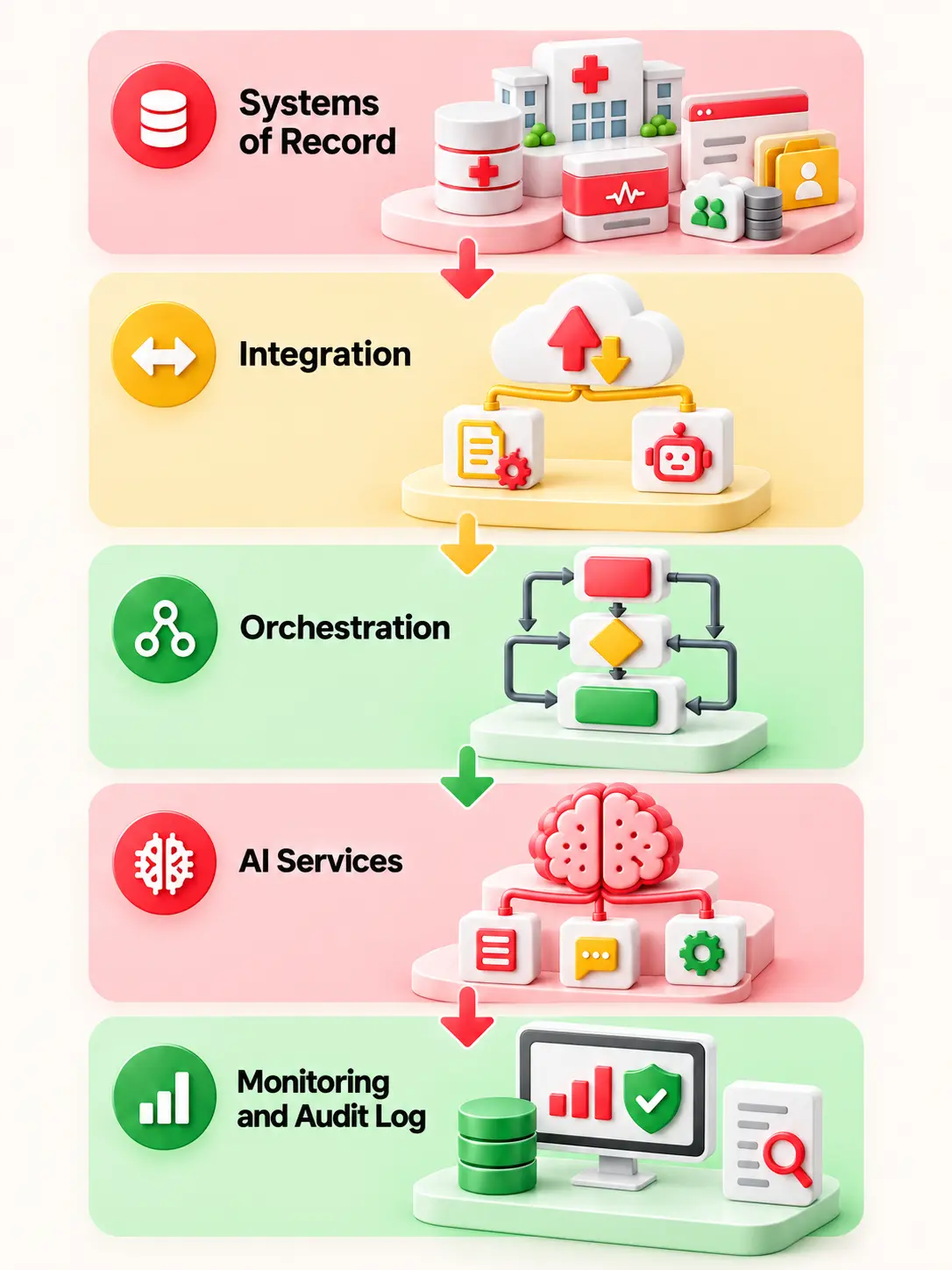
EHR platforms such as Epic and Oracle Health (formerly Cerner), payer portals, billing applications, and scheduling applications store source information.
Exchange healthcare data using HL7 and FHIR APIs first. If no API is available for use, RPA for healthcare may be used to perform the task via the UI.
This layer deals with the workflow tasks, queues, retries, and handoffs. For instance, a revenue cycle workflow may route an incomplete eligibility verification task to employees.
The document AI system pulls information from the insurance card and medical chart. The AI agent will understand the request or categorize an exception, whereas the rule-based process makes predictable decisions.
Record the task status, timestamps, data modifications, errors, approval steps, and bot or agent actions. This information is useful when investigating problems and accessing records.
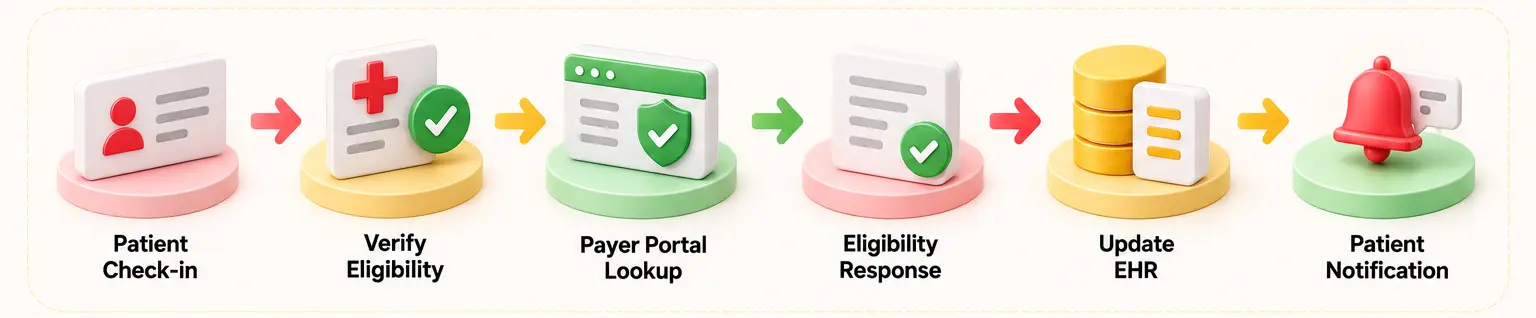
The framework also facilitates the automation of prior authorization, automated medical billing, and many other potential uses of RPA within the healthcare industry. First, look for areas where there is predictability, then incorporate AI when there is information to be interpreted.
Security in healthcare process automation is essential for building patients' trust and following regulations. Contrary to other industries, successful RPA in healthcare should include high security measures.
✓ Assign a unique identity to each bot. Use role-based access and grant only the permissions needed for its tasks.
✓ Store passwords, API keys, and other secrets in a secure vault. Rotate credentials regularly and restrict access
✓ Keep protected health information (PHI) out of application logs unless required. Mask sensitive fields and restrict log access.
✓ Sign business associate agreements (BAAs) with RPA vendors when required under HIPAA.
✓ Record bot activity, timestamps, access events, approvals, and errors.
✓ Test bot updates whenever payer portals or EHR screens change. Review failures before returning bots to production.
These safeguards ensure that healthcare process automation can perform billing, prior authorization automation, and other processes while safeguarding patients’ information.
Costs for RPA implementation within the healthcare industry are determined by the number of workflows involved and the number of systems to be integrated. Automation of one repetitive process within billing is likely to be less resource-intensive than integration of multiple EHR systems, payers' portals, and revenue cycle applications.
Budgeting for RPA in healthcare involves five core elements:
Healthcare processes may also need additional funding for conducting security evaluations, providing employee training, and linking up with existing systems. This should be taken into account when preparing the budget.
To calculate expected returns from revenue cycle automation, use this standard formula:
ROI (%) = (Annual benefits − Annual costs) ÷ Annual costs 100
Assumptions
ROI (%) = ($40,000 - $25,000 ) ÷ $25,000 × 100
ROI (%) = 60%
The calculation is based on the assumption that all saved time can be utilized effectively as the productive capacity of the business. Savings will vary according to how the team will utilize the saved time. Other possible benefits are not considered in this example.
To avoid building bots for the wrong workflows, use a practical scoring rubric before committing engineering resources to your RPA in healthcare initiatives. Evaluate potential RPA use cases in healthcare against six key criteria:
Start with simple, repetitive workflows before moving to complex healthcare automation projects. Use the RPA Fit Test to assess which processes are suitable for automation.
Not every automation project delivers expected results. Challenges often start in the first stage itself without proper planning, exceptions, or long-term ownership.
Several RPA solutions can be selected by healthcare professionals based on their systems, requirements, and capabilities. The software applications below have diverse uses and should not be ranked.
Selecting the right platform depends on many factors; you need to consider its
It is advisable to make sure that APIs are used wherever possible and that bots are used for systems lacking appropriate interfaces.
Hospital workflows and administrative backlogs require more than off-the-shelf software; they demand deep domain expertise and custom engineering. Entrans partners with healthcare organizations to build intelligent, scalable solutions that transform legacy operations into streamlined digital powerhouses.
For instance, our recent work deploying clinical document AI has accelerated prior authorization automation outcomes, achieving 3X faster processing, 70% less manual effort and errors, and over 95% data extraction accuracy.
Another use case involves Entrans assisting a healthcare network in implementing an AI clinical document project into production. The company created a pipeline for documents, which was integrated into the EHR using HL7/FHIR integration points. Clinical decisions made by the team were still reviewed and approved by humans, and logs recorded all activities within the process.
Are you launching your first AI automation in healthcare? Book a consultation call with us to learn more.

RPA in healthcare uses software bots to complete repetitive, rule-based tasks across clinical and administrative systems, such as checking insurance eligibility, submitting claims, or updating patient records. Bots work through existing user interfaces, so hospitals and payers can automate without replacing their EHR or billing systems.
Some common examples of using RPA in healthcare are automated patient appointment scheduling, batch eligibility verifications, claims status checking, and electronic remittance posting. These save administrative teams countless hours every week.
It stands for Robotic Process Automation, referring to software bots that mimic human actions across electronic health records and payer portals. These tools execute repetitive digital workflows without altering underlying legacy infrastructure.
No. AI is not replacing RPA; instead, they work together as complementary partners. RPA handles structured, predictable button clicks, while AI steps in to process unstructured documents and complex clinical reasoning.
Yes. RPA can support HIPAA compliance when teams use proper access controls, secure credentials, audit logs, and approved vendor agreements. Compliance depends on how the system is built, used, and managed.
First, start with high-volume, repetitive tasks that follow clear instructions, such as eligibility checks and claims processing. Choose workflows with few exceptions, low risk, and a clear path to saving time or money.
Leading platforms include UiPath, Automation Anywhere, Microsoft Power Automate, and SS&C Blue Prism. The right tool depends on your healthcare systems, security needs, budget, and workflow goals.