Learn how to design an AI proof of concept that successfully moves to production. Avoid pilot purgatory with clear goals, real data, and pre-signed scorecards.

Agentic Unconference 2026 - September 19, Chennai
View Event →





The truth of the matter is that AI applications seldom leave the lab. The success of these projects relies on their design. The team will be able to develop the project without testing it, based on available data and budgetary constraints. An AI proof of concept solves the problem of
Can this idea work beyond a controlled test?
To design a PoC that can move to production, you need clear goals, real data, and a measurable way.
This blog explains how to design an AI Proof of Concept that can solve a real problem and a clear path to take to production.
AI PoC is a fast evaluation of the capabilities of the AI solution in terms of providing the required levels of accuracy, speed, and cost of transactions.
It displays how much value can be created, which helps the team understand that it’s high time to stop piloting and go for implementation.
POC is the abbreviation used in technology for “Proof of Concept.” It is a prototype designed to confirm that a technical concept is feasible. It provides an opportunity to experiment with the functionality of a proposed system and minimize the risks associated with its implementation.
The key benefits of doing a PoC are
Most companies start their AI journey hoping all PoCs reach production. According to Gartner, at least 30% of GenAI projects will be abandoned after the AI proof-of-concept stage by the end of 2025. Even more striking, IDC research with Lenovo shows that 88% of observed PoCs never reach wide-scale deployment; for every 33 launched, only four make it to production.
This trap is known as pilot purgatory. Teams are stuck forever refining the models on pristine lab data without incorporating any considerations of how they will integrate into the real world, regulatory compliance, and actual costs associated with implementing artificial intelligence in the future.
If your teams are stuck in this loop, read our guide on how to move your AI pilot to production.
An AI project is undertaken through different phases before it becomes part of daily business operations within a company. At each phase, a particular question is asked to decide on the way forward. It is crucial to understand the difference between PoC, prototype, pilot, MVP, and production implementation of AI to plan budgets and goals for AI implementation.
The main point here is not only the development of an AI solution. It is about implementing an AI PoC into production.
According to HSO's February 2026, the duration for each stage is:
This is only an estimate by HSO; there are no such standards for the industry. This will vary depending on the quality of data, interconnectivity, security, etc.
A proof of concept is not always required for an AI development effort. In some cases, the use case will be straightforward enough that there is no need to conduct a test. In other cases, thorough testing needs to take place before proceeding with confidence. Before embarking on this phase, early evaluation can be helped by an AI readiness assessment guide to ensure technical foundations are met.
AI PoC can be skipped in the following cases:
As an example, even a simple chatbot support system could integrate with the current system and require only minimal configuration. Here, implementing a simple proof-of-concept project would suffice, which would not take much time and would prevent high costs for AI deployment.
A dedicated experiment is very important in situations like these:
In these complex scenarios, a dedicated AI proof of concept to production approach is important to test your accuracy, latency, and cost.
Even before writing any code or training any models, AWS advises going up an approach ladder (prompt engineering) to address problems with minimum complexity:
Working from the bottom rung will help to ensure that the feasibility is confirmed early enough, thus not falling into the trap of AI pilot purgatory. A well-scoped AI PoC should focus on the easiest solution to meet the set targets. This will make the transition from AI proof of concept to production smoother and prevent teams from getting into AI pilot purgatory.
Most AI experiments fail because they are built inside isolated sandboxes using clean, synthetic data. When it moves to production, there is certainly a huge risk. To ensure your AI proof of concept to production journey succeeds, your experiment must run on a governed slice of real enterprise data with read access to actual systems.
When it is feasible, try to connect the AI with a controlled subset of actual data along with read-only capabilities for all systems used by the AI. In this way, it will help teams test the performance of the AI in terms of accuracy, speed, access, and implementation costs.
Use of synthetic data is not without merit. It can be used to test the basic process or some corner cases when actual data cannot be shared due to its sensitive nature. However, the use of synthetic data might fail to capture the complexities of real-life data such as missing values, dirty data, etc.
Data access delays are the single biggest cause of project overruns. If your security team isn't aligned on day one, you risk falling straight into AI pilot purgatory. Clear these checklist items in week one to maintain momentum:
Access to data can delay the whole project. The earlier we begin with these checks, the less waste of time and the easier it will be for us to develop an AI PoC.
How do you know if your AI solution works? A good demo is not enough. You need to check it with real examples before development gets too far. So how do you do this? Building an evaluation dataset can help the team set clear targets and catch problems before they move to production.
Select a small number of actual business examples that have been selected with care. As a beginning test of an AI's performance, a set of 20 to 50 typical examples may prove sufficient. The set should contain typical requests, oddball inputs, missing inputs, ambiguities, and instances when the AI is to decline responding and ask for a human's intervention.
Finally, label the expected outputs and outcomes of each example by consulting with subject matter experts. For the technical aspects of evaluation, enlist the help of an AI expert or an evaluator. Establish strict criteria for passing tests.
After evaluating the dataset, save an instance of it to serve as the regression baseline. Perform the same tests every time there is any modification made to prompts, models, retrieval configuration, or code. This will help you identify new bugs and confirm whether a new change works or breaks anything existing.
Keep adding new cases by getting real user feedback, but keep the baseline so results remain comparable. A clear evaluation process also helps teams track quality and AI implementation costs. Strategic execution can be helped by an AI implementation roadmap to structure these long-term milestones effectively.
There must be a set of criteria for success before an AI proof of concept can be tested. Otherwise, the team members will find themselves shifting the goalposts around or wasting too much time and resources on a doomed project. The pre-signed scorecard is there to help the team define success, when to adjust, and when to stop.
Select a few measurable goals. They will be technical accomplishments, cost incurred to run the software, and one business metric. Note down the existing baseline value so that there is an objective basis for comparison. To prevent this, every project needs a pre-signed scorecard approved by key stakeholders before writing code. This locks in clear guardrails, ensuring a smooth path from AI proof of concept to production without inflating your AI implementation cost.
There must be room for just one rescope in your scorecard. In case the model does not meet the scale threshold by Day 30 but holds promise, the team is provided with just one tight, time-boxed window in which the team can make adjustments in terms of prompts, RAG chunking, or the model's parameters. If the kill threshold is breached again during the second review, cut your losses and get out of the purgatory of AI pilots!.
The AI Proof of Concept should be ended by a firm decision, not more testing. Your six-to-eight-week timeframe allows you to test a problem at your company, analyze the results, and make a decision. The process doesn’t try to build a perfect solution in such a short period of time. The objective is to determine if the solution is effective and how ready it is for further development.
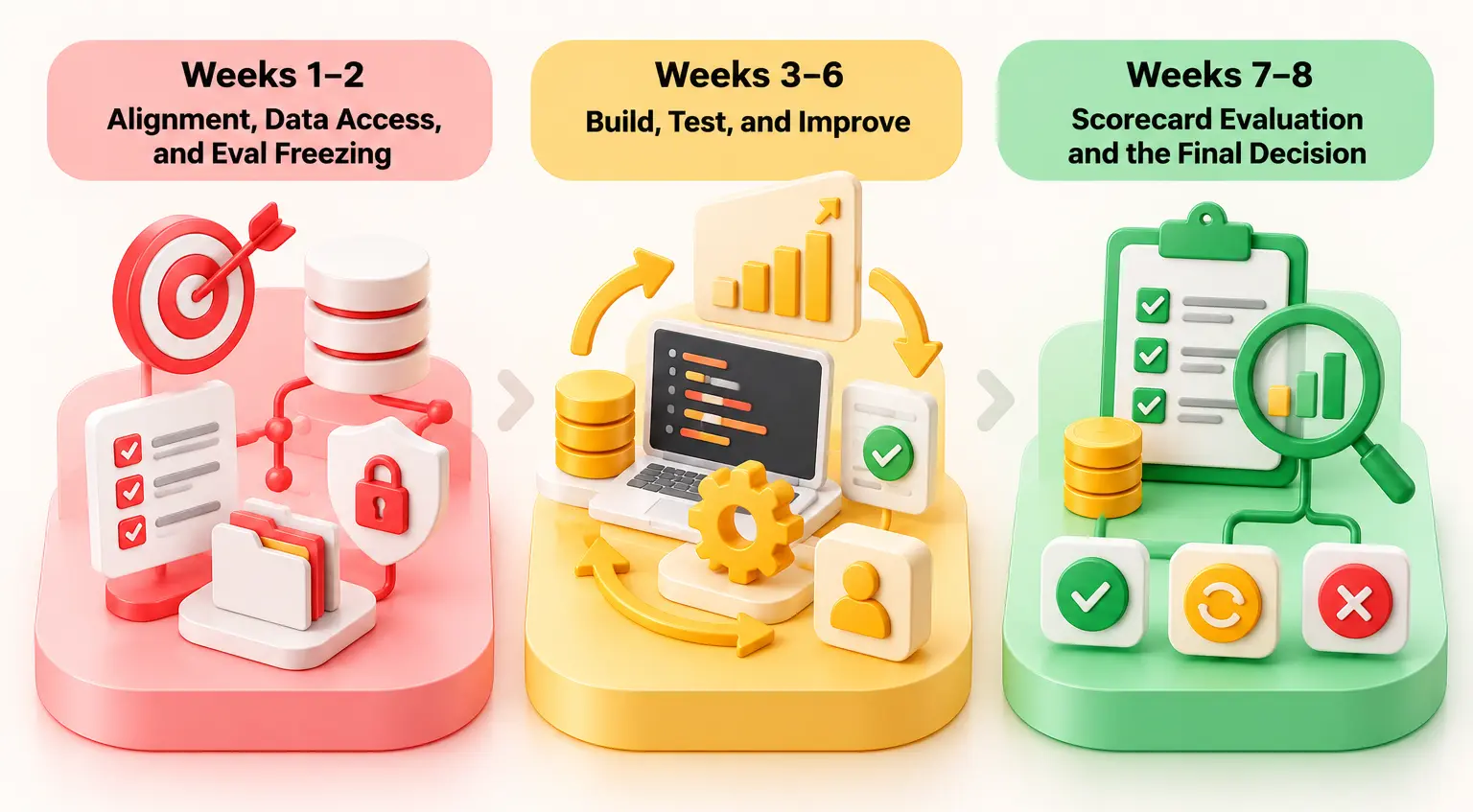
These two weeks are for laying the foundation. One should focus on establishing strict parameters for success:
With access secured and the eval set frozen, build the core logic directly within your target environment:
Keep an eye on the cost of AI implementation here as well. The use of the model, access to data, connectivity within the system, and other factors may influence the total cost. Generative AI pilots may be cost-effective for small transaction volumes, but become very costly for large transaction volumes.
Use the final two weeks to compare the results against the scorecard agreed at the start. Check whether the solution meets its quality, speed, security, and business targets. The final fortnight is dedicated to objective evaluation and long-term financial modeling:
For organizations looking to streamline this trajectory, working through an outcome sprint offers a structured design approach. We structure the work with one defined business outcome and one planned production release over six to eight weeks.
It's a design consideration and not a deadline. It depends on how well you can get access to the data, the complexity of systems involved, security analysis, and the scale of work.
The most important thing is to think about the release decision right from the very first day. It will give your AI proof of concept a bright future and prevent your team from AI pilot purgatory.
A standard AI PoC tests whether a model can answer questions or classify data correctly. Generative AI and agents require additional testing. Results can be inconsistent, and agents can call functions, update logs, and take actions. Teams need to ensure that, apart from testing the results’ accuracy, testing is done on how the system reacts to failures.
Agentic AI PoC requires additional controls because agents are capable of leveraging tools to carry out actions. Agents can query customer information, initiate tickets, update databases, and launch payment workflows. Every tool invocation must have explicit authorization boundaries.
Test individual stages as well as the complete process. Test metrics include completion of tasks, correctness of tool calls, error recovery, and number of actions requiring human intervention. Trace the costs associated with AI implementation in the entire process.
The major cost drivers for an AI PoC are discussed below
To understand how specialized engineering staffing impacts your budget when building an AI proof of concept to production, explore our breakdown of forward-deployed engineer costs.
Partnering with an external team can dramatically improve deployment rates. Selecting the right contract can keep an AI Proof of Concept on track and cost under control. Technical execution can be helped by partnering with a dedicated forward-deployed engineer who integrates natively with internal teams. When sourcing external partners, vendor selection can be improved by learning how to choose forward-deployed engineering company options that best match project needs.
Define IP/Code ownership, data usage/retention, exit strategy, and whether the code from the PoC is reusable. According to the 2025 report released by MIT NANDA, quoted by Fortune, partner/purchase of AI solutions was more successful than those developed in-house. Selecting the right terminology will facilitate your path from AI PoC to production.
At the end of an AI proof of concept, you should have clear results and practical assets to support your next decision. Ensure the checklist below before signing off:
These deliverables help your team move from an AI PoC to production without losing key findings or drifting into AI pilot purgatory.
An AI proof of concept often fails at handover when no one claims responsibility after the testing phase. Without named owners, even a successful PoC can fail.
Include the handover plan in the PoC plan right from the beginning. Outline who will take ownership of the code, monitor the costs of implementing AI, and approve any production changes. Ownership is key to avoiding falling into the purgatory of AI pilots.
At Entrans, we do not build isolated sandbox demos that get abandoned. We run AI PoCs as tightly scoped Outcome Sprints designed to take your AI proof of concept to production within your own environment from day one.
A forward-deployed engineering pod works inside the client environment to understand the workflow, access the right data, and build the solution within existing systems. Accelerating delivery can be helped by utilizing FDE as a service to deploy hands-on engineering capabilities.
Our Outcome Sprint framework focuses on verified production readiness:
Want to build a successful AI Proof of concept? Book a consultation call with us to learn more about it.

An AI PoC (proof of concept) is a short, time-boxed test of whether an AI approach can meet agreed thresholds for accuracy, latency, cost, and a business KPI on a real use case and representative data. It ends with a documented decision to scale, rescope, or stop, not a finished product.
A focused AI proof of concept typically takes four to eight weeks from kickoff to final evaluation. A clear goal and early testing can help teams decide on time.
Most enterprise AI PoCs cost between $30,000 and $100,000 depending on model complexity, integration depth, and evaluation needs. A PoC should cost a fraction of a full build, not as much as an MVP.
An AI PoC checks whether an idea can work and meet business goals, whereas an MVP is a working product built for real users to test its value.
Set clear targets for accuracy, speed, cost, safety, and business results before testing begins. Compare the results with those targets to decide whether to move ahead, rescope, or stop.
You should use realistic, de-identified production data to evaluate real-world edge cases accurately. Synthetic data can help test basic flows, but may miss real-world data issues.
If the PoC succeeds, refactor its modular orchestration and prompt pipelines directly into your production codebase. If it fails, archive the evaluation harness and dataset to prevent repeating the same experiments.
Start testing with real workflows, security checks, cost targets, and clear rules. Next, assign an owner, a rollout plan, and monitor the results. If any issues arise, fix them.