Write a winning forward-deployed engineering RFP with a ready-to-use template, vendor scoring matrix, pricing models, and SOW clauses.

Agentic Unconference 2026 - September 19, Chennai
View Event →





An FDE RFP does more than identify a pool of competent engineers. It identifies a partner that can embrace the business objectives of the project. An effective FDE RFP is created before the engineers hit the ground running.
The RFP establishes criteria that will define delivery, ownership, security, and success of the project. A poorly structured RFP may result in cost uncertainty and unmet expectations.
This blog provides tips on how to write a forward-deployed engineering RFP, complete with a sample FDE RFP template, a vendor evaluation scoring matrix, and SOW clauses.
In its present form, a Request for Proposal (RFP) for an AI software development project simply does not take into account any of the basic mechanics of forward-deployed work. It denotes what you send out to choose the right engineering partner. A forward-deployed engineer does much more than implement the items coming from the pretty-looking ticket queue. The main reasons a general RFP template fails are
The traditional IT recruiting RFP model is built around just two numbers: hours per person per hour and resume. This works well enough as long as all you want is some extra muscle to help with the backlogged project.
But once things get complicated enough for a team of embedded AI specialists to be involved, this model breaks down. FDEs must understand business problems, work with users, explore existing systems, and build solutions that run in production. A staffing RFP rarely covers these needs.
There are many phases to the process other than the completion of the code. This includes testing the solution, troubleshooting, making sure it works on the production side, and then passing that off to your internal team. Some of those items may not be covered when creating the FDE RFP, or even the statement of work for FDE.
Hourly rate alone is not necessarily indicative of good value. The forward-deployed engineer RFP must evaluate the individual's capabilities in discovery, production, problem-solving, and delivery accountability. It should also consider FDE pricing models and outcomes.
Knowing how to select a forward-deployed engineering team beforehand will be of great help. This will enable you to include the expectations in your statement of work for the FDE. Milestone-based FDE pricing models will enable you to transform a staffing agreement into a functional AI engineering contract.
Before sending out an RFP for the forward-deployed engineering procurement process, spend some time defining your needs. A good RFP will allow vendors to understand your business objectives, evaluate the project, and recommend the proper delivery approach. Here are five things you need before you begin.
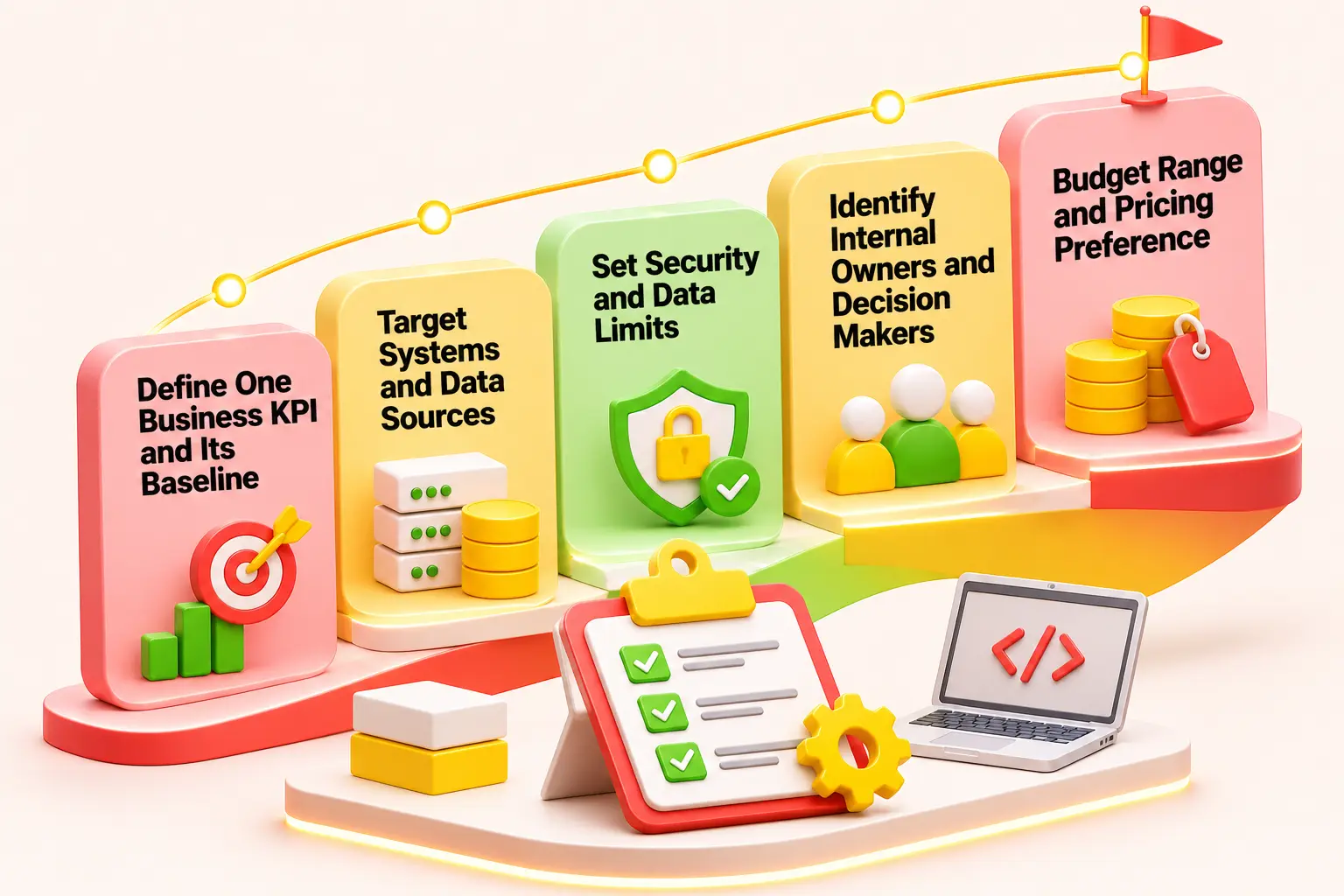
Pick a business problem that you want to tackle. Define a measurable KPI (e.g., invoice processing time, customer onboarding time, support resolution time, etc.). Monitor against that performance. This will give the vendor a baseline of performance to work from.
Identify the systems that the FDE will need to integrate with. Your CRM, ERP, data warehousing system, internal applications, or even AI platforms. Name the data sources and APIs that the FDE vendor might need to access.
When we talk about what data vendors can access and where. Discuss access control, compliance issues, data management practices, and production constraints. This will be critical for your FDE statement of work and the contract.
Identify the people who will lead the project, grant access, keep an eye on the progress, and sign off on the final results. FDE process requires regular input from business & technical teams. Lack of ownership leads to delays in delivery.
Choose between fixed-cost, time-and-materials, or milestone payment structures. If your project has specific business goals, choose an outcome-based AI engineering contract.
Availability of all five items will greatly improve forward-deployed engineering vendor selection, especially for those FDE-as-a-Service providers. The best thing about it is that it will be included in your statement of work for your forward-deployed engineering. If you need help assessing your AI maturity and gaps before setting the scope, explore AI Readiness Assessment.
A good forward-deployed engineering RFP should go beyond explaining the project and asking vendors for quotes. It should demonstrate your vision of how the partner will operate, what he will have to deliver, and how success will be evaluated. Every section should allow vendors to understand the scope of work before estimating its price and offering the team.
The following FDE RFP template includes eight sections. It can be used to evaluate vendors, analyze their delivery plans, and establish expectations before signing the contract.
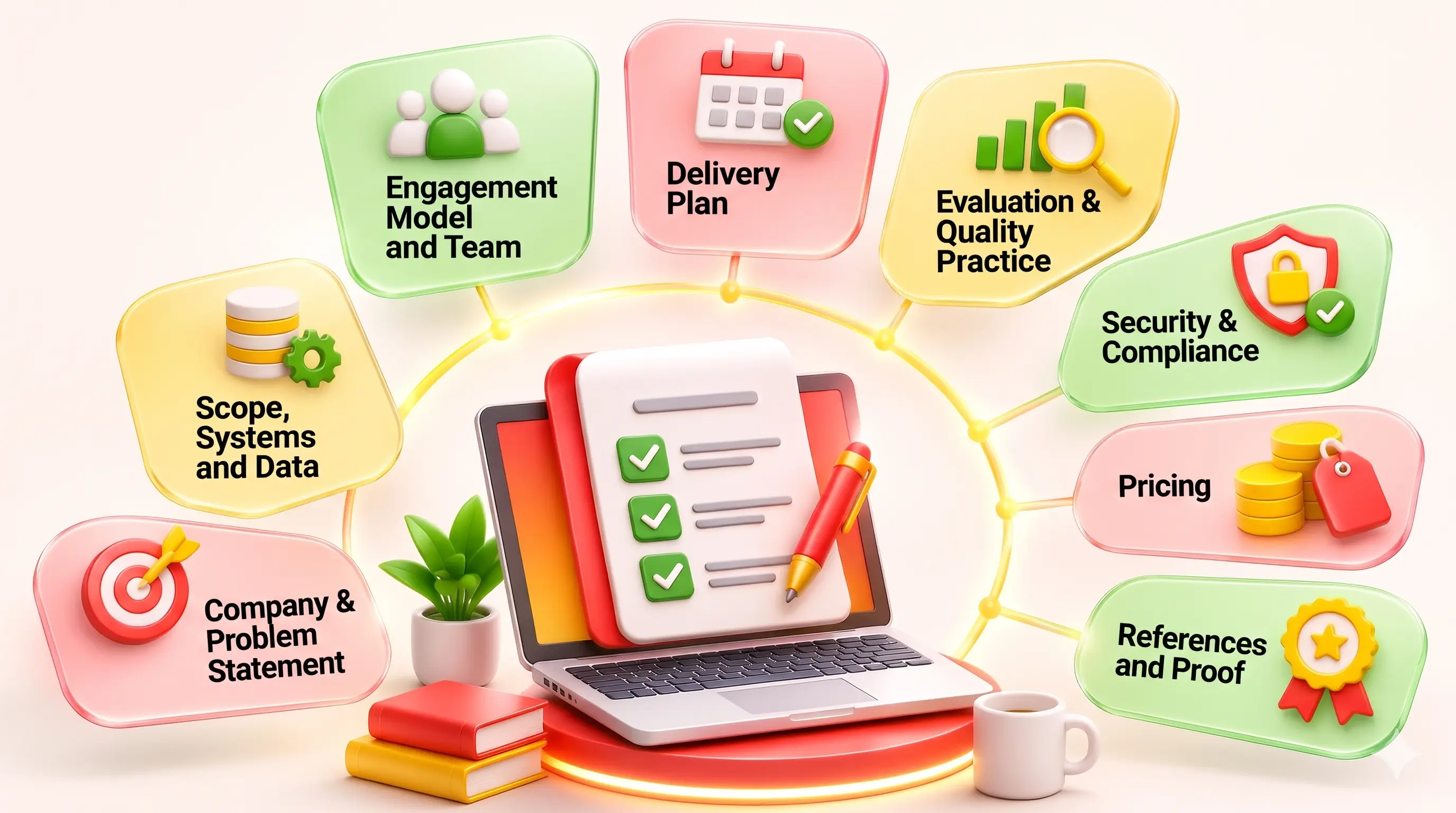
Begin with the basic business bottleneck, not a list of desired AI capabilities. Specify the target KPI, your baseline performance, and the status of any pilot projects that you have in place. This ensures that the vendors stay focused on the operational problem at hand.
Enumerate the systems that must be integrated by the FDE team. This covers your current AI tools, databases, cloud environments, CRM, ERP, and APIs. Describe the data sources that will be available and the extent of your willingness to grant access.
Indicate any limitations on the use of third-party tools, systems, or data. Vendors will be able to evaluate the scope of work in advance thanks to this.
Get vendors to articulate the team that they would be using to work with you. Get details about their seniority and level of experience. Furthermore, outline your expectations about on-siteworking, remote delivery, and hours of overlap in their working hours. You should request a named technical lead who shall be held accountable throughout the engagement.
Ask vendors to break their work into phases (e.g., discovery, first deployment to production, installation, transition). For each phase, also request time frames, key milestones, dependencies, and deliverables.
The FDE statement of work should state who is responsible for testing, production support, documentation, and knowledge transfer.
AI models cannot function without testing. Inquire with vendors about how they test the accuracy of their models, build gold-standard datasets, and hold back deployment until certain criteria are met. Good quality processes are one of the main indicators when assessing an engineering vendor.
Explain your security requirements. Explain access controls, encryption, audit logging, data retention, and approved tools. For LLM calls, ask where the prompts and data go, if they are stored, and if they can be used to train the model.
Request the vendor(s) to price according to at least two FDE price structures. For instance, you may compare pricing based on a pod per month with milestone pricing. Additionally, you may ask for an outcome-based contract in AI engineering when the outcome metrics have been defined. Inquire about exclusions, charges, and payment terms.
Ask for an instance of other similar projects that have made it to the production stage. Ensure there is experience with the same systems and data, and with a process similar to yours. Also, ask for references of the clients who can be contacted during working hours.
These eight points will ensure that the forward-deployed engineering vendor evaluation is much more productive. They will also provide a great basis to begin with in the forward-deployed engineering contract and its deliverables.
The forward-deployed engineering RFP needs to go beyond just asking the vendors about their services and previous experience. It needs to request proof that they can function within the customer's environment. This will show who owns the process, how they deal with delays, and what happens after the initial production release.
Utilize your FDE RFP template to pose 15 questions to each of the vendors. You need to ask for any supporting evidence along with the response. For instance, you can request that vendors submit their previous redacted evaluation report for any production launch.
1. Who owns business KPIs? Question how code commits link to revenue or efficiency metrics.
2. What is your time to first production release? Expect an honest deadline to push out live software instead of a sandbox demo.
3. Who leads discovery? Confirm whether engineers are working directly with your ops or are at arm’s length from account managers.
4. How do you handle stalled data access? Projects are always delayed due to security clearances.
5. How do you measure model accuracy? Find out how they avoid hallucinations before going live.
6. What happens when an integration breaks? Find out their post-deployment incident-handling process.
7. How do you manage prompt and model drift? Ask about system adaptation as users behave differently.
8. Can your team work inside our VPC? Security limitations slow everything down instantly.
9. Which FDE pricing models do you offer? Fixed-fee sprints versus usage- or milestone-based billing.
10. What triggers scope changes? Avoid any unexpected change orders within the sprint.
11. How do you allocate the pod? Make sure that key people remain on the account after the pitch is over.
12. Who owns the custom IP and fine-tuned weights? Safeguard your proprietary methodology.
13. What is your handover deliverable? Make sure that there is no vendor lock-in once the contract comes to an end.
14. How do you upskill our internal staff? The engineers have to support the system once you leave.
15. What defines a failed sprint? Have clear exit strategies if the velocity is low.
With a structured scoring rubric, your subjective review process becomes an objective, forward-deployed engineering vendor assessment process. Rather than rewarding the best sales presentation, your selection committee is forced to score execution evidence first before issuing an FDE statement of work or Forward Deployed Engineering contract.
Use this formula:
WeightedScore=WeightVendorScore5
For example, if a vendor scores 4 out of 5 for outcome ownership:
20 x 4/5=16
Add the weighted points across all seven criteria. The highest possible score is 100.
Use this matrix along with your FDE statement of work and FDE contract. An excellent score should not outweigh any deficiencies in security, key performance indicator ownership, or knowledge transfer.
Selecting the right commercial model when evaluating a forward-deployed engineering vendor ensures that you select the vendor who is geared towards maximizing logged hours rather than actual production value. Embedded engineering works within the operations framework, making traditional software billing models unsustainable after discovery of data bottlenecks.
When creating the statement of work or FDE contract, identify which pricing structures for the FDE you expect the vendor to suggest in your forward-deployed engineering rfp or FDE rfp template. Although the total budget required for the engagement varies based on seniority and pod structure discussed here in this breakdown of forward-deployed engineer cost, the execution risks differ for each business model.
There is no one-size-fits-all solution to engagements. A time-and-materials approach may be used for discovery engagements, while monthly pod retainers are best when a dedicated team is required over several months. A fixed milestone fee is the right approach for a clear deliverable.
An outcome-based AI engineering contract requires additional attention. You have to define the baseline, KPI calculation, measurement period, and uncontrollable factors. Payment of a base fee plus KPI bonus is much more realistic than full payment dependent on business outcomes.
The FDE statement of work and forward deployed engineering contract should outline payment terms, scope changes, acceptance criteria, and exit conditions. All these details have to be included in your FDE RFP template for vendors to quote against them.
A well-executed FDE engagement requires more than just the completion of tasks on a set schedule. The Statement of Work (SOW) must define what assets belong to the vendor, what the client must supply, and what should happen in case of any changes. Failure to include these items means that even the best FDE contract may end up being disputed.
Treat your fde rfp template like the roadmap to your future contract. Add the following nine essential clauses to keep your budget and project schedule safe.
Delaying procurement drains the steam before your engineers even start coding. In contrast to conventional enterprise software purchasing, the forward-deployed engineering vendor evaluation is most effective when you squeeze procurement down to four intense weeks and put actual developers through their paces.
Apply this sprint-style timeline along with your forward-deployed engineering rfp, fde rfp template, or AI development rfp template to go from outreach to signing an FDE statement of work without sacrificing a quarter to vendor evaluation:
Final tip
Do not choose a vendor simply because of its price. Determine who owns the results, how the team interacts with your engineers, and what happens after the first production launch.
A poorly planned forward-deployed engineering RFP could result in the wrong vendor being selected and increased costs, leading to late releases. Look out for these common errors when preparing your RFP:
Effective FDE partnership requires ownership, goals, and a team that can operate in your engineering environment. At Entrans, we adopt this approach in responding to forward-deployed engineering RFPs. The objective is not just to make recommendations but to assume ownership of the solution process. Instead of pitching loose staff augmentation, our proposals anchor on one accountable FDE pod delivered through our FDE as a Service model.
Instead of presenting a prototype in isolation, the pod has been built with production capabilities across the Entrans layers:
The terms may be based on the scope of work, resources available, milestones, and outcomes that have been mutually agreed upon. In addition to this, the fees may be linked to outcomes where appropriate. The specific pricing and performance terms will need to be clarified on a case-by-case basis.
Want to get production-ready software wired straight into your existing systems without paying for bloated teams or endless pilot cycles? Book a consultation call with us.

An effective FDE RFP should specify your target business KPIs, legacy system constraints, security considerations, and evaluation criteria. Rather than getting into specific technical specifications, you should ask vendors how their embedded pod will deliver production software within your current systems.
The RFP for staff augmentation is concerned with the recruitment of talented individuals to augment the team. The RFP for FDE is concerned with the outcome, problem-solving, and product delivery.
Make sure your scoring matrix is heavily weighted toward production deployment experience, legacy integration time, and security compliance, not fancy slides. Have a live architectural walk-through so that you can see the pod work through a problem under pressure.
The FDE providers have time-and-materials, monthly pod retainers, fixed milestone fees, and performance-based pricing models. It is important to select the appropriate model based on the project size, delivery requirements, and measurement of results.
No, a free trial of the POC will not reflect the hard work that goes into discovery, testing, and development. The paid, time-limited pilot will give both sides clear objectives and value.
IP ownership clarity is essential right from the start, along with stringent policies for data privacy and environmental access. The contract must also have a proper knowledge transfer policy so that the process can be owned internally afterwards.
It can take four weeks to consider all of these tasks, conduct scoping conversations, select vendors, and complete reference checks. Reserve the last week for negotiating prices, signing off on the SOW, and drawing up the contract.