A practical guide to forward-deployed engineers for SaaS companies: spot deployment bottlenecks, compare in-house vs. partner pods, and plan capacity.

Agentic Unconference 2026 - September 19, Chennai
View Event →





The deal is closed, software is shipped, but why is the customer still waiting?. Enterprise deployments often get stuck in integration, data access, and user adoption. That is the exact trap forward-deployed engineers for SaaS companies solve.
But there is a bigger decision to make. Hire in-house when the motion is permanent and repeatable. Use FDE as a service to cover spikes, new verticals, or the first 3 to 6 enterprise rollouts.
This blog is about when to hire forward-deployed engineers for SaaS companies, when to rent and when to wait.
Getting the deal from the enterprise is just the first step. Making sure the product works within the client's business is harder. Each company has unique data sources, software systems, security policies, and workflows. Standard onboarding does not necessarily take care of all these issues. This is the reason why forward-deployed engineers in SaaS companies are increasingly important.
As explained by Andreessen Horowitz (a16z) in Trading Margin for Moat, self-serve growth has its limits in the enterprise. Successful companies depend on services-led growth:
Understanding when AI startups need forward-deployed engineers protects your core roadmap from custom glue code. The initial team may use a part-time forward-deployed engineer (FDE as a service for AI startups to make their first few pilots. Once you begin to repeat these systems, it becomes important to consider hiring full-time FDEs. See how companies use forward-deployed engineers to scale faster.
Just because you have a healthy sales pipeline doesn’t mean you are successfully delivering your product to your customers. You might be sealing enterprise deals, demoing successfully, and getting good feedback. But customers are still struggling to make your product live. The disconnect between signing a deal and adding value is an indication that deployment might just be your main problem.
The following are some signs that your SaaS and AI product company might need forward-deployed engineers.
But when all these things happen at once, hiring a forward-deployed engineer for startups or using the FDE as a Service for AI startups is the obvious solution to this roadblock.
It is an expensive mistake to incorporate embedded builders too soon because then the software company becomes a consulting business with low profit margins. Both Plank and the FDE Academy point out several instances where forward-deployed engineers for SaaS companies are premature.
You may not need FDEs yet if:
Do not hire FDEs just because other AI startups are hiring them. Hire when delivering the product becomes a recurring problem in your business. Until that time comes, allow your product team to learn from early adopters and develop a delivery process.
Not every software business benefits from forward-deployed engineers. Determining the need for forward-deployed engineers for AI startups depends heavily on how deeply your product integrates with the customer's data and processes.
There are some cases where services-led growth is the only way to go from pilot to a permanent contract for some teams. There are also other cases where getting forward-deployed engineers for your SaaS company is not necessary until you have the core product ready. Take a look at the table below.
If you have a product that you're going to want to collect customer information from, or have custom workflows or complex integrations, then FDE may be worth the money. A forward-deployed engineer for startups could be helpful in early deployments and in assisting with identifying typical customer requirements.
As an FDE-as-a-service, it can be helpful for the first enterprise deployments of an AI solution and save the cost of having a full FDE team regularly. However, eventually, when this becomes a regular, repetitive affair, it's time to graduate to step two and build your own in-house FDE team. It is based on the interaction with the customer.
Forward-deployed engineers could help SaaS companies or AI companies bridge the gap from deal to delivering value for customers. However, there is a price that comes with that. The question then becomes, “Does the return outweigh the investment?” when it comes to the independent software vendor (ISV) ’s business.
Start with four numbers:
In the early stages of services-led growth, there will be a drop in your gross margin since labor is more expensive than cloud compute. You get back your margin by making scripts used repeatedly for clients into features of the product. Each reusable connector reduces future hours spent onboarding enterprise customers.
If your ACV is not enough to pay for full-time payroll, you can begin with a fractional, forward-deployed engineer (FDE). To model these exact ratios, check out our guide on forward-deployed engineer metrics.
The next big challenge is how to build your FDE team. Should you employ full-time engineers, engage with an outside partner, or do a combination of the two? All have their own respective cost structures, setup periods, and degrees of control. It all depends on your customer pipeline, deployment workload, and plans.
Full-time recruitment of a forward-deployed engineer in a startup may take months, while the best AI talent would require huge amounts of equity and compensation. On the other hand, hiring external builders would give you instant results without any ongoing costs.
Most scaling forward-deployed engineers for SaaS companies end up running a hybrid model. You keep a small, sharp in-house FDE core to own customer architecture, capture product feedback, and guide your roadmap.
Use partner pods when multiple enterprise deals come together or when you decide to move into a new industry. This model allows SaaS companies to adapt the workload of their forward-deployed engineers without increasing the permanent headcount for each new project.
This also helps you retain the customer knowledge inside your company. If you are going to build an internal team, use this guide on how to hire forward-deployed engineers.
In case you require additional capacity in engineering, FDE as a service will be able to compensate for that. It’s quite a straightforward idea - to keep expertise about your products inside the company and turn to outside help if needed.
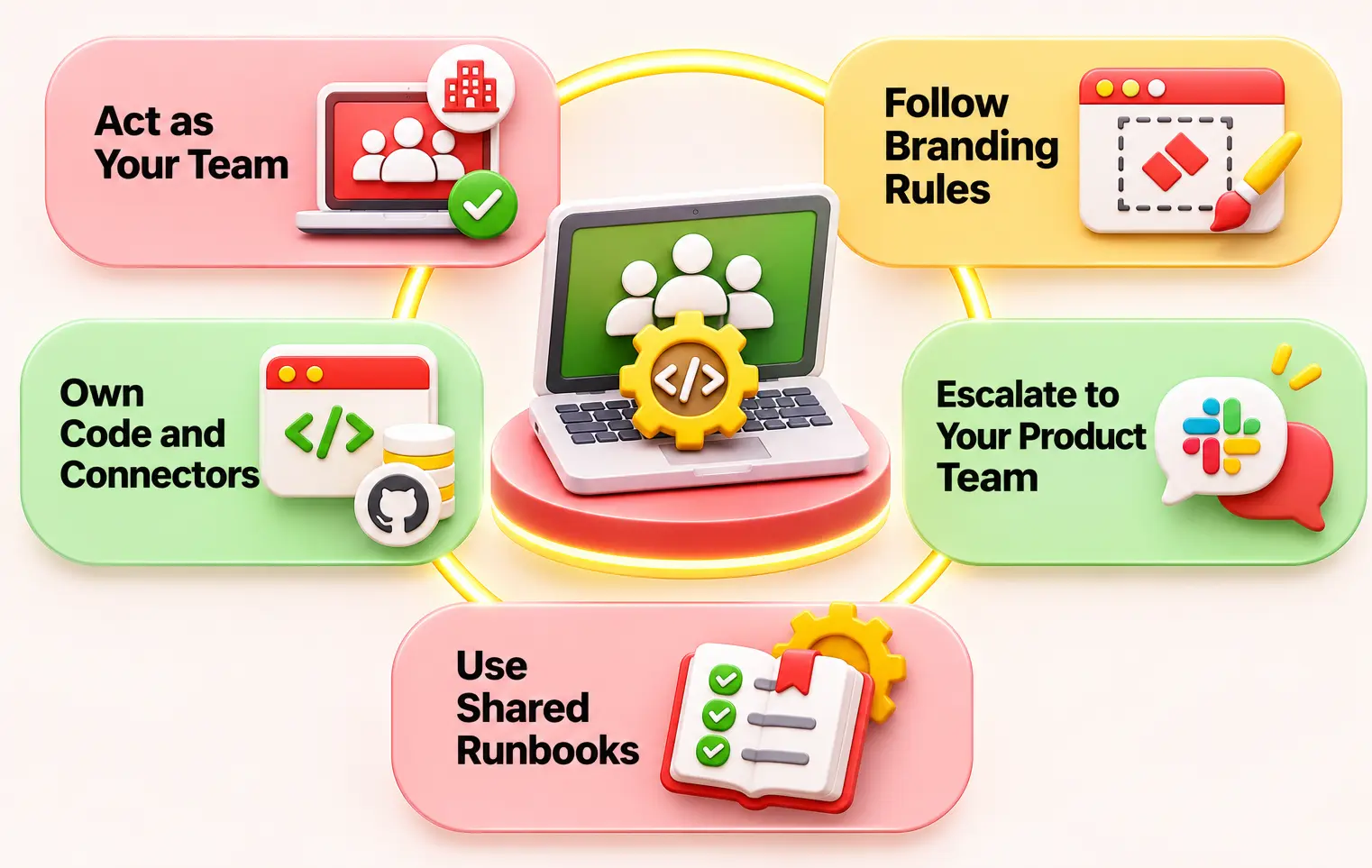
When working with your FDE partner, your customers must not feel that they are engaging with two separate firms. Your partner must extend your product team. Your customers must receive the same quality of service, communication, and technical expertise that they would normally expect from you.
Here are some simple guidelines for SaaS companies following FDEs.
Handled this way, services-led growth strengthens your core platform instead of pulling it apart. Your partner clears the deployment backlog while feeding real-world insights straight back into your roadmap.
The partner FDE model works well if the customer sees just one team, rather than two internal and external teams. Link the communication, technology choices, and project status.
If you decide to use FDE in an AI startup as either a service or as a fractional forward-deployed engineer, the internal team needs to keep control over the customer and the product development direction.
In the absence of a feedback loop, the services-driven development process stealthily converts the software company into a custom shop. What separates the finest forward-deployed engineers for SaaS companies is easy to comprehend: never build the same fix twice.
When it comes to engineers who are deployed forward in SaaS organizations, the idea is to make repeatable customer work into reusable product features. This allows the team to spend less time resolving similar issues for each customer.
After every deployment, collect the components that could be reused:
Calculate the amount of time each customer spends getting from kickoff to production. Analyze the data collected during multiple deployments. If every deployment requires the same setup time because the team does not convert that experience into reusable product components, then something is clearly wrong.
A well-oiled productization process will make future deployments increasingly easier. FDEs solve customer problems, spread knowledge gained through the process, and enable product teams to build reusable features.
This will allow the company to deliver faster, scale via services, and better serve more customers with the same amount of engineering effort spent.
Guessing your post-sales headcount usually ends in two bad outcomes: either enterprise deals sit in a launch queue for months, or highly paid engineers sit idle waiting for contracts to close. Knowing when AI startups need forward-deployed engineers and exactly how many comes down to simple capacity math.
Use this simple formula to determine the size of your enterprise customer onboarding engineering team rather than making hiring decisions based solely on intuition:
FDEHeadcountNeeded = Enterprise Deals per Quarter * Average Deployment Weeks
----------------------------------------------------------------
Week/FDE/Quarter * Utilization of the Target
Assume your company has the following deployment workload:
12 deals × 4 weeks = 48 FDE-weeks per quarter.
13 weeks × 75% = 9.75 productive weeks per FDE.
48 ÷ 9.75 = 4.92 FDEs.
However, since you have changing deployment demand quarterly, hiring five FTEs might not be the optimal solution. FDE as a service for AI startups can be used to solve this type of demand, the industry launch, and client onboarding.
When it comes to forward-deployed engineers for SaaS companies, make sure to recalculate this equation quarterly. Make adjustments based on real deployment time, customer demand, and FDE efficiency.
Selection of the FDE Partner requires more than just verification of technical ability. This partner will be dealing directly with your customers, their systems, and your product during implementation. You need to consider these points before proceeding with any agreement.
The answers will also help you determine which solution is better: FDE in-house or FDE as a service. For the case of forward-deployed engineers working for SaaS businesses, the best partner would be one that adds delivery capacity without controlling the customer and product development.
It isn’t enough to just know when AI startups require forward-deployed engineers; you also require a partner who knows how software vendors release, scale, and maintain their margins.
At Entrans, we’re providing FDE as a service for your AI startups, with a dedicated track for ISVs and SaaS builders where we design the AI directly into the product. We’re not just giving you a set of custom scripts; we’re integrating our pods right into your cloud, repositories, and CI/CD flows. It’s the connection between your APIs and your domain data that transforms enterprise customer onboarding engineering into platform features.
When there is a need for extra capacity in delivery, product companies have the option of employing a dedicated forward-deployed engineering team. In addition to delivery work, we help with design and product engineering, including product conception and product prototyping, through to stack development and modernization.
This allows both startups and seasoned SaaS companies to gain access to engineering services without having to employ everyone in-house. This process can even aid service-led growth, as learning through deployments helps enhance the product.
Want to turn customer deployments into production-ready solutions? Book a consultation call.

FDEs are required if enterprise agreements are left hanging because of data issues, custom integration, or delayed implementation. If the time to value exceeds 90 days or if your core product team ends up fixing problems for clients, then you know when to call them in.
Whether it's a start-up rolling out an early family of devices or a mid-sized company trying to manage an ever-growing set of clients, there's an FDE for just about any business model.
No. FDEs can also be integrated with SaaS, analytics, security, and enterprise software providers. Any products that require custom configuration or interface with complicated client systems could be ideal candidates.
Hire in-house personnel where there is constant deployment of clients, and you require a team of experts for the long term. Go for FDE-as-a-service when you need expertise beyond the regular deployment requirements.
The team that helps the user enjoy the product. The customer success team oversees and directs customer success team products to extract value from the product. FDEs take care of the technical aspects like coding, connectivity, and data preparation.