> Blog >
How Leading Companies Use Forward Deployed Engineers: OpenAI, Palantir, Salesforce, and More
How leading companies use forward-deployed engineers: inside the FDE playbooks of Palantir, OpenAI, Salesforce, Anthropic, and Scale AI.

How Leading Companies Use Forward Deployed Engineers: OpenAI, Palantir, Salesforce, and More

4 mins
July 27, 2026
Author
Jegan Selvaraj
TL;DR
  • Palantir invented the forward-deployed engineer to solve a specific problem: enterprise software with no clean requirements or feedback loops. Embedding engineers with customers became the industry blueprint.
  • The model splits by company. Palantir targets defense and heavy enterprise, Salesforce wires Agentforce into CRM workflows, Scale AI structures data engines, and OpenAI and Anthropic bridge frontier models to production.
  • FDEs are half software engineer, half consultant. They write production code inside the customer's environment, build custom RAG and evals, and feed edge cases back into the core product roadmap.
  • The proof is in adoption. OpenAI FDEs built eval-driven search across millions of Morgan Stanley documents and hit 98% adoption, which is what separates an FDE from an expensive IT consultant.
  • Do you know what the biggest advantage that today’s leading AI companies have over others is?

    It is not just their models. It is their forward-deployed engineers who work side by side with the customers.

    Industry titans such as Palantir, OpenAI, and Salesforce are using these embedded builders. They use them to bridge the dangerous gap between cutting-edge technology and real-world execution.

    In this post, we will step through their playbook of tech’s biggest pioneers. We will look at how they use forward-deployed engineers to turn complex AI into massive business victories.

    Table of Contents

      The Rise of Forward-Deployed Engineer

      Forward-Deployed Engineers (FDEs) have quickly become popular. They are one of the most sought-after roles in enterprise technology. They are involved on the ground floor. They are half-software engineers. They are half-strategic consultants. They assist customers with difficult issues. These issues relate to data. They develop AI systems. They deploy their AI systems.

      FDEs stay involved during deployment. They stay involved during customization. They stay involved during optimization. This has helped to achieve measurable results. This has pushed leading tech giants to invest heavily in FDE teams. These giants include Palantir, OpenAI, and Salesforce.

      How Pioneer - Palantir built the FDE blueprint

      The problem started in the early 2000s. Palantir faced a business challenge. Standard software playbooks couldn’t solve it. Traditional software engineering models need clear requirements. They need standard feedback loops. They need specifications. Palantir’s solutions created a new breed of technical personnel. These are Forward-Deployed Software Engineers (FDSE).

      The company did not keep engineers behind the scenes. Instead, they placed them alongside customers. This helped them understand complex operational challenges. It helped them build solutions. These solutions solved real business problems. This approach helped customers see value faster. It gave engineers firsthand insight. They saw how the product performed in production. Palantir FDE engineers write production code. They connect enterprise systems. They customize workflows. They troubleshoot issues in customer environments.

      How FDE solved the problem

      FDE works closely with stakeholders. It gathers feedback. This makes it a continuous loop. It adapts solutions as the business evolves. This approach makes deployments faster. It keeps them more aligned with customer needs.

      This gives a lot of room for improvisation. This improvisation is based on real customer experiences. It avoids making assumptions.

      Palantir created FDE. By doing so, Palantir set the industry standard. Other companies have adopted the FDE model. These include OpenAI, Salesforce, Anthropic, and Databricks.

      How Salesforce and Scale AI Use Forward-Deployed Engineers 

      Palantir used FDE in government defense. They used it in heavy enterprise data. Modern tech giants have adapted. They solve their own distinct integration challenges. Salesforce and Scale AI deploy FDEs. They bridge the gap between complex software and real-world business value. But they differ in their own ways.

      Salesforce - Deploying Agentic AI into Enterprise workflows

      Salesforce utilizes the services of Forward Deployed Engineers (FDEs). This enables enterprise customers to transition. They move from AI proofs-of-concept to production deployments. Teams adopt Agentforce and other AI-based capabilities. FDEs collaborate with customer teams. They comprehend workflow processes. They handle data integration. They customize AI solutions to customer requirements. Salesforce FDEs focus on agentic actions. They focus on workflow integration.

      They collaborate with product and engineering teams. They share customer feedback. This feedback shapes future platform improvements. FDEs build live agentic AI solutions. They deploy them directly inside a customer’s environment.

      • Custom Agentic Architecture: The FDEs engineer the prompts. They engineer reasoning. They engineer function calls. They engineer APIs. These enable the agents to execute intricate tasks.
      • Unified Data Pipelines: FDEs generate ETL pipelines. They generate real-time data streaming pipelines. These run between Salesforce Data 360 and external destinations. Examples include Snowflake, Databricks, and existing databases.
      • Product-Field Feedback loop: An FDE might encounter an edge case. They might encounter a platform gap when Agentforce is deployed. Feedback is gathered. It is refined to make future core platforms steady.

      Scale AI - structuring data engine for Frontier Models

      Scale AI relies on Forward-Deployed Engineers. FDEs bridge AI models with enterprise deployments. They bridge them with government deployments. FDEs work hand in hand with their customers. They deploy AI within current infrastructure. They develop data pipelines. They build applications. These address the business challenges of their customers.

      They do not provide canned solutions. Instead, they make sure the implementation works. It must work with the customer's technical environment. That way, it becomes simple for customers. They go from a pilot project to production. FDEs from Scale AI take care of data hygiene. They handle evaluation pipelines. They handle model performance.

      Forward-Deployed Engineers bring together software engineering, systems integration, and business collaboration. They assist customers. They help them get past any technical challenges. They make the AI investment a business success.

      How OpenAI and Anthropic Deploy FDEs 

      Frontier AI research labs face a very different challenge. These include OpenAI and Anthropic. They cross the gap between raw model intelligence and enterprise production readiness.

      OpenAI and Anthropic have scaled their FDE teams. They help Fortune 500 enterprises. They help financial institutions. They help government bodies. They move past basic API experimentation. They move into multi-agent systems, complex RAG architectures, and custom workflows.

      OpenAI: Helping Enterprises put AI into production

      OpenAI’s Forward Deployed Engineering function operates at an intersection. It sits between customer delivery and core platform product development. They focus on zero-to-one problem solving for enterprises at immense scale. They help customers evaluate use cases. They refine implementations. They measure business impact. Their close collaboration speeds up deployment. It makes AI solutions fit the customer's environment.

      • Zero-to-One Architecture: FDEs embed with strategic enterprise partners. They design custom multi-step agent systems. They build custom Retrieval-Augmented Generation (RAG) pipelines. They build high-throughput inference setups.
      • Building Custom Evaluation Frameworks: Raw LLM outputs can be unpredictable. OpenAI FDEs build tailored "evals." These sit inside the customer’s data environment. They measure domain accuracy. They check context relevance. They check hallucination rates before go-live.

      OpenAI FDEs worked closely with domain experts at Morgan Stanley. They built robust search tools. These are eval-driven tools across millions of financial documents. They achieved adoption rates as high as 98%.

      Anthropic: Building Trusted Enterprise AI solutions

      Anthropic adopts a customer-centric model. They include technical experts while deploying AI solutions alongside enterprise teams. Forward Deployed Engineers assist customers. They integrate Claude with existing software applications. They link with enterprise data. They develop workflows that comply with security criteria. They comply with compliance criteria. They collaborate with customer developers to perfect integration. They resolve problems. They optimize performance.

      • Model Context Protocol (MCP) Integration: Anthropic FDEs focus on standardized tool-use interfaces. They build these using the Model Context Protocol. They configure Claude to interact cleanly with deep internal databases. It interacts with local execution environments. It interacts with complex third-party software workflows.
      • Governance, Compliance, and Security: Anthropic FDEs work closely with enterprises. These enterprises operate under strict data governance policies. They ensure deployments adhere to strict privacy constraints. They follow VPC boundaries. They use custom safety guardrails.

      OpenAI Forward-Deployed Engineers play a key role. They turn powerful AI models into practical business solutions. They work alongside the customers to solve deployment challenges. They also gather feedback and refine implementations. This approach helps enterprises shorten deployment timelines.
      Comparative Matrix - OpenAI vs. Palantir vs. Salesforce

      Dimension Palantir OpenAI Salesforce
      Goal Palantir pioneered the FDE model by embedding engineers directly with customers. OpenAI uses Forward-deployed engineers to help enterprises move from AI experimentation to production. They do this by integrating foundation models into real business workflows. Salesforce focuses its FDE teams on accelerating AI adoption. They connect Agentforce and CRM capabilities with customer data processes and business goals.
      Why They Use FDEs They use FDEs to build customer-specific solutions inside complex operating environments. They use FDEs to bridge the gap between AI models and production environments. FDEs are used to connect AI capabilities according to the customer workflows and business processes
      Primary target Market Defense, intelligence, government, and heavy commercial enterprises (manufacturing, energy). Developers, consumers, and general enterprise app builders Commercial sales, customer service, marketing, and enterprise sales teams
      Data Requirements Aggregates heterogeneous, unstructured, and structured legacy data into a single source of truth. Requires external RAG or fine-tuning pipelines to access contextual enterprise data. Grounded on structured customer data, interaction logs, and metadata via Data Cloud.
      Pricing model Outcome/bootcamp based Token-based API usage Consumption-based pricing
      Open Popup

      How Companies Can Successfully Build an FDE Team

      FDE operates at an intersecting point. It sits between software engineering, solutions architecture, and customer delivery. Below is a clear roadmap to build and scale a successful FDE organization.
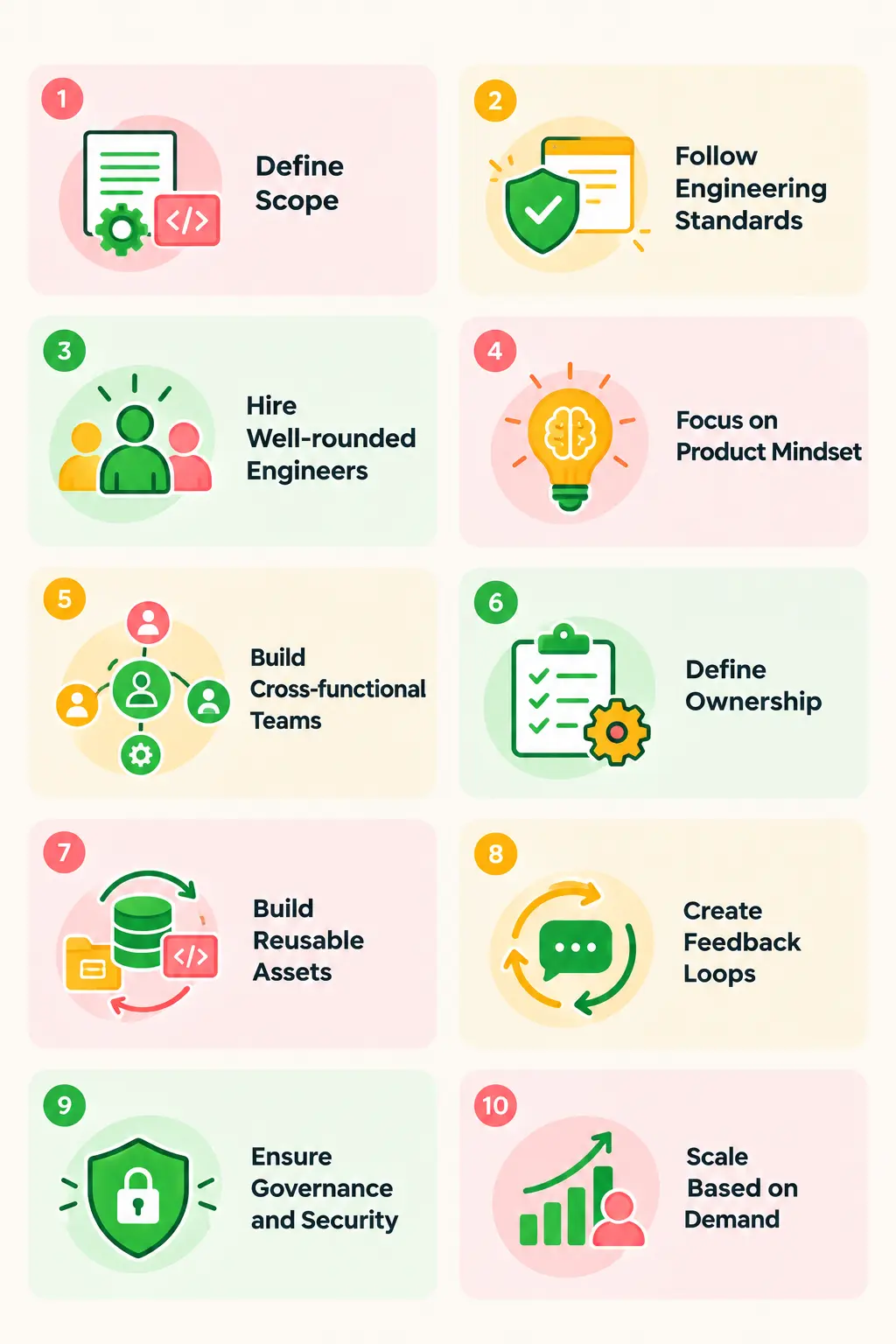
      • Define Scope: Distinguish FDE from solutions Architects. FDEs write production code. They debug edge cases and deploy custom integrations directly into the client’s environment.
      • Ensure FDE-written code is treated within engineering standards.
      • Hire engineers with both technical and communication skills, not just strong coding ability.
      • Focus on product-minded problem solvers who can understand customer goals and shape solutions.
      • Make cross-functional teams by pairing FDEs with key roles. These include product managers, sales, customer success, and engineering.
      • Define clear ownership for discovery, solution design, deployment, customer feedback, and post-launch support.
      • Create reusable internal libraries, infrastructure templates, and integrations. This ensures FDEs never have to start from scratch. 
      • Build rapid feedback loops so customer insights can make product success.
      • Maintain strong governance and security practices when FDEs work within customer environments.
      • Keep FDE teams lean in the beginning, then expand based on customer demand and successful deployments.

      How Entrans brings the FDE model to your enterprise

      Entrans embeds Forward Deployed Engineers directly into your enterprise environment. Our FDEs sit alongside your internal teams. They bridge complex technical platforms with real-world business operations.

      • We write production-grade code and untangle legacy infrastructure. We also configure custom agentic workflows starting from day one. 
      • Our hands-on approach helps build solutions that can fit naturally into your existing systems and workflows.
      • We also provide pre-vetted forward-deployed engineers who have vast technical knowledge. They follow documented practices. They also help your internal teams expand AI solutions with confidence.

      Learn more about how we accelerate AI adoption and achieve measurable business outcomes. Book a consultation call with us.

      Share :
      Link copied to clipboard !!
      Embed Forward-Deployed Engineers in Your Team
      Our pre-vetted FDEs write production code and build agentic workflows inside your environment from day one.
      20+ Years of Industry Experience
      500+ Successful Projects
      50+ Global Clients including Fortune 500s
      100% On-Time Delivery
      Thank you! Your submission has been received!
      Oops! Something went wrong while submitting the form.

      FAQs

      1. Which companies hire forward-deployed engineers?

      Major enterprise AI and data companies mostly hire FDEs. These include companies like Palantir, OpenAI, Anthropic, Salesforce, and Databricks. They use FDEs to help customers deploy, customize, and scale complex software and AI solutions. 

      2. What does a forward-deployed engineer do at OpenAI?

      At OpenAI, an FDE embeds directly with strategic enterprise customers. They build domain-specific AI solutions, custom evaluation frameworks, and low-latency API integrations. FDEs also share regular feedback with internal product and engineering teams.

      3. What is a Salesforce forward-deployed engineer?

      A Salesforce forward-deployed engineer helps enterprise customers. They implement and customize Salesforce's AI and cloud solutions. They adapt these tools for real-world business workflows. They also bridge the gap between Salesforce features and complex client data systems. 

      4. How much do forward-deployed engineers earn at these companies?

      Forward-deployed engineers are among the best-paying engineering positions. They earn more than a traditional software engineer. This is due to the complexity of their knowledge base and their direct interaction with clients.

      5. How do leading companies prevent FDEs from becoming expensive IT consultants?

      Leading companies keep FDEs closely connected to product engineering. They measure success by product adoption, reusable solutions, and customer outcomes. FDEs also measure success by how many custom features get merged into the main product roadmap.

      Hire Forward-Deployed Engineers
      Pre-vetted FDEs who embed with your team, untangle legacy systems, and ship AI to production.
      Free project consultation + 100 Dev Hours
      Trusted by Enterprises & Startups
      Top 1% Industry Experts
      Flexible Contracts & Transparent Pricing
      50+ Successful Enterprise Deployments
      Jegan Selvaraj
      Author
      Jegan is Co-founder and CEO of Entrans with over 20+ years of experience in the SaaS and Tech space. Jegan keeps Entrans on track with processes expertise around AI Development, Product Engineering, Staff Augmentation and Customized Cloud Engineering Solutions for clients. Having served over 80+ happy clients, Jegan and Entrans have worked with digital enterprises as well as conventional manufacturers and suppliers including Fortune 500 companies.

      Related Blogs

      How Leading Companies Use Forward Deployed Engineers: OpenAI, Palantir, Salesforce, and More

      How leading companies use forward-deployed engineers: inside the FDE playbooks of Palantir, OpenAI, Salesforce, Anthropic, and Scale AI.
      Read More

      Loop Engineering: How Enterprises Turn AI Agents Into Reliable Software Builders

      Loop engineering turns unreliable AI agents into production-ready software builders with Observe-Act-Verify-Refine cycles, tests, and human guardrails.
      Read More

      Legacy Code Reverse Engineering with AI: Turning Undocumented Systems into a Modernization Blueprint

      Legacy code reverse engineering with AI: extract hidden business rules, map dependencies, and turn undocumented systems into a modernization blueprint.
      Read More