Learn how to build a data warehouse step by step. Explore proven architectures, team setups, realistic timelines, and actual costs to scale your analytics.

Agentic Unconference 2026 - September 19, Chennai
View Event →





Ever thought about the reasons why your business reports take ages to load? In the majority of cases, it is the dispersed data that creates problems from a back-end point of view. Once you know how to build a data warehouse, everything will become different, as all applications will be unified into one.
The use of a data warehouse enables us to collect data, analyze it based on performance, prepare reports, and make decisions. How then is this done? What kind of architecture, software, and personnel are required for that?
In this blog, you will find out how to build a data warehouse.
A data warehouse is a central place that gathers data from all your business apps in one spot. This is done to process the information very rapidly for reporting and analysis purposes. Businesses utilize it to have their transactional and historical databases separated.
A data warehouse will be required in case your organization deals with huge amounts of data that is scattered across many different systems and requires performance insights.
Building a data warehouse will help solve problems related to disorganized reporting, but one should allocate funds wisely to cover the data warehouse cost. Following best practices for a data warehouse from the start will save a lot of time in the future. Knowing how to build a data warehouse correctly is sure to avoid any problems later on.
The following table clearly shows the difference between a database, data warehouse, data lake, and lakehouse.
You may not need one if:
Apart from simply accepting and storing your data, today's data warehouses can also link different systems, prepare data for analysis, and provide reliable data for different units. Understanding different components will ensure that your data warehousing project takes the right form and you make correct decisions when implementing your data warehouse.
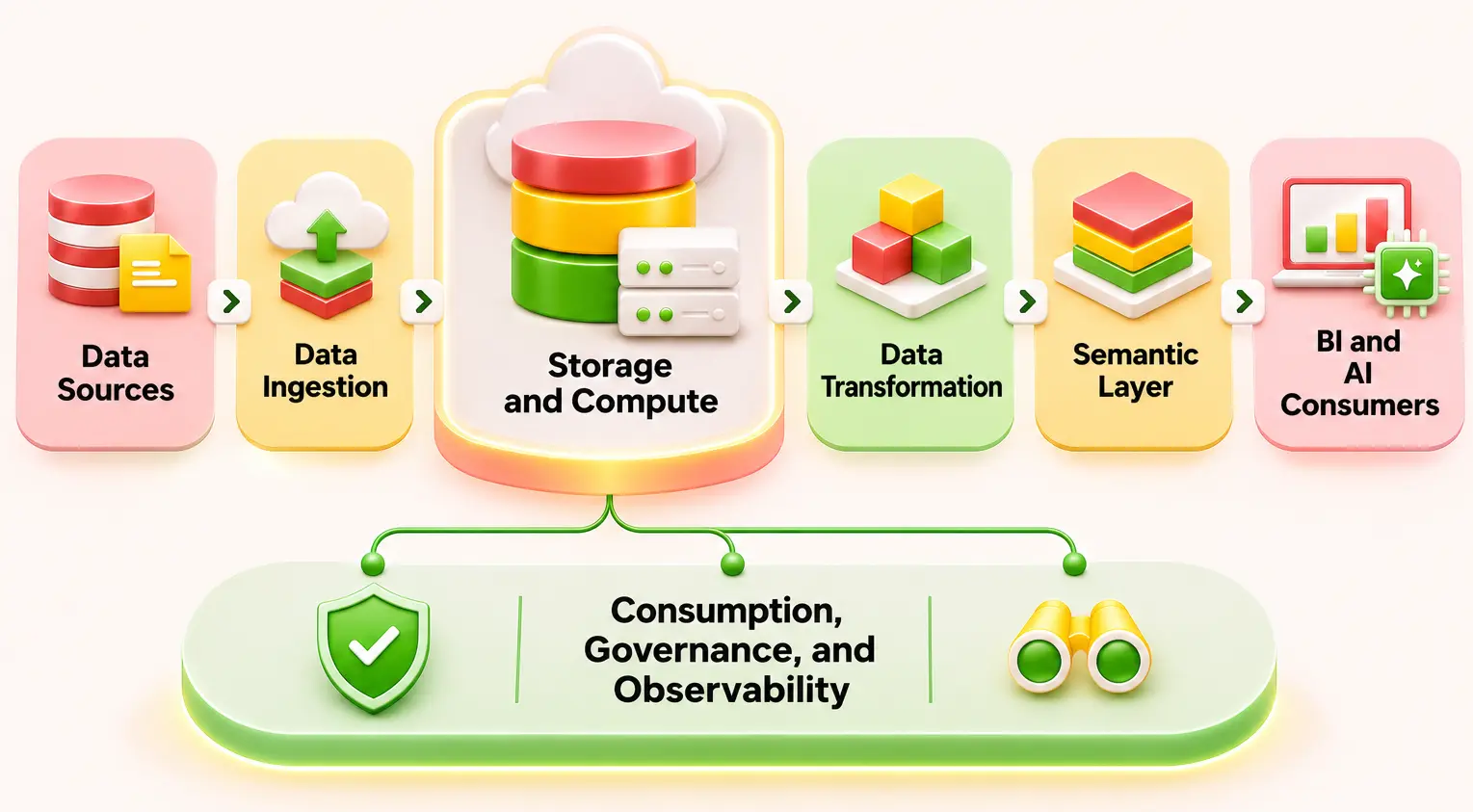
Data comes from different sources such as CRM, ERP, website, payment, and application database sources. These are the initial sources from which the data is extracted to create the data warehouse.
Data ingestion is the process of loading data from external sources into the data warehouse. The ELT method is used for loading and transforming data after loading. CDC is the process of detecting changes in the source database and transmitting those changes without moving the whole dataset.
Modern data pipelines employ data ingestion methods such as change data capture or ELT to get raw data into storage. By making use of automated data ingestion processes, resilient data ingestion workflows can be created using modern data platform modernization pipelines.
The cloud decouples storage and computing resources. This makes it easier to adjust computing resources upward or downward independently, and hence makes cost management for the data warehouse cheaper, as it is only necessary to pay for the amount of computing capacity that is used.
Software tools like dbt make the data cleaning and joining processes easier to perform. Tests can also be added before the data is sent to the reporting system.
The semantic layer consists of business terminology and metric definitions. For example, both financial and sales reports use the same definition for revenue.
BI software develops dashboards and reporting capabilities. Artificial intelligence (AI) applications employ warehouse information to analyze, predict, and search using natural language.
Lastly, the clean model will be consumed by the business intelligence dashboard and the AI applications. For performance that can be depended upon, the best practices of a data warehouse must be followed, which calls for the requirement of governance and observability in ensuring good data quality and data lineage.
The choice of architecture in data warehousing is a very important thing when it comes to building a good data warehouse. Every architecture has its unique way of handling storage, information processing, and presentation. The selection of the right architecture will depend on several things, such as the needs of the business, among others.
Kimball's approach involves the bottom-up method. This is where you create data marts based on your business processes, such as sales, finance, and marketing. The design of conformed dimensions and fact tables may be done using foundational dimensional modeling principles that ensure easy querying by end-user reports.
The fact tables and dimension tables help in creating fast reports. This methodology is suited for scenarios where quick analysis of business information is needed.
Inmon follows a top-down methodology. It constructs a centralized enterprise data warehouse before constructing any data marts. This is appropriate for organizations that require uniformity in their data.
Data Vault is a type of architecture that comprises hubs, links, and satellites that stand for data entities, data relationships, and data history. The use of Data Vault can be seen in cases of complex data requiring flexibility and auditability.
Lakehouse is as flexible as a data lake and has querying capabilities like those of a data warehouse. Medallion architecture categorizes the data into three different layers, which include the bronze layer, silver layer, and gold layer.
Think about your data warehousing needs, your reporting needs, and your expected growth. Data warehousing consulting services will also assist in finding the right architecture for your system before implementation.
Learning how to build a data warehouse using data warehousing best practices saves time. Having the requirements and cost considerations of data warehousing in mind is critical.
Data warehousing is the process whereby your hodgepodge of data is turned into a source of information that can be used to make decisions in your business. Data warehousing needs to be well-planned and requires knowledge of data warehousing best practices as well as data warehousing requirements.
The seven steps involved in building a data warehouse are as follows.
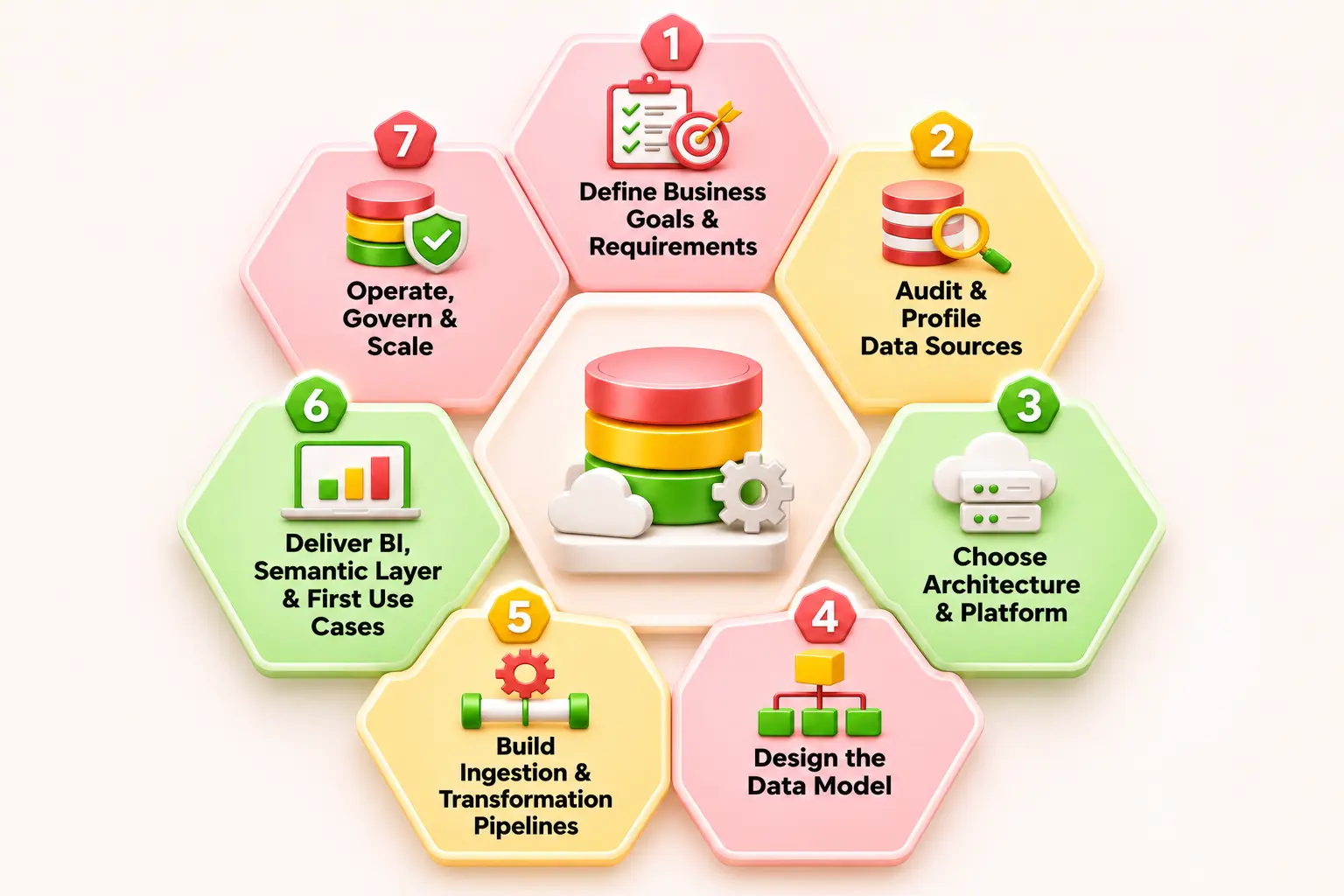
Start by learning the reasons behind your company wanting to build a data warehouse. Meet and speak with individuals from various departments such as finance, sales, operations, and more to learn what is expected of the reporting. Learn about your use cases, KPIs, SLAs, etc.
Next, find the place where the source of information exists. CRM, ERP, databases, spreadsheets, and third-party systems should all be examined. Find out the amount of data, the form of data, data that might be missing, duplication of data, and ownership of data.
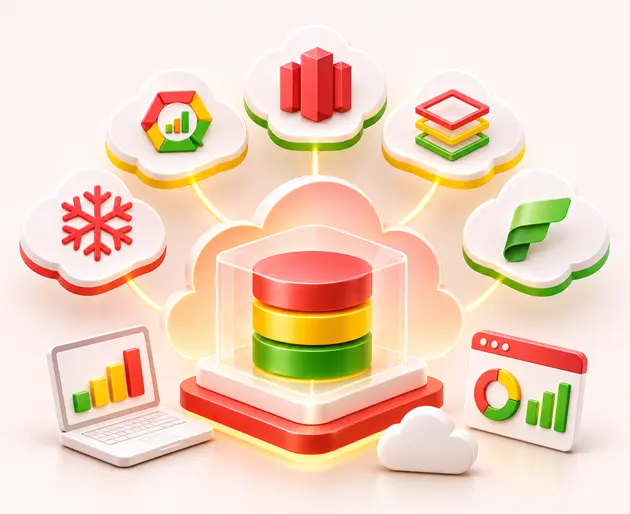
Picking the right data warehouse is crucial, depending on your dataset, requirements, and budget. Find out which of the cloud data warehouse, lakehouse, and hybrid models suits you. There are different data warehouses available, such as Snowflake, Google, Amazon, Azure, etc.
Check out our real-world implementations, such as how a Microsoft Fabric data warehouse implementation supported specialized operational reporting for funeral services.
Create a plan for data organization for reporting and analysis. One approach to database design that is commonly used is the Star schema. Fact tables in such databases store facts/events, while dimension tables describe the fact tables. This will guarantee efficient reports from a business user's perspective.
Now that you have understood how you should design your data warehouse, it is time to load your data into the warehouse. The best practice here would be to use the ELT process for loading your data without transforming it first.
Create the data relevant to business teams. Create a semantic layer using common terminology for KPIs such as revenue, retention rates, and order value. Connect your business intelligence software such as Power BI, Tableau, and Looker. Start with the 1- 2 most important dashboards instead of waiting until you have all reports done.
Monitoring is an essential activity that should be performed occasionally on the data warehouse once it is put in place. Pipeline failures, data aging, query performance, and data quality are the aspects that have to be monitored. Access control must be enforced, data lineage must be maintained, and security policies must be evaluated. Effective management of the unpredictable costs associated with cloud computing infrastructure can be achieved using cloud FinOps frameworks. FinOps approach should be adopted.
Building a data warehouse requires various technical and business professionals. Every team member is responsible for one of the tasks involved in the construction of the data warehouse.
This includes everything from architecture design to the delivery of reports through pipeline construction. The team size varies according to the scope of the project, complexity of data, and budget.
Here is a breakdown of the core roles needed and how to split them between internal staff and external partners:
The first question people want answered when it comes to building a data warehouse is how long it is going to take to build it. The entire period depends greatly on the requirements of your data warehouse project, the complexity of the architecture, and your dependence on the help of outside experts for faster development of your data warehouse.
Four key factors will determine your timeline, not any standard estimate:
Here is how timelines typically break down by scope:
These ranges are planning estimates, not fixed deadlines.
It is important to understand that the price for implementing data warehousing will depend on the platform used, volume of data, number of sources, and degree of customization required. In the case of a small-scale cloud-based data warehouse, there may be no large expenses required, whereas enterprise data warehousing may cost hundreds of thousands of dollars.
The following is an illustrative USD estimate for a mid-size cloud warehouse with five data sources, daily data refreshes, and 10 BI users.
Published estimates vary widely because vendors use different project sizes, pricing models, and service scopes. Following proper data warehouse best practices and outlining clear data warehouse requirements early on helps control expenses while building a data warehouse that scales.
Choosing how to handle data warehouse development depends on your team's skills, budget, and project needs.
Before signing an agreement, ask:
Choose a partner who has good engineering capabilities and a well-defined handover process. For end-to-end guidance when building a data warehouse, explore specialized delivery partners via Entrans Cloud & Data Engineering Solutions to secure expert data warehouse consulting services.
A modern data warehouse should support more than dashboards and reports. It should also prepare your business data for AI applications.
These data warehouse best practices help prepare your data for future AI workloads. To dive deeper into preparing your infrastructure, read more via Entrans AI-Ready Data Insights.
The process of developing a data warehouse may turn into something quite costly and cumbersome if there is no planning before the start. The proper choice of software does not guarantee that there will be no mistakes and failures. Below, you will find some frequent mistakes.
Check out our case study on how implementing a scalable data engineering platform enabled robust, future-proof reporting for trust and corporate management environments.
In many cases, legacy systems will be associated with expensive maintenance, poor scalability, and long query processing times. In this case, migrating to a platform like Snowflake will enable companies to deal with these problems.
Think about migrating when you have:
The entire transition away from brittle legacy architectures can be helped by following structured strategies for ETL migration to the cloud to minimize operational disruptions and control compute expenses. There are benefits to adopting phased implementation of a data warehouse because it helps risk management and cost controls on the process of migration.
There are also data warehouse consultation services that will help you assess your current state and move on from there. Partnering with Entrans makes it possible for organizations to take their fragmented data and build a solid base for reporting, analytics, and AI workloads.
This is achieved through our team of data engineers who engage throughout the entire process of developing a data warehouse, covering everything from architecture design and platform choice to pipeline creation and migration. We partner with various platforms like Snowflake, Databricks, AWS, and Azure based on the requirements of businesses.
Be it a new data warehouse or an existing one being updated, we can plan that out for you. Book a consultation call to learn more.

The steps to build a data warehouse are: define business requirements, audit data sources, choose an architecture and platform, design the data model, build ingestion and transformation pipelines, deliver BI and first use cases, then operate and govern the warehouse.
Building a data warehouse can take anywhere from 3 to 9 months, depending on its size and complexity. Simple projects may take less time, while large enterprise projects need more planning and testing.
Initial setups range from seventy thousand dollars to over one hundred thousand dollars for year one. Ongoing costs depend heavily on your data volume and cloud compute usage.
A data warehouse project needs data engineers, data architects, BI developers, and data analysts. Cloud engineers, database administrators, and project managers may also join the team.
A database handles live daily application traffic and fast transactions. A data warehouse stores cleaned history from many sources specifically for business reporting.
Choose cloud storage because it scales easily and separates compute costs from storage. On-premises setups create heavy maintenance burdens and limit flexibility.
Consultants design your system architecture and speed up implementation. They help your team avoid costly mistakes and set up best practices from day one.