Discover how AI claims processing works in insurance, from key use cases and architecture to real costs and safe deployment strategies.

Agentic Unconference 2026 - September 19, Chennai
View Event →





Imagine telling a frustrated customer their claim is handled before they finish their cup of coffee. Sounds crazy?. Enter the future of AI-based claims handling.
With intelligent document capture, automated case prioritization, and human expertise at play, modern insurance companies have made handling insurance claims a differentiator. But faster claims processing is not the whole picture. Bad quality data, false alarms on fraud, and wrong decisions from AI can bring additional risks.
This blog covers practical use cases, the processes behind them, the cost of being, and steps for a successful pilot-to-production transition for claims automation.
AI claims processing includes the deployment of machine learning, document AI, and intelligent agents for the purpose of processing claims and analyzing documents. Fraudulent claims will be identified using this process.
It will allow a team to reduce the time spent on paperwork and process trivial claims immediately. But human reviewers still make final decisions on coverage and complex cases.
Filing insurance claims meant drowning in paperwork and waiting endlessly. With the help of AI Claims Processing, the insurance company can automate the entire claims process right from FNOL (First Notice of Loss) to claim settlement.
Each stage is significant and has its own set of data needs and challenges. The entire claims process is automated to gather data, evaluate the insurance coverage, determine the damage, and identify the claims that need further investigation.
Claims process in insurance using AI will help the teams in detecting frauds, determining reserve amounts, and recovery. Nevertheless, human verification is needed in dealing with complicated cases and making important decisions.
By 2026, Agentic AI shall develop from text creation to task completion aimed at goal achievement. Agentic AIs can plan, gather information, verify information, and perform tasks.
Here is how key agentic patterns reshape claims automation:
These programs help the claims process of AI by conveying their findings and exception cases to the adjuster. Human beings decide on coverage, disputes, and approval.
The first and foremost transition in 2026 shall be the transition from summaries to agents who manage the activities in the current claims environment. Well-defined criteria for the decision of approval are very important.
While the basics of how AI is applied in claim management do not vary much, their application is unique in different industries. Different industries have varying limitations, necessitating the specific application of AI in insurance claims for managing different data types and risks.
In auto claims, delay usually stems from scheduling physical appraisals. Automated claims processing utilizes computer vision and multimodal algorithms to analyze initial loss photos uploaded by drivers.
Systems instantly compare vehicle damage against vast historical databases, estimate part and labor costs, and flag manipulated photos before an adjuster ever steps on site.
For instance, Ageas utilizes AI created by Tractable to inspect and estimate the cost of fixing their damaged cars. The clients will receive their next steps within minutes of reporting their accident.
After storms, the agentic AI in the insurance process thermally and visually captures aerial images to identify any roof damage, missing tiles, and fallen trees in an entire neighborhood.
These findings can be used by the claims team to determine which cases require an adjuster. This has certainly reduced field visits. According to Sedgwick, the AI-driven process completed all eligible and relatively simple water damage claims from receipt through completion in under 30 hours.
Claim documents may include bills, case notes, coding systems, and guidelines. The AI can extract all these components and identify whether there is any missing data or any discrepancies in the billing process.
For workers’ compensation, AI can also aid in examining injury and treatment case documentation. The remaining disputes are managed by human reviewers.
An example of such an application can be seen with the India National Health Authority, which has used an AI-based claims adjudication engine to process large numbers of claims and clinical documents. The technology uses machine learning, natural language processing, and document recognition to validate data and apply policies.
Commercial insurance lines include property, liability, and specialty insurance, with long-term policy history, loss runs, and third-party documents. The application of generative AI in the insurance industry is through reading hundreds of pages of complex insurance policies to make coverage position maps and identify subrogation opportunities.
The aim here is not to take the adjuster away from the scene. Insurance claims automation makes it possible for them to reduce their time spent looking through papers and increase their time investigating losses.
Building a reliable AI claims management ecosystem requires a robust reference architecture that cleanly bridges modern intelligence layers with mission-critical core platforms. Boundaries have to be clear for the architecture.
AI is capable of gathering data, examining documentation, summarizing information, and making recommendations. The business rules will govern the process of decision-making, while adjusters will deal with exceptions and make decisions that require human involvement.
A list of some important aspects of architecture for modern claims processing is provided below:
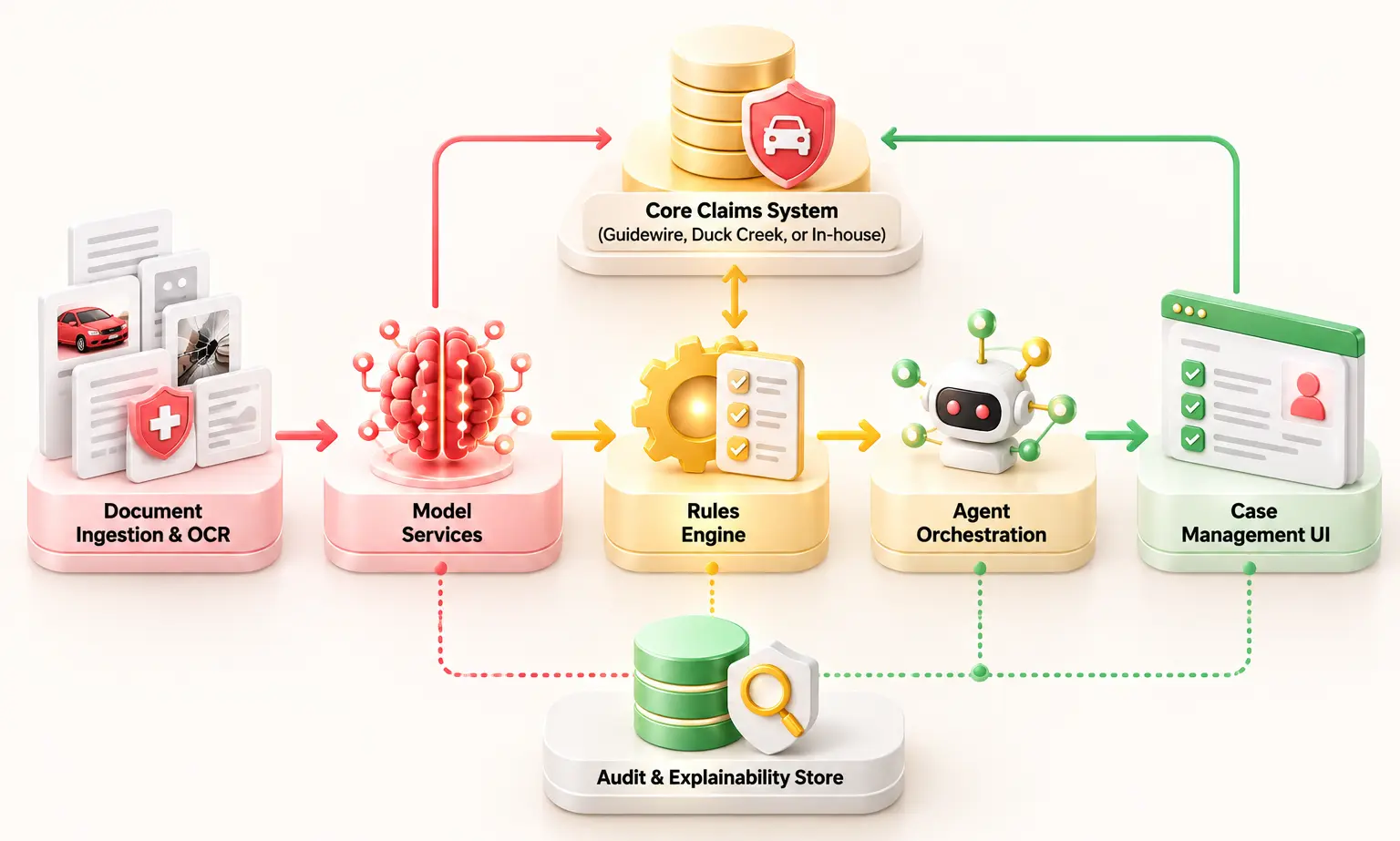
The two systems should share data through secure APIs. The AI agents should have access only to the information necessary for the system. The rules engine should reject all actions that go beyond the limitations of the system. The adjusters should investigate any disputes, hard cases, and large settlements.
The audit store should have information regarding the kind of evidence collected, the rules used, and the approval of the decision. The companies must keep records of the model precision, transaction times, exception ratio, and cost per transaction. Such information can be used to identify mistakes and ensure that automation improves the results.
The use of intelligent technology within a claims process is highly regulated. Taking into account the reality of increased scrutiny on the part of insurance regulators regarding compliance with standards like the NAIC Model Bulletin on Artificial Intelligence, there will be grave consequences for poor auditing of systems and denial of claims without providing any reasons, because such practice opens up possibilities for improper claims settlement.
Overall compliance and risk management would benefit greatly from adopting an agentic AI governance framework within the automated decision pipeline. The current claims processing with the help of AI technologies should be quick and open.
These procedures facilitate the insurer’s ability to justify its actions and respond to any inquiries or complaints.
However, the application of AI technology could be useful for detecting fraud, but it could equally be used by fraudsters to create fraudulent evidence as well. This is because the technology used in the generation of AI can modify the image of an accident or damaged property or even fake documents.
AI can be used to verify the image and identify any form of alteration in the picture, match the details from the document, and look for any pattern in the claims. There cannot be one method that would be able to identify all types of fake claims. It is advised that insurance firms use AI to verify the information along with other factors such as policies and timestamps.
Insurers may also employ layered detection techniques for media manipulation, mismatches, and other signs of digital fraud. Refer to our case study on AI-generated deepfakes and KYC fraud detection.
The performance of claims processing by artificial intelligence must be evaluated based on its impact on claims outcomes and costs. Processing speed is not an indicator of success. It is important for insurers to also measure overpayment, underpayment, labor costs, and the cost of exception handling.
To prove the value of automated claims processing, insurers measure three foundational financial and operational metrics. Tracking these metrics clearly separates surface-level workflow updates from hard bottom-line savings.
Use the same baseline, e.g., three months before the implementation, and compare it with the result after the implementation. This should include software, modeling costs, and human intervention costs.
ROI (%) = (Annual Benefits - Annual Costs) % Annual Costs * 100
Count benefits from staff time saved, lower adjustment expenses, fewer processing errors, and additional recoveries. Avoid counting the same benefit twice.
Budgeting for AI in insurance claims depends heavily on your technical starting point and deployment model. Key cost drivers include data preparation, core system integration, software licensing, and human-in-the-loop oversight.
Don’t forget to budget for post-deployment support and human intervention!
Successful AI claims processing begins with solving just one business problem. An insurance company can implement a specific use case, measure its success, and then roll out further implementation only if the system meets the objectives set out.
Such a phased approach will provide insurers with the time needed to gather their data, integrate the claims system, and put in place any required human oversight. An actual deployment may be achieved in 3 to 6 months.
The processes involved are

Head of Claims Operations, data team, IT architect, compliance lead.
12–24 months of historical claims logs, document taxonomies, and clear KPI baselines (e.g., average handle times, touchless rates).
Audit data readiness, evaluate API readiness for core platforms like Guidewire or Duck Creek, and select initial low-complexity target lines.
Approved business case, governance risk assessment, and defined technical baseline.
Lead Claims Product Manager & Data Science Lead.
Clean FNOL feeds, sandbox environment, and trained adjuster focus group.
Deploy agentic AI in insurance for a single, high-volume line (e.g., auto glass replacement or minor water damage). Route extraction and triage through model pipelines with mandatory human-in-the-loop review
Accuracy meets targets, users accept the workflow, and costs stay within budget.
VP of Transformation & Claims Regional Managers.
Additional claim types, core-system records, and performance data from the pilot.
Expand AI in claims processing into broader P&C lines, integrating computer vision for damage appraisal and complex rules engines for automated reserving.
>25% Straight-Through Processing (STP) rate on eligible claims and seamless cross-system data synchronization.
Chief Risk Officer & AI Governance Board.
Immutable audit logging, real-time drift monitoring dashboards, and model retraining infrastructure.
Institutionalize continuous bias testing, maintain strict compliance with NAIC Model Bulletin guidelines, and operationalize automated claims management enterprise-wide.
Named owners, regular reviews, clear rollback plans, and sustained business results.
Guiding principle: Roll out insurance claim automation based on the proof of concept, not simply because a pilot is successful in a demonstration.
AI-enabled claims processing is fast at dealing with repetitive tasks, but a lack of proper planning could make it very costly. Below are five major reasons why these systems fail.
It is easy to see why AI can be a logical choice for insurers that have invested in automating claims processing. Whereas claims processing AI will help teams process claims once the damage has been done, underwriting AI will enable insurers to assess risks before issuing the policy.
Additionally, claims information is a good way for insurers to find out which risks result in increased losses, repetitions, and costly repairs. If this data is used properly, then it will aid the insurer in its underwriting process and pricing strategies in the future. Of course, the data should be handled accordingly.
The use of AI in insurance underwriting does not mean that underwriters will be phased out of the system. It simply means that they can process their data much faster and more accurately.
AI claims processing turns complex document intake and decision-making into structured, rapid operations. Entrans builds tailored insurance claims processing software by unifying real-time data orchestration with multi-agent models.
AI claims processing depends on accurate, accessible data. Entrans addressed this challenge in its insurance data modernization case study. The team moved a Virginia-based insurer from legacy Oracle databases to Snowflake on AWS, built automated data pipelines across policy, claims, and billing systems, and introduced near-real-time data flows.
The results included an 85% drop in database maintenance and manual performance tuning tasks, 70% faster queries for multi-year actuarial analysis, and a reduction in claims reporting data latency from 24 hours to under 30 minutes.
This data foundation can support faster claims reporting, better risk visibility, and more informed decisions. By combining document AI, agentic workflows, and modern data platforms, Entrans helps insurers build the technical foundation for insurance claims automation while keeping human oversight in the process.
Not all claims involve only the extraction of information. The team would require the capability of checking for coverage under the policy, requesting missing documents, comparing the presented information, and routing exceptions to the proper adjuster. This can be assisted with agentic AI in insurance.
Entrans offers intelligent agents that can perform tasks through a series of business processes and integrate with enterprise applications. If such agents were applied to claims management, they would help process a claim through intake, validation, and review, all the while adhering to certain rules and requirements. However, human adjusters would have control over more complicated matters.
Want to turn AI claims processing from an idea into a solution that works with your existing insurance systems? Book a consultation call with us to learn more.

AI reads incoming documents like accident reports and medical bills to extract key data fields instantly. It also flags potential fraud and routes routine files straight to automated systems for fast approval.
Yes, automated tools process routine documents in seconds instead of days of manual data entry. They also catch human errors and spot data mismatches that standard manual reviews often miss.
No, AI is more likely to handle routine tasks than replace claims teams. People will still need to review complex cases, resolve disputes, and make key decisions.
Major carriers like Travelers, Lemonade, and State Farm use automated systems for customer intake and document handling. Many property and casualty providers also deploy specialized software tools to speed up damage estimation.
Systems must follow strict legal guidelines regarding consumer privacy, data security, and fair treatment. Insurers use transparent software architectures to keep audit trails open and meet local regulatory standards.
Start with claim forms, policy details, supporting documents, and past claims records. Clean, secure data with clear access rules helps AI process claims more reliably.
Buying a platform can help insurers get started faster with ready-made tools and support. Building a custom solution gives more control but needs more time, technical skills, and ongoing care.