Struggling to scale AI past the pilot stage? See how a forward-deployed AI engineer turns enterprise AI PoCs into production-ready systems.

Agentic Unconference 2026 - September 19, Chennai
View Event →


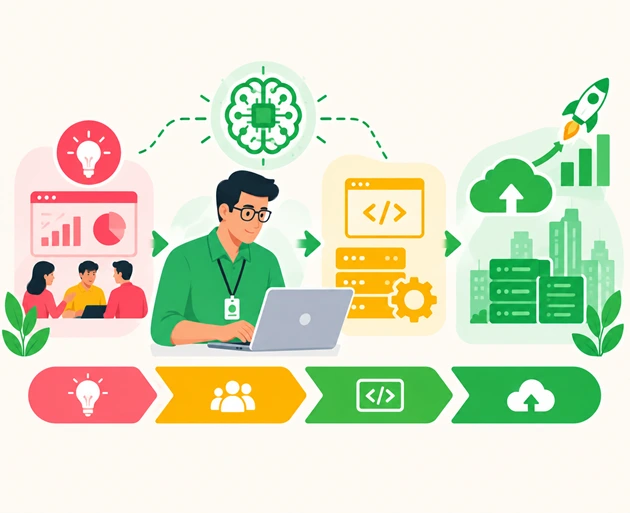


Are you working with an AI model that performs well during the piloting/demo stage but failed miserably after being scaled up to production? Well, most companies find out about the real challenge once they do PoC. And that is when the Forward Deployed AI Engineer (FDAIE) can come into play.
The Forward Deployed AI Engineers are the circulatory system of enterprise AI since they operate within the client's environment and make AI proofs of concept scalable for production.
In this post, discover everything about what a Forward Deployed AI Engineer is, their roles, skills, and more.
A forward-deployed AI engineer is a software engineer who deals directly with clients on integrating and tailoring pre-existing AI algorithms into existing enterprise applications.
The role combines software engineering, data science, and consulting to ensure that AI systems are scalable, safe, and properly integrated with existing enterprise systems.
It is important that building an AI model alone is not sufficient to succeed. The real success lies in making it work. That is the primary role of a forward-deployed AI engineer and let’s see why it is in such demand.
As described earlier, a forward-deployed AI engineer works directly with enterprise customers to design, build, and give suggestions for improving AI solutions. They spend more time with the customer to understand their needs and turn AI into practical business solutions.
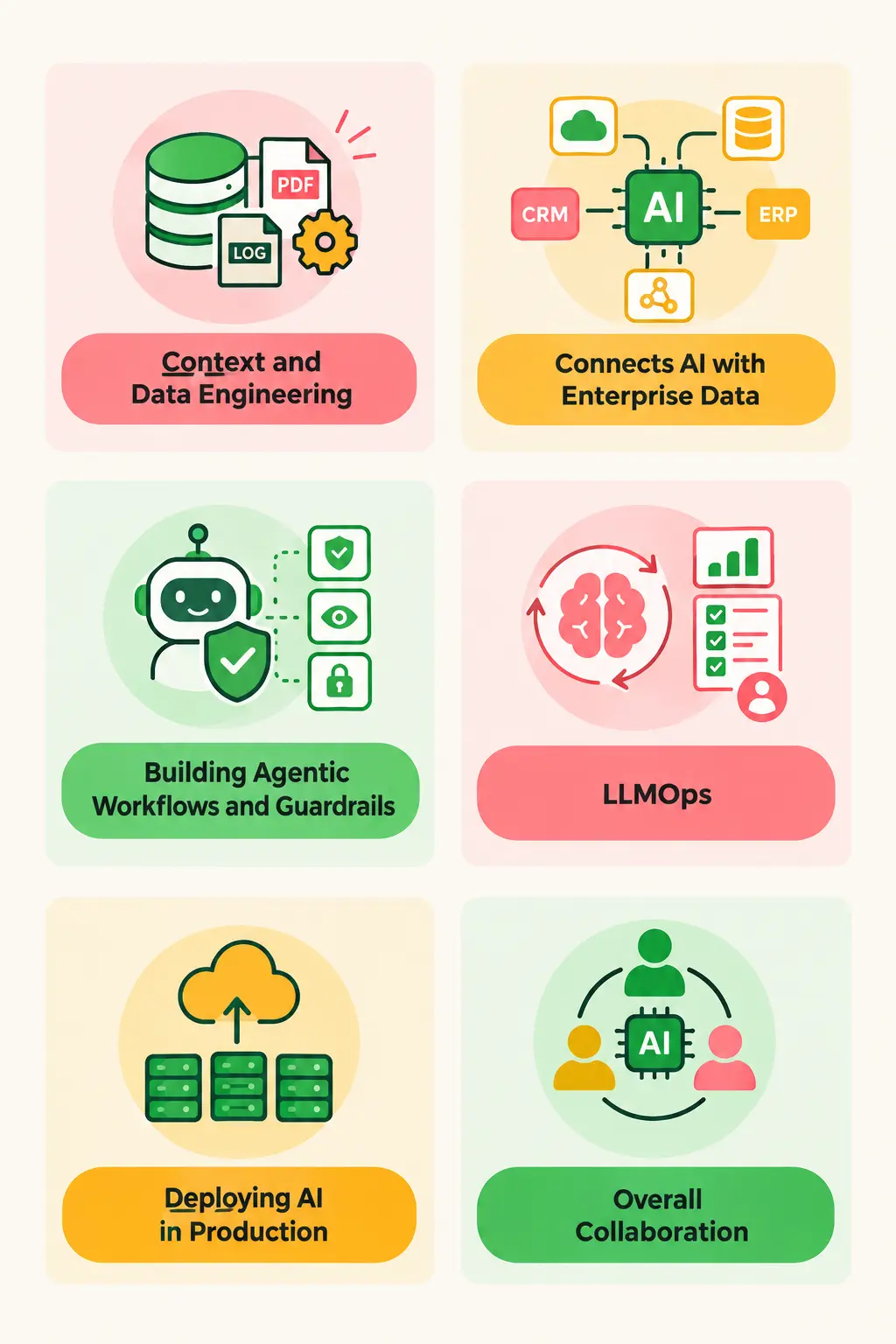
An FDAIE works in collaboration with business and technical stakeholders to pinpoint areas where there is difficulty, set criteria for success, and figure out how much value different AI technologies will offer. The work that FDAIE does is mainly focused on unstructured enterprise data such as PDF files, legacy databases, and logs, along with high-precision RAG pipelines.
AI can only be as effective as the data that it has access to. Forward-deployed AI engineers are responsible for integrating models into enterprise-level software like CRMs, ERPs, document management systems, databases, and internal APIs. They will also develop retrieval-augmented generation pipelines to allow AI access to relevant business data.
Forward-deployed AI engineers are tasked with designing AI assistants, AI copilots, agents, and AI automation systems. It is also their responsibility to develop custom guardrails, hallucination detection, and fallbacks to ensure safety and compliance with row-level security permissions.
When the system outputs vary, FDAIE establishes an automated evaluation suite that is based on LLM-as-a-Judge techniques, human-in-the-loop interfaces, and synthetic datasets for constant benchmarking of accuracy, latency, and token costs.
FDAIE monitors response quality, latency, token usage, retrieval accuracy,y and user feedback. With these findings, they will be able to do further prompt, pipeline, and AI behaviour optimization.
Forward-deployed AI engineers serve as the bridge between customers, product teams, AI researchers, and AI engineers. FDAIE takes the responsibility of translating the customer needs into working technical solutions while getting continuous feedback.
Generally, forward-deployed engineers (FDE) build pipelines, integrate APIs, and ship the software, but forward-deployed AI engineers (FDAIE) don’t have straight pipelines; they need to handle the unpredictable nature of AI models.
Apart from the skills required by a forward-deployed engineer, a forward-deployed AI engineer requires additional skills. The main skills required are
FDAIE must be a solid production engineer who must be expertised in programming languages such as Python (for type hints, error handling, logging) and JavaScript (for building custom UI/dashboards). They must be good at designing and consuming REST APIs, gRPC, and GraphQL endpoints alongside version control testing and cloud-native development. Strong debugging and systems design skills are also equally important. Hands-on experience in handling cloud architectures (AWS, GCP, Azure), Docker containerization, Kubernetes, and automated CI/CD deployment pipelines is also important.
A forward-deployed AI engineer should know how to build applications using prompt engineering, Retrieval-Augmented Generation (RAG), function calling, AI agents, and model evaluation techniques.
A forward-deployed AI engineer must be capable of dealing with SQL, data pipelines, vector databases, document processing, and data integration.
FDE must implement inline PII redaction, data encryption, and row-level Access Control (RBAC) to meet enterprise security requirements.
Since forward-deployed engineers spend most of the time with customers to gather requirements and create a roadmap, explain the technical concepts, lead work, and translate business goals into working concepts. Having clear and concise communication is essential for successful deployment of AI models.
Forward-deployed engineers must quickly learn new tools, evaluate emerging models, solve integration challenges, and adopt solutions as business needs change.
Forward-deployed AI engineers create the most value where enterprise AI projects face technical, operational, or other challenges. Most of the forward-deployed data engineers find it difficult to make the AI model adapt according to the customer needs. The main use cases where a forward-deployed AI engineer creates an impact are:
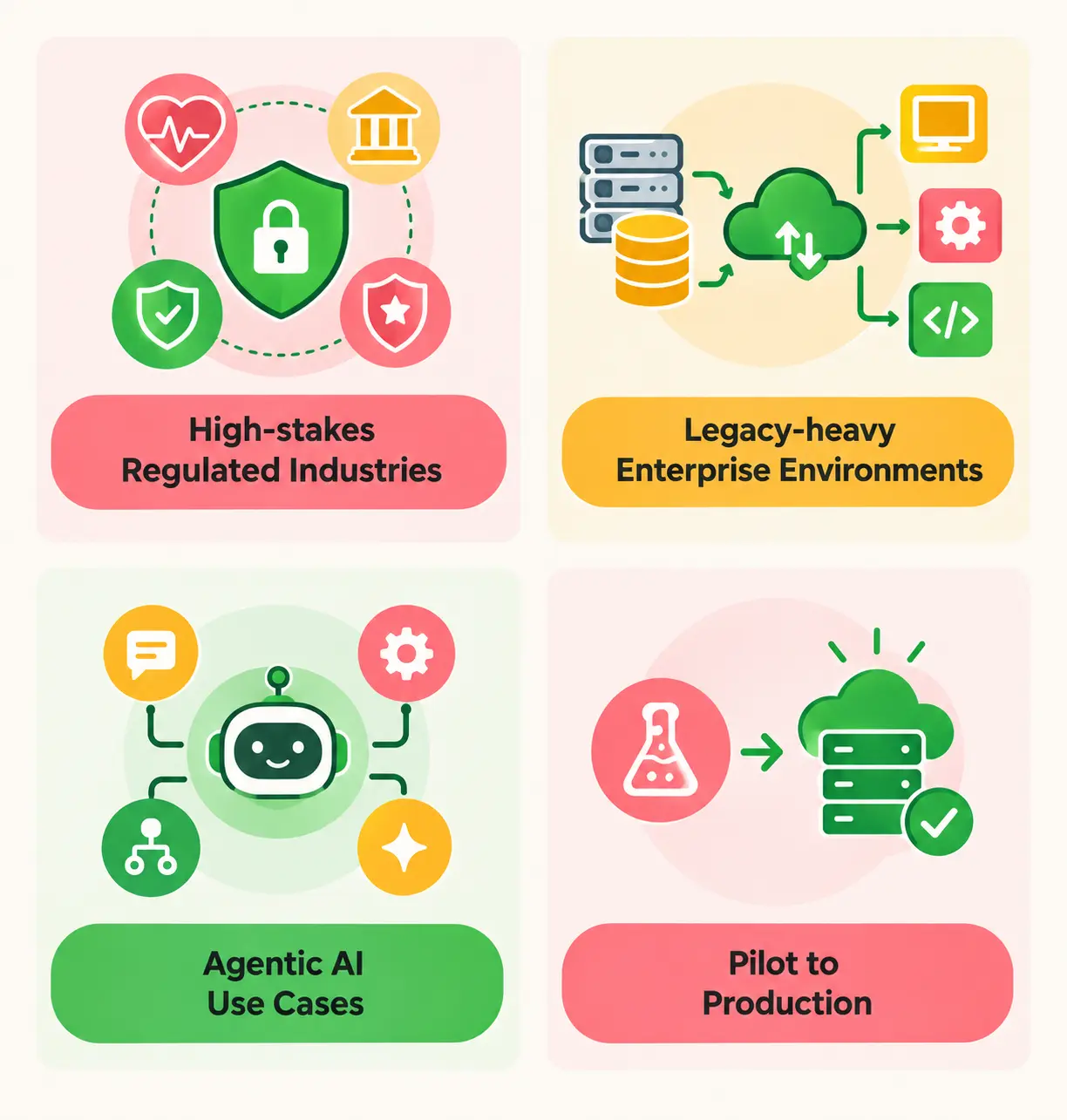
Failures of AI pose major regulatory, economic, and ethical concerns in the health care, finance, insurance, and defense industries. There must be access to confidential information, an audit trail, and permissions to use the information by certain users. This is where the forward-deployed AI engineers come into play through integration of applications that interface with authorized information sources and control access to such.
However, a large number of organizations rely on legacy software, local databases, and other old business solutions. This problem is solved by forward-deployed AI engineers, who combine the existing infrastructure with AI technology instead of creating something new. The engineers connect existing systems to the cloud, create APIs, enable data flow, and prepare enterprise data for AI technology implementation.
AI is well understood by many companies, but they lack knowledge on how to get started with implementing it. Forward-deployed AI engineers assist in finding viable use cases for AI and developing applications capable of delivering tangible benefits. Some of the most common examples are building Agnetic AI for business operations, AI-powered workflow automation, etc.
Most AI programs demonstrate potential at the time of concept proving but fail to scale throughout the organization. These problems that usually arise in these cases involve poor quality data, problems with integration, ambiguity regarding workflow, and non-use. AI forward-deployed engineers solve these problems through better prompting, connecting enterprise data, increased system stability, and better AI performance.

The main need for a forward-deployed AI engineer is bridging the gap between raw AI capabilities and real-world operations.
Forward-deployed AI engineers work with evolving customer requirements, security constraints, and changing AI models. These can slow down AI initiatives, and it is the main task for the forward-deployed AI engineers to handle them and move projects into production.
AI outputs are only valid as the content fed into them. Data often gets trapped in unindexed PDFs, legacy mainframes, or restricted behind complex Role-Based Access Controls (RBAC).
To handle this, FDAIE spends most of their time in data engineering (hybrid search indices, multi-modal parsing pipelines, Change Data Capture (CDC)streams) before fine-tuning it or prompting. Here they build trusted enterprise data sources and remove outdated records.
Many organizations still work with their older applications, which do not support AI features. To handle this, forward-deployed AI engineers build APIs around legacy systems, create middleware for data exchange, connect cloud and on-premises applications, and now they can slowly introduce AI into the legacy systems.
Customers often expect LLMs and autonomous agents to perform with 100% deterministic accuracy. When the model hallucinates or fails an edge case, it loses the trust of the stakeholders.
To overcome this, forward-deployed AI engineers educate the stakeholders using confidence scores and set statistical benchmarks. They hold regular customer workshops and deliver working prototypes early.
Not all AI models are the same; each model has different strengths, costs, and performance characteristics. Appropriate model selection can increase costs or limit functionality.
To mitigate this, forward-deployed AI engineers make a comparison of the models against business requirements, test their accuracy, latency, and cost, and evaluate security and deployment options. They select the models carefully based on specific use cases rather than popularity.
In most cases, enterprise-level AI operates on confidential customer information and company data. This problem is solved by the forward-deployed AI engineer operating at the front end, enforcing RBAC, protecting sensitive data through masking and encryption, and conducting audits.
The cost of a forward-deployed AI engineer depends on the engineer's experience and the complexity of the AI project. Given that they combine software engineering with consulting, they should command a considerable premium in the market.
For short-term projects, organizations use forward-deployed AI engineers via consulting firms or an FDE as a Service partner. Large organizations can create a team for their longer-term AI projects.
Entrans works alongside business stakeholders, engineers, and IT management to resolve operational problems, integrate enterprise systems, and create measurable impact.
Want to know more about it? Book a consultation call with us.

A standard AI engineer focuses primarily on building, training, and optimizing models in a centralized environment. Whereas a forward-deployed AI engineer works along with the customers to understand their needs and make AI models get deployed into real-world workflows.
A forward-deployed AI engineer should have experience in model-fine-tuning, systems integration, and software engineering, alongside strong client-facing communications skills. They should also possess problem-solving skills to handle complex legacy architectures and unique business requirements.
Forward-deployed AI engineers follow enterprise security policies, role-based access controls, encryption standards, and compliance requirements. They take responsibility for deploying solutions within existing secure environments such that sensitive data does not leave your infrastructure.
Yes. Forward-deployed AI engineers are cloud-agnostic and design solutions to integrate seamlessly with your current cloud providers (AWS, Azure, and GCP) without requiring a complete rebuild.
Forward-deployed AI engineers specialize in agentic AI, generative AI applications, enterprise integrations, AI workflow automation, retrieval-augmented generation (RAG), and production deployment.
Forward-deployed AI engineer engagement typically ranges from a few months to a year, depending on the complexity of the deployment and integration goals.

-1.svg)