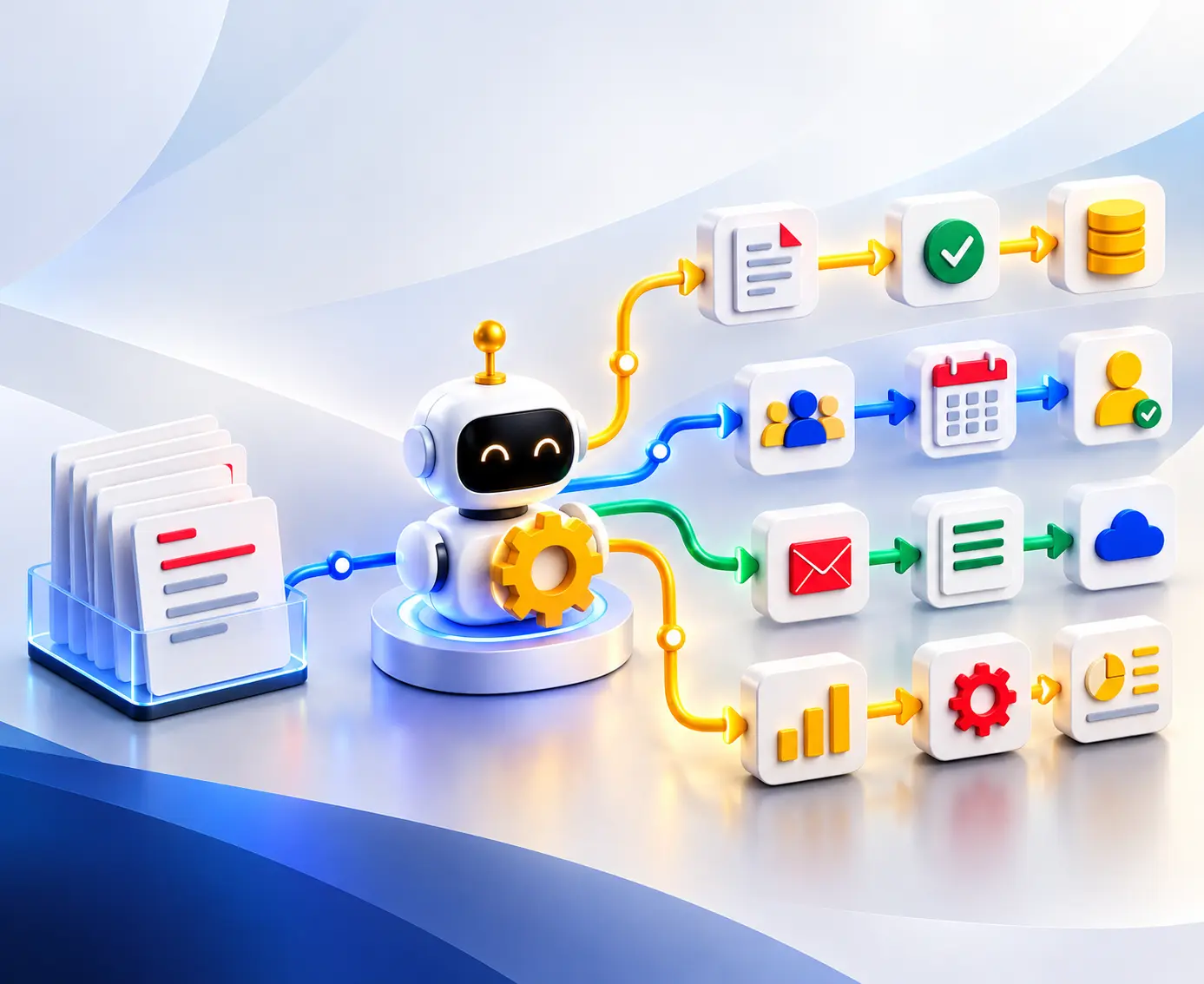
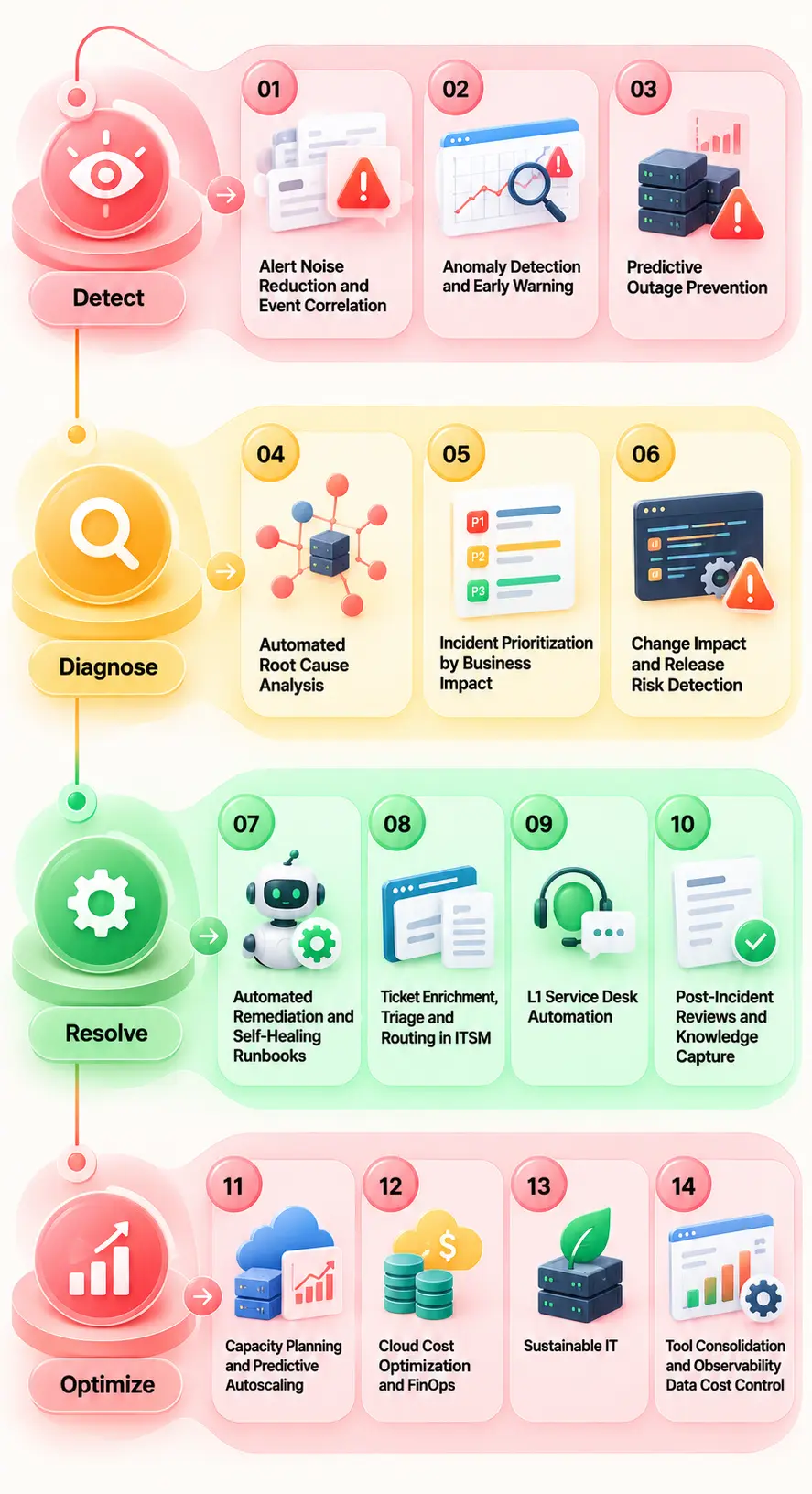
Modern AIOps use cases span four distinct stages: detecting anomalies early, diagnosing root causes automatically, resolving incidents faster, and optimizing system costs.
AI agents for IT operations go beyond passive monitoring by using reasoning capabilities to autonomously investigate alerts, run approved runbooks, and triage tickets.
AIOps works best when teams have reliable telemetry, service ownership, accurate dependency data, and clear guardrails before moving toward self-healing workflows.
The best way to measure AIOps value is through real operational gains such as lower MTTD and MTTR, fewer alerts, more automated resolutions, less engineer toil, and better SLO performance.
Are you tired of dealing with thousands of alerts daily?. Endless war room debugging. Out-of-control observability bills. Are you tired of hearing this? The world of IT Operations seems on the verge of breakdown, but not anymore, because future AIOps use cases and AI in engineering look promising.
In this blog, we will be covering 14 AIOps use cases divided into four categories: Detect, Diagnose, Resolve, Optimize. In each of these, we will see the kind of data needed, the KPI to look out for, and the level.
Table of Contents▾
What does AIOps mean?
AIOps refers to Artificial Intelligence for IT Operations. This refers to the application of artificial intelligence in monitoring, detecting, and correlating IT infrastructure event problems. Big data analytics is used to detect and solve these problems before the user is aware of them.
How AIOps Works in 5 Steps
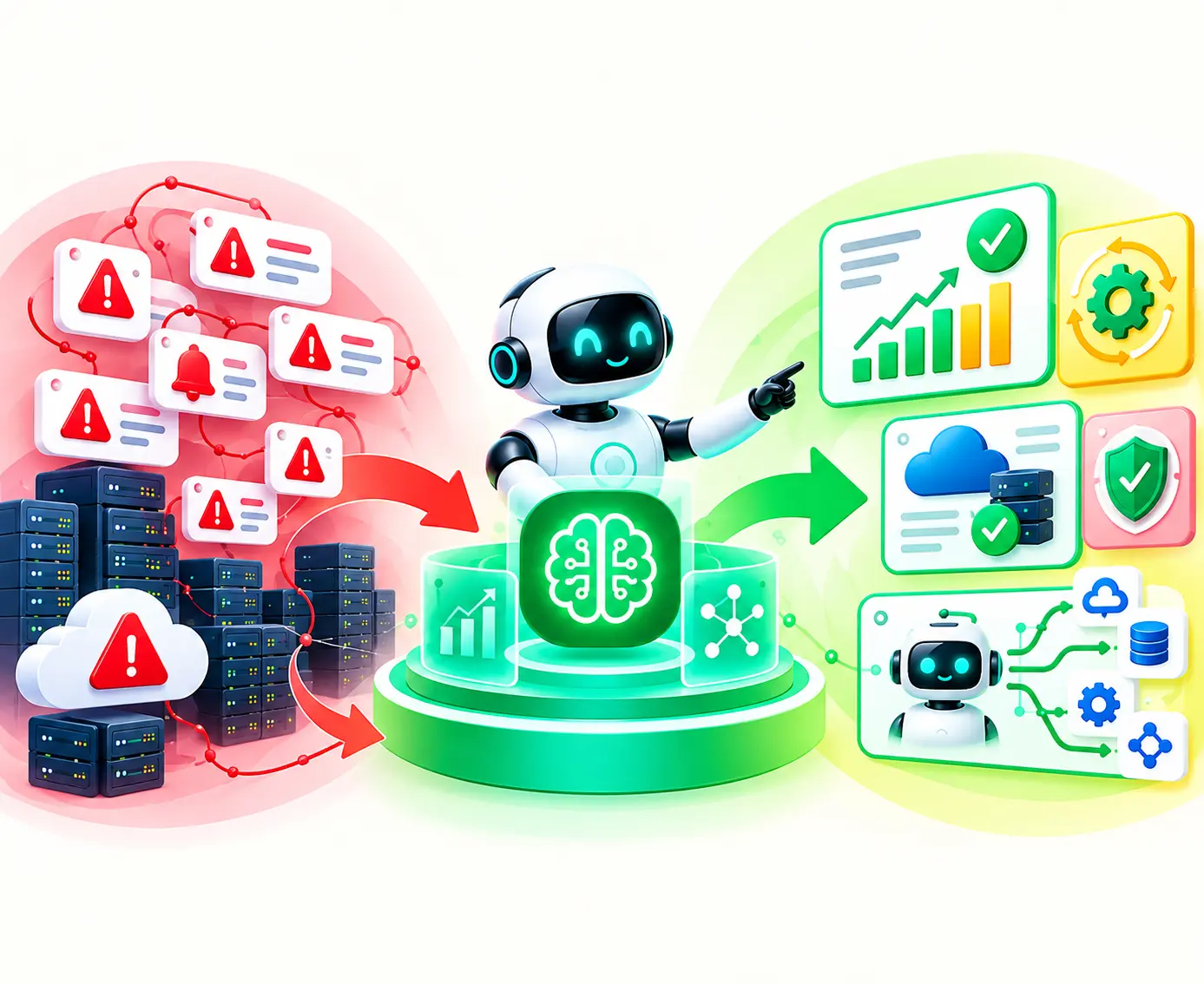
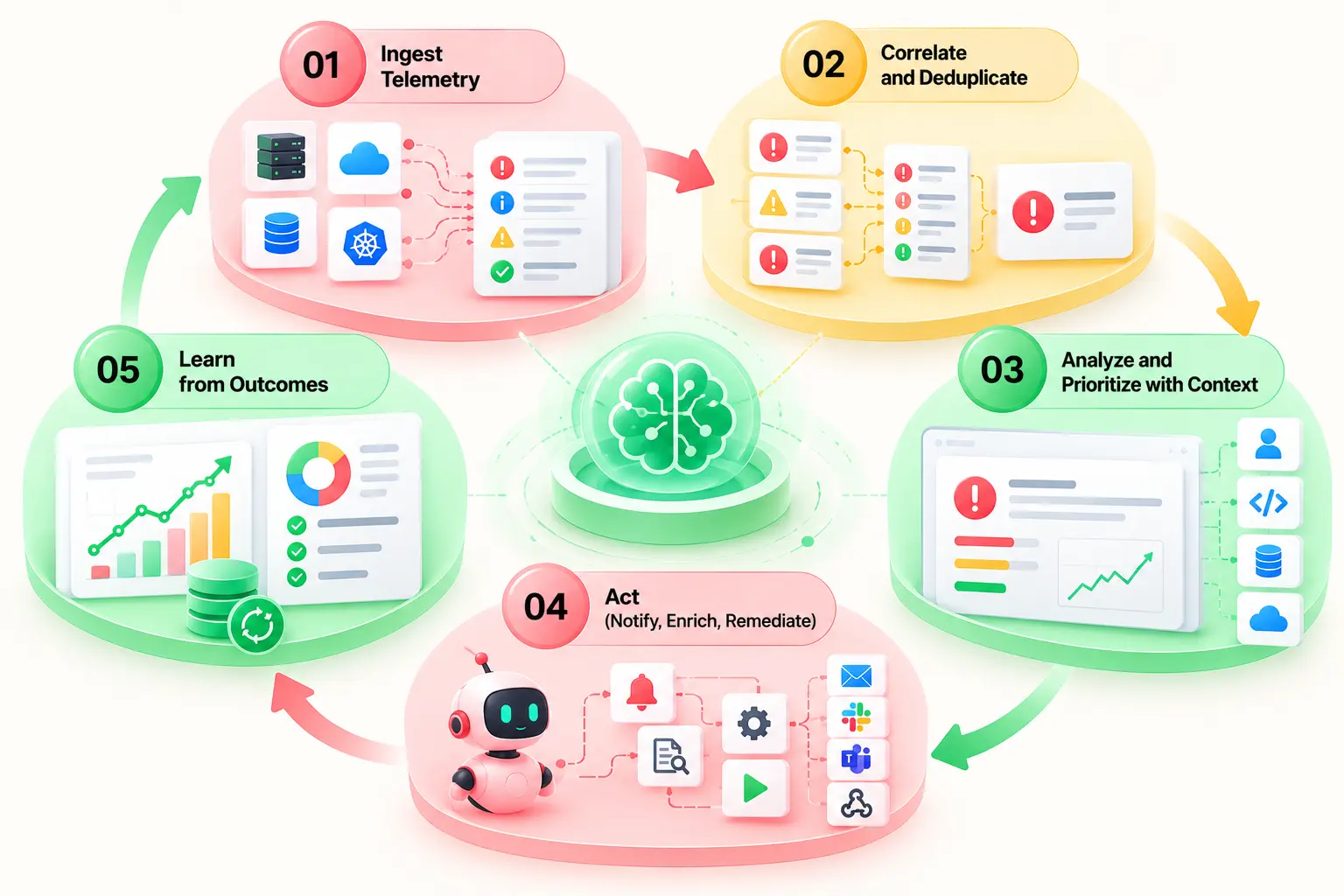
Today's agentic AIOps takes uncorrelated noise and makes it autonomous through an ongoing pipeline. AIOps brings disparate operational signals together by virtue of an ongoing process of detect, understand, act, and learn. The architecture of an ordinary AIOps follows the below-mentioned five stages:
Ingestion - Collect operational signals in their raw forms from the distributed environment.
Correlate and Deduplicate - Utilize machine learning to correlate and deduplicate events that will help distinguish between noise and events, and merge all events into one event.
Analyze and Prioritize with Context - Conduct an automated root cause analysis using large language models.
Act ( Notify, Enrich, Remediate) – Use workflows that trigger notifications for AI agents for SRE and run self-healing infrastructure protocols.
Learn from Outcomes - Incorporate the outcomes from the process of solving, post-mortems, and operator feedback into the machine learning algorithms.
AIOps vs. Observability vs. ITSM Automation vs. AI Agents
To understand the place of AIOps tools in relation to AI in DevOps and IT operations, one has to consider the following factors:
Category
What it does
Main inputs
Who Acts
Typical tools
AIOps
Pattern recognition, alert correlation, and automated incident response within hybrid IT systems
Metrics, logs, traces, events, changes, and incidents
Automated processes, SREs, and IT operations teams
Moogsoft, Dynatrace, BigPanda, Datadog
Observability
Gives detailed insights into internal state information to assist engineers in determining the root cause of the failure.
Improves efficiency in managing service management processes, ticketing systems, and employee requests
Incident tickets, service requests, and CMDB items
IT Service Desk agents and automation scripts
ServiceNow, Jira Service Management, Freshservice
AI Agents for IT Operations
Autonomous multi-step reasoning to diagnose, debug, and carry out intricate workflows
Unstructured logs, natural language prompts, documentation, API specs
Autonomous AI Agents acting alongside or on behalf of engineers
Moveworks, Cognition (Devin for Ops), custom LLM agents
It is the basic difference between the two: observability helps teams see, while AIOps helps them understand the relationships between the signals and do something about them. Artificial intelligence agents can go beyond this and execute multiple operational tasks within certain controls.
That explains why the use of AIOps in today’s world includes event correlation, root cause analysis, self-healing architecture, and agent-based workflows.
Is AIOps Still Relevant in 2026?
Yes. Nevertheless, still pertinent up to 2026, even though the language used by companies when talking about this issue has changed. AIOps has now become one of the domains of observability, AI-based IT operations, and agent-enabled workflows.
Why AIOps Still Matters
With today's IT environment, there will be significantly more operational data than humans can analyze. Examples of such information may include cloud infrastructure, Kubernetes, microservices, applications, security solutions, and artificial intelligence solutions.
It is here that the significance of traditional uses of AIOps comes into play, such as event correlation, root cause analysis, anomaly detection, and self-healing technologies. The objective remains the same: to gather data of various kinds, interpret them, and respond accordingly.
From AIOps to Agentic Operations
The key change is the emergence of AI agents for IT operations and SRE AI agents. In addition to just diagnosing the problem or recommending a solution, advanced software can look into incidents, validate any changes made recently, perform diagnostic steps that have been approved, update the tickets, and remediate.
So, is there any place left for AIOps? Yes, definitely. This term will probably change, but the need for something like this is increasing. With the increasingly sophisticated nature of cloud, Kubernetes, and AI-based workloads, machines are needed to do some tasks before these workloads make people do them.
AIOps Use Cases by Stage of the Incident Lifecycle
AIOps is easier to understand when its use cases follow the incident lifecycle:
Detect → Diagnose → Resolve → Optimize
Through such mapping of AI within DevOps and IT operations, from early detection to post-incident optimization, engineering teams will be able to develop a robust, self-healing system infrastructure.
Below is how modern agentic AIOps revolutionizes each step of operational management.
1. Detect - Catching Signal in the Noise
Use Case 1: Alert noise reduction and Event Correlation
The Problem: The microservices-based architecture that is used in today’s world causes way too much unnecessary alerting when there is a problem and makes alert fatigue for SREs way too excessive.
How AIOps Helps: Using machine learning techniques to correlate and aggregate events, metrics, logs, and traces into one incident.
Data It Needs: Telemetry stream, alert logs, and system events
KPI: Alert-to-incident ratio
Autonomy Level Today: Act autonomously
Use Case 2: Anomaly detection and early warning
The Problem: Static thresholds fall short by failing to identify any anomalies within operations or security until there is an impact on the user’s experience.
How AIOps Helps: Set baselines on user and system behavior to detect multivariate anomalies using logs, metrics, and security events.
Data It Needs: Metrics with high granularity, access logs, and user experience metrics.
KPI: Mean Time to Detect (MTTD).
Autonomy Level Today: Act autonomously.
Use Case 3: Predictive outage prevention.
The Problem: Outages from hardware issues, SSL certificate expiration, and memory leaks happen unexpectedly.
How AIOps Helps: Uses the history of consumption patterns to predict resource exhaustion and hardware issues in advance.
Data It Needs: Disk / Memory consumption patterns, certificates, and hardware health.
KPI: Number of incidents avoided; unplanned outages reduced.
Autonomy Level Today: Act with approval.
2. Diagnose - Uncovering the "Why" and "What Next"
Use Case 4: Automated root cause analysis
The Problem: Pinpointing the exact cause of an issue among the numerous microservices would consume a significant amount of time through manual log analysis.
How AIOps Helps: Conducts root cause analysis automatically by matching live incidents' telemetry data with dynamic topologies and dependency maps.
Data It Needs: APM traces, dependency topology, and service maps.
KPI: Time to identify root cause.
Autonomy Level Today: Act with approval.
Use Case 5: Incident prioritization by business impact
The problem: Too many hours are being spent on lower-priority defects, leaving the revenue-generating services under par.
How AIOps helps: An incident management application for correlating incidents with the business service, sales channel, and SLAs.
Data it needs: Incident, customer, SLA, and business data.
KPI: P1 accuracy, SLA breaches.
Autonomy Level Today: Suggest.
Use Case 6: Change impact and release risk detection
The problem: Over 80 percent of problems arise from recent deployments, schema updates, and configuration drift.
How AIOps helps: Application performance metrics with CI/CD pipeline changes by AIOps.
Data it needs: Deployment details, configuration information, and incidents.
Autonomy Level Today: Suggest.
3. Resolve - Takes Action Faster
Use Case 7: Automated remediation and self-healing runbooks
The Problem: Manually repairing it is going to take time, and most probably it is going to be incorrect due to the high level of stress involved.
How AIOps Helps: The runbook will be executed to provide support for restarting the application, scaling, clearing the queue, and reversing the operation done.
Data It Needs: Runbook scripts, execution of the runbook policy, and test hooks.
KPI: Mean Time to Resolve MTTR; Automatically resolved.
Autonomy Level Today: The action to be taken after approval of this level (planning autonomously if the problem domain is known).
Use Case 8: Ticket enrichment, triage, and routing in ITSM
The problem: Engineers get tickets in the absence of contextual information.
How AIOps helps: Taking context into account when creating tickets based on logs, changes, and incident data.
Data it needs: Tickets, logs, changes, and knowledge base articles.
KPI: Reassignment rate.
Autonomy Level Today: Act autonomously.
Use Case 9: L1 service desk automation
The problem: Repetitive work is performed by groups.
How AIOps helps: Password resets, access requests, and frequent errors will be addressed using automation and artificial intelligence agents.
Data it needs: Tickets, identities, and processes.
KPI: Time to resolution, automation percentage.
Autonomy Level Today: Act with approval.
Use Case 10: Post-incident reviews and knowledge capture
The Problem: Postmortems are done haphazardly, are incomplete, or sometimes not even done after a critical incident.
How AIOps Helps: Creation of automatic timelines, generation of a summary of the incident through generative AI, and recommendations for runbook improvements
Data It Needs: Chat logs of incidents (Slack/Teams), audit information, and timelines of remediation.
KPI: Frequency of repeat incidents.
Autonomy Level Today: Suggest.
4. Optimize - Continuous Improvement & Cost Control
Use Case 11: Capacity planning and predictive autoscaling
The Problem: The current reactive solution for autoscaling is unable to handle bursts of traffic, resulting in subpar performance.
How AIOps Helps: Uses predictive models of traffic to scale up capacity.
Data It Needs: Traffic patterns in history, business events, and current traffic data.
KPI: Performance stability at peak; resource utilization rate.
Autonomy Level Today: Act autonomously.
Use Case 12: Cloud cost optimization and FinOps.
The Problem: Excessive costs from cloud spending, owing to unnecessary capacity and stranded assets.
How AIOps Helps: Cost anomaly detection, underutilized workload detection, and rightsizing automation.
Data It Needs: Cloud bills, usage metrics for resources, and tags on resources.
KPI: Cost per workload unit.
Autonomy Level Today: Act with approval.
Use Case 13: Sustainable IT scheduling.
The Problem: Increasing power consumption of data centers that don’t have optimized workloads.
How AIOps Helps: Combine workloads and schedule non-essential processes during times of green energy.
Data It Needs: Energy usage measurements, compute workload data, and the carbon-intensity of the grid API.
KPI: Carbon footprint; energy efficiency ratio.
Autonomy Level Today: Act with approval.
Use Case 14: Tool consolidation and observability data cost control
The Problem: The cost of logs increases due to the growth of cloud infrastructure.
How AIOps Helps: Filtering irrelevant log data at the edge level and avoiding duplicate tools.
Data It Needs: Ingestion volumes, tool license telemetry, and log utility scores.
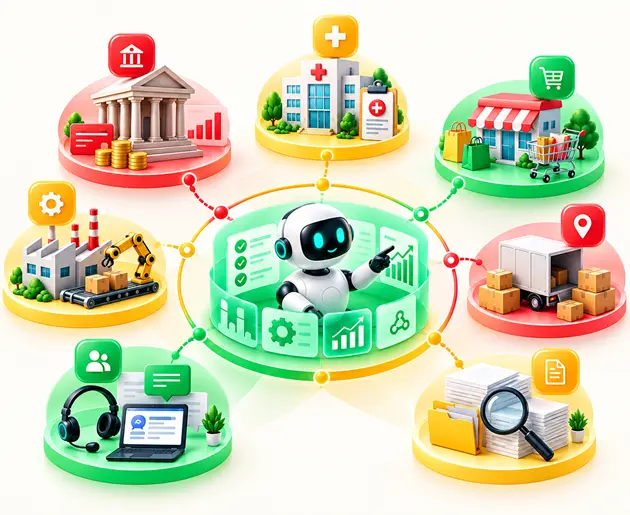
The value created through AIOps is not necessarily the same for all organizations. Signals, failure patterns, the business impact of failure, and KPIs differ based on the sector. A payment failure in the middle of a bank’s batch processing period requires an entirely different approach than a delay at checkout when a sale is being made. The following table identifies the high-value use cases of AIOps.
Industry or environment
Highest-value AIOps use case
Why
KPI
Telecom
Prevention of Network Outage and Self-Healing
Telecommunications networks produce enormous amounts of syslog and telemetry data from distributed cell towers and edge nodes. Agentic AIOps identifies cross-network events and predicts their degradation to perform automated routing of traffic or reset pods.
• Network Uptime / Availability • MTTR for Network Incidents
BFSI (Banking, Financial Services & Insurance)
Transaction Latency and Prevention of Payment Failure
Micro-latencies or failures in API requests during high-transaction-volume time frames affect core banking systems, clearing houses, and payment gateways, resulting in regulatory penalties and financial loss.
When flash sales or holiday shopping seasons occur, for example, traditional auto-scaling proves to be too slow to handle the surge in traffic and, therefore, leads to cart abandonment and poor performance of the checkout API due to its AI-based predictive approach to capacity in advance.
• Checkout API Availability • Cart Abandonment Rate due to Errors
Healthcare
Maintenance of EHR & Clinical Systems Uptime
When there is downtime in an EHR system or any other medical device, clinical processes get stalled instantly, and patients’ care gets affected immediately. AI Operations can detect problems within the infrastructure in real time.
• EHR Application Uptime • P1 Incident Resolution Time
SaaS & Cloud-Native
SLO Attainment and Error Budget Management
Cloud-native teams that deploy microservices every day are prone to burning up their error budgets fast. Contemporary SRE AI agents can correlate telemetry with the latest commits to detect any regression bugs before breaking any customer SLAs.
• SLO Attainment Rate • Error Budget Burn Rate
Manufacturing
OT & IT Convergence Monitoring
IIoT, MES, and enterprise IT systems are very interdependent. AIOps uses OT/IT telemetry data to ensure that there is no disruption to the production line because of issues in the network or database.
• Overall Equipment Effectiveness (OEE) • Unplanned Line Downtime
Hybrid & Mainframe Estates
Cross-Domain Legacy and Cloud Signals Correlation
Old-school mainframe systems (such as AS400 or IBM z/OS) used in combination with cloud-based infrastructure lead to gaps in visibility. The use of AIOps ensures that old-school mainframe logs are collected and correlated with cloud-based traces.
• Cross-Domain MTTR • Mean Time to Identify (MTTI)
AI Agents for IT Operations: What Changes and How Far to Trust Them
Transitioning from the conventional AIOps solutions to agentic AIOps is a paradigm shift in the way engineering teams deal with systems. While the traditional approach to AIOps architecture performs excellently in detecting anomalies and correlating events, agents that use AI to operate on IT do more than that. They use reasoning capabilities to deal with complicated incidents and even devise remediation steps.
How agents differ from classic AIOps
Classic AIOps can detect anomalies, correlate events, perform root cause analysis, and recommend what to do next. AI agents for IT operations go a step further. They can reason through an incident, pull context from monitoring platforms, ITSM systems, runbooks, and code, then suggest or take action and report what happened.
Autonomy levels framework
To safely integrate AI in DevOps workflows, IT organizations implement a clear four-tier autonomy matrix:
Autonomy Level
Execution Model
Today’s Realistic AIOps Use Cases
Level 0: Suggest
The agent analyzes data and drafts a diagnosis; humans execute all steps.
Agent executes end-to-end detection, triage, and resolution without human intervention.
• Alert Noise Reduction • Anomaly Detection • Ticket Enrichment & Routing • L1 Service Desk Automation • Observability Data Cost Control
Guardrails agents need
When entrusting self-healing infrastructure with production environments, it is important to have deterministic boundary controls:
Least-privilege RBAC: Permissions for agents to execute within predefined operational boundaries.
Human-in-the-loop gates: Approval gates for actions that will have a high blast radius, such as database schema changes or region failover.
Audit logs and rate limits: Immutable logging of all agent actions and execution velocity limits.
What practitioners actually use agents for
These days, the most useful victories are not about allowing AI complete freedom to impact production but rather putting together context. An agent can collect Kubernetes events, cloud metrics, alerts, recent deployments, tickets, and runbooks for an on-call engineer to make decisions more quickly. Enterprise workflows can be helped by implementing agentic AI framework integration to securely orchestrate multi-agent actions.
This is how agentic AIOps is gaining momentum – not by overriding SRE intuition, but by moving from random information to actionable insight.
AIOps vs AI in DevOps
Both AIOps and AI in DevOps are interchangeable, but they solve different parts of the software lifecycle. AI in DevOps mainly helps teams build, test, secure, and ship software. AIOps steps in after systems are running, helping teams monitor what is happening, connect operational signals, and respond to incidents.
AI in DevOps: Build and Ship
In DevOps, the applications of AI can assist developers in writing and reviewing code, test case creation, vulnerability detection, improvement of the CI/CD pipeline, and creation of infrastructure as code. Deployment efficiency can be improved by following a DevOps implementation guide during delivery pipeline setup. The aim is to facilitate the process of getting from code changes to production without delays and avoidable mistakes.
Unlike DevOps, AIOps is mainly interested in the post-deployment processes. Examples of the application areas of AIOps are anomaly detection, event correlation, root cause analysis, prioritization of incidents, and self-healing infrastructure. An example would be connecting the increased latency with the deployment and providing an explanation for that to SRE.
However, there is no clear dividing line. The intersection includes deployment verification, risk detection of the changes, and rollback. AI can evaluate the riskiness of the release, while AIOps can monitor the signals from production and roll back the changes automatically under certain conditions.
Automated unit test generation, smart code completions, IaC policy enforcement, and pipeline build caching.
Alert noise reduction, predictive outage prevention, automated root cause analysis, and self-healing runbooks.
Primary Key Metrics
DORA Metrics: Deployment Frequency, Lead Time for Changes, Change Failure Rate, and Time to Restore.
Operational Metrics: Mean Time to Detect (MTTD), Mean Time to Resolve (MTTR), SLA/SLO Attainment, and System Availability.
The Data Foundation AIOps Needs
AIOps is only as useful as the data behind it. A good AIOps design consists of metrics, logs, traces, and events, where OpenTelemetry can play a role in standardizing telemetry. However, this is just one piece of the puzzle. To unlock true self-healing infrastructure, your AIOps architecture needs data from every corner:
Telemetry: Metrics, logs, traces, and events standardized via OpenTelemetry.
High quality is essential for accurate root cause analysis and event correlation. Ensure consistent service tagging, accurate dependency maps, unified incident tracking, and sufficient data retention. Operational automation can be helped by exploring AI automation examples to structure data processing workflows.
First Use Case: Automated ticket context gathering.
KPI: 30% faster initial response.
3. Analytical (Root Cause Analysis): Accelerate root cause analysis across dependencies. Custom model training can be improved by onboarding a dedicated AIOps developer for specialized algorithmic pipelines.
First Use Case: Cross-domain incident causation tracking.
KPI: 40% reduction in MTTR.
4. Prescriptive (Guided Remediation): Generate action plans for human approval.
First Use Case: Change risk prediction and guided fixes.
KPI: 25% lower change failure rate.
5. Autonomous (Self-Healing Infrastructure): Deploy AI agents for IT operations to execute scoped remediations.
First Use Case: Automated disk cleanup and service restarts.
KPI: 80% automated resolution for routine incidents.
Share your details and our experts will reach out to discuss your goals.
Where AIOps Fails and How to Avoid It
AIOps can look impressive, but when moved to a production environment, it may fail at some point for some reason. The problem is often not the AIOps tools themselves. Weak data, unclear ownership, and automation without enough guardrails can quickly turn a promising setup into another source of noise.
Poor or inconsistent telemetry: Inconsistent logs, missing metrics, and fragmented telemetry render AI models useless for root cause analysis.
Mitigation: Set clear telemetry standards, service tags, ownership rules, and data-quality checks before expanding AIOps use cases.
No clear service ownership: When nobody owns a service, alerts can sit unresolved even when AIOps identifies the problem.
Mitigation: Assign owners to services, dependencies, and incident queues before introducing automated workflows.
Black-box correlation engineers do not trust: If an AIOps platform says two events are related but cannot explain why, engineers may ignore its recommendations.
Mitigation: Use explainable signals, show the evidence behind correlations, and let engineers validate results during early stages.
Remediation starts before diagnosis is reliable: Moving straight toward self-healing infrastructure can make a bad incident worse if the underlying diagnosis is wrong.
Mitigation: Start with recommendations and human approvals, then move to narrowly scoped, reversible actions.
Another tool adds to existing sprawl: A new AIOps layer can create another dashboard, data pipeline, and workflow for teams to maintain.
Mitigation: Check the existing AIOps architecture and tools first, and add technology only where it fills a clear gap.
Data costs grow faster than savings: Sending every log, trace, and event into an AIOps platform can become expensive without producing enough value.
Mitigation: Prioritize high-value data, set retention rules, and track ingestion costs against measurable outcomes.
Expecting AI agents to solve everything:AI agents for IT operations need reliable context, clear boundaries, and tested actions.
Mitigation: Start with a small AIOps use cases list and expand only after each workflow proves its value.
Measuring AIOps ROI
The ROI on AIOps isn't based solely on the number of incidents that an AI process is able to handle. Rather, the critical factor is whether or not incident resolution is occurring more quickly, whether repetitive tasks are reduced, and whether service reliability improves.
Before implementing AIOps use cases, establish a baseline for each service; otherwise, it's hard to know what impact AIOps processes are having.
Category
Key Metric
What it Measures and Core Impact
Response & Speed
MTTD, MTTA, & MTTR
Tracks how fast AI agents for SRE identify, acknowledge, and resolve incidents.
Operational Noise
Alert-to-Incident Ratio
Measures event correlation efficiency by calculating noise reduction.
Automation & Health
% Auto-Resolved
Percentage of routine tasks handled by self-healing infrastructure.
Service Quality
Change Failure Rate
Tracks delivery stability and risk prediction during deployments.
Business Value
Availability & SLO Attainment
Directly measures system uptime and customer reliability guarantees.
Efficiency & Cost
Engineer Toil & Cloud Spend
Reclaimed hours from manual root cause analysis vs. total observability costs.
Record all these figures before deploying anything and evaluate them every month with service owners. Identify movement in terms of improvements in root cause analysis, alert noise reduction, toil reduction, and SLO adherence. Remember to keep track of the expenses involved with telemetry and AIOps infrastructure to make sure savings are not eaten up by increasing costs in observability.
In the case of AI agents for IT operations and self-healing processes, one more question should be added to the list of questions: Has automation addressed the problem safely without generating a new one?
AIOps Tools and Platforms
A single tool will not fit in every IT department. The choice depends on where your telemetry, incidents, automation, and service data are.
Observability Platforms: Dynatrace (Davis AI), Datadog (Bits AI), New Relic, Elastic Observability, LogicMonitor, and Cisco AppDynamics integrate native AI to monitor performance metrics, logs, and traces.
ITSM Platforms: ServiceNow IT Operations Management (ITOM) connects service management with proactive operational insights.
Event Correlation & Incident Management: BigPanda and PagerDuty streamline noise reduction and group alerts for faster root cause analysis.
Automation & Orchestration: Red Hat Ansible Automation Platform powers automated workflow execution across hybrid environments.
Agent Frameworks: Emerging tools enable AI agents for SRE to perform autonomous diagnostics and remediation.
Evaluating your organizational needs across these categories is essential when deploying AI agents for IT operations. Explore our guide on top AIOps companies to evaluate vendor selection and partner fit.
How Entrans Helps IT Operations Teams Adopt AIOps
AIOps works best when teams connect AI to the systems, workflows, and people already handling day-to-day operations. Entrans works with IT teams across application support, IT operations, managed services, DevOps, and quality engineering to bring AIOps use cases into real production environments. Ongoing maintenance can be supported by partnering with managed services for continuous infrastructure optimization.
Entrans accelerates your journey to self-healing infrastructure across key core areas:
Application Support & Managed Services: Modernizing legacy IT operations into proactive, automated managed service environments.
DevOps & Quality Engineering: Establishing automated pipeline delivery, continuous event correlation, and zero-defect QA frameworks. Continuous testing can be improved by incorporating DevOps quality engineering practices across early pipeline stages.
Agentic AI Framework Integration: Integrating tailored AI agents for IT operations and AI agents for SRE to automate contextual root cause analysis.
We have transformed 200+ enterprises and delivered over 150+ AI projects. By utilizing enterprise-grade AI frameworks, Entrans helps IT operations teams reduce manual incident triage, minimize downtime, and scale modern cloud infrastructure with confidence.
Make IT Operations Faster with AIOps and AI Agents
Reduce alert noise, speed up root cause analysis, and automate incident response with AIOps solutions built around your operations.
20+ Years of Industry Experience
500+ Successful Projects
50+ Global Clients including Fortune 500s
100% On-Time Delivery
Thank you! Your submission has been received!
Oops! Something went wrong while submitting the form.
FAQs
1. What is AIOps?
AIOps (Artificial Intelligence for IT Operations) combines big data, machine learning, and automation to streamline and enhance IT operations. They collect vast streams of data in real time to automatically detect anomalies and find root causes.
2. What are the most common AIOps use cases?
Common AIOps use cases include alert reduction, event correlation, root cause analysis, and incident management. Teams also use it for change risk, ticket enrichment, and automated remediation.
3. Is AIOps still relevant?
Yes, AIOps is still relevant as IT environments grow more complex and generate more data. Its role is also expanding as teams use AI agents for IT operations and SRE.
4. How is AIOps different from observability?
Observability helps teams understand what is happening inside their systems through metrics, logs, traces, and events. AIOps builds on that data to detect patterns, connect events, find causes, and automate actions.
5. How do AI agents help IT operations?
AI agents can investigate alerts, gather context, suggest fixes, and carry out approved actions. Teams can start with small, well-defined tasks before giving agents more control.
6 . What is the difference between AIOps and AI in DevOps?
AIOps mainly applies AI to IT operations, including monitoring, incidents, and service health. AI in DevOps covers a wider range of software delivery tasks, from coding and testing to deployment.
7. What data does AIOps need?
AIOps requires metrics, logs, traces, events, topology, deployment information, tickets, and runbooks. Effective tagging, ownership of services, and good dependency data can make AI work effectively.
8 . How do you measure the ROI of AIOps?
Monitor key performance indicators like MTTD, MTTA, MTTR, alert count, automation ratio, and engineering toil. Compare the results to your baseline while at the same time monitoring observability and cloud costs.
Hire AIOps Developers for Smarter IT Operations
Build AIOps workflows with skilled developers experienced in AI integration, incident automation, observability, and self-healing infrastructure.
Free Project Consultation
Trusted by Enterprises & Startups
Top 1% Industry Experts
Flexible Contracts & Transparent Pricing
50+ Successful Enterprise Deployments
Aditya Santhanam
Author
Aditya Santhanam is Co-founder & CTO of Entrans Technologies, spearheading AI-driven cloud and data solutions. A 13-year tech veteran, he leads innovation in generative AI, AI agents and MLOps. He also co-founded Infisign (identity security) and Thunai.AI (enterprise AI agents)
Related Blogs
Business Process Automation Examples: 24 Use Cases Across Finance, HR and Operations
Explore 24 business process automation examples across finance, HR, and operations to reduce manual work, cut errors, and improve efficiency.
Explore top forward-deployed engineering services in 2026. Discover how FDE-as-a-service helps teams ship production-ready software inside live workflows.
Intelligent Automation Use Cases: 15 End-to-End Examples Across Industries
Explore 15 real-world intelligent automation use cases across industries to see how AI, RPA, and smart workflows cut costs and boost operational speed.






-1.svg)