Explore the top 10 AI agent platforms for enterprises in 2026. Compare key features, security, and tools to find the right fit for your business.

Agentic Unconference 2026 - September 19, Chennai
View Event →


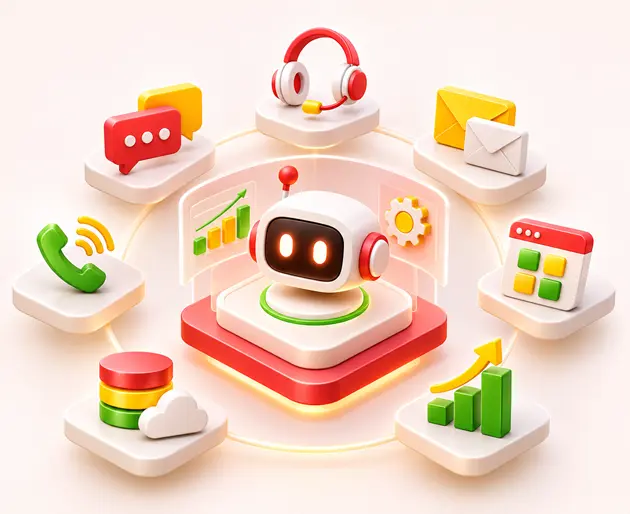


Consider an example in which intelligent agents independently handle complex service requests and streamline the entire supply chain and data pipelines.
However, building and managing them requires proper technology. That is where AI agent platforms come in. Choosing the right AI agent platform for business processes is challenging because each platform serves a different purpose.
This blog describes the 10 top AI Agent platforms for Enterprises in 2026 and what they offer to help you find the right fit for your business needs.
An AI agent platform is where businesses create, test, deploy, and scale autonomous AI agents. Such agents are capable of carrying out specific functions and interacting with the business system while making decisions based on certain principles without any human intervention.
Gartner reports that 40% of AI apps are intelligent enough to perform complete processes. The benefits of AI agent platforms are
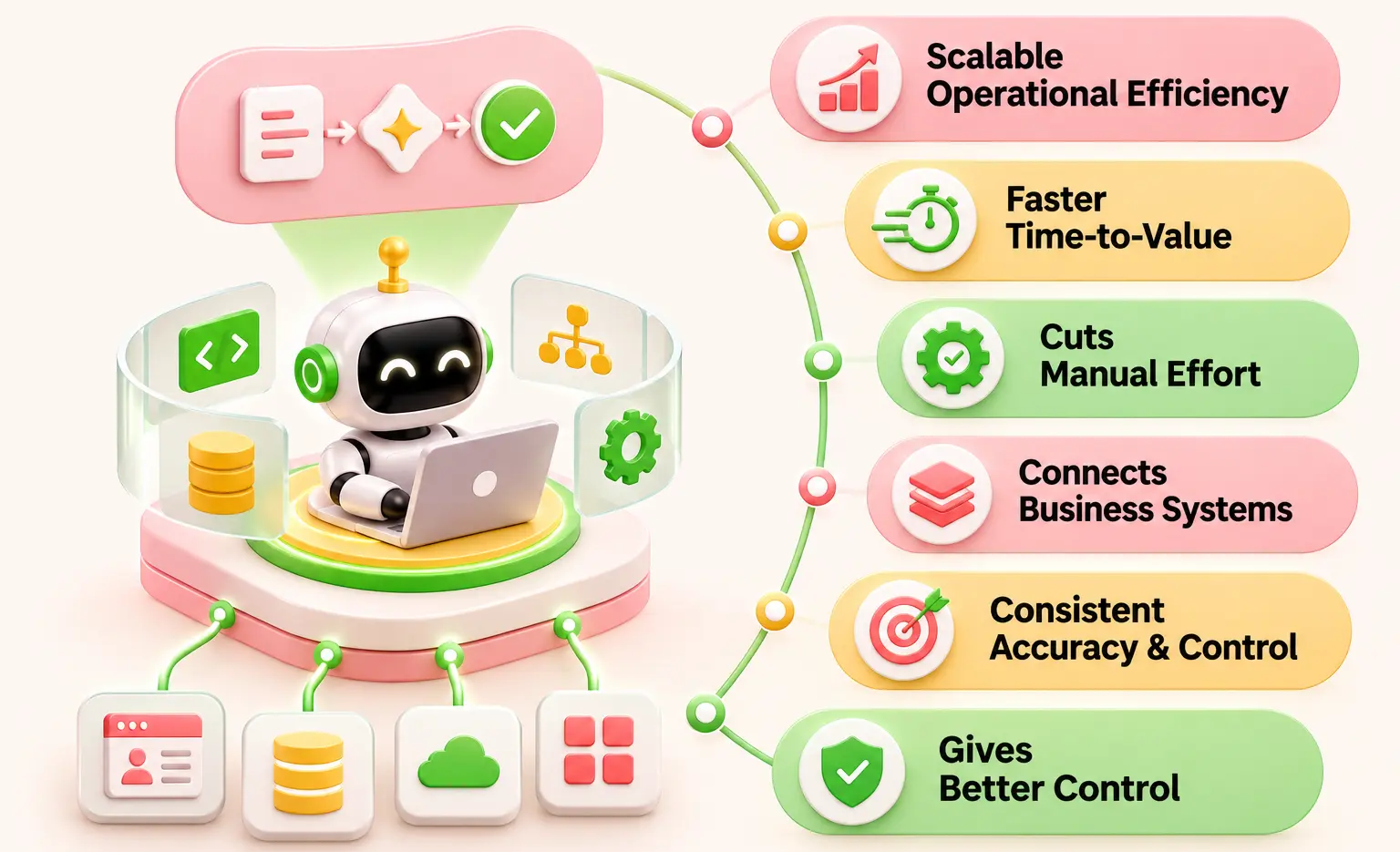
Evaluating an enterprise AI agent platform requires matching your technical requirements, whether low-code business building, code-first developer orchestration, or deep SaaS app integrations, with the right vendor infrastructure. Our selection also gives preference to established product companies over agencies that mainly sell AI development services, though strategic initiatives can be helped by specialized agentic AI services when navigating complex architecture designs.
We considered each firm’s year of establishment and years of operation. The number of employees and presence in the market were also considered. Companies with more than 50 employees were prioritized, as this gives readers a perception of their business scope and market experience.
We examined the key characteristics of the AI agents platform. These included the agents' building capabilities, multi-agent processes, data integration, process automation, security measures, and performance monitoring. In addition, we examined whether the platform has all the necessary tools for a complete lifecycle of an agent.
Autonomy in decision-making requires clear borders. All platforms mentioned below have been considered secure AI agent management platforms. The most important criteria were role-based access control, telemetry, human-in-the-loop validation, runtime data redaction, and SOC 2, GDPR, and enterprise compliance.
Lastly, we emphasized selecting those AI agent platforms that have been deployed for production use. Those solutions that have agent libraries ready to use, built-in knowledge grounding (RAG), known costs, and observability achieved the highest ranking.
The best AI agent platforms in the enterprise market are those that have been developed by cloud companies, enterprise software companies, and AI software companies.
There are various uses for each of the AI agent platforms.
The list of the AI agent platforms utilized by the 10 companies includes:
Thunai was created by Entrans to develop an enterprise-scale agentic AI builder platform with CX at its core, and service desk & operations as use cases. Its self-learning brain, pre-trained multi-agent ecosystem, and native tool integrations make for quick deployments in support, sales, and other processes.
It was ranked the #1 product of the day on its launch by Product Hunt. Thunai is mainly used for customer experience automation and operations decision intelligence for handling routine workflows. Workplace execution can be improved by exploring diverse practical use cases, and reviewing real-world AI agent examples can be useful for planning custom implementations.
Thunai embeds itself into various business applications such as Salesforce, HubSpot, Slack, and Zendesk. Additionally, Thunai lets you manage business customers and operations through a single platform.
A powerhouse among top AI agent platforms, Microsoft Copilot Studio allows for the creation, testing, and deployment of custom autonomous agents. Compatible with Microsoft 365, Azure AI Foundry, and Power Platform, the tool is capable of enabling autonomous reasoning, use of 1,500+ system connectors, and completion of end-to-end enterprise processes.
AWS Bedrock Agents is an AI Agent builder platform as a service provided by AWS. Through AWS Bedrock Agents, developers can configure the foundation models to carry out several steps, connect to enterprise data through knowledge bases and AWS Lambda services in the cloud environment.
Google Cloud Gemini Enterprise Agent Platform is Google's unified AI agent platform for building, deploying, governing, and managing enterprise AI agents. Formerly known as Vertex AI Agent Builder, the platform supports both low-code and code-based agent development.
Kore.ai is an enterprise AI agent management platform that automates customer and employee engagement for businesses using artificial intelligence agents. This platform provides no-code and low-code solutions to create, deploy, and manage intelligent virtual assistants through different channels.
As a native enterprise AI agent platform, Salesforce Agentforce enables companies to build and deploy autonomous agents across Sales, Service, Marketing, and Commerce.
Glean Agent allows workers to interact with AI-based agents for the discovery of information within the enterprise and completion of tasks through different business applications. This solution links corporate knowledge with workplace tools.
Embedded directly into the Now Platform, ServiceNow provides Now Assist alongside its agent development tools. It operates as an enterprise AI agent deployment platform that automates L1/L2 IT service desk tickets, HR requests, customer service workflows, and cross-departmental operations seamlessly.
One of the premier platforms for developing AI agents is CrewAI, which offers a Python framework that is open source, in addition to CrewAI AMP. CrewAI is focused on developing a team of multi-agents working in specific roles.
LangChain provides LangGraph (its orchestration engine) alongside LangSmith as a full developer and runtime platform for building control-oriented agentic software. Paired with LangSmith, it serves as a full-stack AI agent deployment platform offering deep tracing, debugging, and human-in-the-loop controls.
The right AI Agent Platform depends on how effectively it deals with real problems, how well it integrates with your existing infrastructure, and whether it is scalable for the future.
However, before comparing and contrasting the leading AI Agent Platforms, one should consider the analysis of the requirements. Start your pilot project in the context of your business process. The rollout process across business units can be improved by establishing a structured AI implementation roadmap.
Firstly, determine what has to be automated. For instance, customer service, document processing, and data analysis. Look for an AI agent platform that supports your specific use cases rather than one with features you may never use.
The ideal AI agent deployment platform should seamlessly integrate with your existing enterprise systems (such as CRMs, ERPs, and databases) via robust APIs. Look for multi-agent orchestration features to handle multi-step workflows smoothly.
Evaluate whether your team needs AI agent builder platforms featuring low-code/no-code visual drag-and-drop canvases for business users, or code-first AI agent development platforms tailored for software developers.
Look for access controls, data encryption, audit logs, and human approval options. These features matter when AI agents handle sensitive information or business decisions.
Choose an AI agent management platform that offers real-time tracking, interaction evaluation, and performance monitoring to debug and optimize agent performance effectively.
Consider usage-based pricing, licensing fees, deployment costs, and ongoing maintenance. The best AI agent platform should support more users, workflows, and agents as your business grows.
You need technology that enables task understanding, decision-making, use of corporate data, and action across applications. Leading AI agent platforms provide all of these capabilities.
They allow the developer to build and integrate artificial intelligence agents, coordinate their actions, and measure their performance in response to the organization's changing requirements.
A good platform for artificial intelligence agents should have all the features of the agent's life cycle, including its design, testing, and management. Organizations should assess the features before choosing the agent platform.
Below are the essential characteristics of AI agents' platforms to compare in the selection process.
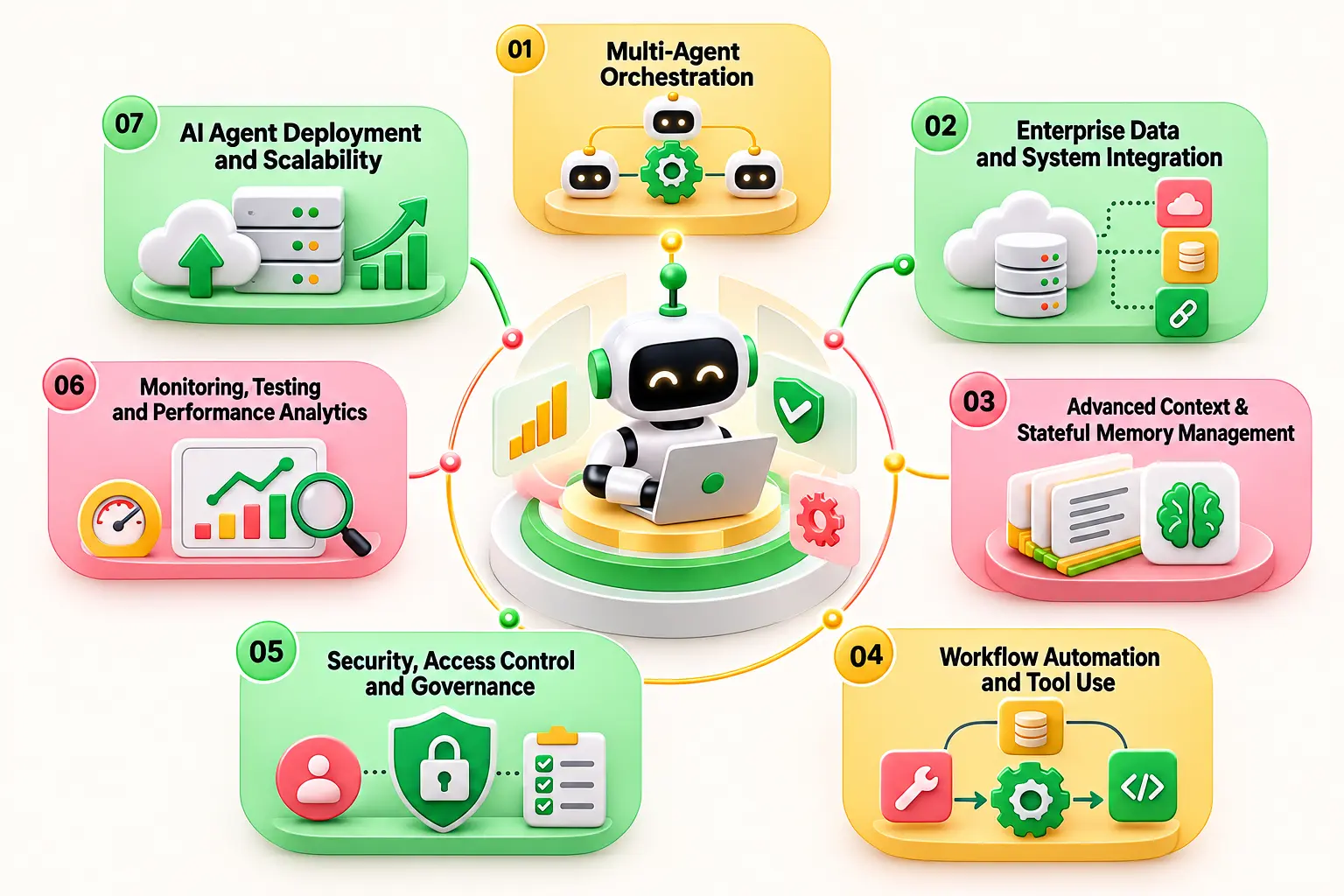
The AI agent creation platforms employ a specific multi-agent systems architecture. The use of multi-agent coordination allows several agents to collaborate on such tasks.
The platform will function as the controller that splits the tasks into several subtasks and assigns them to individual agents (planner, executor, and reviewer). Cooperation consists of task delegation and coordination between the agents if the agents encounter problems with the task.
Multi-agent systems have architectures that are created specifically to support AI agents. Multi-agent coordination allows many agents to collaborate in completing the assigned tasks.
The development environment serves as the controller that breaks down the organizational goals into sub-tasks and assigns these tasks to specific agents such as the planner, executor, and reviewer. System connectivity can be improved, and legacy hurdles can be addressed by studying how to integrate AI into existing enterprise systems.
Language models have tight context windows and do not have memory. An effective AI agent framework addresses the problem by having persistent state memory.
With hybrid memory architectures, which comprise short-term interaction buffers, semantic vector retrieval (RAG), and long-term transactional state memory storage, agents will be able to recall the context of multi-step dialogues and multi-day corporate interactions.
In addition to generating text, the AI agent may need to take actions if required. The AI agent platform allows the agents to use tools, invoke API, update records, send messages, and initiate a business process.
For instance, the AI agent may verify the invoice by checking the details in light of the purchase order.
AI agents in an enterprise could handle customers’ information, financial reports, and internal documents, which is why security and access control are crucial.
A proper platform will offer role-based access, encryption, logging, and permissions for the AI agents. Enterprises must be able to set rules on the kind of data the agent has access to and the tasks it should be authorized to do. Overall data protection can be improved, and risk mitigation can be helped by adhering to robust protocols for agentic AI security.
Where the work being done is of a very serious nature, like financial transactions or software deployment, approval gates are automatically built into the system.
The answer provided by AI systems may not always be the right one, or the task may not be accomplished correctly. This is where an AI agent management platform becomes useful for a team in testing the agents and monitoring their performance.
The following features need to be considered:
The ability to test agents before their deployment is also necessary.
Creating an agent is just one step towards the solution. Companies need a solid deployment system that would allow them to roll out their agents while making sure that they can manage them as the load of requests increases.
The deployment platform for AI agents would help in the implementation and management of the deployment of the agent in the production environment. The platform should provide versioning, deployment configuration, rollback features, and connectivity to cloud/premise services.
Choosing from the many AI agent platforms available today can be challenging. Businesses need more than a tool to build AI agents. They need a platform that can connect workflows, handle business tasks, and support real-world operations. This is where Entrans – Thunai comes in.
It gives your enterprise a distinct edge in modernizing customer experience and operational workflows. Widely recognized among the top AI agent platforms, Thunai combines domain-specific intelligence with autonomous multi-agent orchestration to streamline complex enterprise tasks.
Ready to explore the best AI agent platform experience to scale support and drive growth? Book a consultation call to learn more about it.

AI agent platforms help businesses build, deploy, and manage autonomous AI agents that perform tasks, make decisions, and automate workflows.
Enterprise AI agent platforms use large language models as a reasoning engine to break down tasks and execute multi-step workflows. They connect with business tools, access data, and complete workflows with minimal human input.
AI agent platforms use large language models (LLMs), machine learning, natural language processing, and retrieval-augmented generation (RAG). They also use APIs, vector databases, and workflow engines to carry out tasks.
AI platforms use encryption, role-based access control, and identity management to protect business data. They also apply audit logs, data masking, and security policies to control access.
AI agent platforms connect with enterprise software through APIs, webhooks, and prebuilt connectors. This lets AI agents work with tools such as CRMs, ERPs, databases, and HR systems.
Multi-agent orchestration is a system where different specialized AI agents work together to solve a single large problem. One agent might write code while another tests it, passing tasks back and forth until the job is done.
Traditional chatbots respond to user questions based on set rules or trained responses. AI agents can plan tasks, use tools, make decisions, and take action with less human input.