Looking for Palantir alternatives? Discover leading competitors for data, AI agents, and custom delivery models to scale AI without platform lock-in.

Agentic Unconference 2026 - September 19, Chennai
View Event →




Looking for Palantir alternatives? Before jumping into comparing providers, you may want to stop and ask yourself one question: Do you need a new platform, or something better for creating AI products?
It is really that execution gap that needs to be considered. To replace Palantir, you need better data tools, AI agents, or engineers who can build solutions in existing systems. Each Palantir competitor comes with different prices, trade-offs, and control levels.
This blog gives a clear view of choosing the right Palantir alternative that fits your goals without paying for features you may never use.
The actual Palantir alternatives usually mean they want Palantir’s operational speed and capability without the heavy price tag or tight vendor lock-in. Palantir isn’t just one tool. It is a multi-layer architecture of data warehousing, semantic ontology modeling, generative AI orchestration, and mission-critical investigative software backed by a team of forward-deployed engineers. To tell the truth, there is no single complete replacement for Palantir that can fit all business needs exactly. The right alternative depends on
Palantir Foundry integrates data and links it to business processes via an ontology provided by it.
The software is one part of the decision too. Palantir solutions may be based on considerable engineering effort, new workflows, and support beyond the software itself.
Embedded engineering teams who operate in your existing technology stack may suit you better if you would like to develop bespoke AI systems without having to upgrade your whole setup.
You should choose the ideal Palantir alternative that will work well with your system without complicating your processes.
Palantir not only sells software. This company provides an integrated suite of products that includes data platforms, artificial intelligence technologies, operational services, and engineering.
To evaluate Palantir alternatives effectively, you first have to unpack what Palantir actually delivers. The core product suite spans four primary platforms:
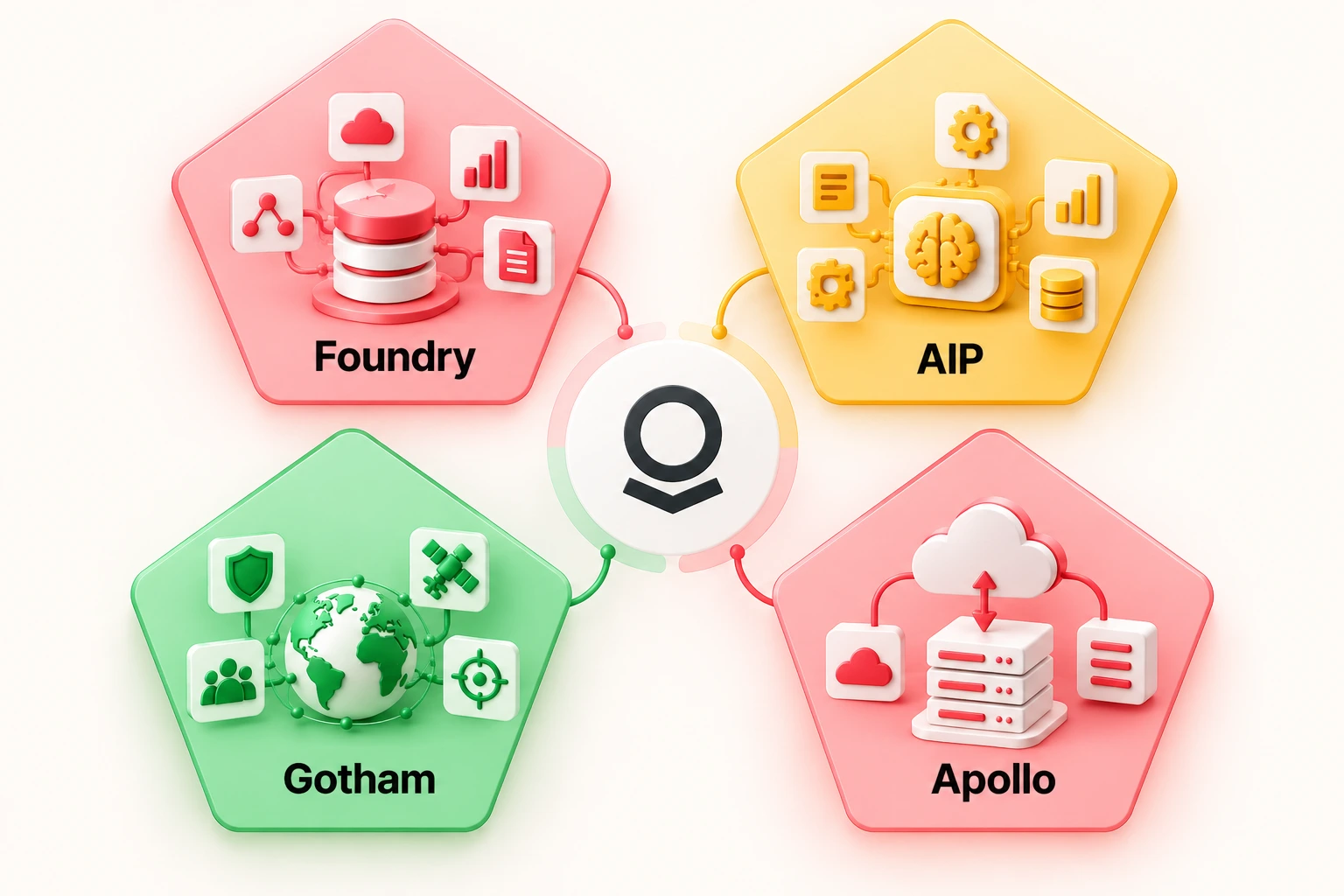
Foundry is Palantir’s platform for bringing data from different systems into one shared environment. This will help the team relate the information to the business process and make decisions based on the same understanding of the process.
Artificial Intelligence Platform (AIP) of Palantir is responsible for connecting the artificial intelligence models with the enterprise data and workflows.
This platform supports AI-powered applications and AI-directed actions in business processes. It allows organizations to build context-aware AI agents that will carry out complex tasks under the existing security constraints. The execution of such workflows can be enhanced through a robust data foundation for agentic AI.
Gotham supports intelligence, defense, and investigative work; this platform excels at complex link analysis and threat detection. It helps users connect information from different sources to support analysis and decision-making.
Apollo Acts as the continuous deployment engine powering the rest of Palantir's stack across any environment. It supports software operations across cloud, on-premises, and other specialized settings.
Palantir popularized the concept of a forward-deployed engineering model where the FDEs are embedded directly within customer teams to build solutions on-site. Buyers do not wish to be locked into a platform and the associated engagement model. Learn more about how Palantir and OpenAI use forward-deployed engineers.
This is because the buyer can decouple the replacement of the platform from the delivery model. It means that they can swap out the platform with a new set of data/AI technologies and keep the engineer intact. It is worth taking into consideration the different aspects of having a forward-deployed engineer rather than a consultant or professional services when choosing an organizational structure.
Enterprises evaluate Palantir alternatives due to specific architectural and financial constraints which are described below.
Since Palantir does not disclose list prices, the normal commercial cost is not known. The final Palantir pricing cost depends on the contract and the customer’s needs. The company’s second-quarter 2026 business update revealed that there were 73 deals worth at least $10 million.
When budgeting, the initial platform license is only a fragment of total expenditures. Organizations looking to find the right Palantir alternatives must also consider the factors below.
As industry strategist BD Emerson notes, the year-one platform cost is often not the largest expense in an enterprise AI deployment. Total program cost ultimately hinges on delivery and operational scale. Compare Palantir competitors on total cost over time, not just the starting price.
Deciding on Palantir competitors depends on the task that needs to be accomplished by the software. The chart below shows the top competitors of Palantir in data processing, orchestration, and domain-specific analytics engines.
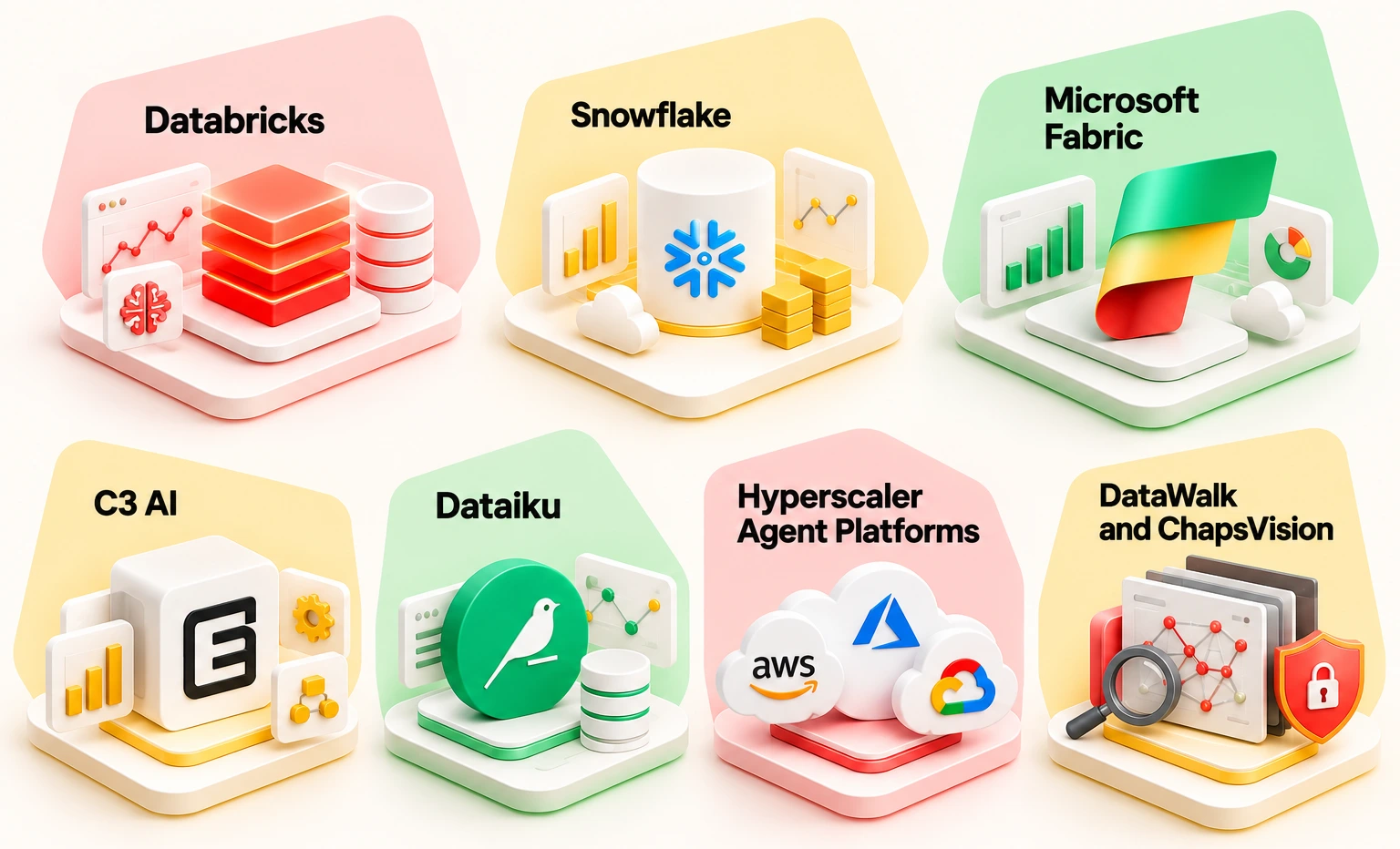
Large-scale data engineering, open-source lakehouses, machine learning, and companies that are dedicated to maintaining open data formats.
Teams that want out-of-the-box non-technical business user interfaces or pre-built operational write-back applications.
The team or the delivery partner will be responsible for building the business object model, application interfaces, permissions, and processes. This distinction comes into play in case of a comparison of Palantir vs. Databricks. While Databricks provides the data and AI platform, your team determines the operational experience.
Consumption-based pricing calculated via Databricks Compute Units (DBUs). See the official Databricks pricing page
Companies that require cloud data storage, analysis, data sharing, and artificial intelligence capabilities near their enterprise data.
Organizations wanting an integrated operational application runtime directly coupled to their data platform.
Business applications, user interfaces, workflow logic, and linking to other systems that perform business functions. Snowflake could provide the data layer, but the application layer is still a design choice on its own.
Usage-based pricing based on Snowflake credits for compute and flat storage rates per terabyte. Details are listed on the official Snowflake Pricing Page.
Enterprises already using Microsoft identity, Power BI, Azure, Office 365, and related data services.
Multi-cloud or non-Azure-centric architectures seeking cloud-agnostic data infrastructure.
Complex custom AI agent pipelines, custom investigative networks, and non-Power BI operational interfaces.
Capacity-based pricing, with costs varying by capacity size and purchase option. Check the official Microsoft Fabric pricing page.
Businesses whose needs match an available C3 AI application, such as predictive maintenance or supply chain optimization.
Companies that want to build bespoke data architectures or require flexible open-ended ad-hoc analytics.
Data connections, custom extensions, and workflows that fall outside the chosen application.
Confirm licensing, deployment, and ongoing service costs for your use case rather than relying on undated price estimates. See details via the official C3 AI Website.
Democratizing data science, enabling collaboration between business analysts and data teams, and rapid prototyping.
Heavy operational write-back workflows or large-scale transaction processing systems.
Enterprise-grade production integration, operational application frontends, and low-latency API layers.
Tiered licensing based on user roles and node deployments. Contact Dataiku for current commercial pricing and package details.
Platform offerings like Amazon Bedrock AgentCore, Azure AI Foundry (and Copilot Studio), and Google Cloud’s agent creation tools excel at model orchestration and governance.
Flexible LLM choices, strict enterprise security boundaries, and building custom autonomous agents directly on cloud estates.
Teams needing an out-of-the-box business user interface without software engineering effort.
Grounding data pipelines, business ontology logic, and end-user frontends.
Pay-per-use consumption (token and compute usage).
For defense, national security, and law enforcement buyers focused primarily on link analysis and intelligence fusion, standalone platforms like DataWalk and ChapsVision serve as direct alternatives to Palantir Gotham.
Defense, intelligence, and investigative teams that need to connect records and analyze relationships across complex datasets.
General-purpose enterprise data engineering or teams seeking a broad AI development platform.
Data connections, case-specific workflows, and links to existing systems. Compare DataWalk and ChapsVision directly to confirm product fit and pricing.
Request a vendor quote based on deployment scope and requirements.
Bottom Line
No platform covers all aspects of Palantir. Take into account not only the cost of licensing and using the software but also the engineering effort required to develop applications and workflows.
It is quite common when people compare Palantir to its alternative to make a Palantir vs. Databricks comparison. Although both tools address data-driven initiatives and AI technologies, each one addresses a different area. Palantir consists of data management and operations components, enabling employees to use the insights they gain as part of business decision-making. Databricks is dedicated to data engineering and AI.
Choose Palantir when it’s mostly about making connections between enterprise data, decisions, and actions in the context of an operation. On the other hand, choose Databricks if it’s about utilizing a data and AI platform to create applications your business needs.
Use Databricks as the platform for processing data, analytics, and AI development but keep Palantir for existing workflows relying on its Ontology and action layer. Take into consideration cost, data transfer, governance, and maintenance.
For potential Palantir AIP alternatives' buyers, there are factors other than AI capabilities that matter when making a final choice. Determine what amount of application development is needed from your team and which option will be easier to maintain after completion.
In considering Palantir competitors, people usually consider the software solution first. However, when the need is for a team capable of converting business problems into functional artificial intelligence solutions, it helps to use the Palantir forward-deployed engineers (FDE). There are other solutions that will assist, yet they have their own assets and lack of assets.
Consultancy and system integration firms usually provide you with a project or transformation. Staff augmentation brings highly trained individuals to work on your project, usually charged on an hourly basis.
The forward-deployed engineering pod works in your environment and builds on your stack to deliver agreed-upon business results. Researching specialized FDE as a service providers can be helped by reviewing options that match your organization's delivery speed and technical scope.
An alternative delivery model can be applied within the context of Databricks, Snowflake, Microsoft Fabric, Amazon Bedrock, Azure AI Foundry, or Vertex AI. The MCP suite will facilitate linking AI applications to various platforms such as SAP, Salesforce, and ServiceNow.
Explore FDE as a service to see how this model can help you pursue AI outcomes without committing to a new platform solely to access embedded engineering. Choosing the right external partner can be helped by reviewing how to choose forward-deployed engineering company options that align with your technical goals.

The right choice depends on what you need to replace and what your team already has. Some enterprises need Palantir Foundry alternatives for data and analytics. Others need Palantir AIP alternatives for AI agents, or a delivery team that can build on existing systems. Use this matrix to narrow down your options based on your technology stack, team capacity, security needs, and target timeline.
There are some places where we can run Palantir alongside it or completely move away from it. The reasons are discussed below.
While exploring Palantir alternatives makes sense for many organizations, replacing Palantir isn't always the right strategic move. In some cases, Palantir remains the most effective solution on the market.
Every company searching for Palantir alternatives does not necessarily require a completely new platform; some companies need people who can develop AI apps on their existing platforms. This is where Entrans comes in.
Entrans is an engineering partner, not a software platform. We do not sell a proprietary ontology engine, do not market a Gotham-class intelligence tool, and do not claim defense-sector or air-gapped security accreditations.
We fit precisely when you want Palantir-style outcomes driven by embedded forward-deployed engineering (FDE) pods without taking on a new proprietary platform. Organizations looking to expand their technical capabilities can be helped by choosing dedicated forward-deployed engineering team options that seamlessly integrate into their existing environment.
Our teams can work with existing technologies such as Databricks, Snowflake, Microsoft Fabric, and cloud AI services. The work can also connect to business systems through APIs and MCP tools, where supported.
The first step can be that of a 6-8-week results sprint. The team will begin with a clearly specified business challenge, and evolve towards a solution while tracking their progress on the agreed business key performance indicator. This allows the buyer to experiment with the delivery approach before scaling up.
There is an actual Entrans study on invoice and goods receipt note (GRN) reconciliation that has shown to require 80% fewer manual reconciliations and double the speed of payments processing. This gives a real-life example for buyers to analyze. Read the invoice and GRN reconciliation case study.
Ready to move on from Palantir? Entrans is worth considering when the main gap is building and delivering AI solutions on your existing stack, rather than replacing Palantir's platform capabilities. Book a consultation call with us.

The best alternative depends on which product of Palantir is replaced.
Databricks is the biggest Palantir competitor for enterprise data and AI, while Snowflake depends on cloud warehousing and analytics. For defense and intelligence link analysis, specialized platforms like DataWalk are the closest direct match.
A standardized rate list is not published by Palantir. Palantir pricing depends on the platform, contract terms, usage, support, and engineering services.
Databricks can replace Foundry's data engineering, lakehouse storage, and machine learning infrastructure. However, your team will still need to build the operational application layer and semantic business ontology manually.
Yes. Forward-deployed engineers can be hired from specialized engineering partners or FDE-as-a-Service providers. They build production-grade workflows directly on your existing cloud stack without forcing proprietary software locks.
Some of the Palantir alternatives include Amazon Bedrock, Azure AI Foundry, and Google Cloud's Vertex AI platform. The right choice depends on your cloud setup, security needs, agent tools, and engineering capacity.
No, you can keep your existing warehouse and gradually migrate Palantir pipelines to your native stack. Replacing Palantir is about shifting data transformations, semantic layers, and frontends onto modern tools connected to your current data lake.
Palantir remains the good choice if you need a fully integrated operational ontology with multi-team write-back out of the box. It is also ideal for complex defense programs requiring pre-accredited, air-gapped security infrastructure.