Learn how to build an LLM evaluation framework to test AI quality, set release gates, and align model performance with business KPIs.

Agentic Unconference 2026 - September 19, Chennai
View Event →


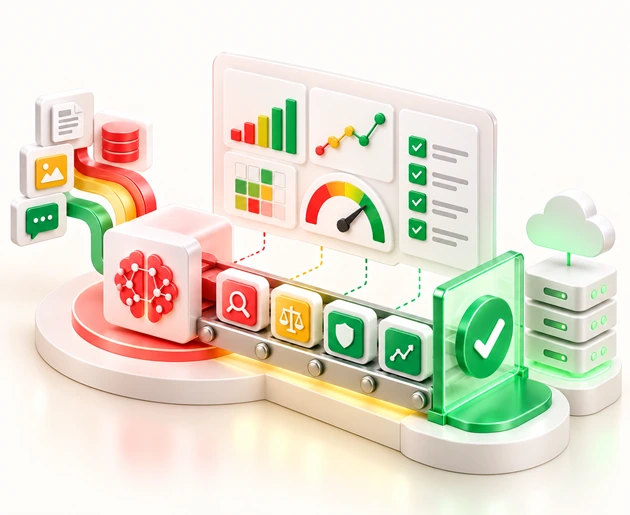


What if the biggest risk to your AI strategy isn’t a better competitor, but a silent failure hiding inside your own prompt stack? A good demo does not guarantee a reliable AI system.
Once an application reaches production, many factors such as costs and slow responses can hurt business results. That is where an LLM evaluation framework comes into play. It allows businesses to measure and monitor the performance of their artificial intelligence applications and fix the issues beforehand.
The guide provides information on how to use LLM evaluation frameworks for release gates and business KPIs.
The LLM Evaluation Framework is made up of datasets, graders, metrics, thresholds, and release guidelines that enable the team to test whether the particular LLM project is ready for release or still of good quality during the production phase.
Frameworks are real processes made up of artifacts and not just another software product. Tools only execute your guidelines and process flows.
While general terms like LLM evaluation and shorthand LLM evals describe the ongoing practice of measuring application behavior, public model benchmarks (such as MMLU) frequently mislead developers.
Public metrics like MMLU can help benchmark general abilities, but these may not be indicative of how the model behaves on your company's data or prompts. Your teams require metrics that simulate actual customer queries and failure modes.
The evaluation of the model alone will not be enough to make the LLMs operational. There is a requirement for prompt engineering, retrieval, tools, and guardrails, too. The model can do well independently but still fail to generate proper responses because of obsolete information or malfunctioning tools.
A well-designed LLM evaluation framework assesses the entire application. For retrieval-based systems, the RAG evaluation framework measures the ability of the system to retrieve the right information and use it appropriately. Overall search relevance can be improved by RAG accuracy metrics and fixes.
The AI agent evaluation framework evaluates the choice of tools, the accuracy of actions performed, and safety. This will facilitate evaluation-driven development, whereby issues can be identified early on for the product and even measure its performance post-release.
Deploying generative intelligence into enterprise workflows is a high-stakes engineering challenge. With no proper testing, most projects fail by themselves before even offering any value. LLM Evaluation allows project teams to test if the AI application is able to offer reliable results before its implementation.
Gartner claims that more than 40% of agentic AI projects were expected to fail because of increased costs, lack of business value, or poor risk management by 2027. While evaluation is not able to guarantee the prevention of failure, at least it will be possible to notice the faults of the project during its early stages.
This allows for LLM evaluation to turn the process from a guessing game into an actual testing process. It enables teams to check the accuracy of the system, response quality, tool usage, security, and costs before each deployment. Transitioning from an initial AI pilot to production can be helped by establishing these quantitative baselines early. As far as RAG systems go, RAG validation checks whether the system has retrieved relevant data and uses it correctly.
Validation of AI agents also checks whether the agents act appropriately within the acceptable range of actions.
True reliability demands adoption of evaluation-driven development (EDD). Entrans is based on one core principle: If it isn't measured, then it isn't shipped. Evaluation is done continuously to ensure that all LLMs deployed are accurate, safe, and performant.
An enterprise LLM evaluation framework provides a team with the means to determine whether an AI application can be launched in practice. Instead of just showcasing a couple of successful demonstrations, a team utilizes repeatable evaluations, performance metrics, and regular monitoring to gauge the behavior of the system.
An enterprise evaluation framework operates as a quality assurance engine driven by five essential building blocks forming a closed-loop process:
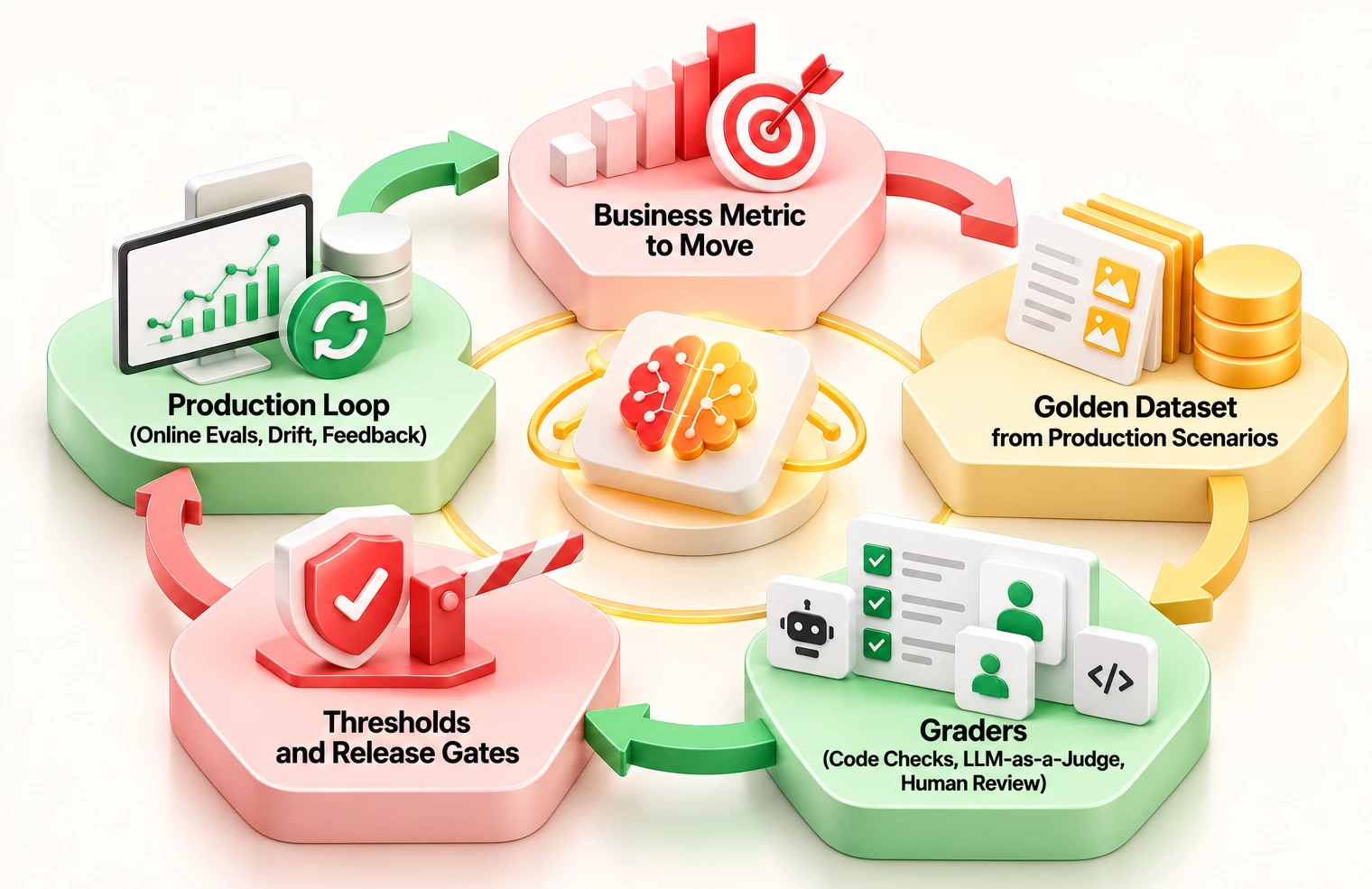
One must start with defining the metrics that the AI application will improve. An invoice processing system may aim at lowering the time required for manual reviews, while a customer support agent may concentrate on improving their response rate and accuracy.
This will add purpose to the evaluation of the LLM. In the absence of these criteria, the team may improve scores without adding any value.
A golden set of data refers to the data that is used to evaluate the performance of the system. Start with around 20 to 50 examples of realistic tests and then move on to tougher ones. Also, discuss how the controls can be worked around.
Perform the processing, establish the ownership of data, and use it as a regression baseline. Every time there is a change in the prompt, model, or algorithm, you should perform the tests.
Graders are deterministic evaluators that grade system responses for accuracy, correctness, and performance. The selection should match the test being done.
For the judge model, examine how well its grades correlate with those of humans and modify grading criteria when there are differences. Do not take statements about the accuracy of graders from tool companies as independent verification of that claim.
Set the quality, safety, lateness, and price standards before launching the program. For example, there should be set standards for what qualifies a client service assistant to answer clients' inquiries without breaching their confidentiality.
The program will be deemed defective if it fails the safety test or does not match the established standards. This means that development will involve evaluation during the process.
However, the process of evaluation will not be finished just because the software is put into action. The performance of the software needs to be monitored, user feedback taken into account, any changes in the data or models learned about, and tested before the fixes can be released.
In this context, DataOps and MLOps services might prove useful. In the case of RAG, the evaluation of RAG may reveal issues with retrieval and unsupported answers.
Together, these components help enterprises assess AI model quality and the full application. An LLM evaluation framework is a process supported by datasets, rules, and testing tools, not a single product.
An effective approach to testing an LLM will not only examine how well the AI produces the correct response but also take into account the efficiency of every process in generating that response. Metrics categorized per layer help the team identify issues.
The first step in the process should be the evaluation of the output produced by the model. The criteria that can be used for this purpose are accuracy, relevance, completeness, and correctness of facts. If there is a need to have some structure in the output, then the criteria of schema validity and consistency can be used.
RAG must include team evaluations of whether the right documents have been retrieved and whether the system uses them appropriately.
The precision of retrieval, recall, context relevancy, and groundedness may be applied to find out when certain documents are missing or whether there is an answer without any documents at all. It is particularly helpful for applications based on company data.
Evaluation of an AI agent assesses whether the agent uses the proper set of tools, performs actions according to the right process, and completes the task under approved constraints. Groups can monitor the success rate of task completion, tool calls, policy violations, and unnecessary actions.
An LLM in production also needs to meet targets for latency, token usage, cost per task, and data protection. These metrics help teams balance output quality with operating needs.
In summary, link the assessment of the LLMs to business success. This can be measured in terms of how it affects manual processing, case handling times, or error reduction. The use of assessment to facilitate development allows you to assess the proposed changes before release and then assess the results after the release.
In an LLM evaluation framework, there need to be criteria that state when code can be merged, when the release is good enough to be deployed, and when the deployed release must be pulled back. A good release policy will include criteria for each deployment phase:
Handle model upgrades and API depreciation from the model providers as events that are formally gated. Since the addition of an automated LLM assessment tool to your CI/CD workflow, everybody is now deploying LLMs in production with full confidence, thanks to enterprise AI assessment tools.
Use the exact golden dataset to conduct benchmarking tests of Claude, GPT, Gemini, Llama, and others with respect to quality, cost, and response time. Select the least expensive model from those that pass your LLM gate test. Benchmark again with any newly released models, and switch models when there is a good reason to do so.
A well -defined RACI model helps teams manage LLM evaluation without confusion over roles. Each person knows who makes decisions, who runs tests, and who reviews risks.
According to one FDE pod model designed by Entrans, an evaluation specialist performs the work along with the FDE Lead and engineers. An evaluation specialist takes care of the LLM evaluation process, and the rest of the team develops, tests, and iterates on the application.
This collaborative model can be improved by using a dedicated forward-deployed engineer to work directly alongside internal engineering teams. It allows alignment of the technical validation and business requirements.
To connect engineering metrics to executive decisions, there is a need for a reporting mechanism that can help make sense of the engineering metrics. This will be done by converting raw LLM evals to a scoreboard.
The efficient reporting dashboard segregates the technical performance metrics into:
Make sure to review the scorecard weekly with the engineering and product teams. Create a report every month to ensure that the business results, quality trends, and open risks are clear to the leadership team.
The measurement of output quality could also be facilitated by tracking the relevant forward-deployed engineer metrics as measures of team productivity and performance. The error budget will need to be defined for each category where there is something for the team to do, e.g., investigate, block the release, etc.
A comprehensive LLM evaluation framework serves as the foundational audit engine for enterprise AI compliance. Assessments using AI allow the team to ensure that the models are performing well and to capture how risks are being mitigated. Good LLM assessment practices can even link the findings to any relevant regulations and management system information.
According to the EU AI Act, Article 9(8) concerns testing of high-risk AI systems based on predefined metrics and probabilities. Article 15(3) is about the declared level of accuracy and related accuracy metrics.
NIST AI Risk Management Framework aids this process through the Measure function of the Framework, which includes AI risk assessment and monitoring. LLM evals may be useful in operationalizing this function, although each test alone does not guarantee compliance. Compliance and risk mitigation can be improved through enterprise AI governance frameworks that enforce strict auditability.
ISO/IEC 42001 is the management system for AI. Reports of evaluation, release gates, versioning history, and audit trail records may be used to prove the team's evaluation and management of the AI system.
The best tool supports evaluation-driven development and fits your team's existing workflow, budget, and governance needs.
AI Evaluation at Entrans occurs during the development phase, not as a last-minute measure before deployment. Through the Evaluate layer of the Entrans Framework, organizations can assess their AI solutions against actual business requirements before deployment. Deploying complex systems can be helped by having forward-deployed engineers deploy AI agents directly into production environments.
Crucially, when an engagement transitions, customer teams receive not just application code, but the entire LLM evaluation framework and evaluation harness to maintain long-term reliability independently.
For clinical document AI, the team can start with de-identified documents, validate extraction results in phases, and keep human reviewers involved. Technical delivery can be helped by utilizing FDE-as-a-Service to accelerate integration. This helps identify errors before the system handles more complex workloads. Read our clinical document AI case study.
By embedding continuous LLM evals and rigorous AI model evaluation inside customer stacks, Entrans ensures every LLM in production delivers verifiable, enterprise-grade business value.
With evaluation built into every release, your team can catch failures early, track business outcomes, and move forward with greater confidence. Book a consultation call.

LLM evaluation methods combine three complementary scoring tiers: deterministic code checks (exact string/JSON schema matching), LLM-as-a-judge scoring (evaluating semantics, context, and tone with structured prompts), and expert human review. Teams also use RAG evaluation, safety checks, and performance tests to measure quality.
Test the application with real-world examples and measure accuracy, response time, cost, and safety. Track business results, user feedback, and failures to see how well it performs in production.
LLM-as-a-judge is an automated evaluation technique where a powerful, distinct language model scores another model's outputs against structured rubrics or ground truth. It provides scalable, nuanced feedback on subjective qualities like tone, factual consistency, and contextual accuracy without requiring human manual review for every query.
Popular tools include DeepEval, RAGAS, TruLens, LangSmith, Langfuse, Braintrust, and Arize. Vertex AI, Amazon Bedrock, and Azure AI Foundry also offer evaluation features.
Offline evaluation tests a model against a fixed dataset before release, helping teams catch issues early. Online evaluation checks live performance using production data, user feedback, and ongoing monitoring.
Test the complete workflow of the agent, including tool invocation, decision-making, task completion, and fault tolerance. Make sure you test permissions, safety constraints, human handover, and goal attainment by the agent.
Yes. Teams can set release gates that prevent deployments if their scores are below certain thresholds. Such checks can be done in CI pipelines, and any decrease in performance metrics can trigger them.
Ownership is to be shared between AI engineers, product managers, domain experts, and risk or compliance teams. An owner should monitor performance, analyze failures, and sign off on changes.