> Blog >
30 LLM Use Cases for the Enterprise: What Works in Production, and the Architecture Behind Each
Discover 30 real-world enterprise LLM use cases, 4 key architecture patterns, and practical guides to move AI projects from pilot to production smoothly.

30 LLM Use Cases for the Enterprise: What Works in Production, and the Architecture Behind Each

5 mins
October 16, 2026
Author
Arunachalam
Talk To Our Experts
TL;DR
  • Enterprise LLM adoption succeeds when projects align with 4 key architectures: Prompt/Copilot, RAG, Fine-Tuned models, or Agentic workflows based on task complexity.
  • 30 practical LLM use cases span 8 key core capability groups, with the highest-value production impact found in document extraction, classification, search, and workflow automation.
  • Deployment failures stem from ungrounded hallucinations, weak retrieval, and unmonitored costs, which require strict context controls, hybrid search, and clear system ownership.
  • Success requires measuring real metrics like accuracy, edit rates, and latency to prove ROI and move AI systems reliably from pilot to production.
  • Ever wondered why great AI demonstrations falter as soon as they are deployed within business processes? The most valuable use cases might actually be related to invoice processing, request categorization, and lengthy document summarization. 

    These are just some of the use cases that demonstrate where LLMs can help out the most within enterprises. However, not every use case requires the same architecture, and an ill-fitting one may pose additional challenges.

    In this article, we cover 30 LLM use cases categorized into 8 capability sets and highlight possible pitfalls and metrics for success.

    Table of Contents ▾

      What Is a Large Language Model (LLM)?

      A large language model (LLM) refers to AI systems that have been designed using vast amounts of data that enable the model to reason, understand, and generate natural language or programming language. 

      Companies employ LLMs for reading, categorizing, searching, writing, summarizing, and analyzing natural and programming languages as well as other types of documents. Teams looking to expand their artificial intelligence capabilities can find that foundational systems can be improved through tailored strategy. 

      Is ChatGPT an LLM or Generative AI?

      ChatGPT is a computer program created using the concept of Large Language Models (LLMs). Generative AI uses LLMs among other technologies. To understand the concept of generative AI in greater detail, knowledge of basic terminology is useful.
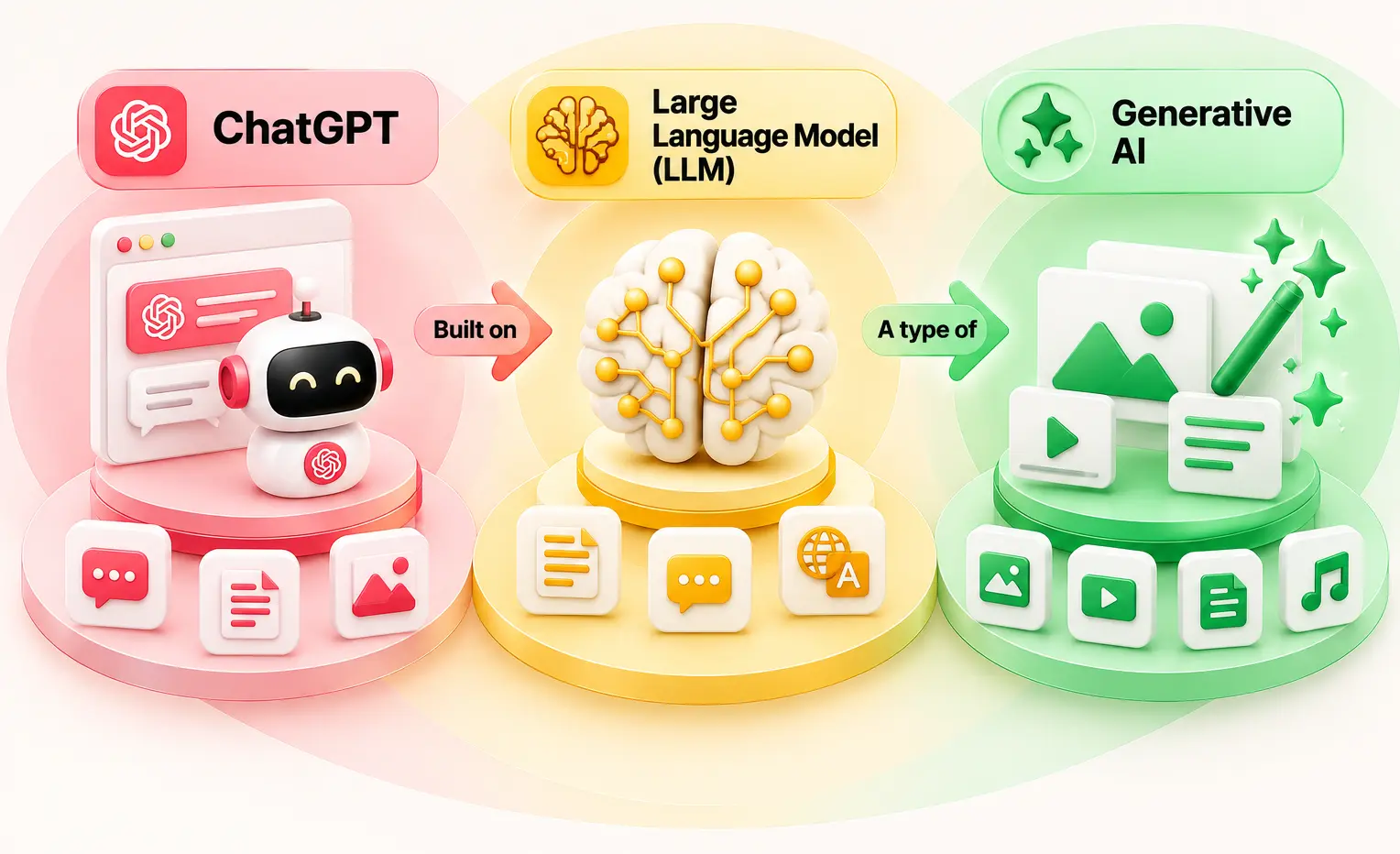
      Is ChatGPT an LLM or generative AI?

      In simple language,

      • Artificial Intelligence (AI): A wide range of areas in the computer science arena where humans carry out intelligent activities.
      • Machine Learning (ML): It is one of the AI subfields where a computer program learns from data.
      • Large Language Model (LLM): It is a machine learning model used in the analysis and generation of human languages.
      • Generative AI: This refers to the use of AI systems to create content such as text, images, audio, and even code.
      • ChatGPT: This refers to the AI system used to reply to inquiries with the help of a language model.

      LLM Use Cases vs LLM Applications: The 4 Architecture Patterns

      LLM use case vs. application is an extremely important concept when planning an architectural framework. The LLM use case defines what is expected to be achieved with the system, such as answering customer questions or performing invoice audits. 

      The LLM application defines how that is done. Custom enterprise AI app development processes can be improved when standard deployment frameworks are used. 

      What are LLM apps?

      LLM applications consist of language models, data, tools, and guardrails. Language models perform language-related tasks, company data provides additional context, tools integrate with business systems, and guardrails establish boundaries of the capabilities of the app.

      The 4 Core Architecture Patterns

      To evaluate build effort and technical feasibility across enterprise LLM use cases, organizations rely on four primary architectural patterns:

      S.no Pattern When to Use Data needed Cost and Latency Main Risk Example
      1 Prompt / Copilot  Simple writing and summarizing tasks  User prompt and context  Low cost, fast response  Hallucinated facts, lack of context.  Writing code snippets or drafting marketing copy. 
      2 RAG  Answering questions over proprietary enterprise knowledge.  Indexed internal documents and vector databases.  Medium cost / Medium latency  Retrieval of stale or incorrect chunks.  LLM use cases in healthcare for medical policy lookup. 
      3 Fine-Tuned Model  Repeated tasks need a specific output or style  Curated examples and task data  Upfront training cost; efficient at scale  Poor results on new cases  Invoice classification 
      4 Agentic Workflow  Tasks need multiple steps or actions across systems  Business data, APIs, permissions, and rules Higher cost and latency  Wrong actions or excess permissions  Resolving invoice mismatches 

      Which Pattern Should You Choose?

      Begin with the most basic pattern that will work to satisfy the business requirements. 

      • Use prompt-based applications for simple use cases
      • Use RAG for responses where company domain knowledge is needed
      • Use specialized models for repeated use cases
      • Use agentic workflows where the application needs to do some action. 

      These are all different patterns that will help you to compare different LLM applications. Implementation guidance can be helped by engaging specialized gen AI consulting to determine the right path. 

      30 LLM Use Cases by Capability

      An LLM does not always need a complex architecture to perform its task. Although certain operations are effectively performed using simple prompt formats, some applications may need the use of company data or human approval. Great LLM use cases address a business problem and create measurable outcomes.

      The most effective enterprise LLM use cases fit into eight core capability groups. Below is an architectural overview of these capabilities across production systems.

      S.no Capability Example use cases Architecture pattern Risk level
      1 Extract Invoices, medical intake, product catalogs, KYC  RAG / Fine-Tuned  Low
      2 Classify & Route  Ticket triage, spam, data tagging, lead intent  Fine-Tuned / Prompt  Low
      3 Summarize  Call notes, incident records, research digests  Prompt / Copilot  Low-Medium
      4 Search & Answer  Internal policy, self-service, sales enablement  RAG Low-Medium
      5 5. Generate & Draft  Marketing copy, RFPs, regulatory filings  Prompt / Copilot  Medium
      6 Converse  Test generation, Text-to-SQL, legacy modernization  Copilot / Fine-Tuned  Medium
      7 Code & Data  Test generation, Text-to-SQL, legacy modernization  Copilot / Fine-Tuned  Medium
      8 Reason & Act  Incident response, multi-step research, approval workflows  Agentic High

      The risks involved will depend on the nature of the data, consequences of an error, and the system’s ability to access the LLM.
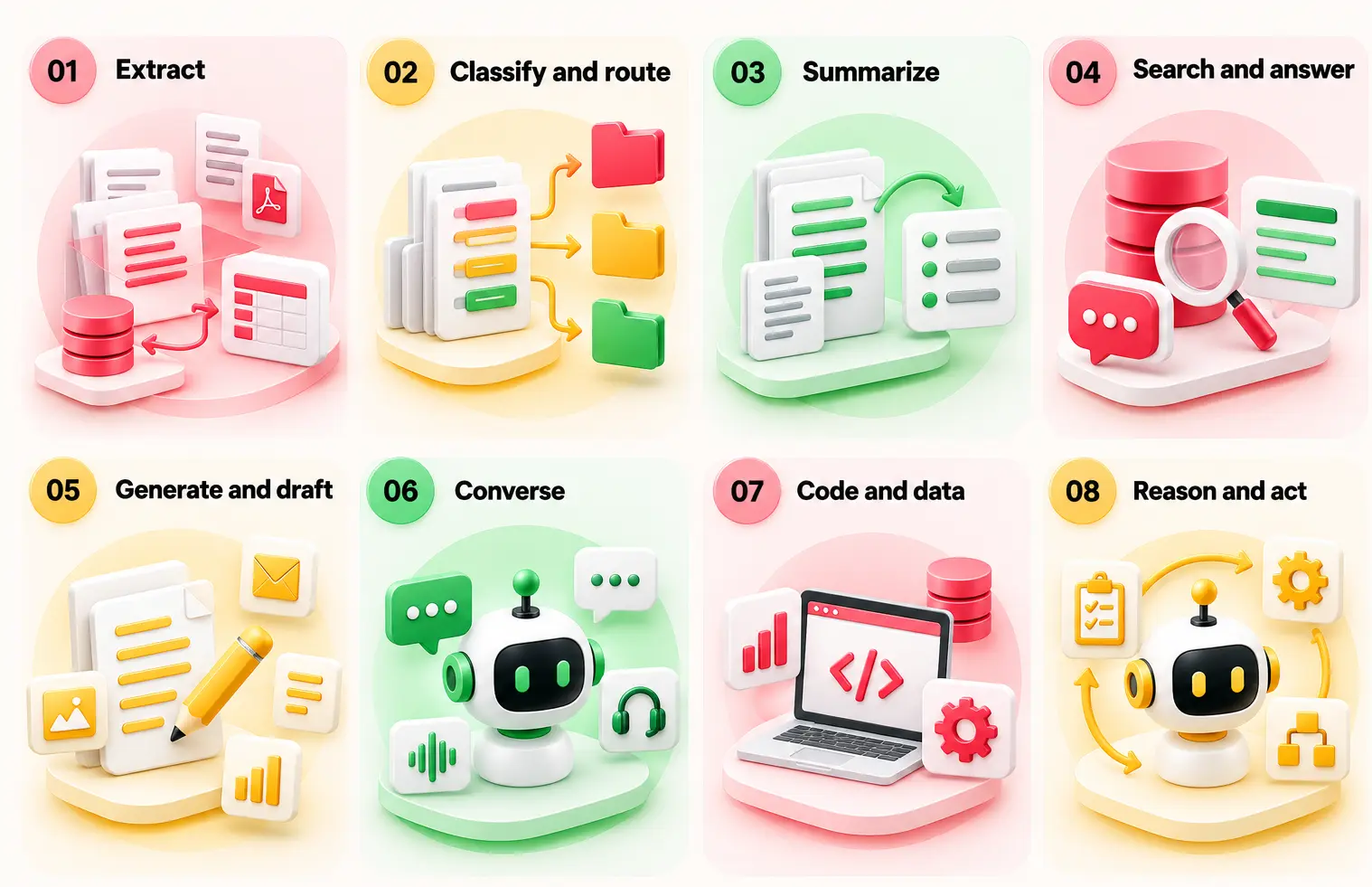
      Eight main LLM capabilities and their uses

      1. Extract: extracting information from documents into data

      The LLMs are also able to read data from documents and store data in fields. This will prove effective when dealing with huge volumes of data without having to key it in.

      Invoice and contract field extraction

      Extract key-value pairs (amounts, terms, line items) directly into ERPs. 

      • Pattern: LLM + structured output. 
      • Metric: Field-level accuracy and straight-through processing rate. 

      Insurance and medical form intake

      Parse clinical notes, claim forms, and patient histories into standardized formats. 

      • Pattern: LLM + document processing pipeline. 
      • Metric: Field-level accuracy and review rate. 

      Product attribute extraction from catalogs and PDFs

      Process supplier spec sheets to populate e-commerce catalog attributes at scale (e.g., Instacart). 

      • Pattern: LLM + schema validation. 
      • Metric: Attribute accuracy and processing time. 

      KYC document checks

      Validate customer IDs, utility bills, and bank statements for onboarding.

      • Pattern: LLM + rules engine. 
      • Metric: Extraction accuracy and exception rate. 

      Entrans moved clinical document AI from a blocked pilot to production for a healthcare provider network, inside the client's secure cloud with EHR integration and a full audit trail.

      2. Classify and route

      Sorting huge volumes of incoming traffic streams, including inquiries, emails, and alarms, is one of the urgent issues that should be resolved first. Classification methods help to understand the nature of the traffic and direct it accordingly. Workflow can become more efficient when studying AI automation examples in terms of traffic sorting.

      Support ticket and email triage

      Group support requests by type and priority level, and then assign them to the right team.

      • Pattern: Prompt-based classification + routing rules. 
      • Metric: Precision and recall per class; time to first reply. 

      Content Moderation and Spam Detection

      Filter user-generated content according to the rules of the platform.

      • Pattern: LLM classifier + policy rules. 
      • Metric: Precision, recall, and false-positive rate. 

      Sensitive-data tagging

      PII, PHI, and PCI information must be identified and tagged in file storage for compliance purposes. This can be guaranteed through the review of data governance in light of generative AI best practices.

      • Pattern: LLM + data detection rules. 
      • Metric: Detection recall and false-positive rate. 

      Lead and intent scoring.

      Analyze sales inquiries to prioritize high-intent prospects for account executives.

      • Pattern: LLM classification + CRM rules. 
      • Metric: Qualified-lead precision and conversion rate.  

      3. Summarize

      Big reports, many-party conferences, and complicated incident logs slow down operations. LLMs give a summary of all the big data in executive summary form.

      Meeting and call summaries

      Automatic extraction of action items, decisions, and owners from call recordings.

      • Pattern: LLM summarization chain. 
      • Metric: Reviewer edit rate and time saved per meeting. 

      Incident and case summaries

      Distill multi-day IT outage logs or legal case histories into concise timelines.

      • Pattern: Context-grounded summarization. 
      • Metric: Review time and summary correction rate. 

      Long-document and research digests.

      Summarize industry journals, income statements, and other legal papers for analysts.

      • Pattern: Summarization hierarchy and citations.
      • Metric: Reviewer edit rate and time per document.

      Salesforce describes using OpenAI models to generate customer account summaries and service case summaries. 

      4. Search and answer over company knowledge (RAG)

      The RAG paradigm helps an LLM to collect relevant data from the sanctioned sources before providing any output response. Information retrieval can be improved using RAG patterns to link unstructured files with vector databases. 

      This may help make internal knowledge more accessible without depending on the model's memory alone. Context precision can be improved by implementing a production-grade RAG ingestion pipeline for enterprise content repositories. 

      Internal policy and knowledge assistants

      Provide employees with immediate, citation-backed answers on company policies. 

      • Pattern: RAG + access controls. 
      • Metric: Answer accuracy and citation correctness. 

      Customer self-service answers

      Power external help centers with precise, contextual answers. Performance can be improved by reading how to improve RAG accuracy in live retrieval scenarios. 

      • Pattern: RAG + conversational interface. 
      • Metric: Resolution rate and customer satisfaction. 

      Sales enablement Q&A

      Aid sales reps in researching product spec sheets, battle cards, and collateral in deal cycles

      • Pattern: RAG + document metadata filters. 
      • Metric: Answer accuracy and time to find information. 

      IT and HR helpdesk answers.

      Automate answers to common internal support tickets, reducing IT queue volumes. 

      • Pattern: RAG + workflow escalation. 
      • Metric: First-contact resolution and escalation rate. 

      Entrans helped develop a robotic automation program that helped reduce manual work hours of their AI SaaS clients by 24%, as well as sped up policy training by 35%.

      Execution through technical capability can be greatly optimized by employing a developer specializing in the RAG indexing pipeline.

      5. Generate and draft

      The LLMs will be able to create the initial draft of the content based on the instructions and approved templates. Humans will be able to check the facts and tone before publication or distribution of the content. Output accuracy can be improved if you hire dedicated prompt engineer support to design reliable system instruction templates. 

      Marketing and product copy at scale

      Scale up creation of targeted ad copy and localized campaigns for product listings.

      • Pattern: Prompt templates + brand guidelines. 
      • Metric: Draft acceptance rate and editing time. 

      Personalized sales emails

      Generate customized email drafts based on prospect account research.  

      • Pattern: LLM + CRM context + human review. 
      • Metric: Acceptance rate and qualified replies.

      Proposal and RFP first drafts

      Assemble tailored responses to complex RFPs using pre-approved knowledge bases.

      • Pattern: RAG + generation + review. 
      • Metric: Draft completion time and answer accuracy. 

      Regulatory narrative drafts (for example, financial crime reports) with human sign-off.

      Draft initial financial crime or compliance reports for mandatory human sign-off.

      • Pattern: Structured generation + source grounding + human sign-off. 
      • Metric: Reviewer correction rate and time to approval. 

      6. Converse

      Today’s chatbots are much more advanced than rule-based decision trees. They understand complex contexts, take into account customers’ preferences, and function without problems during multi-turn transactions.

      Customer service chat and voice agents

      Answer common questions and help customers complete routine tasks. 

      • Pattern: Conversational LLM + RAG + approved tools. 
      • Metric: Resolution rate, CSAT, and escalation quality. 

      Employee assistants

      Help staff find policies, draft messages, and complete routine knowledge tasks. 

      • Pattern: Enterprise assistant + secure retrieval. 
      • Metric: Active usage and time saved. 

      Multilingual support

      Respond in supported languages and translate customer messages. 

      • Pattern: Multilingual LLM + language detection. 
      • Metric: Resolution rate and language-specific quality scores.

      Real-time translation.

      Translation of conversations and messages between teams and customers.

      • Pattern: Streaming LLM translation pipeline. 
      • Metric: Translation quality and response latency.

      Intercom explains how its Fin AI Agent uses LLMs to solve customer inquiries and how its architecture has evolved along with the advancements in models.

      7. Code and data

      LLMs can assist in writing code, testing changes, and interrogating the database through natural language. Delivery velocity could be enhanced through investigation of some of the best uses of generative AI in software development. The output should still be verified in terms of accuracy, security, and efficiency.

      Code generation and review

      Draft sample code, conduct security checks, and recommend improvements.

      • Pattern: LLM + repository context + code checks. 
      • Metric: Accepted suggestions and defect rate. 

      Test generation

      Write unit, integration, and edge case tests automatically

      • Pattern: LLM + test framework. 
      • Metric: Test acceptance and defect detection rate. 

      Natural-language-to-SQL analytics

      Queries in databases using natural language.

      • Pattern: LLM + schema retrieval + SQL validation. 
      • Metric: Query execution accuracy and correction rate. 

      Legacy code explanation and modernization.

      Describe, translate, and refactor old codebases (such as COBOL, AS400) into new frameworks. Upgrades to systems can be done by referencing our legacy app modernization with the GenAI Enterprise Guide for structural refactoring methods.

      • Pattern: Repository-aware LLM + Test-driven codebase. 
      • Metric: Review time, test pass rate, and defect rate. 

      8. Reason and act (Agentic)

      Agentic LLMs can perform actions, make use of tools for executing those actions, check whether the goal is achieved, and then proceed. Understanding system dynamics can be improved by reading about agentic AI vs. generative AI in multi-step execution tasks. These are some of the hardest enterprise LLM applications, as an error can affect live systems, data, or business decisions.

      Multi-step research and reporting

      Execute autonomous web and internal database research to assemble market intelligence reports.

      • Pattern: Research agent + retrieval + source checks. 
      • Metric: Task completion rate and citation accuracy. 

      IT incident investigation

      Diagnose root causes of infrastructure alerts across distributed systems and suggest remediation. 

      • Pattern: Agentic workflow + observability tools + approval gates. 
      • Metric: Time to diagnosis and human intervention rate. 

      Procurement and vendor checks

      Verify vendor credentials, cross-reference contract terms, and draft purchase requisitions. 

      • Pattern: Agent + retrieval + rules engine. 
      • Metric: Review time and exception detection rate. 

      Workflow agents that update systems with approval gates.

      Execute actions across CRM, ERP, and payment tools behind strict human approval gates.  

      • Pattern: Agent orchestration + APIs + human approval. 
      • Metric: Task completion rate, intervention rate, and cost per task. 

      LLM Use Cases by Industry

      Large Language Models (LLMs) have become core operational infrastructure for modern businesses. From automating repetitive administrative tasks to surfacing real-time insights buried in complex datasets, enterprise LLM use cases span nearly every major sector. 

      Organizations today utilize LLM apps to reduce cost per transaction, accelerate time-to-market, and deliver hyper-personalized customer interactions.

      While general capabilities like drafting and summarizing are universal, the best LLM use cases vary significantly depending on sector-specific constraints such as data privacy, regulatory oversight, and performance latency. Below is a high-level snapshot of key LLM applications and their primary constraints across major sectors.

      LLM Applications Across Key Sectors

      Industry Top 3 LLM Use Cases Primary Constraints
      BFSI KYC automation, Financial crime narratives, Policy assistants  High regulatory compliance (AML/SEC), Strict data residency 
      Insurance First Notice of Loss (claims intake), Underwriting summaries, Risk evaluation  Auditability, Hallucination risk in liability clauses 
      Retail & E-commerce  Dynamic catalog enrichment, Semantic search, AI customer support  Low latency requirements, High query volume 
      Manufacturing  Maintenance manual Q&A, Quality report analysis, Supply chain log processing  Edge deployment, Strict accuracy for safety protocols 
      Legal  Contract risk review, Obligation extraction, Regulatory compliance mapping  Zero-hallucination tolerance, Strict client confidentiality 
      Software & SaaS  Developer code generation, Automated technical docs, Tier 1/2 support  Code security vulnerabilities, API cost optimization 

      Choosing the Right Industry Use Cases 

      These LLM use case scenarios demonstrate how language models can assist teams in managing information and performing regular tasks. Nevertheless, each use case will require proper protection mechanisms to be implemented. 

      • Approvals and auditing processes might be required for financial and legal use cases. 
      • Patient information requires protection in healthcare-related applications. Specialized clinical solutions can be supported by reviewing healthcare life sciences industry standards for data security. 
      • Quick responses are essential in customer-facing LLM applications.

      For broader industry coverage and deep-dive domain strategies, explore our detailed guide on Entrans GenAI applications by industry. 

      LLM Use Cases in Healthcare

      Large language models are helping healthcare teams manage clinical information, prepare documents, and handle routine administrative work. The most useful LLM use cases in healthcare support doctors and staff without taking control of clinical decisions.

      6 Key LLM Use Cases in Healthcare and How LLMs Help

      • Clinical Documentation: Drafts visit notes from clinician-patient conversations for review.
      • Discharge & Visit Summaries: LLMs convert complex inpatient encounter logs into clear, actionable, post-care instructions customized for patient readability. 
      • Prior Authorization & Referral Intake: Automated extraction processes unstructured medical histories and insurance forms to accelerate prior authorization approvals and referral triage.
      • Medical Coding Support: LLMs assist health information managers by suggesting precise ICD-10/CPT codes directly from clinical narratives.   
      • Patient Message Drafting: Generative models pre-draft responsive portal replies to routine patient inquiries, queuing them for seamless clinician review. 
      • Clinical Trial Matching & Literature Review: LLMs in healthcare scan unstructured patient records against eligibility criteria to accelerate trial recruitment and digest vast scientific literature. 

      Essential Safety & Compliance Guardrails

      Stanford HAI research highlights the need to test real-world performance, privacy, bias, and patient safety rather than rely on benchmark scores alone. Deploying enterprise LLM use cases in clinical settings requires strict governance:

      • HIPAA Compliance & BAAs: Secure, HIPAA-compliant cloud hosting with signed Business Associate Agreements (BAAs) to ensure data confidentiality.
      • PHI Minimization: Automated de-identification and zero-retention policies for Personal Health Information.
      • Human-in-the-Loop Review: Mandatory clinician sign-off on all patient-facing or diagnostic outputs.
      • Hallucination Testing & Audit Trails: Rigorous benchmark evaluation protocols paired with granular audit logs for every generated output.
      • FDA Regulations: Alignment with updated FDA Clinical Decision Support (CDS) guidance for software influencing clinical interventions.

      Entrans in Practice: From Clinical Document AI to Production

      In a separate healthcare payer project, Entrans' automated prior authorizations using AI delivered 3X faster turnaround times, a 70% reduction in human errors and manual intervention, and 95%+ accuracy in data extraction. This illustrates how LLMs can be used to assist healthcare administration with document extraction and validation. Read the prior authorization case study.

      LLM Examples: Which Models Power These Use Cases

      • GPT models (OpenAI): Help with content generation, customer support, coding, and document summaries.
      • Claude (Anthropic): Handles long documents, contract review, and complex text analysis.
      • Gemini (Google): Supports research, multimodal tasks, and enterprise knowledge search.
      • Llama (Meta): Suits businesses that want more control over model hosting and customization.
      • Mistral: Supports document processing, summarization, and private enterprise LLM applications.
      • Med-PaLM and domain-specific models: Support healthcare research and medical question-answering tasks.

      Choosing the right model depends on accuracy, cost, privacy, response speed, and deployment needs. For regulated LLM use cases in healthcare and finance, test models with real workflows before production. 

      How to Choose Your First (or Next) LLM Use Case

      • Start with something common with definable inputs, definable outputs, and someone to validate the output. 
      • Set your baseline before deployment, and track metrics on quality, time savings, cost per task, and exceptions. 
      • Start with the simplest architecture possible and only add retrieval, systems capabilities, or agency once the task demands it.
      • LLM use cases may not be the ones with the fanciest technology. They should be the use cases where an actual problem is being solved, where the technology fits into the process, and demonstrates value.

      What are LLMs actually useful for?

      LLMs are useful for tasks that involve understanding and working with language, such as summarizing documents, extracting data, classifying messages, answering questions, and drafting content. 

      They can also help with coding, searching company knowledge, and carrying out multi-step workflows when connected to business tools and guided by clear rules.

      Where LLM Use Cases Fail in Production and how to overcome them

      Even the best LLM use cases struggle between prototype and production. Here is where LLM applications fail and how to fix them: 

      • Ungrounded Hallucinations: LLMs may make up facts. Ground answers in trusted sources and test them regularly.
        • Fix: Enforce strict context retrieval and ground responses with RAG tuning. 
      • Poor retrieval: RAG systems may pull the wrong information. Improve document chunking, search quality, and retrieval settings.
        • Fix: Optimize embedding models, hybrid search, and semantic re-ranking.
      • Security and Data Leakage: Prompt injection and data leaks can expose sensitive information. 
        • Fix: Deploy robust input filtering, output sanitization, and enterprise guardrails. 
      • Unexpected costs and delays: Complex requests can increase cost and response time. Use model routing to match tasks with suitable models.
        • Fix: Implement dynamic model routing and response caching. 
      • No proper testing: Build golden test sets to check accuracy before release.
        • Fix: Establish golden evaluation test sets before launch. 
      • No clear owner: Unmonitored models degrade in production. 
        • Fix: Assign clear ownership and automated continuous monitoring.

      Measuring Value: Evaluation, Cost, and ROI

      The selection of appropriate use cases for LLMs is the first step that needs to be taken. However, it is also essential for companies to ascertain whether such use cases save time, enhance accuracy, and are justified based on the cost incurred in executing them.

      Metrics That Matter for LLM Applications

      Different tasks need different measures. A document extraction tool needs high accuracy, while a customer support assistant should resolve requests correctly and respond quickly.

      Metric What it measures
      Accuracy or F1 score  How well the model produces correct results 
      Groundedness  Whether answers match trusted source material 
      Edit rate  How much users change model-generated output 
      Resolution rate  How many requests are completed successfully 
      Latency  How long each response takes 
      Cost per 1,000 requests  The cost of running the application 
      Hours saved  Staff time saved through automation 

      Calculate ROI and Manage Costs

      A simple ROI formula helps teams compare the value gained with the money spent.

      ROI (%) = (Net Benefits − Total Costs) / Total Costs × 100

      Here, 

      Net benefits mean the financial value gained from time savings, fewer errors, and faster processing. 

      Total costs include model usage, development, hosting, monitoring, and human review. To avoid double counting, calculate the value of time saved separately from labor cost savings. 

      Test Before and After Launch

      Conduct offline evaluations using a test set before deployment. Test for accuracy, groundedness, security, latency, and cost. Once deployed, monitor live requests, user reviews, error rates, and costs. This will enable teams to iterate on how they can use LLMs better and determine whether there is tangible value in their applications.

      How Entrans Helps You Take LLM Use Cases to Production

      Taking the use of Large Language Models from a limited pilot to a fully operational business application requires much more than selecting the right model. This includes having the right data, architecture, security, and measurement techniques. Entrans Technologies assists companies in making the transition from experimentation to full-fledged operationalization of LLM use cases.

      • We start with a use-case scoring workshop to identify tasks with clear business value. Then we select the right architecture based on the problem.
      • The team builds and deploys applications in the client's cloud environment, with evaluation, access controls, guardrails, and human review where needed.
      • Entrans Forward Deployed Engineers (FDEs) work alongside client teams to connect the application to existing systems, test real workflows, and address issues that come up during production use. Development schedules can be improved if you hire dedicated LLM engineer specialists to work directly alongside internal software teams. 

      We bring experience from 150+ AI projects and 200+ enterprises. Our work includes clinical document AI taken from pilot to production, compliance bots, and AI-driven prior authorization automation. 

      From our proven case studies, we showed how well-defined workflows and careful testing can turn LLM use cases into practical business applications. 

      Ready to move your LLM application into production? Book a consultation call with us.

      Share :
      Link copied to clipboard !!
      Take Your LLM Use Cases From Pilot to Production
      Build secure, production-ready LLM applications with the right architecture, enterprise data integration, and measurable business outcomes.
      20+ Years of Industry Experience
      500+ Successful Projects
      50+ Global Clients including Fortune 500s
      100% On-Time Delivery
      Thank you! Your submission has been received!
      Oops! Something went wrong while submitting the form.

      FAQs

      1. What are LLMs actually useful for?

      LLMs are most useful for high-volume language tasks: extracting data from documents, classifying and routing requests, summarizing long content, answering questions over company knowledge, drafting text and code, and powering conversational assistants. They work best when grounded in your data and paired with human review where errors are costly.

      2. What are the most common LLM use cases for businesses?

      Businesses primarily use LLMs to automate customer support, summarize complex internal documents, and accelerate software development through AI code generation. They also leverage these models to personalize marketing campaigns and extract actionable insights from unstructured enterprise data. 

      3. What are examples of LLMs?

      Popular LLMs include OpenAI's GPT models, Anthropic's Claude, Google's Gemini, Meta's Llama, and Mistral. Each has different strengths in writing, coding, research, and document processing.

      4. Which LLM is best for which use case?

      The right model for an LLM will depend on the task, cost, privacy requirements, and speed needed. Consider various models using case studies from your workflow.

      5. What are LLM apps?

      LLM applications refer to software applications that utilize large language models to analyze and produce text or other content forms. Such applications may include AI chatbots, writing assistants, document search utilities, and coding assistants.

      6. How are LLMs used in healthcare?

      LLMs in healthcare summarize clinical notes, streamline prior authorization requests, and assist physicians with diagnostic research. They also power patient-facing virtual assistants that answer routine care queries and schedule appointments.

      7. What are the challenges of implementing LLMs?

      Some common problems are wrong answers, risks to data confidentiality, costly operations, delayed response times, and low-quality data. There are solutions to these problems, such as testing, security measures, and monitoring.

      Hire LLM Developers for Enterprise AI
      Build and scale LLM applications with skilled developers experienced in RAG, model integration, AI workflows, and enterprise deployment.
      Free Project Consultation
      Trusted by Enterprises & Startups
      Top 1% Industry Experts
      Flexible Contracts & Transparent Pricing
      50+ Successful Enterprise Deployments
      Arunachalam
      Author
      Arun S is co-founder and CIO of Entrans, with over 20 years of experience in IT innovation. He holds deep expertise in Agile/Scrum, product strategy, large-scale project delivery, and mobile applications. Arun has championed technical delivery for 100+ clients, delivered over 100 mobile apps, and mentored large, successful teams.

      Related Blogs

      AI in Accounts Payable: 2026 Guide for Enterprise Finance

      Discover how AI in Accounts Payable automates invoice processing, improves matching, reduces manual work, and helps finance teams measure ROI.
      Read More ↗

      AI Agents Examples: 30 Real-World Use Cases Businesses Are Running in 2026

      Explore 30 AI agents examples across business functions and industries, with real-world results, practical use cases, and tips to choose your first project.
      Read More ↗

      The AI Implementation Roadmap That Ends in Production, Not a Slide Deck

      Build an AI implementation roadmap that moves projects from idea to production with a step-by-step guide, timelines, costs, and measurable business results.
      Read More ↗