Top 10 Agentic AI Frameworks in 2026: How to Pick One That Survives Production
Explore the top 10 agentic AI frameworks in 2026. Compare features, strengths, costs, and production readiness to find the right fit for your enterprise.
Top 10 Agentic AI Frameworks in 2026: How to Pick One That Survives Production
Building scalable agentic AI frameworks in 2026 demands durable state persistence, checkpoint recovery, and built-in human-in-the-loop controls rather than simple prompt loops.
Major enterprise consolidation has shifted the market toward production-ready tools like LangGraph for stateful graphs and Microsoft Agent Framework following AutoGen's retirement.
Interoperability standards like Model Context Protocol (MCP) and Agent-to-Agent (A2A) protocols are now essential to prevent ecosystem lock-in and simplify tool integration.
Real-world operational costs depend far more on token overhead, multi-agent chatter, and continuous observability than on upfront framework licensing fees.
Imagine an AI architecture capable of planning, decision-making, manipulation, and task execution without any human intervention. That's what an agentic AI does. Frameworks are important to make all of that happen. But different frameworks are suitable for different purposes. Some frameworks facilitate the collaboration of multiple agents, and some grant developers more control over the actions of agents.
This blog will help you learn about the Top 10 Agentic AI frameworks of 2026.
Table of Contents▾
What Are Agentic AI Frameworks?
"Agentic AI" framework refers to a software platform responsible for the way in which a large language model interacts with other systems.
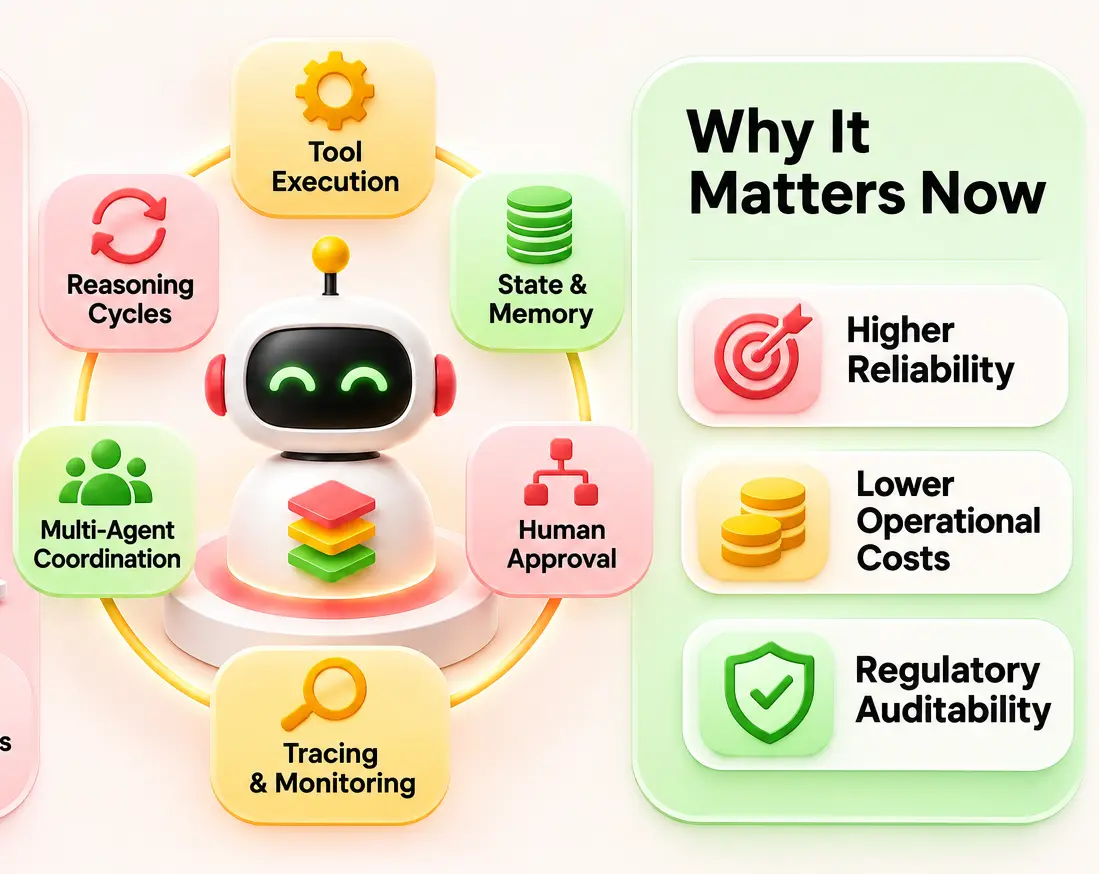
Agentic systems make use of tool execution, reasoning loops, state and memory management, coordination of multiple agents, human-in-the-loop, and tracing. Unlike simple AI that uses a single prompt, Agentic systems handle processes with various stages.
Why it matters now
As building artificial intelligence shifts from simple prompt wrappers to autonomous, long-running workflows, these agentic AI frameworks have become essential. As building artificial intelligence shifts from simple prompt wrappers to autonomous, long-running workflows, these agentic AI frameworks have become essential.
The architecture of agents controls the flow in which multi-step processes are completed, and thus influences the performance of a system in terms of costs and auditing. Agents are capable of retrieving information, modifying information, controlling workflow processes, and making decisions within the given constraints.
The right agent framework helps organizations take care of the reliability issue and manage their operations and operational costs. The enterprise automation process can be enhanced by learning from real-world examples of AI automation.
What a framework does that a raw LLM API does not
A raw LLM API generates responses based on prompts. But it does not control the complete cycle of complex task completion. Deployment problems will be resolved through effective integration of an agentic AI system, which integrates language models with business logic seamlessly.
These types of agentic AI solutions form a bridge between language modeling and action. Modern agent frameworks automate six fundamental jobs:
Orchestration: Directs execution loops, dynamic branching, and routing.
Integration of tools: Deals with schemas and action parsing for calling external APIs safely.
State Management: Keeps the state of checkpoints for the workflows to pause, resume, or retry even on network failures.
Memory Management: Manages short-term memory of the conversation context and long-term memory of vector storage.
Human-in-the-Loop (HITL): Enables approval gates to approve any sensitive actions.
Observability and Evaluation: Step-by-step tracking and latency measurement, and even evaluation of the outputs can be enabled by using the LLM evaluation framework.
When Do You Actually Need an AI Agent Framework?
You do not always need an open-source AI agent framework. An agent with one or two tools without memory or workflow can go through the LLM API with a simple execution loop.
Agentic AI frameworks are required in situations where there is a need for multi-step execution, multiple agents, and recovery. LLM orchestration frameworks should only be sought after when dealing with non-linear workflows, lengthy processes, or teams of multiple agents. There are times when complex multi-agent implementations can be aided by hiring skilled developers of agentic AI.
Frameworks vs. Platforms vs. Visual builders vs. Protocols
Not all tools used for making AI agents have the same functions. Some provide means to develop agent programming, while others provide an already set environment or allow creating a process visually.
System design can be helped by reviewing the distinct types of AI agents to match specific business requirements with the right control patterns. Protocols enable communication between different agents and systems. Knowledge of such differences will simplify the choice of the best AI agent development frameworks in 2026.
Category
What it means
What it does
Best suited for
Examples
Agentic AI frameworks
Code-first software libraries and SDKs used to program custom agent logic, control flow, memory, and state loops
Imported into your codebase; provides APIs for multi-step reasoning, graph state management, and tool routing
Custom AI applications and complex workflows
LangGraph, CrewAI, PydanticAI, Mastra, MS Agent Framework
Agentic AI platforms
Cloud software-based platforms and turnkey, with enterprise management and ready-to-use AI agents
Self-management as a SaaS/PaaS platform with ready AI agents and enterprise-level security and UI dashboards
Enterprises developing their AI agents
Thunai, Salesforce Agentforce, ServiceNow AI, ServiceNow AI Agent Orchestrator
Visual builders
Drag-and-drop graphical interface for visually creating the workflows of agents, triggers, and actions
Visual canvas to connect triggers, logic conditions, LLM prompts, and API actions without coding
Teams that want to create agents with less coding
Microsoft Copilot Studio, n8n
Protocols
Technical standards for open and universal communication between agents and other software, databases, or agents
Standardizing data formats and communication protocols (such as JSON-RPC over HTTP) so that different systems may communicate
Connecting agents across different applications
MCP, A2A
Which One Should You?
Choose AI Agent Framework when you want better control over the code, model, and agent.
Choose Platform when you want a managed platform for creating and deploying the agents.
Go for Visual Builders in case you have people who would rather configure the workflow instead of writing the code.
For gluing the mentioned components, protocols like MCP and A2A can be used.
What Changed in Agentic AI Frameworks in 2026
Agentic AI frameworks have moved closer to enterprise production in 2026. Some important changes include:
Framework Consolidation: AutoGen was moved to its maintenance phase, with development converging towards Microsoft Agent Framework 1.0, which achieved its general availability release date of April 3, 2026.
Experimental Repos Phased out: OpenAI shut down experimental codebases such as OpenAI Swarm, relying on enterprise developers with OpenAI Agents SDK as production-ready.
Changes in LangChain Architecture: Post the GA release of LangChain 1.0 and LangGraph 1.0 on October 22, 2025, LangGraph emerged as the engine behind complicated agentic workflows and durable execution in the industry. Stable production performance can be obtained by employing teams of developers who know how to use LangChain's developer expertise to customize cyclical graph architectures.
SDKs for First-Party Providers: All AI frontier labs have their own SDKs for agents (OpenAI, Anthropic, Google ADK, AWS Bedrock Agents). It is worth checking LangGraph vs. Google ADK to decide which kind of architecture is better – either graph-based control or cloud-native orchestration.
Interoperability Standards: Model Context Protocol (MCP) became the default integration protocol for tools (Linux Foundation, transferred in December 2025), along with developing standards for Agent-to-Agent (A2A) cross-framework multi-agent calls.
Adoption of TypeScript: Node.js/TypeScript agent orchestration libraries like Mastra and Vercel AI SDK adopted for mainstream web backend architecture.
How We Evaluated Agentic AI Frameworks
Evaluating agentic AI frameworks requires looking beyond quick demo setup times to assess true enterprise production fit. At Entrans, we are a model-agnostic enterprise integration firm. Organizational roadmaps can be supported through specialized gen AI consulting to select and deploy the right infrastructure without costly platform lock-in.
As we don’t own any proprietary framework to market, our analysis purely measures the effectiveness of these agent frameworks within a complicated corporate IT environment and controlled workflow and production environment. Our analysis values production reliability, control, security, and longevity over just development speed.
Evaluation Criteria
What we Analyzed
Orchestration Model
Graph-based state machines, sequential chains, role-based teams, or event-driven loops
State & Durable Execution
Native state persistence, checkpointing, and execution recovery across failures
Multi-Agent Support
Specialized agent sub-delegation, hierarchy, and cross-framework communication support
Human-in-the-Loop (HITL)
In-built approval gates, interrupt capability, and state reviews. Observability & Evaluations
Observability & Evals
OpenTelemetry out-of-the-box emissions, step-wise tracing, and regression test suites
Model Portability
Support for switching between proprietary (OpenAI, Claude, Gemini) and open LLMs
Role-based access control (RBAC), sandboxed code execution, and data leak protection
Cost & Loop Controls
Enforced token budgets, maximum recursion depth limits, and timeout protection
Maturity & Ecosystem
Active GitHub community, enterprise support tiers, production track record, and backing
Licensing
Open-source (MIT, Apache 2.0) vs. commercial enterprise tier dependencies
Comparison table of Top 10 Agentic AI Frameworks
This comparative analysis presents the top 10 AI agent frameworks in the year 2026. The following comparison is done with respect to technical background, orchestration model, licensing, and applications best suited for them.
Framework
Backer / Maintainer
Language(s)
Orchestration Model
Multi-Agent Support
Human-in-the-Loop (HITL)
Durable State
Model-Agnostic?
License
Best For
LangGraph
LangChain
Python, JS/TS
Stateful cyclical graph (Nodes & Edges)
Native (Sub-graphs & Multi-agent nodes)
Native (Interrupt & Rewind checkpoints)
Native (Built-in checkpointers)
Yes
MIT
Complex, stateful, and non-linear enterprise workflows
CrewAI
CrewAI Inc.
Python
Role-based delegation (Sequential & Hierarchical)
Native (Role-based teams / Crews)
Built-in (Task execution feedback)
Moderate (Flow state persistence)
Yes
MIT (Enterprise tier available)
Persona-driven multi-agent team collaboration & rapid R&D
Type-safe Python microservices requiring zero runtime schema errors
Top 10 Agentic AI Frameworks in 2026
There is a definite trend in the top 10 agentic AI frameworks in 2026 towards performance, state management, and agent collaboration. They were ranked based on enterprise production readiness ahead of breadth of use cases.
1. LangGraph (with LangChain v1)
What It Is
LangGraph is an open-source framework that models the workflows of agents using stateful and cyclic graphs. LangGraph forms the core orchestration layer of the LangChain 1.0 environment.
Best For
Complex, long-running, and production-critical enterprise agent systems requiring precise control loops.
Native persistence layer that allows the agents to pause, save the state to disk/database, and come back seamlessly.
Human-in-the-Loop (HITL) gate approval and state inspection rewinding.
Out-of-the-box observability via LangSmith.
Limitations
Steeper learning curve compared to simple sequential chain SDKs.
Graph schema definition introduces boilerplate overhead for small, linear tasks.
Requires disciplined state design to prevent unintended state bloat in large graphs.
Enterprise Readiness
Very High. Enterprise-grade telemetry system (OpenTelemetry compatible), strong Human-in-the-Loop approval workflow, strict access control, and consistent state rollback capabilities.
License & Cost
Open-source (MIT). Self-hosted framework is free; optional enterprise tracing via LangSmith SaaS/Enterprise key.
When to choose
If full control over the process is your need, and you have to be part of the process at every stage, choose this.
2. CrewAI
What It Is
CrewAI is a role-based multi-agent system where autonomous agents are organized in teams similar to human teams ("crews").
Best For
Cooperative Role-Based Coordination with multiple agents, research processes, and rapid prototyping.
Orchestration Model
Hierarchical/sequential role delegation through persona agents.
Strengths
Intuitive abstractions for assigning explicit roles, backstories, goals, and isolated toolsets to individual agents.
Native support for Model Context Protocol (MCP) servers and asynchronous multi-agent delegation. Tool connectivity can be improved by following a comprehensive MCP server development guide to create standardized interfaces for enterprise data sources.
Fast development speed with minimal code required to launch functional multi-agent teams.
Limitations
Non-linear execution paths can become unpredictable without tight task parameters.
High reliance on LLM intelligence for effective sub-task delegation, increasing token consumption.
Harder to debug edge-case state mutations compared to explicit graph frameworks.
Enterprise Readiness:
High (via CrewAI Enterprise). Provides enterprise management dashboards, secure team execution runtimes, central telemetry, and role-based access control.
License & Cost
Open-source core (MIT).vCrewAI Enterprise features proprietary subscription pricing.
When to choose
Choose it if your application naturally mirrors human team dynamics with distinct operational roles.
3. LlamaIndex (Agents and Workflows)
What It Is
LlamaIndex is an event-driven agent framework tailored specifically for complex Retrieval-Augmented Generation (RAG) and document intelligence workflows.
Best For
Data-heavy enterprise applications, deep document analytics, and complex retrieval pipelines.
Orchestration Model
Event-driven architecture where agents publish and consume events to navigate data pipelines dynamically.
Strengths
Deepest native integration with vector databases, enterprise data lakes, and structured/unstructured indexes.
Advanced document parsing and dynamic query planning over multi-modal enterprise repositories. Retrieval pipelines can be improved by applying methods to improve RAG accuracy to minimize hallucinations in dense data workflows.
Strong pipeline auditability with clear event emission logging across every retrieval step.
Limitations
Less flexible for pure general-purpose control tasks unrelated to data search and retrieval.
Event-driven logic can require complex event handler setup for non-standard workflows.
Requires careful tuning of index parameters to manage latency on massive data volumes.
Enterprise Readiness
High. Excellent data access control capabilities, robust enterprise vector database security integrations, and comprehensive audit trails for regulatory data access.
License & Cost
Open-source (MIT). Core framework is completely free.
When to choose
Choose it if your agents' primary mission revolves around searching, extracting, and reasoning over complex corporate data.
OpenAI-centric tech stacks, low-latency conversational agents, and minimalist multi-agent handoffs.
Orchestration Model
Lightweight functional primitives handling sub-agent delegation, model handoffs, and tool execution.
Strengths
Exceptionally clean, low-boilerplate API designed for fast production deployment.
Built-in guardrails, structured output validation, and native OpenAI model optimization.
Seamless handling of multi-agent handoffs without introducing heavy framework abstraction layers.
Limitations
Optimized primarily for the OpenAI ecosystem, limiting native multi-cloud provider switching.
Durable state persistence must be implemented manually at the application level.
Fewer pre-built enterprise connectors compared to cloud-native vendor frameworks.
Enterprise Readiness
Medium-High. Built on enterprise-ready API endpoints (SOC 2, HIPAA compliance via OpenAI Enterprise), though multi-cloud governance relies on custom backend architecture.
License & Cost
Open-source SDK (MIT). API cost is tied directly to OpenAI model token usage.
When to choose
Choose it if you operate strictly within the OpenAI model suite and value minimal architectural overhead.
5. Google Agent Development Kit (ADK)
What It Is
Google Agent Development Kit is a cloud-native framework designed to deploy and orchestrate scalable multi-agent applications across Google Cloud Platform (GCP).
Best For
GCP-native enterprise architectures, multi-modal processing, and cloud platform automation.
Orchestration Model
Microservice-oriented runtime utilizing OpenAPI, Agent-to-Agent (A2A) protocols, and Vertex AI orchestration.
Strengths
Native integration with Google Cloud IAM, Vertex AI governance, Cloud Run, and enterprise security.
In-the-box support for isolated code execution environments (sandboxed Python runtimes) for data processing agents.
Native A2A protocol support allowing enterprise agents to discover and invoke peer agents securely.
Limitations
Tightly coupled with GCP services for maximum benefit, introducing cloud lock-in risks.
Higher configuration complexity for local-only offline development environments.
Requires familiarity with Google Cloud infrastructure paradigms.
Enterprise Readiness
Very High. Delivers cloud-native security, automated audit logging, enterprise IAM role mapping, and scalable serverless execution.
License & Cost
Open-source SDK components (Apache 2.0). Production execution is billed via GCP service consumption.
When to choose
Choose it if your enterprise infrastructure is heavily anchored on Google Cloud Platform.
6. Mastra
What It Is
Mastra is a full-stack, TypeScript-first agentic framework designed to bring durable agent execution natively into Node.js and web backend stacks.
Best For
Full-stack web teams, TypeScript/JavaScript microservices, and interactive visual debugging.
Orchestration Model
Workflow graph state engine featuring built-in vector memory and local execution tracing.
Strengths
Purpose-built for TypeScript environments, eliminating language context switching for web engineering teams.
Includes "Mastra Studio," a local visual dashboard for real-time trace inspection and step-by-step debugging.
Seamless compatibility with modern web deployment frameworks (Vercel, AWS Lambda, Node.js runtimes).
Limitations
Python-based AI ecosystem libraries occasionally require custom wrapper bridges.
Smaller community size compared to legacy Python-first frameworks.
Advanced RAG features require integration with specialized external vector indexers.
Enterprise Readiness
High. Features strict schema typing, built-in telemetry tracing, and commercial enterprise deployment options.
License & Cost
Open-source (Apache 2.0). Enterprise cloud tier available with custom pricing.
When to choose
Choose it if your engineering organization standardizes on TypeScript and full-stack web applications.
Deep out-of-the-box connectivity with AWS Bedrock, Lambda, Fargate, and Amazon Bedrock AgentCore infrastructure.
Model-agnostic runtime supporting Bedrock models, Anthropic, Meta Llama, OpenAI, and local endpoints via LiteLLM.
Production-ready features including hot-reloading tool development, token streaming, and built-in metric aggregation.
Limitations
Requires deployment on AWS compute/serverless tools to leverage its full enterprise scalability features.
Smaller open-source community footprint compared to LangGraph or CrewAI.
Advanced graph states require additional setup when deployed outside Amazon Bedrock AgentCore.
Enterprise Readiness
Very High. Offers built-in OpenTelemetry logging, session isolation runtime environments, AWS IAM credential governance, and CloudWatch integration.
License & Cost
Open-source (Apache 2.0). Charges are incurred strictly for underlying AWS compute and model inference tokens.
When to choose
Choose it if you want an open-source, model-agnostic agent runtime tailored for AWS serverless microservices.
10. Pydantic AI
What It Is
PydanticAI is a type-safe Python agent framework built by the Pydantic team, designed to bring strict runtime data validation, dependency injection, and software engineering best practices to AI agent development.
Best For
Python-centric backend engineering teams requiring strict schema validation, type-safe APIs, unit-testable AI logic, and zero runtime shape errors.
Orchestration Model
Functional, dependency-injected execution loops for linear/multi-tool agents, alongside explicit typed graph state machines (Pydantic Graph) for complex workflows.
Strengths
Deep native Pydantic integration for end-to-end type validation of dynamic system prompts, tool inputs, and structured LLM outputs.
Model-agnostic design with built-in provider support (OpenAI, Anthropic, Gemini, Groq, DeepSeek, and local endpoints via LiteLLM).
Built-in testing utilities (TestModel), dynamic dependency injection, and native model-retry loops for self-correcting validation failures.
Limitations
Python-only framework; no native TypeScript or Node.js runtime support.
Smaller pre-built ecosystem of higher-level agent templates compared to legacy frameworks like LangChain or CrewAI.
Requires pairing with external engines (e.g., Temporal, Restate, DBOS) for fault-tolerant, long-running durable execution checkpointing.
Enterprise Readiness
High. Features native OpenTelemetry (OTel) instrumentation and Logfire integration for complete auditability, granular token and USD cost usage limits (UsageLimits), and safe dependency injection for passing enterprise credentials.
License & Cost
Open-source (MIT license; core framework is completely free). Observability via Logfire offers a free tier alongside paid growth and enterprise plans.
When to choose
Choose it if you are building in Python and want a lightweight, type-safe, and highly testable agent framework that treats LLM interactions like validated, deterministic software APIs
Honorable Mentions and When They Fit
While not in our core list due to scope, specialized niches, or UI focus, these specialized tools excel in specific developer scenarios:
Haystack: Omitted for its heavy focus on traditional RAG pipelines rather than general agent execution; pick it for strict document search systems.
smolagents: Hugging Face’s ultra-minimal library; omitted for lack of enterprise graph state, but ideal for quick code-acting Python scripts.
DSPy: Misses out as an orchestration runtime because it focuses on algorithmic prompt optimization; choose it to optimize prompt weights systematically.
Agno (formerly Phidata): Focuses on lightweight Python execution; pick it when you need ultra-low latency without complex graph overhead.
AG2: The community-driven fork of legacy AutoGen 0.2; best for maintaining existing AutoGen setups outside Microsoft's ecosystem.
Vercel AI SDK: Excluded as a backend-first engine because it acts as UI/streaming middleware; ideal for streaming generative interfaces directly to frontend web applications.
Separate category: n8n, Flowise, and Microsoft Copilot Studio are visual or low-code agent-building platforms, not direct equivalents to developer-first agent orchestration frameworks.
Multi-Agent Frameworks and Orchestration Patterns Explained
Getting multiple agents to work. This is where multi-agent frameworks and orchestration come into play. They define how agents communicate, share tasks, pass information, and decide what happens next.
Five orchestration patterns
Orchestration Pattern
How Control Flows
Determinism
Graph / State Machine(e.g., LangGraph)
Explicit nodes (tasks) and conditional edges (logic loops).
High
Role-Based Crews(e.g., CrewAI)
Persona-based delegation (sequential or manager-led).
Medium
Group Chat(e.g., MS Agent Framework)
Multi-turn conversational debate with a routing selector.
Low to Medium
Structured Handoffs(e.g., OpenAI Agents SDK)
Explicit model-to-model control transfers via function calls.
Agents publish and consume events across data steps.
Medium to High
Single agent vs multi-agent: when more agents hurt
While multi-agent systems sound impressive, adding more agents often degrades performance. Every inter-agent handoff multiplies inference costs, increases latency, and introduces context-window drift.
Open Source Framework vs. Vendor SDK vs. Managed Platform
Choosing how to build agentic systems requires balancing operational autonomy with speed-to-market and ongoing maintenance overhead. The comparison below highlights the primary deployment models for modern agent architectures:
Architectural Metric
Open Source Framework (e.g., LangGraph, CrewAI, PydanticAI)
Model Vendor SDK (e.g., OpenAI Agents SDK, Claude Agent SDK)
Full Control: Complete access to internal state machines, custom loops, memory stores, and guardrails.
Moderate Control: Bound by the vendor’s API primitives, execution harnesses, and supported parameter limits.
Low to Moderate: Configurable via admin dashboards and UI components, but underlying logic is fixed.
Model Portability
High: Swap LLM providers (OpenAI, Claude, Gemini, local models) using unified abstraction adapters.
Low: Optimized specifically for the vendor's proprietary models; provider migration requires code refactoring.
Vendor-Managed: Tied to the platform's multi-model routing or pre-selected foundation models.
Time to Production
Slower: Engineering teams must manually build production infrastructure, UI, tracing, and hosting layers.
Fast: Minimal boilerplate code speeds up rapid prototyping and lightweight service deployment.
Immediate: Turnkey setup with pre-built CRM/ERP integrations, out-of-the-box UI, and managed hosting.
Operational Burden
High: Self-managed hosting, state persistence databases, scaling, security patching, and telemetry stack.
Low to Moderate: API management, retry mechanics, and application-level session storage rest on your dev team.
Zero to Low: Managed SLAs, hosting infrastructure, compliance updates, and security patches handled by the vendor.
Cost Profile
High Dev Cost / Low Licensing: Free open-source core; costs scale with cloud compute and raw LLM tokens.
Variable: Consumption-based API token pricing without upfront framework licensing fees.
High Subscription Cost: Enterprise seat-based or monthly platform licensing fees alongside usage tiers.
Lock-in Risk
Minimal: Portable open-source code deployable across any private cloud or hybrid infrastructure.
High: Deep structural dependency on vendor-specific tooling, fine-tuning APIs, and proprietary endpoints.
Very High: Complete dependency on the platform's proprietary ecosystem, UI workflows, and data pipelines.
How to Choose the Right Agentic AI Framework (decision framework)
Choosing among the best AI agent frameworks of 2026 can seem to be difficult. Every framework possesses unique advantages, and the best choice is determined by what you wish your agents to do. Rather than selecting the most widely used solution, you should start with your needs.
Factors to Consider
Complexity of the task: For easy task execution using tools, consider going for a lightweight AI agent framework. In case of complex workflows, opt for graph-based or multi-agent frameworks, including LangGraph and CrewAI.
Programming language used: Ensure that the framework is compatible with your choice of programming language, such as Python and TypeScript.
Model-agnostic or flexible: If you want to work with multiple LLM providers, consider choosing a model-agnostic framework. You should avoid being locked into just one provider.
Agent orchestration: The framework should have capabilities for handling state management, task routing, retries, and human approval.
Production requirements: Check if there are deployment, monitoring, security, and scalability features, as well as long-running capability support.
Costs: Compare the cost of usage, hosting, licensing, and other maintenance costs.
Total Cost of Ownership: Where Agent Budgets Actually Go
Though agentic AI frameworks and LLM orchestration frameworks are generally free to install, actual runtime budgets scale rapidly across unexpected infrastructure and operational layers:
The Real Cost Drivers: Primary spending is driven by high LLM model token usage, repetitive prompt orchestration framework overhead, inter-agent multi-agent chatter, observability telemetry seats, managed enterprise hosting, and engineering rework when early-stage agent frameworks deprecate APIs.
Cost-per-Task Formula:
Total Cost = (Tokens Per Cycle x Token Rate) + Total API Fees + Observability Overhead + Governance Multiplier
Essential Cost Controls:
Enforce strict token spending caps and maximum loop execution limits per task.
Implement aggressive prompt and vector semantic caching.
Route simple intent classification and validation to smaller models (e.g., Gemini Flash, Llama 8B), reserving flagship models solely for complex reasoning.
Replace probabilistic LLM steps with deterministic, code-first functions whenever reasoning adds no business value.
Governance, Security, and Compliance Checklist
Enterprise engineering teams must evaluate which controls are natively provided by modern agent orchestration frameworks in 2026 versus what requires custom application engineering or third-party tools.
Tool permissions: LangGraph, OpenAI Agents SDK, and Microsoft Agent Framework support configurable controls. Fine-grained access policies need additional setup.
Agent identity: Usually requires external IAM and secrets management.
Even the best agentic AI frameworks can run into problems when moved from demos to real business environments. The framework is only one part of the system. Here are five common challenges and how to handle them.
Demo-to-Production Rebuilds: Prototyping speed rarely translates to reliability.
Mitigation: Decouple core business logic from framework abstractions so control loops can be refactored without rewriting backend tools.
API Churn & Stale Documentation: Rapid updates across evolving agent frameworks constantly break dependencies.
Mitigation: Pin library versions strictly in CI/CD pipelines and wrap third-party framework interfaces behind internal adapter layers.
Runaway Execution Loops: Unbounded multi-step loops quickly drain model budgets and trigger API rate limits.
Mitigation: Enforce strict maximum iteration caps, budget limits, and deterministic timeout breakers within your LLM orchestration frameworks.
Mitigation: Export standard OpenTelemetry traces to your own vendor-agnostic monitoring stack.
Over-focusing on Frameworks vs. Tool Design: Developers spend weeks tweaking multi-agent frameworks when poor tool schemas or low-quality vector retrieval are the real root causes of failures.
Mitigation: Standardize on Model Context Protocol (MCP) for tool definitions and invest heavily in retrieval-augmented generation (RAG) data quality.
Reference Architecture: Combining Frameworks in One Enterprise Stack
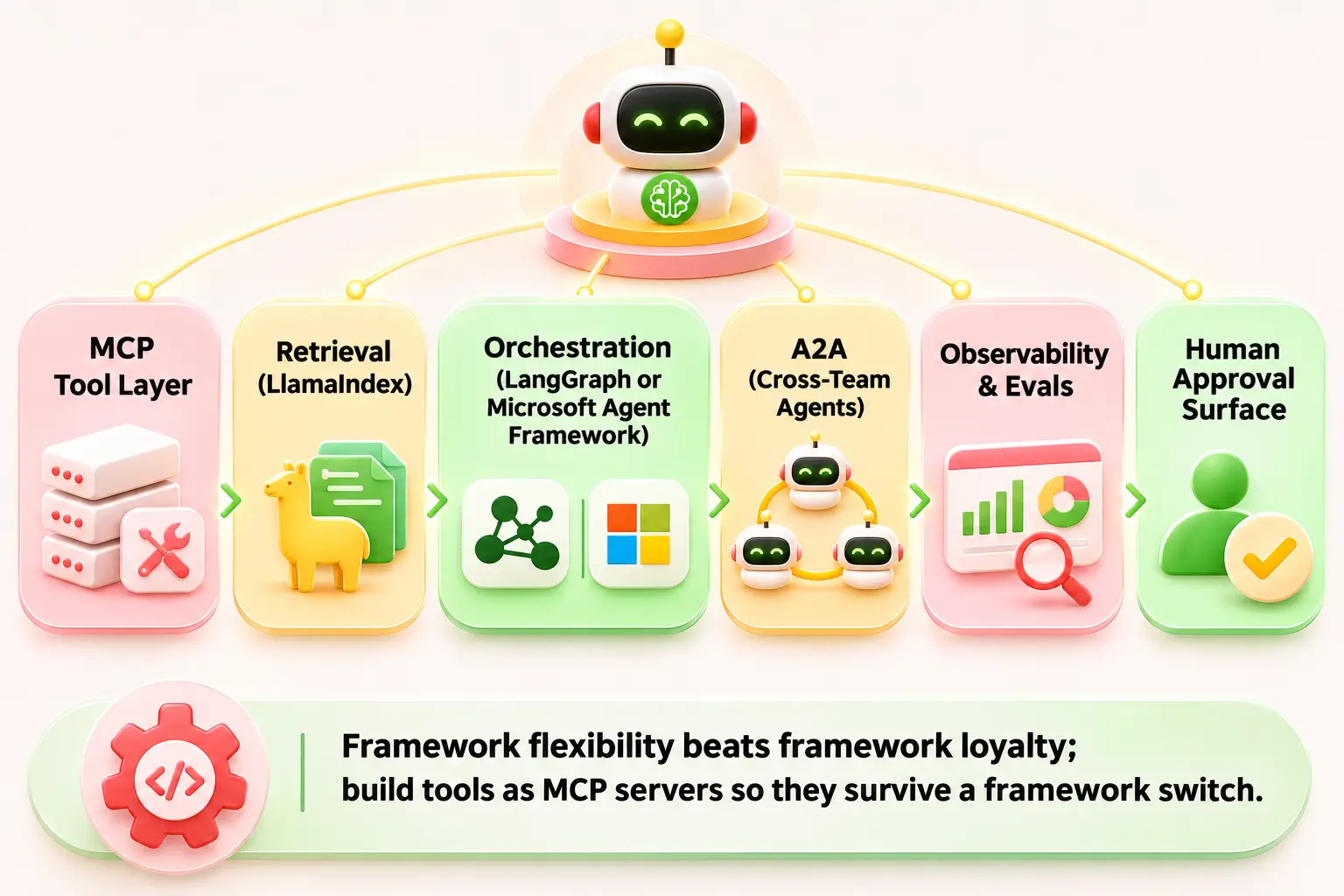
Not all Enterprise AI systems require one particular framework to perform all tasks. Each agentic AI framework is designed to solve a certain problem. One may control data acquisition, while another is responsible for workflow coordination. There is even a separate layer that controls tools and their monitoring.
The real-life Enterprise AI system architecture will integrate all mentioned capabilities into one coherent stack. It leaves development teams free to pick the most appropriate framework for creating their AI agents.
How the enterprise agent architecture works
The architecture consists of six interrelated layers:
MCP tool layer: Provides access to business tools, databases, and APIs via Model Context Protocol (MCP) servers. The agent may access authorized tools through a unified interface.
Retrieval layer – LlamaIndex: Retrieves relevant data from enterprise documents, databases, and knowledge bases.
Orchestration layer – LangGraph or Microsoft Agent Framework: Orchestrates agent workflows, routing, states, retries, and human approval steps.
Cross-team communications – A2A: Facilitates communication and task delegation between agents belonging to different teams or systems via the Agent2Agent protocol.
Observability and evaluations: Monitors the activities of agents, responses of models, tool interactions, errors, latency, and the quality of outputs.
Human approval interface: Provides the ability for employees to evaluate sensitive actions, approve requests, and intervene in case an agent requires human intervention.
How Entrans Helps Teams Build Production Agents
Moving agentic AI frameworks from experimental notebooks to secure, high-availability enterprise environments requires a partner focused on execution, scale, and measurable ROI. Having delivered over 150 AI projects across 200+ enterprises, Entrans provides model-agnostic and framework-neutral integration expertise across the entire agent framework landscape.
Framework-neutral development: Work across different AI agent frameworks, models, and enterprise systems without depending on one vendor.
Production deployment: Design, build, integrate, and maintain agents for real business workflows.
Enterprise ROI & Impact: In financial and procurement operations, custom AI agentic workflows delivered an80% reduction in manual reconciliation effort with 2x faster payment processing.
Thunai: Entrans's own agentic AI product supports enterprise customer interactions across voice, chat, and email.
The results matter. We have helped automate lending workflows, cutting processing time by 45%, and deliver 80% faster enterprise customer onboarding.
Entrans moves your AI agent from a cool prototype to enterprise production. With hands-on engineering and a clear path to production, Entrans helps your team build agents that work, deliver results, and scale with confidence. Book a consultation call with us to learn more.
Get expert help to build, integrate, and deploy AI agents.
20+ Years of Industry Experience
500+ Successful Projects
50+ Global Clients including Fortune 500s
100% On-Time Delivery
Thank you! Your submission has been received!
Oops! Something went wrong while submitting the form.
FAQs
1. What is an agentic AI framework?
An agentic AI framework is a toolkit that connects a large language model to real systems so it can plan and act over many steps. It handles tool calling, the reasoning loop, state and memory, multi-agent coordination, human approvals, and tracing, so teams don't have to hand-code that infrastructure. Examples include LangGraph, CrewAI, and Microsoft Agent Framework.
2. What are the top 3 agentic AI frameworks in 2026?
LangGraph, CrewAI, and Microsoft Agent Framework are three leading choices in 2026. Each supports different needs, from complex workflows to multi-agent collaboration and enterprise applications.
3. What is the difference between an agentic AI framework and an agentic AI tool?
An agentic AI framework provides the foundational codebase, abstractions, and orchestration logic to build custom agents programmatically. An agentic AI tool is a pre-built application or specific functional capability that an agent calls to execute concrete tasks, such as web searching or API invocation.
4. Is LangGraph better than CrewAI for production?
Yes. LangGraph gives the production agents that need control, saved state, retries and human approval whereas CrewAI works well for role-based teams of agents and faster development.
5. Is AutoGen still maintained in 2026?
Yes, AutoGen is maintained, but it has officially been transitioned into maintenance mode for receiving security patches and critical bug fixes. Active development and new features have shifted to the Microsoft Agent Framework, which merges AutoGen and Semantic Kernel concepts.
6. What is the best open-source AI agent framework?
LangGraph is widely considered the best open-source framework for complex, auditable, and stateful production applications. CrewAI is another good option for building teams of agents quickly.
7. Do I need a framework to build AI agents?
No. You can build simple AI agents using an LLM API, tool calls, and custom code. A framework helps when you need multiple agents, memory, complex workflows, and better control.
8. Can you use more than one agentic AI framework in the same system?
Yes, you can combine multiple frameworks by isolating them as microservices or wrapping sub-agents inside standard API interfaces. For instance, a system can use a CrewAI team for specialized content generation and expose that output as a node within a broader LangGraph control system.
Looking for Agentic AI Developers?
Hire AI developers to build and deploy your agentic AI solutions.
Free Project Consultation
Trusted by Enterprises & Startups
Top 1% Industry Experts
Flexible Contracts & Transparent Pricing
50+ Successful Enterprise Deployments
Aditya Santhanam
Author
Aditya Santhanam is Co-founder & CTO of Entrans Technologies, spearheading AI-driven cloud and data solutions. A 13-year tech veteran, he leads innovation in generative AI, AI agents and MLOps. He also co-founded Infisign (identity security) and Thunai.AI (enterprise AI agents)
Related Blogs
Azure Consulting Services: What to Expect, What It Costs, and the Top Azure Consulting Companies
Explore what Azure consulting services cost in 2026, what to expect in your first 90 days, and the top 10 US Azure consulting companies to consider hiring.
Healthcare Data Warehouse: Architecture, Data Models, Vendors, and Cost
Learn how a healthcare data warehouse works, its architecture, top data models, vendors, HIPAA rules, and real build costs to unify patient and billing data.